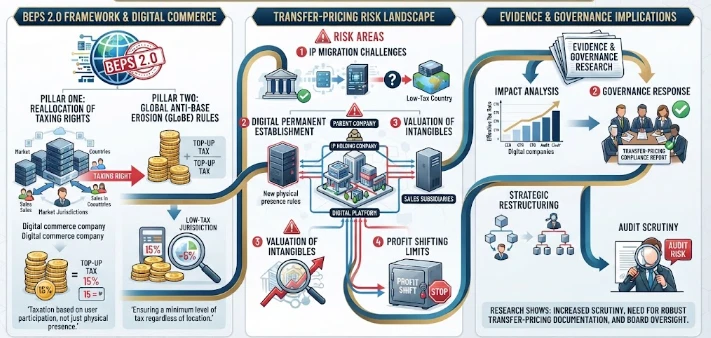
With the advent of the digital business, it is more difficult to align the place of value creation with the classical tax frameworks. Several jurisdictions can coordinate sales, IP rights, financing, data, marketing and distribution; legal entities have separate taxable results; and the coordination can be achieved by a multinational group. The issue of transfer pricing today, hence, is central to the international tax risk. The fundamental problem is being able to tell the difference between allocation which is economically defensible and allocation for the purpose of shifting profits into lower tax economies.
One of the most common ways of escaping the consequences of an international crime is by the use of avoidance strategies, which may make use of differences in the legal systems of various countries. Hybrid instruments, intra-group financing, intellectual-property arrangements, treatment and transfer prices may cross some jurisdictions. BEPS reforms are an attempt to close those gaps and provide more information for authorities. Accounting-governance research supplements this from an internal point of view by examining whether or not the board can proactively consider tax-risk decisions before they become a feature of the structures in contracts and reporting systems.
This is where the accounting governance is going to play a key role – international tax calculations start with the financial information and then add the tax adjustments. A lack of controls on entity data, intercompany charges, deferred tax, or uncertain positions may present compliance risk and reporting risk. Audit committees and boards should thus have visibility of tax governance and not tax as a filing matter. Integrated control framework integrates accounting, transfer pricing policies, agreements, and tax return processes.
Indirect influences on tax behaviour by executive remuneration can be through performance targets. Highly leverage related incentives based on post-tax earnings, cash flow or earnings per share can create a strong incentive to engage in aggressive planning when governance is lax. This alone does not constitute misconduct for compensation design. It does provide justification for board discussion on whether there is an alignment between the tax appetite, clawback arrangements, internal assurances and the reputation of the company and remuneration arrangements.
A bit of discipline and complexity is added by transparency. Certain patterns will emerge when reporting to he country by country and disclosing publicly, which might need explains, while ratios can be misleading when losses, timing differences etc are introduced or when tax credits or sector specific rules impact results. Responsible communication is the bridge between the accounting profit, taxable income, current tax, and deferred tax and cash tax. Only when better disclosure is done in the context of the information, it reduces suspicion.
Lower-capacity jurisdictions pose more transfer pricing issues since specialist knowledge is costly, and data from multinationals are often not readily available. In cases of disputes with facts that fall into distinct categories, simplified approaches to routine activities can help reduce disputes. Capacity building, information sharing and standardized documentation is important, too. International coordination is worthwhile as long as rules can be executed by authorities with differing staffing, data and litigation capabilities.
Legitimate trade must not be lost through anti-avoidance design. Vague rules can lead to double taxation, uncertainty, and lack of timely investment, particularly if there are varying interpretations of the same transaction across jurisdictions. Conflict can be minimised through mutual agreement procedures, advance pricing arrangements, safe harbours and good guidance. Effective rules: counter-productive profit shifting, and maintainable administration of ordinary cross-border trade.
The real governance issue is if tax results are aligned with business reality. Even with full documentation, a profit focused in an entity that has limited people, decision making and/or risk exposure warrants further investigation. Ohio does not have strong government, however, if the tax levy is high and the controls are ineffective. When the linkage of legal agreements, accounting entries, operational functions and transfer price narratives are strong, inconsistencies become apparent early on.
The discussion on corporate social responsibility (CSR) has become more and more part of the tax discussion, since tax payments are linked to social licence and public infrastructure through stakeholders. However, a legal minimum approach may still result in reputational risk if it results in structures looking out-of-sync with real activity. Meanwhile, if taxes are to be based on public sentiment, lack of certainty regarding the impact of those taxes can weaken any expectations. Good governance is the separation of legal compliance, policy risk and reputational judgment and voluntary disclosure, and an awareness that they all will impact on corporate decision-making.
The most robust multi-lateral response is thus proactive, and not reactive. The tax team requires accurate entity data, clear transfer pricing approaches, Pillar Two calculations, governance controls, and escalation procedures in the event of uncertainty. Boards must be able to understand risk reporting and finance systems must have traceable adjustments/reconciliations. That architecture decreases the odds that compliance turns into a year-end reconstruction exercise that is made out of inconsistent spreadsheets and unrecorded assumptions.
The OECD and G20 BEPS project had the effect of heightening reporting requirements, strengthening anti-avoidance requirements and instilling greater coordination. The 2021 negotiation of a global minimum tax regime, under Pillar Two, for large multinational groups of companies was added to the 15 percent effective minimum tax rate. Implementation work for 2025 consisted of qualified-legislation records, information-return forms, and additional administrative guidance. Those changes shifted the focus of the discussion from principle to system, data and operational compliance.
Pillar Two alters the cost-benefit analysis of tax incentives, but it doesn't kill competition. While a jurisdiction may have grants, accelerated deductions, refundable credits, etc., infrastructure or tax regime benefits, the lack of an effective tax rate may lead to top-up tax in another jurisdiction. This lessens the appeal of some incentive support based on profit and more attention is paid to substance-based or expenditure-based support. When developing their corporate tax strategies, companies must take into account both the statutory incentives and global minimum taxes' group level effective rate implications.
There is still a risk of transfer pricing as minimum taxes address a different issue than arm's length pricing. The arm's length principle asks whether related parties' conditions are similar to those of independent parties, and Pillar Two introduces an alternative effective tax framework. If a group is willing to pay the minimum effective rate, disputes can still arise over intangibles, financing, services, distribution and/or business restructures. Therefore, in order to ensure strong compliance, transfer pricing analysis and calculations of global minimum-tax must be performed.
Evidence problems are exacerbated through digital business models. But without a traditional physical presence, there are a number of factors that can help drive revenue, such as customer data, network effects, brand, local marketing, and remote delivery. Important functions and risks may not be in the hands of those who have the legal rights to the intangible. Documentation, country-by-country data, financial statements, contracts and evidence of economic activity are being used by tax authorities more and more to determine if the allocation of profits is consistent with economic activity.
BEPS 2.0 didn't take away international tax competition, or transfer-pricing judgment. It has created a greater need for uniformity between what is written on the paper, what is on the books, what is actually happening, and what is happening on the tax return. Concepts of traditional commerce in the digital world are continually being tested, and global minimum-tax rules are another layer of computation and reporting. The policy direction is towards more transparency and coordination, and yet long-term compliance requires credible facts, good governance and rules that are administrable.
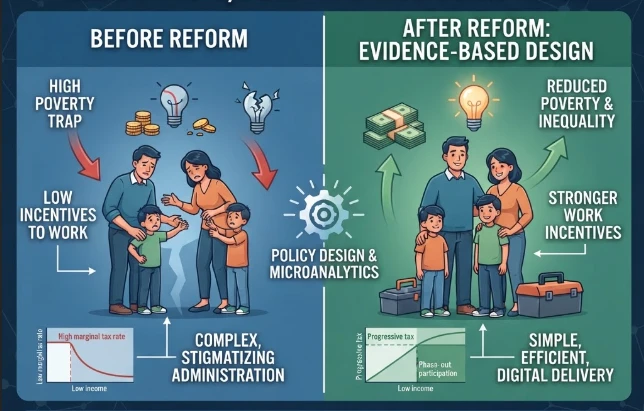
Another way of providing this protection is to state the assumptions clearly, so that an independent analysis can be done or the central result challenged. The strength of evidence is also improved by looking at distribution, administration and behaviour collectively, rather than separately, in reports. Evaluating and agreeing upon criteria in advance of beneficiaries and administrators adapting around a permanent policy promotes policy durability. The only thing that matters is whether a reform is still defensible when fiscal costs, distribution effects, complexity and uncertainty all are on the same page of the book.
Good design thus does not just involve communicating the transparency of a policy after it has been put in place but as a part of the policy architecture. One benefit of this is that any hidden trade-offs become apparent before thresholds, exemptions or enforcement settings are ingrained in the routine. The more profound point is that fiscal design should be tested on actual behaviours, not based on what it is called in the statute. That matters because legal and economic incidence may diverge once the adjustment of households and firms has taken place.
Another way of providing this protection is to state the assumptions clearly, so that an independent analysis can be done or the central result challenged. Evidence is also more compelling when distribution, administration and behaviour are discussed in one report, as opposed to each occurrence separately. Evaluating and agreeing upon criteria in advance of beneficiaries and administrators adapting around a permanent policy promotes policy durability. The hard test of a reform will be whether or not it is defensible after including the fiscal cost, distribution, complexity, and uncertainty on the same side of the equation.