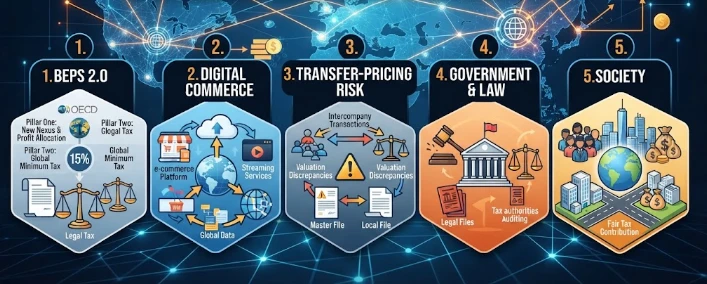
This article places BEPS 2.0 within a broader relationship between taxation law, government capacity, markets and society. Digital commerce allows revenue, data, intellectual property, financing and marketing functions to be distributed across jurisdictions, making transfer pricing and the location of taxable profit difficult to establish. Governments need revenue for public services, while businesses need certainty and protection from double taxation; the article presents international tax reform as an attempt to balance those interests. Digital business models also complicate evidence because legal ownership of an intangible may not identify where key functions and risks are controlled. Accounting governance, country-by-country information, contracts and operational evidence therefore become central to enforcement. The article also considers executive incentives and the need for contextual tax disclosure. The Subject to Tax Rule is discussed as a response to source-country concerns where certain related-party payments are taxed at very low rates. Developing economies face particular challenges because specialist expertise, data and dispute-resolution capacity are uneven. Sustainable international tax policy requires enforceable rules, credible information, proportionate administration and socially legitimate allocation of taxing rights.
Location of value creation is more difficult to map on to traditional tax concepts when focusing on digital commerce. Multinational groups are able to coordinate sales, IP, financing, data, marketing and distribution across multiple jurisdictions, while legal entities report taxable results separately. Thus, transfer pricing is the focal point of the tax risk of the present day. The fundamental issue is the difference between commercially viable allocation and buildings purpose-built to facilitate profit shifting to lower tax jurisdictions.
International taxation is finally a thing of law, the capacity of the state, markets, and social legitimacy. Governments require income to be able to provide public services, while there is need for certain rules and protections from double taxation in cross-border investment. BEPS reforms aim for a balance between base protection and legal certainty so as to prevent artificial profit shifting, balancing between ordinary commerce and base protection. This equilibrium turns into a social issue when the power of negotiation, administrative skills, or information quality differs in various countries.
Evidence problems are exacerbated in the context of digital business models. Without a traditional physical presence, customer data, network effects, algorithms, local marketing, and remote delivery can be sources of revenue. The control of critical functions and risks can also be found outside the boundaries of legal ownership of an intangible. The documentation, country-by-country information, financial statements, contracts and operational evidence are increasingly the tools used by tax authorities to test the reported profit allocation against economic activity.
Given the international tax calculations start from the financial information and then work through tax adjustments, accounting governance is of paramount importance. Controls over entity data, intercompany charges, deferred tax or uncertain positions that are weak can result in compliance risk and reporting risk. Audit committees and boards should be able to see tax as a whole and not just the tax filing process. There is a coherent control framework that links accounting systems, transfer-pricing policies, legal agreements and tax-return processes.
An indirect influence on tax behaviour is that executive remuneration can be influenced through performance targets. Strong incentives based on post-tax profits, cash flow or earnings per share can add to the pressures of aggressive planning where there is weak governance protection. This is not enough to prove compensation design as misconduct. A point on which it is not wrong to have a board's eye on whether the appetite for tax risk, clawback provisions, internal assurance, and long-term reputation are consistent with the remuneration structure.
The discipline and complexity of transparency. Patterns that warrant explanation can be identified in country-by-country reporting and in public tax disclosures, but the numbers can be confusing when losses, timing differences, sector-specific rules, tax credits, and other factors influence the numbers. Responsible communication is the bridge between accounting profit, taxable income, current tax, deferred tax and cash tax. Greater disclosure is only addressing the suspicion when it gives context instead of a pretty face without reconciliation.
It was part of that distributional concern that led to the creation of the Source to Tax rule in the treaties, which was a tool for certain related-party payments which were taxed at a below-agreed minimum level. The 2024 multilateral instrument was agreed to assist implementation in treaty relationships. These are important measures for developing economies as rights and source taxation can provide significant revenue streams. Treaty administration, data, staff capability and dispute processes are still more important than the formalities of the treaty.
Specialist expertise is costly, and data from multinationals can be hard to come by, which poses special transfer pricing problems for developing and lower capacity jurisdictions. Straightforward methods for common tasks can defuse conflict when there are clearly defined fact categories. The importance of capacity building, exchange of information, and standards on documentation are pertinent. International co-ordination is of value only if rules can be enforced in jurisdictions which have significantly different staffing, data and litigation resources.
Anti-avoidance design must ensure a viable commerce. Ambiguous rules can lead to double taxation, uncertainty and delayed investment, particularly if they have different interpretations from the same transaction across jurisdictions. Conflict can be minimised through mutual agreement procedures, advanced pricing arrangements, safe harbours and clear guidance. Rules are effective in addressing artificial profit shifting without making the ordinary operation of international trade too cumbersome.
Stakeholders link tax payments to social licence and public infrastructure, which has put corporate social responsibility in the tax debate. Even a legal minimum strategy can result in reputation risk, if a structure looks disembodied from actual activity. At the same time, lack of clear expectations can result in loss of certainty if liability becomes public opinion. With the right governance, legal compliance, potential policy risk and reputational judgement are kept distinct and it is understood that each of these areas has an impact on company decisions as well as on voluntary disclosure.
Integration is the most robust multinational reaction, not reaction. Tax teams must have accuracy and consistency of entity data, documentation of transfer-pricing methods, calculations of Pillar Two and governance controls, as well as escalation rules for positions of uncertainty. Boards must have clear risk reporting and finance systems must have clear tracking of adjustments and reconciliation. That design minimizes the risk of compliance being a year-end re-construction job based on disparate spreadsheets and assumed values.
Trust is also a factor in the sustainability of international tax cooperation. When business groups can move profits and citizens can see the withholding or consumption taxes imposed on them, they may view the complexities of the agreements with scepticism. Governments require clear statements of goals, compromises, and outcomes in terms of revenue impacts, and cannot guarantee accuracy that international tax forecasts have limits on. Enforcement of anti-avoidance, taxpayer rights, accountability of public spending and international co-ordination work have a multiplicative effect on social legitimacy.
The OECD and G20 BEPS project ushered into a new era for international taxation by ushering in greater reporting requirements, anti-avoidance principles and international coordination. The Two-Pillar agreement negotiated in 2021 has introduced a global minimum-tax pillar Two framework, based on an effective rate of 15 per cent. Several administrative instructions throughout 2023 and 2024 gradually extended the implementation of the jurisdictional calculations, the safe-harbour questions, information systems and coordinated rules. That change put data quality and operational governance on par with high-level tax policy.
Pillar Two introduces a new game in the tax game, where a modification of the rules of the game does not mean that there is no competition. A jurisdiction may provide infrastructure, grants, accelerated deductions, or a refundable credit or regulatory benefits, but with low effective tax rates, top-up tax may result elsewhere. This diminishes the incentive of some profit-maximising initiatives and puts a spotlight on support based on substances or expenditure. Corporate tax strategy must take into account both statutory tax incentives and group level effective-rate consequences that arise from the world-wide minimum tax rules.
The issue of transfer pricing risk is still relevant, as minimum tax and arm's length pricing address different issues. The arm's length principle is asking if related-party conditions are similar to those of arm's length parties, Pillar Two is using a different effective-tax framework. Disputes can still arise even if a group pays at least the minimum effective rate, as issues of intangibilities, financing, services, distribution, and business restructures can still cause disputes. There is therefore a need for transfer-pricing analysis and global minimum-tax calculations to ensure strong compliance.
International tax competition, and transfer pricing judgment, remain unchanged with BEPS 2.0. It has increased the importance of consistency in all areas of the legal form, accounting records, substance, and tax results. Digital commerce continues to challenge traditional notions, and global minimum-tax rules add to the calculation and reporting. There is a shift towards increased transparency and coordination in the policy direction, however sustained compliance will require credible facts, solid governance, and rules that can be administered.
A sustainable system is one that is able to reconcile the protection of revenue with the accessibility and predictability of the procedures, and accountability of public and private actors. A good evaluation thus maintains the legality, the reactions of users, the administrative resources and the dissemination within the same analytical framework. The test is whether the rule provides measurable public value after taking account of fiscal costs, compliance burden, and unintended consequences. Transparency is best used when assumptions, definitions, limitations and review criteria are in place before a policy becomes hard to change.
That way, you won't fall into the trap of assuming a single headline solution is the evidence of fairness, efficiency, or responsible behaviour. Regular evaluation is important because the technology, market structure, household situation, and administrative ability evolve more quickly than do many statutes.
CITE THIS ARTICLE
Sultana, K. R. (2025). BEPS 2.0, Digital Commerce, and Transfer-Pricing Risk: Evidence from Taxation law, international taxation, government, society. https://researchbysultana.com/article/db34602f-2995-585a-a534-fc50acefb729
K. R. Sultana, “BEPS 2.0, Digital Commerce, and Transfer-Pricing Risk: Evidence from Taxation law, international taxation, government, society,” 2025. [Online]. Available: https://researchbysultana.com/article/db34602f-2995-585a-a534-fc50acefb729
Sultana, K. R. (2025) ‘BEPS 2.0, Digital Commerce, and Transfer-Pricing Risk: Evidence from Taxation law, international taxation, government, society’. Available at: https://researchbysultana.com/article/db34602f-2995-585a-a534-fc50acefb729
Sultana, Kazi Rukaiya. “BEPS 2.0, Digital Commerce, and Transfer-Pricing Risk: Evidence from Taxation law, international taxation, government, society.” 2025, https://researchbysultana.com/article/db34602f-2995-585a-a534-fc50acefb729.
Kazi Rukaiya Sultana. “BEPS 2.0, Digital Commerce, and Transfer-Pricing Risk: Evidence from Taxation law, international taxation, government, society.” (2025). https://researchbysultana.com/article/db34602f-2995-585a-a534-fc50acefb729.
Sultana KR. BEPS 2.0, Digital Commerce, and Transfer-Pricing Risk: Evidence from Taxation law, international taxation, government, society. 2025. https://researchbysultana.com/article/db34602f-2995-585a-a534-fc50acefb729
@misc{article_db34602f2995585aa534fc50acefb729,
  title = {BEPS 2.0, Digital Commerce, and Transfer-Pricing Risk: Evidence from Taxation law, international taxation, government, society},
  author = {Kazi Rukaiya Sultana},
  year = {2025},
  url = {https://researchbysultana.com/article/db34602f-2995-585a-a534-fc50acefb729},
}
TY  - GEN
AU  - Kazi Rukaiya Sultana
TI  - BEPS 2.0, Digital Commerce, and Transfer-Pricing Risk: Evidence from Taxation law, international taxation, government, society
PY  - 2025-04-13
UR  - https://researchbysultana.com/article/db34602f-2995-585a-a534-fc50acefb729
ER  -
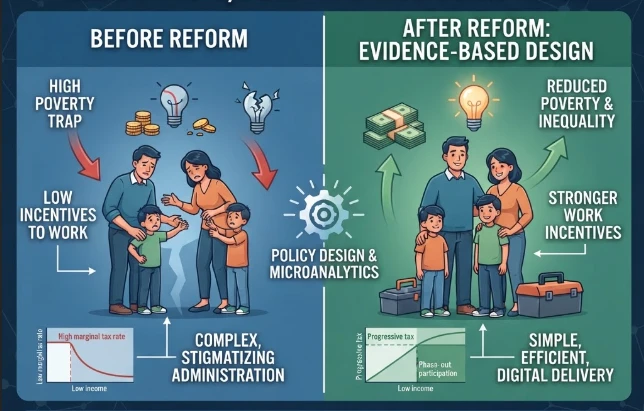
This article uses institutional economics and applied microeconomics to show why tax-transfer reform cannot be evaluated from policy rules alone. Household disposable income reflects earnings, taxes, contributions, benefits, housing support and withdrawal schedules, but the effectiveness of those rules also depends on institutions that administer them. Different data systems, delayed appeals, inconsistent local delivery and administrative capacity can cause a theoretically efficient policy to wo
This article presents tax transparency as a governance and accounting issue rather than a simple disclosure exercise. Boards oversee tax outcomes that are influenced by risk appetite, capital allocation, internal controls, remuneration and significant transactions, while accounting systems provide the common record connecting financial profit, taxable income, deferred tax, cash tax and uncertain positions. IFRS S1 and IFRS S2 are used to show how sustainability-related financial information can
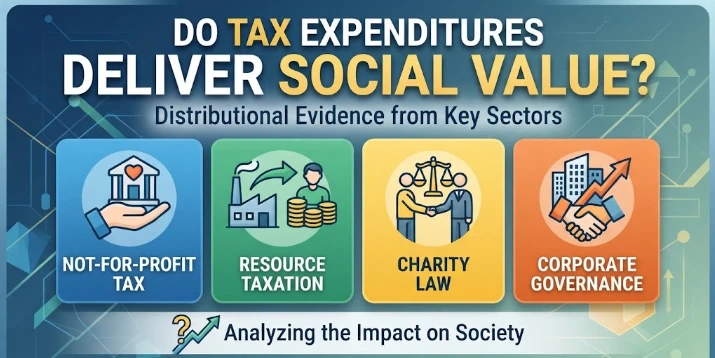
This article evaluates tax expenditures in not-for-profit, charity and resource-tax settings through distribution, governance and public value. Preferential treatment for charities and similar organisations is justified by public or community benefit, so reporting and governance should show whether concessions expand valued services, improve access or instead accumulate as private or organisational advantage. The article warns that annual income alone is an incomplete equity measure because life