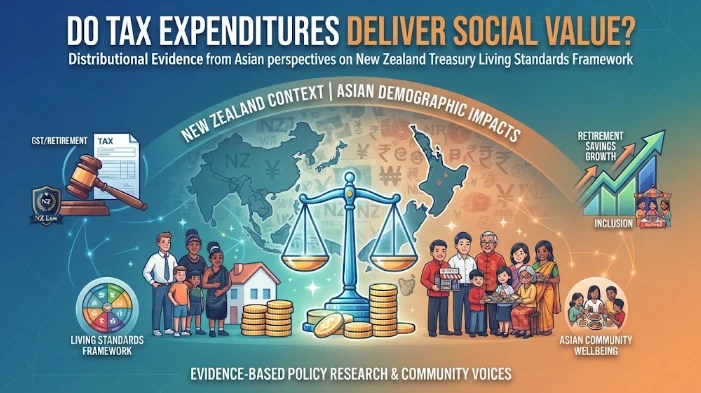
This article evaluates tax expenditures in not-for-profit, charity and resource-tax settings through distribution, governance and public value. Preferential treatment for charities and similar organisations is justified by public or community benefit, so reporting and governance should show whether concessions expand valued services, improve access or instead accumulate as private or organisational advantage. The article warns that annual income alone is an incomplete equity measure because lifetime income, wealth, age, disability, family structure, geography and housing exposure can change who benefits. Resource taxation adds another dimension because concession values can fluctuate with commodity cycles, investment risk and economic rents. Fiscal modelling must therefore make uncertainty, benchmarks and behavioural assumptions visible. Microsimulation can also reveal interactions between tax concessions and transfer withdrawal, while alternative-policy analysis compares concessions with grants, public services, refundable credits or other uses of the same fiscal capacity. Governance quality matters because tax expenditures can persist even when their costs are less visible than direct spending. Clear objectives, reporting, sunset dates, administrative simplicity and regular evaluation help determine whether preferential treatment remains socially defensible.
Distributional analysis has transitioned to the mainstream of fiscal policy decision making due to OECD work on inequality budgeting. The microsimulation models integrate information from the tax-benefit survey, administrative data, and tax/transfer decisions to enable policy staff to examine how different groups of the population benefit and lose, and how outcomes vary by income group. This matters because a tax concession may appear cheap in statutory terms, but may have a high fiscal cost when it is taken up. It also sheds light on whether a concession impacts the households that are experiencing the identified social issue or if it primarily benefits activities that would have occurred anyway.
Governance becomes a key aspect of social-value analysis, as not-for-profit tax concessions are grounded in public or community benefit. Definitions of exemptions can be weak enough to lead to boundary issues or private-benefit risks. Evaluation should be conducted on whether financial assistance enlarges valued services, improves access to services or merely enlarges the reserves and size of the organisation. Charity legislation and reporting guidelines offer a part of the proof for that assessment.
Equity analysis should not be limited to just income earned each year. The apparent distribution of a concession may change as a result of lifetime income, wealth, age, disability, family structure, geography, and exposure to housing costs. One example that is easy to understand is the retirement incentive, which allows for tax relief today that can be felt for decades to come. Another concern with resource-tax concessions is that fiscal value may fluctuate with the ups and downs of commodities. Without a wider lens the annual cash-flow analysis can be misinterpreted as a total social review.
Being uncertain is important in good fiscal modelling. Forecasts rely on take-up, economic conditions, elasticities, data quality, and selected benchmark tax system. Ranges of publication and sensitivity tests can help make uncertainty visible, instead of hidden inside technical assumptions, and improve trust. This is especially significant in the case of large concessions, for which predicted levels of investment or growth are of little value to defend if they are not independently deducible from broader economic developments.
Tax-expenditure reporting has also evolved into more of a transparency tool than a simple accounting exercise. The Tax Expenditures and Insights Statement in Australia includes concessions as deviations from a benchmark and quantifies losses of revenue due to the policy environment as it is. Statistic data on reliefs of the United Kingdom is also divided into two classes, structural and more detailed relief data. The guiding principle of those systems is straightforward – preferential tax treatment should be subject to the same sort of examination as direct spending, since both are a limited resource for the government.
The incidence of a distributional policy is generally not as clear as it appears on the policy label. Deductions attached to taxable income can provide greater absolute benefits at a higher marginal rate of taxation, and non-refundable credits can avoid the less heavily taxed households. Other types of concessions, such as those related to property, retirement savings, investment, or business are also subject to accrual over several years. A credible social value test also asks questions such as who can access the provision, what is the value of each group of the financial benefit they receive and, crucially, who is responsible for making the decision to access it and who does not – is it based on professional advice or on asset ownership.
The value of fiscal modelling is particularly high when tax expenditures are linked to withdrawal rules for transfers. Higher disposable income may also affect one's eligibility for means-tested benefits, leading to significant effective marginal rates that can vary widely from the actual tax rates. The New Zealand Treasury's TAWA framework is an example of how modelling can be a useful tool for integrating tax and welfare policy. Ordinary budget tables can obscure the existence of overlapping incentives and cliffs, but such modelling can help to uncover them.
The long-term interaction between economic rents, commodity cycles, investment risk and depletion poses a different distributional question, given that resource taxation imposes a burden on the sector. When prices rise, prices of concessions which promote extraction can escalate and when prices change suddenly the investment certainty can be lost. Social-value analysis should be done to compare the loss of revenues between the lost revenue and the extra investment, as well as the environment, regional effects and the public ownership interest in natural resources.
Avoid combining cost with behavioural response in evaluation. Revenue-forgone estimates typically rely on an assumption of current behaviour; however, the removal of a concession may result in changes in behaviour in the areas of saving, investments, labour supply, pricing, and/or organisational structure. That is not to say that static estimates aren't useful, but it makes interpretation more disciplined. A strong review offsets the static fiscal cost against a behavioural review of evidence, incidence of distribution, administrative burden, and plausible alternatives and lets the decision maker make a value judgment instead of taking a single cost estimate as a final.
The alternative-policy question is a must. A large tax concession or a targeted transfer, direct grant, public service, refundable credit or a neutral-rate tax cut financed from the same budget can be compared. The instruments have varying uptake, administrative requirements and political salience. The best way to understand social value is not whether it is continuation or abolition of the system, but continuation or the most effective possible utilization of the same fiscal capacity.
Labor market impacts should also be treated with care. Changes in reliefs associated with employment, child care, retirement savings, and earned income will affect the return of the extra work and will be dependent on household structure and the existing transfer rules. There can be high effective marginal rates of income taxes, social contributions and benefit withdrawal combined. It can be used to locate those zones and to differentiate between a genuine increase in your 'work incentive', and a change in headline rate which does little to increase your NTI.
Evaluation is influenced by the quality of governance. Tax expenditures tend to be continued because the burden is not as apparent as a line item expense and because the recipients arrange around existing tax breaks. That inertia can be overcome through a regular publication, clear goals, designated agencies, termination dates, and evaluation timelines. All the more meaningful is the parliamentary scrutiny when reports include intended beneficiaries, actual incidence, uncertainty ranges and evidence on behavioural additionality.
Social value can be generated by the simplicity of administration itself. A technically correct concession can be unsuccessful for the reason that eligibility requirements may require that records, valuations, elections or expert interpretation are performed beyond the capacity of its intended recipients. Enforcement costs and access will also be uneven with complexity. Filing burden, error risk, certainty, and where better taxpayers obtain more advantages through planning than through the planning area of policy are all aspects of design quality.
The starting point of a durable reform process is an inventory, the endpoint is comparison. Each concession should have a clear goal, measurable measures, distributional analysis, administrative assessment and a timeline for reevaluation. Strong evidence is used to keep provisions that are doing well, while poor provisions can be redesigned, capped, converted or removed. The goal is not to eliminate tax expenditures, it's to treat them equally.
Good design thus looks at transparency as an integral component of policy architecture, not as a post-policy communications activity. Another benefit of this is that hidden trade-offs start to be apparent before thresholds, exemptions, or enforcement routines "take over". The deeper message is that fiscal design should be challenged by observing behaviour, and not taking it for granted based on statistical labels. That distinction is important because once households and/or firms adapt, the legal form and economic incidence may go in opposite directions.
An additional precaution is to make assumptions explicit in a manner that other researchers can later verify or question the main finding. The strength of the evidence also increases if distribution, administration and behaviour are considered together, instead of in separate reports. When evaluation criteria is agreed prior to changes by beneficiaries and/or administrators around a durable policy, policy durability improves. The ultimate test is whether a reform can still be defended when fiscal costs, distribution, complexity, and uncertainty are put on the same page.
Good design, therefore, views transparency as a component of the policy design framework and not a communication tool following the policy's adoption. A second bonus of this strategy is that it helps to expose hidden trade-offs before thresholds, exemptions or enforcement rules are institutionalized in routine practices. The more subtle message is that fiscal design should be evaluated in terms of actual rather than presumed behaviour. But it is important to note that legal form and economic incidence can diverge when households or firms adjust.
CITE THIS ARTICLE
Sultana, K. R. (2025). Do Tax Expenditures Deliver Social Value? Distributional Evidence from Not-for-profit tax, resource taxation, charity law, corporate governance. https://researchbysultana.com/article/2c29b01d-cdd9-5cf8-ade2-d0b17a417537
K. R. Sultana, “Do Tax Expenditures Deliver Social Value? Distributional Evidence from Not-for-profit tax, resource taxation, charity law, corporate governance,” 2025. [Online]. Available: https://researchbysultana.com/article/2c29b01d-cdd9-5cf8-ade2-d0b17a417537
Sultana, K. R. (2025) ‘Do Tax Expenditures Deliver Social Value? Distributional Evidence from Not-for-profit tax, resource taxation, charity law, corporate governance’. Available at: https://researchbysultana.com/article/2c29b01d-cdd9-5cf8-ade2-d0b17a417537
Sultana, Kazi Rukaiya. “Do Tax Expenditures Deliver Social Value? Distributional Evidence from Not-for-profit tax, resource taxation, charity law, corporate governance.” 2025, https://researchbysultana.com/article/2c29b01d-cdd9-5cf8-ade2-d0b17a417537.
Kazi Rukaiya Sultana. “Do Tax Expenditures Deliver Social Value? Distributional Evidence from Not-for-profit tax, resource taxation, charity law, corporate governance.” (2025). https://researchbysultana.com/article/2c29b01d-cdd9-5cf8-ade2-d0b17a417537.
Sultana KR. Do Tax Expenditures Deliver Social Value? Distributional Evidence from Not-for-profit tax, resource taxation, charity law, corporate governance. 2025. https://researchbysultana.com/article/2c29b01d-cdd9-5cf8-ade2-d0b17a417537
@misc{article_2c29b01dcdd95cf8ade2d0b17a417537,
  title = {Do Tax Expenditures Deliver Social Value? Distributional Evidence from Not-for-profit tax, resource taxation, charity law, corporate governance},
  author = {Kazi Rukaiya Sultana},
  year = {2025},
  url = {https://researchbysultana.com/article/2c29b01d-cdd9-5cf8-ade2-d0b17a417537},
}
TY  - GEN
AU  - Kazi Rukaiya Sultana
TI  - Do Tax Expenditures Deliver Social Value? Distributional Evidence from Not-for-profit tax, resource taxation, charity law, corporate governance
PY  - 2025-12-03
UR  - https://researchbysultana.com/article/2c29b01d-cdd9-5cf8-ade2-d0b17a417537
ER  -
This article uses institutional economics and applied microeconomics to show why tax-transfer reform cannot be evaluated from policy rules alone. Household disposable income reflects earnings, taxes, contributions, benefits, housing support and withdrawal schedules, but the effectiveness of those rules also depends on institutions that administer them. Different data systems, delayed appeals, inconsistent local delivery and administrative capacity can cause a theoretically efficient policy to wo
This article presents tax transparency as a governance and accounting issue rather than a simple disclosure exercise. Boards oversee tax outcomes that are influenced by risk appetite, capital allocation, internal controls, remuneration and significant transactions, while accounting systems provide the common record connecting financial profit, taxable income, deferred tax, cash tax and uncertain positions. IFRS S1 and IFRS S2 are used to show how sustainability-related financial information can
This article evaluates tax expenditures through a broader wellbeing and distributional framework, drawing on New Zealand’s Living Standards Framework, GST and retirement policy. It argues that fiscal analysis should not stop at annual income, revenue or GDP because concessions can affect consumption, saving, retirement security, housing, work, culture and resilience across generations. Distribution should therefore be examined by age, income, wealth and long-term wellbeing. Consumption taxes ill