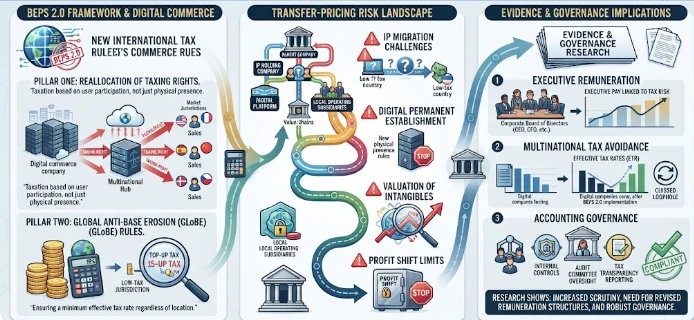
This article explores how executive remuneration and accounting governance shape multinational tax risk in the BEPS 2.0 environment. Digital commerce allows sales, intellectual property, financing, data and management functions to be distributed across jurisdictions, leaving transfer pricing central to the question of where profit should be taxed. Short-term compensation tied closely to after-tax earnings, cash flow or earnings per share may create pressure for aggressive tax planning when governance safeguards are weak. The article therefore supports risk-adjusted performance measures, clawbacks, independent tax oversight and stronger board understanding of tax strategy. Country-by-country reporting and public tax disclosures add transparency, although losses, timing differences, incentives and sector rules mean effective tax ratios require context. Pillar Two’s 15 percent minimum-tax framework changes the value of certain profit-based incentives but does not eliminate transfer-pricing disputes over intangibles, financing, services or restructures. Digital business models further complicate evidence about value creation. Sustainable compliance depends on accurate entity data, reconciled accounting systems, consistent documentation and governance that aligns legal form, operational substance and reported tax outcomes.
The mapping of the place of value creation onto traditional tax concepts is more difficult in the digital commerce space. Several jurisdictions can coordinate sales, IP rights, financing, data, marketing and distribution; legal entities have separate taxable results; and the coordination can be achieved by a multinational group. In modern international tax risk, transfer pricing is, therefore, at the core. The key issue is the difference between commercially defensible allocation and structures which seek to shift profits towards lower tax jurisdictions.
Tax consequences impact on executive compensation, which makes executive compensation relevant. The pressure of short-term incentives based on earnings or cash may lead to strategies that impact the reported results in the short-term but have longer-term repercussions such as legal or reputational consequences. That pressure can be mitigated by governance, via metrics adjusted for risk, delayed awards, clawbacks, and independent tax oversight. The goal is to eliminate market incentives, but not to eliminate compensation structure based on hidden tax risk.
Discipline and complexity come from transparency. Patterns, which can be identified in country-by-country reporting and in public tax disclosures, may be explained and while ratios may be useful, they can be misleading if tax losses or timing differences, tax credits or rules apply differently to different sectors. The relationship between accounting profit, taxable income, current tax, deferred tax and cash tax is explained by responsible communication. Only when better disclosure is done in the context of the information, it reduces suspicion.
It is common for developing and lower capacity jurisdictions to be confronted with specific transfer pricing issues, as the expertise can be costly and multinationals may not be readily available. There are simpler ways of dealing with routine activities that can minimize conflicts if the facts are easily categorized. Capacity building, sharing of information and regular practices of documentation is equally important. International coordination is worthwhile as long as rules can be executed by authorities with differing staffing, data and litigation capabilities.
Anti-avoidance design cannot allow for the very legitimate business to be avoided. Vague rules can lead to double taxation, uncertainty, and lack of timely investment, particularly if there are varying interpretations of the same transaction across jurisdictions. Agreements between the parties, the APA, safe harbours and guidance can help avoid conflicts. Good rules seek to promote artificial abuse of the profit motive without over-complicating regular cross-border trade.
CSR has become a part of the tax debate because it is associated with the stakeholders with tax payment and public infrastructure. However, a legal minimum approach may still result in reputational risk if it results in structures looking out-of-sync with real activity. Meanwhile, if taxes are to be based on public sentiment, lack of certainty regarding the impact of those taxes can weaken any expectations. Good governance is the separation of legal compliance, policy risk and reputational judgment and voluntary disclosure, and an awareness that they all will impact on corporate decision-making.
An integrated and not a reactive response is the most resilient multinational response. Tax teams require accurate entity information, transfer pricing procedure documentation, Pillar Two work and escalation procedures for grey areas, and governance measures. Boards must be able to understand risk reporting and finance systems must have traceable adjustments/reconciliations. That architecture minimizes the risk of compliance being a year end re-construction night based on an inconsistent spreadsheet and undocumented assumptions.
In addition, the accounting governance has an impact on the way uncertain tax positions are reached in financial statements. Judgement regarding recognition, provisions, deferred tax and disclosure can have an impact on market perceptions before a dispute occurs. Audit committees must have sufficient tax literacy to question facts and figures, but cannot be expected to replace tax specialist teams. That's even more relevant with group level calculations under Pillar Two, which rely on uniform financial information across numerous companies.
The OECD and G20 BEPS project had the effect of heightening reporting requirements, strengthening anti-avoidance requirements and instilling greater coordination. The 2021 negotiation of a global minimum tax regime, under Pillar Two, for large multinational groups of companies was added to the 15 percent effective minimum tax rate. Implementation activities by 2025 comprised qualified legislation, records and information-return formats, as well as additional administrative guidance. Those advances shifted the discussion from the principle to systems, data and compliance and operation.
Pillar Two is altering the incentives game, but not eliminating the competition. There may be top-up tax elsewhere for an offering of a jurisdiction to provide grants, accelerated deductions, refundable credits, infrastructure, or regulatory benefits if they provide such benefits with low effective tax outcomes. This means that certain profit-driven incentives will lose their appeal as attention will turn to the substance-based or expenditure-based support. When developing their corporate tax strategies, companies must take into account both the statutory incentives and global minimum taxes' group level effective rate implications.
There is still a risk of transfer pricing as minimum taxes address a different issue than arm's length pricing. The arm's-length principle suggests whether or not the conditions of the arm differ from those of independent parties, Pillar Two sets up a different effective-tax framework. Even if a group pays at least the minimum effective rate, they can still generate disputes due to intangibles, financing, services, distribution and/or business restructures. Therefore, in order to ensure strong compliance, transfer pricing analysis and calculations of global minimum-tax must be performed.
Evidence problems are exacerbated through digital business models. A long list of factors, including customer data, network effects, brand, algorithms, local marketing and remote delivery, can be used to generate revenues without the physical presence of the business. The interface between the legal owner of an intangible and control over important functions and risks is not necessarily congruent. Documentation, country-by-country data, financial statements, contracts and evidence of economic activity are being used by tax authorities more and more to determine if the allocation of profits is consistent with economic activity.
International tax calculation relies on the information in the accounts and then making the adjustments for taxes, making accounting governance very important. Compliance risk and reporting risk may exist because of weak controls over entity data, deferred tax or intercompany charges, or uncertain positions. Audit committees and boards should thus have visibility of tax governance and not tax as a filing matter. Integrated control framework integrates accounting, transfer pricing policies, agreements, and tax return processes.
Indirect influences on tax behaviour by executive remuneration can be through performance targets. Incentives that are much more strongly correlated with post-tax profits, cash flow or profitability per share can exacerbate the pressure to engage in aggressive planning in weak-governance situations. This alone does not constitute misconduct for compensation design. It does provide justification for board discussion on whether there is an alignment between the tax appetite, clawback arrangements, internal assurances and the reputation of the company and remuneration arrangements.
BEPS 2.0 didn't take away international tax competition, or transfer-pricing judgment. It has increased the importance of consistency in the legal form, accounting records, substance and tax consequences. Concepts of traditional commerce in the digital world are continually being tested, and global minimum-tax rules are another layer of computation and reporting. The direction of the policy is towards greater transparency and coordination, but sustainable compliance relies on credible facts, robust governance and rules that can be administered.
A durable policy is one that has evaluation criteria that are agreed to in advance of beneficiaries and administrators modifying around a policy that is permanent. The test for a reform to hold up is whether it can survive the balancing of fiscal costs, distribution, complexity, and uncertainty. Good design thus does not just involve communicating the transparency of a policy after it has been put in place but as a part of the policy architecture. A further benefit of this strategy is that the potential for unintended consequences is exposed in the process before they become a regular feature of a threshold, exemption, or enforcement approach.
But the underlying concept is that fiscal design should be subjected to real behavior, not assumed from fiscal labels. But it is important because legal form and economic incidence can go in different directions after adjustment. Another way of providing this protection is to state the assumptions clearly, so that an independent analysis can be done or the central result challenged. Further strength is gained if distribution, administration, and behaviour are also considered as a group instead of individually in reports.
Policy persistence is better when there is a consensus regarding the criteria for evaluation prior to the adaptation around a persistent policy. The test which is really important is whether a reform is defensible after putting fiscal cost, distribution, complexity, and uncertainty on the same page. Good design thus does not just involve communicating the transparency of a policy after it has been put in place but as a part of the policy architecture.
CITE THIS ARTICLE
Sultana, K. R. (2026). BEPS 2.0, Digital Commerce, and Transfer-Pricing Risk: Evidence from Executive remuneration, multinational tax avoidance, accounting governance. https://researchbysultana.com/article/71a7d2a9-7f74-569d-8b60-e825c7bb8f1b
K. R. Sultana, “BEPS 2.0, Digital Commerce, and Transfer-Pricing Risk: Evidence from Executive remuneration, multinational tax avoidance, accounting governance,” 2026. [Online]. Available: https://researchbysultana.com/article/71a7d2a9-7f74-569d-8b60-e825c7bb8f1b
Sultana, K. R. (2026) ‘BEPS 2.0, Digital Commerce, and Transfer-Pricing Risk: Evidence from Executive remuneration, multinational tax avoidance, accounting governance’. Available at: https://researchbysultana.com/article/71a7d2a9-7f74-569d-8b60-e825c7bb8f1b
Sultana, Kazi Rukaiya. “BEPS 2.0, Digital Commerce, and Transfer-Pricing Risk: Evidence from Executive remuneration, multinational tax avoidance, accounting governance.” 2026, https://researchbysultana.com/article/71a7d2a9-7f74-569d-8b60-e825c7bb8f1b.
Kazi Rukaiya Sultana. “BEPS 2.0, Digital Commerce, and Transfer-Pricing Risk: Evidence from Executive remuneration, multinational tax avoidance, accounting governance.” (2026). https://researchbysultana.com/article/71a7d2a9-7f74-569d-8b60-e825c7bb8f1b.
Sultana KR. BEPS 2.0, Digital Commerce, and Transfer-Pricing Risk: Evidence from Executive remuneration, multinational tax avoidance, accounting governance. 2026. https://researchbysultana.com/article/71a7d2a9-7f74-569d-8b60-e825c7bb8f1b
@misc{article_71a7d2a97f74569d8b60e825c7bb8f1b,
  title = {BEPS 2.0, Digital Commerce, and Transfer-Pricing Risk: Evidence from Executive remuneration, multinational tax avoidance, accounting governance},
  author = {Kazi Rukaiya Sultana},
  year = {2026},
  url = {https://researchbysultana.com/article/71a7d2a9-7f74-569d-8b60-e825c7bb8f1b},
}
TY  - GEN
AU  - Kazi Rukaiya Sultana
TI  - BEPS 2.0, Digital Commerce, and Transfer-Pricing Risk: Evidence from Executive remuneration, multinational tax avoidance, accounting governance
PY  - 2026-02-11
UR  - https://researchbysultana.com/article/71a7d2a9-7f74-569d-8b60-e825c7bb8f1b
ER  -
This article uses institutional economics and applied microeconomics to show why tax-transfer reform cannot be evaluated from policy rules alone. Household disposable income reflects earnings, taxes, contributions, benefits, housing support and withdrawal schedules, but the effectiveness of those rules also depends on institutions that administer them. Different data systems, delayed appeals, inconsistent local delivery and administrative capacity can cause a theoretically efficient policy to wo
This article presents tax transparency as a governance and accounting issue rather than a simple disclosure exercise. Boards oversee tax outcomes that are influenced by risk appetite, capital allocation, internal controls, remuneration and significant transactions, while accounting systems provide the common record connecting financial profit, taxable income, deferred tax, cash tax and uncertain positions. IFRS S1 and IFRS S2 are used to show how sustainability-related financial information can
This article evaluates tax expenditures in not-for-profit, charity and resource-tax settings through distribution, governance and public value. Preferential treatment for charities and similar organisations is justified by public or community benefit, so reporting and governance should show whether concessions expand valued services, improve access or instead accumulate as private or organisational advantage. The article warns that annual income alone is an incomplete equity measure because life