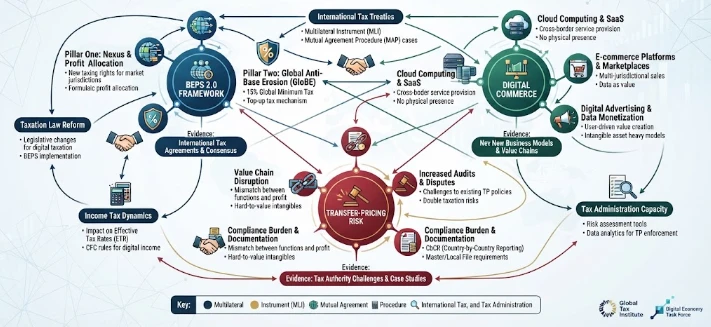
This article examines international tax risk created by digital commerce, transfer pricing and the expanding administrative demands of BEPS 2.0. Multinational groups can distribute sales, intellectual property, financing, data, marketing and operating functions across jurisdictions while legal entities report separate taxable results. That makes the alignment of profit with economic activity a central issue. The article explains that Pillar Two changes the value of some low-tax incentives through minimum-tax calculations, but it does not replace the arm’s-length principle or eliminate disputes over intangibles, financing, services and restructures. Country-by-country reporting, entity data and transfer-pricing documentation have made international tax administration more data intensive, increasing the importance of accounting governance and consistent systems. Developing and lower-capacity jurisdictions face particular challenges because specialist expertise and comparable data are expensive. The article also emphasizes tax certainty, mutual agreement procedures, advance pricing arrangements and clear guidance so anti-avoidance rules do not create unnecessary double taxation. Sustainable compliance depends on credible facts, coordinated governance, traceable reconciliations and rules that administrations with different capacities can actually apply.
Location of value creation has become less determinate in digital commerce due to its connection with traditional tax concepts. Multinational groups may coordinate sales, intellectual property, financing, data, marketing and distribution in multiple jurisdictions and legal entities keep separate taxable results. Transfer pricing is thus at the heart of the present tax risks. The key issue is figuring out how to tell the difference between a defensible allocation and buildings that have been built to shift profit to a more tax-friendly jurisdiction.
International tax administration has become more data-driven with the increase in reporting and coordination requirements under BEPS rules.BEPS has increased data requirements for reporting and coordination in international tax administration. This adds a more complex compliance framework for multinational groups and revenue agencies, country-by-country information, entity structure and transfer pricing files along with Pillar Two calculations. Even though the income-tax law is still based on domestic laws, effects of the cross-border transborder entities now rely more and more on treaties and mutual conventions. Complex rights are hard to enforce without the capacity to administer them, and administrative capacity is thus a core element of tax sovereignty.
Pillar Two will shift the tax-incentive calculus without eradicating competition. A jurisdiction may provide grants, accelerated deductions, refundable credits, infrastructure, and/or regulatory benefits, however, poor effective tax results can result in top-up tax in another jurisdiction. It lessens the pull of some incentive to profit and raises the focus on substance-based or spending-based support. When designing corporate tax strategy, both the statutory incentives and the group effective-rate effects arising from global minimum-tax rules must be taken into account.
The issue of transfer pricing risk is significant because minimum tax addresses a different issue than arm's-length pricing. The arm's length principle is asking the question of whether related-party conditions are similar to conditions between arm's length parties, and Pillar Two a separate effective tax regime. All that can still cause trouble when a group collects at least the effective rate, even if no other issues such as intangibles, financing, services, distribution and business restructures arise. S. Compliance is therefore both transfer pricing analysis and global minimums (GMT) generation.
Evidence problems are exacerbated by digital business models. There is no physical footprint associated with these revenue sources: customer data, network effects, algorithms, local marketing and remote delivery. Important functions and risks are not always in the hands of the legal owner of an intangible. In today's age, documentation, CBI, financial statements, contracts, and operational evidence are becoming more and more important documents that tax authorities are using to assess whether reported profit allocation is based on economic activity.
Governance of accounts becomes important because transactions into and out of the international tax calculation start from the financial data and then include tax adjustments. Lack of control over entity data, intercompany charges, deferred tax or uncertain positions may generate compliance and reporting risk. Audit committees and boards must, therefore, have transparency into tax governance, not just tax filing. A coherent control framework integrates accounting systems, transfer pricing policies, legal agreements and tax return procedures.
Tax behaviour can be affected indirectly through performance targets with regard to executive remuneration. Governance protections that are inadequate can add to the pressure for pushy planning when incentives are strongly tied to post-tax income, cash flow or earnings per share. This does not constitute a violation of the compensation structure. It does warrant board consideration as to whether there is a consistency in tax-risk appetite, clawback provisions, internal assurance and long-term reputation with remuneration structures.
Digital commerce makes that challenge more apparent. Revenue can come from customers, data, marketing, platforms, or remote services, without the need to have a traditional local operating footprint. While traditional source/residence notions are still relevant, there is a need for functional mechanisms for information, allocation and dispute resolution in modern rules. BEPS 2.0 is not about eliminating judgments from international taxation, it adds to the expense of how much it costs when data is inconsistent and documentation is weak. The real danger is just as much in the systems and governance as in legal interpretation.
Discipline and complexity are added to transparency. Patterns that can be explained by country-by-country reporting and public tax disclosures can be misrepresented by simple ratios when losses, differences in timing or tax credits influence the results, and when sector-specific rules impact the results. The connection between accounting profit, taxable income, current tax, deferred tax and cash tax is explained by responsible communication. The more disclosure, the less suspicion – but not the more context, the less reconciliation.
Lower capacity jurisdictions such as developing jurisdictions are especially challenged by transfer pricing issues due to the cost of specialist expertise and the lack of data from multinationals. Routine activities in categories of facts can minimize conflicts. Capacity Building, information exchange, and uniformity in documentation is important too. International coordination is only valuable in the context that such rules could be enforced by officials who employ vastly different resources, data and litigation protocols.
Anti-avoidance design must ensure valid trade. Vaguely drafted rules can lead to double taxation, uncertainty, and delayed deployment of investment, particularly when some jurisdictions read a transaction ambiguity, or something entirely different, into the rules. Conflict can be minimised through mutual agreement procedures, advance pricing arrangements, safe harbours and clear guidance. Good rules would seek to strike a balance between stifling artificial profit shifting and allowing normal cross-border trade.
This is why corporate social responsibility is on the agenda of the tax debate increasingly. While it's possible that a legal minimum approach will result in reputational risk if structures seem detached from real activities. Meanwhile, when taxes are part of public opinion, the lack of clear expectations can diminish certainty. Good governance distinguishes between legal compliance, policy risk, reputation decision and voluntary disclosure, and acknowledges that all three have an impact on corporate decisions.
The best solution is not a reactive, but an integrated multi-national response. Tax teams require accurate entity data, documented transfer-pricing approaches, Pillar Two calculations, governance mechanisms and escalation procedures for positions of uncertainty. There is a need for accessible reporting of risk, and accessible and traceable adjustments and reconciliations in finance systems. That architecture lowers the risk of becoming an end-of-the-year re-architecting effort comprised of misaligned spreadsheets and unspoken assumptions.
The international tax landscape has been transformed by the OECD and G20 BEPS project, which has added to the volume of reporting, enhance the anti-avoidance criteria and require greater coordination. In 2021, the OECD adopted an architecture for Pillar Two under a global minimum-tax threshold of 15 per cent as part of the Two-Pillar agreement. Administrative guidance provided in 2023 and 2024 accelerated implementation of jurisdictional calculation, safe harbour questions, information systems and coordinated rules. That change brought data quality and operational governance to the same level of prominence as tax policy.
International tax competition and transfer pricing judgment is not eliminated by BEPS 2.0. It has enhanced the consistency of the legal form, accounting records, operational substance, and tax results. Digital commerce continues to challenge traditional notions and global minimum taxes are creating an additional layer of complexity for calculation and reporting. While the policy direction seems to be towards increased transparency and coordination, the real compliance is still dependent on credible facts, sound governance and rule of administration.
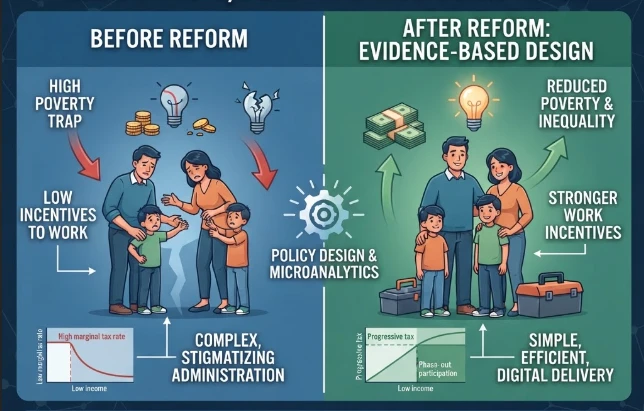
A more robust analytical methodology is to challenge statutory design with incentives actually observed, administrative capacity, and distributional outcomes, instead of use of labels. That view also adds the element of uncertainty to the picture, aiding decision-making when there is not clear, precise data on behavioural responses or implementation costs. Another layer of protection is that assumptions, definitions, and evaluation criteria are published early in the life of a policy, before it is politically challenging to change. It is best to present evidence that includes fiscal cost, equity, behavior and administrative burden within a single assessment and not in separate policy stories.
Long run credibility relies on review procedures that will be able to adapt to changing economic conditions and technology. The question is thus whether the instrument does provide measurable public value when compliance cost, distribution and opportunity cost are added. Transparent governance transforms that question into a process rather than a single justification when it is introduced. This comprehensive perspective minimizes the chances that a technically sound rule yields low-quality results when people, businesses, and agencies face actual incentives.
The better way to go about testing statutory design is to examine what it offers as incentives, what capacity it has to be administered, and what its distributional consequences are.
CITE THIS ARTICLE
Sultana, K. R. (2025). BEPS 2.0, Digital Commerce, and Transfer-Pricing Risk: Evidence from Taxation law, income tax, international tax, tax administration. https://researchbysultana.com/article/a999713a-017e-5566-9dab-7424376ae526
K. R. Sultana, “BEPS 2.0, Digital Commerce, and Transfer-Pricing Risk: Evidence from Taxation law, income tax, international tax, tax administration,” 2025. [Online]. Available: https://researchbysultana.com/article/a999713a-017e-5566-9dab-7424376ae526
Sultana, K. R. (2025) ‘BEPS 2.0, Digital Commerce, and Transfer-Pricing Risk: Evidence from Taxation law, income tax, international tax, tax administration’. Available at: https://researchbysultana.com/article/a999713a-017e-5566-9dab-7424376ae526
Sultana, Kazi Rukaiya. “BEPS 2.0, Digital Commerce, and Transfer-Pricing Risk: Evidence from Taxation law, income tax, international tax, tax administration.” 2025, https://researchbysultana.com/article/a999713a-017e-5566-9dab-7424376ae526.
Kazi Rukaiya Sultana. “BEPS 2.0, Digital Commerce, and Transfer-Pricing Risk: Evidence from Taxation law, income tax, international tax, tax administration.” (2025). https://researchbysultana.com/article/a999713a-017e-5566-9dab-7424376ae526.
Sultana KR. BEPS 2.0, Digital Commerce, and Transfer-Pricing Risk: Evidence from Taxation law, income tax, international tax, tax administration. 2025. https://researchbysultana.com/article/a999713a-017e-5566-9dab-7424376ae526
@misc{article_a999713a017e55669dab7424376ae526,
  title = {BEPS 2.0, Digital Commerce, and Transfer-Pricing Risk: Evidence from Taxation law, income tax, international tax, tax administration},
  author = {Kazi Rukaiya Sultana},
  year = {2025},
  url = {https://researchbysultana.com/article/a999713a-017e-5566-9dab-7424376ae526},
}
TY  - GEN
AU  - Kazi Rukaiya Sultana
TI  - BEPS 2.0, Digital Commerce, and Transfer-Pricing Risk: Evidence from Taxation law, income tax, international tax, tax administration
PY  - 2025-09-21
UR  - https://researchbysultana.com/article/a999713a-017e-5566-9dab-7424376ae526
ER  -
This article uses institutional economics and applied microeconomics to show why tax-transfer reform cannot be evaluated from policy rules alone. Household disposable income reflects earnings, taxes, contributions, benefits, housing support and withdrawal schedules, but the effectiveness of those rules also depends on institutions that administer them. Different data systems, delayed appeals, inconsistent local delivery and administrative capacity can cause a theoretically efficient policy to wo
This article presents tax transparency as a governance and accounting issue rather than a simple disclosure exercise. Boards oversee tax outcomes that are influenced by risk appetite, capital allocation, internal controls, remuneration and significant transactions, while accounting systems provide the common record connecting financial profit, taxable income, deferred tax, cash tax and uncertain positions. IFRS S1 and IFRS S2 are used to show how sustainability-related financial information can
This article evaluates tax expenditures in not-for-profit, charity and resource-tax settings through distribution, governance and public value. Preferential treatment for charities and similar organisations is justified by public or community benefit, so reporting and governance should show whether concessions expand valued services, improve access or instead accumulate as private or organisational advantage. The article warns that annual income alone is an incomplete equity measure because life