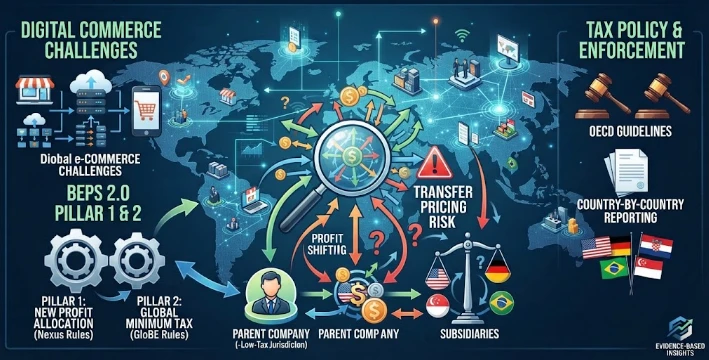
This article explains how international corporate taxation is changing in response to digital business models, profit shifting and competition between jurisdictions. It argues that traditional assumptions about business location are increasingly strained when customers, intellectual property, financing and operations are spread across countries. The article reviews the BEPS agenda and the two-pillar reform framework, emphasizing that Pillar Two’s minimum-tax rules change the value of very low effective corporate tax rates without eliminating competition for real investment. Governments may still use infrastructure, grants, skills, accelerated deductions and other tools to attract activity. Transfer pricing remains important because multinational groups continue to price services, financing, intellectual property and distribution within corporate groups. Country-by-country reporting supports risk assessment, while Pillar One raises difficult political questions about reallocating taxing rights among market, residence and investment jurisdictions. Tax certainty is treated as equally important as anti-avoidance, with mutual agreement procedures and advance pricing arrangements helping prevent double taxation. The article concludes that successful international reform requires coordinated rules, administrable compliance and effective dispute resolution.
International corporate taxation has reached a new stage where the assumption of where business is located is no longer compatible with today's world of business. A multination can sell their digital service in a market, control valuable intangibles from a different jurisdiction, finance their operations from a third location, and own them through multiple entities. The national tax systems are still based on territorial lines, while the activity of companies is more and more interconnected. By July 2026, the central policy challenge is not just about tax avoidance; it is about taxing rights and about avoiding harmful competition and overcomplicating things.
The initial base erosion and profit shifting agenda targeted those arrangements that take advantage of gaps and mismatches between domestic systems. These can include shifting taxable profits out of areas that have substantial economic activity, including through interest deductions, royalty payments, treaty, hybrid mismatches, and transfer pricing. The OECD/G20 BEPS project developed minimum standards and coordinated actions in areas such as treaty abuse, harmful tax practices, country by country reporting, dispute resolution, and other BEPS-related areas. These reforms had led to decisions on transparency and coherence of the rules, however the pressure on the system did not decline with digitalisation and the mobility of intangible income.
BEPS 2.0 grew out of that pressure. Pillar One aims to change the nature of nexus and profit allocation for the biggest and most profitable multinational corporations, with market jurisdictions playing a bigger part. Pillar Two does it in another way, establishing a global minimum tax framework. Under the Global Anti-Base Erosion rules, a 15 percent minimum effective tax framework is applied to in-scope multinational groups with "consolidated revenue" (as defined by the detailed scope of the rules) of EUR 750 million or more. Coordinated top-up mechanisms are designed to dampen the advantages of finding excess benefit in some very low-tax jurisdictions.
Pillar Two will alter incentives alongside revenue. In the absence of a minimum tax, a jurisdiction might entice mobile profits or investment with a low effective tax rate, and a multinational group might be able to evaluate tax results across jurisdictions. When a top-up tax takes away the advantage, low income can be subject to increased tax liability in other parts of the tax system. This is not an end to tax competition. Governments can still compete with each other by investing in infrastructure, improving workforce productivity, providing grants, allowing faster deductions, offering refundable incentives, bestowing regulatory stability, or offering taxes not covered by Pillar Two.
That evolution creates a need to develop tax policy which more clearly favours real investment over incentives that are largely directed towards reducing the taxes on mobile profit. A concession that is attached to something as physical as an investment, payroll, research activity or even something else may have a policy purpose other than a preferential one that has little to do with local economic activity. Governments are thus in need of greater tax expenditure and investment incentive analysis, whether to determine if an incentive affects business behaviour, contributes to the generation of new economic activity, or merely results in a transfer of revenue. In a minimax tax environment, an incentive can also lose value if another jurisdiction takes an offsetting “top up.”
Even with the minimum tax regime, transfer pricing is still relevant. There are ongoing corporate group transactions involving the acquisition, sale, licensing, lending and provision of services by multinational groups. The arm's length principle imposes the obligation to assess controlled transactions under the same conditions as those considered acceptable by independent transactions and cases that are difficult are characterized by unique intangibles, integrated operations, financing and risk allocation. Documentation and functional analysis will thus continue to be at the heart of the compliance and dispute-avoidance requirements. The difficulty lies in maintaining precision in complex transactions without putting an unnecessary burden on everyday transactions.
Country by country reporting has enabled tax administrations to have a more comprehensive picture of the activity of multinationals, and has influenced enforcement. BEPS Action 13 requires reporting of key indicators under tax jurisdictions, such as revenue, profits, taxes paid, employees and tangible assets in a large group. These types of data are not meant to replace audit evidence, but unusual patterns may indicate risk. If a jurisdiction has a significant profit percentage and a low percentage of employment or tangible assets, it may warrant a closer look. Exchange of information enables authorities to be able to look at the whole picture of the world and not just a part of it.
Pillar One also highlights the complexities of reaching consensus on a reform that alters who has the right to tax rather than just establishing a floor. There may also be varying interests between market jurisdictions, residence jurisdictions, and investment hubs and a further layer of treaty coordination. The reason for this is precisely that technical detail and multilateral legitimacy go hand-in-hand in international tax reform, as this political economy makes clear.
Anti-avoidance is no longer the only concern, it's tax certainty. Double taxation can occur even though no conduct is improper. Therefore, the mutual agreement procedures, advance pricing arrangements, consistent interpretation and dispute prevention mechanisms are integral to international tax policy. Well-designed anti-avoidance provisions that are not accompanied by adequate dispute resolution processes can discourage investment or keep businesses stuck in a state of uncertainty. The ideal is not to maximize taxes but to minimize them, but rather to have a defensible taxable profit allocation with rules that administrations and businesses can reasonably apply.
The developing economies are under a unique set of pressures. While corporate tax revenue can be crucial, complex transfer pricing audits will need specific staff, data and legal expertise. Administrative overheads may be created by complex global rules, using up limited resources. Enforcement can be strengthened through simplified approaches, capacity building, access to information and international cooperation, but this requires a design that takes account of various tax bases and development priorities. The best global coordination is achieved when it is feasible for implementation by revenue authorities with varying resources, and not just the largest.
The issue of sovereignty continues to be a key conflict. Tax policy is one of the central powers of nation states, which is usually determined by domestic decisions on spending, investment, redistribution and competitiveness. Some options are limited due to international coordination but opportunities for cross-border arbitrage are reduced. While some critics see that as a lack of policy autonomy, others see an advantage when mobile capital can compete among jurisdictions. The practical balance is achieved through governance – inclusive rule making, transparent standards, dispute mechanisms, and sufficient flexibility for legitimate domestic goals.
The outcomes of the situation are also influenced by corporate responses. As new rules come into effect, groups can consider changes to their entities, financing, intellectual-property systems, data systems, and function placement. There is a need for the creation of compliance systems based on effective-tax ratings by jurisdiction and for more information flows. There's growing need for coordination between tax departments and other functions such as finance, legal, sustainability, treasury and operational. The evaluation of a tax position can only be considered based on a local return, as the same transaction may impact financial reporting, disclosure, transfer pricing, and minimum tax calculations within the group.
Policy assessment should go beyond to statutory corporate tax rate. It's not just about effective rates, but tax expenditures, investment, profits distribution, compliance cost, the number of disputes and the level of revenue stability. The assessment of change should be done over time due to companies and governments adapting. A tax increase, which at first benefits the revenue, may have different consequences over time after changes in structures. Similarly, a weak tax incentive that is advertised for investment can be a weak deal if a lot of activity would have taken place anyway without the incentive.
The international corporate tax system is more coordinated but not simpler in July 2026 than it was in July 2016. BEPS 2.0 is a call to action to close the divide between global business models and nationally-based tax rules, by introducing new allocation principles, minimum taxation, transparency and cooperation. The key to success relies on the consistency of implementation, manageability compliance, robust dispute resolution, and treatment of real investment incentives. While corporate tax avoidance is a perennial issue, it will take more than closing tax loopholes to bring it to an end. The more powerful goal is a system under which the powers to tax are linked to verifiable economic connections, competition is based on more productive criteria, and trade across borders can happen under a tax framework that remains legitimate and reasonably certain.
CITE THIS ARTICLE
Sultana, K. R. (2026). BEPS 2.0, Digital Commerce, and Transfer-Pricing Risk: Evidence from International taxation, corporate tax, tax avoidance, tax policy. https://researchbysultana.com/article/f5ffdd3f-e384-5848-bbd3-863831328141
K. R. Sultana, “BEPS 2.0, Digital Commerce, and Transfer-Pricing Risk: Evidence from International taxation, corporate tax, tax avoidance, tax policy,” 2026. [Online]. Available: https://researchbysultana.com/article/f5ffdd3f-e384-5848-bbd3-863831328141
Sultana, K. R. (2026) ‘BEPS 2.0, Digital Commerce, and Transfer-Pricing Risk: Evidence from International taxation, corporate tax, tax avoidance, tax policy’. Available at: https://researchbysultana.com/article/f5ffdd3f-e384-5848-bbd3-863831328141
Sultana, Kazi Rukaiya. “BEPS 2.0, Digital Commerce, and Transfer-Pricing Risk: Evidence from International taxation, corporate tax, tax avoidance, tax policy.” 2026, https://researchbysultana.com/article/f5ffdd3f-e384-5848-bbd3-863831328141.
Kazi Rukaiya Sultana. “BEPS 2.0, Digital Commerce, and Transfer-Pricing Risk: Evidence from International taxation, corporate tax, tax avoidance, tax policy.” (2026). https://researchbysultana.com/article/f5ffdd3f-e384-5848-bbd3-863831328141.
Sultana KR. BEPS 2.0, Digital Commerce, and Transfer-Pricing Risk: Evidence from International taxation, corporate tax, tax avoidance, tax policy. 2026. https://researchbysultana.com/article/f5ffdd3f-e384-5848-bbd3-863831328141
@misc{article_f5ffdd3fe3845848bbd3863831328141,
  title = {BEPS 2.0, Digital Commerce, and Transfer-Pricing Risk: Evidence from International taxation, corporate tax, tax avoidance, tax policy},
  author = {Kazi Rukaiya Sultana},
  year = {2026},
  url = {https://researchbysultana.com/article/f5ffdd3f-e384-5848-bbd3-863831328141},
}
TY  - GEN
AU  - Kazi Rukaiya Sultana
TI  - BEPS 2.0, Digital Commerce, and Transfer-Pricing Risk: Evidence from International taxation, corporate tax, tax avoidance, tax policy
PY  - 2026-07-05
UR  - https://researchbysultana.com/article/f5ffdd3f-e384-5848-bbd3-863831328141
ER  -
This article uses institutional economics and applied microeconomics to show why tax-transfer reform cannot be evaluated from policy rules alone. Household disposable income reflects earnings, taxes, contributions, benefits, housing support and withdrawal schedules, but the effectiveness of those rules also depends on institutions that administer them. Different data systems, delayed appeals, inconsistent local delivery and administrative capacity can cause a theoretically efficient policy to wo
This article presents tax transparency as a governance and accounting issue rather than a simple disclosure exercise. Boards oversee tax outcomes that are influenced by risk appetite, capital allocation, internal controls, remuneration and significant transactions, while accounting systems provide the common record connecting financial profit, taxable income, deferred tax, cash tax and uncertain positions. IFRS S1 and IFRS S2 are used to show how sustainability-related financial information can
This article evaluates tax expenditures in not-for-profit, charity and resource-tax settings through distribution, governance and public value. Preferential treatment for charities and similar organisations is justified by public or community benefit, so reporting and governance should show whether concessions expand valued services, improve access or instead accumulate as private or organisational advantage. The article warns that annual income alone is an incomplete equity measure because life