This article examines BEPS 2.0, digital commerce and transfer-pricing risk through the lens of multinational tax governance and corporate responsibility. It explains how global groups can separate legal entities, intellectual property, financing, data and management across jurisdictions, creating opportunities for profit shifting and complexity in determining where value is created. The article outlines the two-pillar international tax framework, with Pillar One addressing nexus and profit allocation and Pillar Two establishing a minimum effective tax system for large multinational groups. Transfer pricing remains central because related-party transactions involving intangibles, financing and integrated functions still require functional analysis and defensible documentation. Country-by-country reporting and GRI 207 are presented as important transparency mechanisms, while the article cautions that public tax figures require context because losses, timing differences and incentives can affect outcomes. Boards and audit committees are given a major governance role in supervising tax strategy, risk and disclosure. Overall, the article argues that international tax risk has become a broader governance issue requiring consistent data, documentation, economic substance and credible explanation.
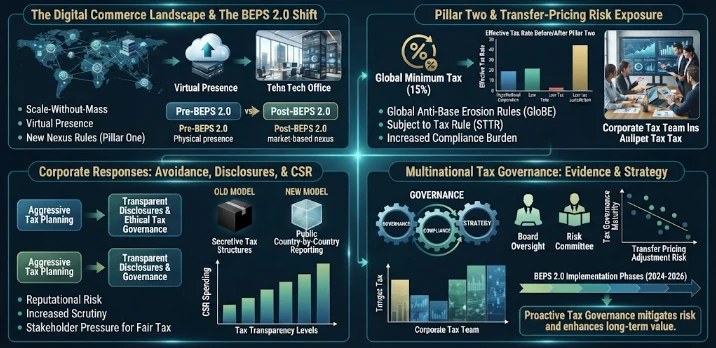
Corporate tax has become a key issue in the discussion of globalisation, digital trade, and sustainability and corporate legitimacy. Large, global corporate groups can exist with hundreds of legal entities, their customers, their IP assets, their funding, their data, and their management all crossing the borders with little concern for the traditional tax lines. That structure provides a good amount of commercial intricacy, but it also allows for the distinction between the profit earned and the place of significant economic activity. Today, BEPS 2.0, tax disclosure and corporate social responsibility are integral - and linked - components of the same governance discussion.
Base erosion and profit shifting refers to schemes that take advantage of gaps and mismatches in national tax policies to shift profits to lower-tax jurisdictions or to lower the tax base. The OECD/G20 BEPS project reacted on basis of the transfer pricing, treatment abuse, interest deductions, harmful tax practices, dispute resolution and country-by-country reporting. The challenge further increased due to the digitalisation, as the number of physical locations in the market is lower than what older tax rules would have anticipated. The location and valuation of profit are also difficult because of highly mobile intangible assets and because of integrated business models that involve business entities operating in multiple locations internationally.
BEPS 2.0 became a two pillar solution. Pillar One tackles issues of profit allocation and nexus in a digitalised economy; Pillar Two sets a global minimum tax regime for big multinational groups. The Global Anti-Base Erosion rules provide for an in-scope minimum effective 15 percent tax rate on a jurisdictional basis for in-scope groups with revenues exceeding EUR 750 million, with detailed rules and exclusions. The aim is not a common global company tax rate. The framework rather establishes coordinated top-up systems aimed at mitigating the effect of ‘profit booking’ in jurisdictions with a lower than agreed tax rate.
That is a change in logic of tax planning. The same effect can no longer be achieved with a low statutory rate or a high incentive if another jurisdiction can top up with a tax. Domestic minimum top-up taxes may also provide the host jurisdiction with some revenue up front for low taxed income. This shifts the discussion from tax competition and investment incentives to the place of real activity. The old tricks continue to apply, particularly where payroll, tangible assets or real investment is involved, but governments now need to consider whether a concession shifts the tax burden to other sources or just hides it within an in-scope organisation.
This is where transfer pricing still plays a major role since multi-nationals continue to conduct transactions between divisions of different countries. Application of the arm's length principle is challenging where unique intangibles, functions, financing and little comparables exist to make a controlled transaction as similar as possible to independent transactions. Documentation and functional analysis and economic evidence therefore continue to be important. The complexity associated with the treatment of certain basic marketing and distribution activities is also an interest under Pillar One work under Amount B. Simplification can minimize disputes however any procedure that is standardized must be sufficiently precise to avoid the creation of any ambiguity between routine activities and arrangements that have significant economic risks or intangibles.
Transparency has become the second key tenet of governance. The BEPS Action 13 principle of country-by-country reporting provided tax administrators with a top-level picture of revenue, profits, taxes, employees and tangible assets of large multinational groups in various tax jurisdictions around the world. This type of information helps in the risk assessment process and helps discern unusual geographic patterns more easily.
The transparency of public opinion has followed a parallel course. GRI 207, reporting on tax strategy, governance, stakeholder engagement and a public disclosure of country-by-country information, was developed as a new, global standard for tax sustainability reporting, effective for reporting from 2021. These frameworks are an indication of moving away from a confidential calculation of tax and toward corporate accountability for tax conduct.
Corporate social responsibility shifts the focus from “is it legal?” to “how does corporate action relate to broader economic impact?” It is possible for a company to meet the technical requirements but be criticized at the same time because the profits seem to be made in an area where there is little real activity in the business. The reverse is also significant, that is, a low cash-tax number in one year doesn't necessarily mean tax avoidance, it can be as a result of losses, capital investment, timing differences, tax credits or prior year adjustments. Context is needed for responsible tax communication. What is more mis-leading than silence is selective numbers without reconciliation.
Under this model, oversight of the board is even more critical. Tax strategy can generate financial, regulatory, reputational and operational risk: governance should not be delegated to return preparation alone. Boards and audit committees require oversight of key tax positions, cross-border arrangements, transfer pricing strategies, uncertain tax positions, disclosures, and aligning public sustainability statements with tax strategies. Incentive systems are also important. The narrow correlation of executive compensation to after-tax income might generate aggressive planning unless offset by risk management and actions that control conduct.
The other challenge is data quality. There are various kinds of figures, accounts and financial statements for each country, as well as consolidated financial statements, public tax transparency disclosures, tax returns, sustainability reports and others, which may employ different definitions. Revenue, profit, tax accrued and tax paid do not necessarily correspond.
There are additional complexities with currency conversion and entity classifications as well. Consequently, good governance needs to involve reconciling and making explanations, not just comparing single ratios. A believable tax story needs to relate strategy, numbers, business substance and changes over time.
Tax administrations are also moving towards a data-driven approach. There is potential for risks to be identified early through country-by-country reports, automatic information exchange, large-business assurance programmes, e-invoicing and advanced analytics. This increase compounds the expense of having various jobs in various tax jurisdictions globally.
A transfer-pricing explanation in one country may be incompatible with a sustainability statement in another and/or a functional analysis in another. Multinationals require global coherent governance which is technically accurate locally. Local teams must have authority to reflect actual functions, assets, risks, and law but consistency is also helped by central policies.
These reforms are particularly important for developing economies given that the administrative capacity is not uniform and that income tax imposed on corporations is an important revenue source. Transfer pricing disputes are not always straightforward; they often take up significant specialist time and resources, and it may be difficult to access comparable data. Enforcement may be enhanced by international cooperation, simplified approaches, as appropriate, capacity building and effective information exchange. Meanwhile, the world's rules must be flexible in adapting to various tax and development priorities. The focus of a system on a single set of advanced administrations can lead to a compliance complexity, but achieve little in terms of enforcement elsewhere.
There are also boundaries for the connection between tax transparency and CSR. More disclosure can lead to more scrutiny, but does not necessarily lead to more understanding. Stakeholders must be provided with similar definitions, reconciliations, and explanations about business models. Confidential information is still needed beyond the public reports, and commercially sensitive information should be protected accordingly by tax authorities. Transparency is most effective when integrated into a comprehensive accountability framework with effective governance, dispute resolution, audit, and administration as well as clear and accessible law.
Despite the ongoing development of international tax under BEPS 2.0, the world of international tax has changed by July 2026. What is evident, is the trend of tax governance in multinationals to become minimum effective, richer, more well-documented and more public. In this context, corporate responsibility is not just about avoiding penalties. It involves ensuring tax positions are aligned with economic substance, that board level governance is commensurate with public statements of sustainable contribution, and that material differences are explained in a transparent manner and defensible transfer pricing. Tax risk has evolved into governance risk and credible governance now demands not only technical compliance, but an evidence-based explanation of where value and profit, the economy and public contribution, and tax outcomes meaningfully intersect in the global landscape of different tax jurisdictions.
CITE THIS ARTICLE
Sultana, K. R. (2026). BEPS 2.0, Digital Commerce, and Transfer-Pricing Risk: Evidence from Corporate tax avoidance, tax disclosures, CSR, multinational tax governance. https://researchbysultana.com/article/f4130955-068c-582e-b345-dedbd2af6d68
K. R. Sultana, “BEPS 2.0, Digital Commerce, and Transfer-Pricing Risk: Evidence from Corporate tax avoidance, tax disclosures, CSR, multinational tax governance,” 2026. [Online]. Available: https://researchbysultana.com/article/f4130955-068c-582e-b345-dedbd2af6d68
Sultana, K. R. (2026) ‘BEPS 2.0, Digital Commerce, and Transfer-Pricing Risk: Evidence from Corporate tax avoidance, tax disclosures, CSR, multinational tax governance’. Available at: https://researchbysultana.com/article/f4130955-068c-582e-b345-dedbd2af6d68
Sultana, Kazi Rukaiya. “BEPS 2.0, Digital Commerce, and Transfer-Pricing Risk: Evidence from Corporate tax avoidance, tax disclosures, CSR, multinational tax governance.” 2026, https://researchbysultana.com/article/f4130955-068c-582e-b345-dedbd2af6d68.
Kazi Rukaiya Sultana. “BEPS 2.0, Digital Commerce, and Transfer-Pricing Risk: Evidence from Corporate tax avoidance, tax disclosures, CSR, multinational tax governance.” (2026). https://researchbysultana.com/article/f4130955-068c-582e-b345-dedbd2af6d68.
Sultana KR. BEPS 2.0, Digital Commerce, and Transfer-Pricing Risk: Evidence from Corporate tax avoidance, tax disclosures, CSR, multinational tax governance. 2026. https://researchbysultana.com/article/f4130955-068c-582e-b345-dedbd2af6d68
@misc{article_f4130955068c582eb345dedbd2af6d68,
  title = {BEPS 2.0, Digital Commerce, and Transfer-Pricing Risk: Evidence from Corporate tax avoidance, tax disclosures, CSR, multinational tax governance},
  author = {Kazi Rukaiya Sultana},
  year = {2026},
  url = {https://researchbysultana.com/article/f4130955-068c-582e-b345-dedbd2af6d68},
}
TY  - GEN
AU  - Kazi Rukaiya Sultana
TI  - BEPS 2.0, Digital Commerce, and Transfer-Pricing Risk: Evidence from Corporate tax avoidance, tax disclosures, CSR, multinational tax governance
PY  - 2026-07-12
UR  - https://researchbysultana.com/article/f4130955-068c-582e-b345-dedbd2af6d68
ER  -
This article uses institutional economics and applied microeconomics to show why tax-transfer reform cannot be evaluated from policy rules alone. Household disposable income reflects earnings, taxes, contributions, benefits, housing support and withdrawal schedules, but the effectiveness of those rules also depends on institutions that administer them. Different data systems, delayed appeals, inconsistent local delivery and administrative capacity can cause a theoretically efficient policy to wo
This article presents tax transparency as a governance and accounting issue rather than a simple disclosure exercise. Boards oversee tax outcomes that are influenced by risk appetite, capital allocation, internal controls, remuneration and significant transactions, while accounting systems provide the common record connecting financial profit, taxable income, deferred tax, cash tax and uncertain positions. IFRS S1 and IFRS S2 are used to show how sustainability-related financial information can
This article evaluates tax expenditures in not-for-profit, charity and resource-tax settings through distribution, governance and public value. Preferential treatment for charities and similar organisations is justified by public or community benefit, so reporting and governance should show whether concessions expand valued services, improve access or instead accumulate as private or organisational advantage. The article warns that annual income alone is an incomplete equity measure because life