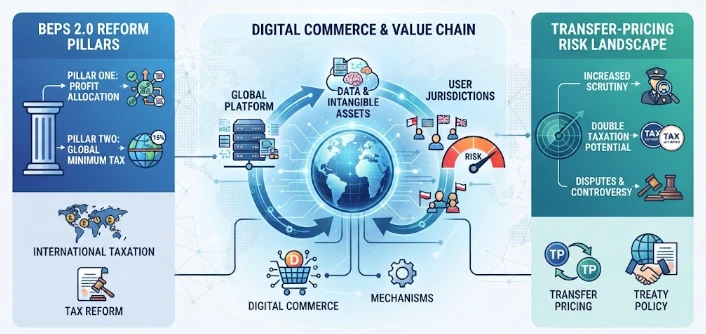
This article examines BEPS 2.0 through international taxation, transfer pricing, treaty policy and tax reform. Digital commerce makes it difficult to assign value creation to a single jurisdiction because sales, intellectual property, financing, data and operational functions can be distributed across multinational groups. Transfer pricing therefore remains central, particularly where intangibles and integrated business models make reliable comparables difficult. The article discusses simplified approaches for routine activities while stressing that they cannot resolve every case involving valuable intangibles or unusual risks. Treaty reform must protect taxing rights without creating persistent double taxation, making mutual agreement procedures, advance pricing arrangements and clear guidance essential. Pillar Two changes the economics of some profit-based incentives through the global minimum-tax framework, yet it does not eliminate transfer-pricing judgment. The article also connects executive incentives, accounting governance and public tax transparency with multinational risk management. Strong compliance requires accurate entity data, consistent legal agreements, traceable financial adjustments and aligned reporting. The overall direction is toward more coordination and transparency, but sustainable reform still depends on administrable rules, dispute resolution and evidence of economic substance.
The geographical origin of value creation is much more difficult to attribute in the context of digital commerce, which is not captured by tax rules.The rules of tax are not capturing the geographical origin of value creation, which is becoming more difficult in the context of digital commerce. Multinational groups have the ability to coordinate activities in several jurisdictions for sales, IP, financing, data, marketing and distribution, while reporting separate taxable results for legal entities. The subject of transfer pricing is thus at the heart of contemporary international tax risk. The problem is, however, to find a line between commercial defensibility and the building of structures that are mainly for the purpose of transporting profits to lower-tax areas.
Transfer pricing is still a key aspect of treaty policy as treating functions, assets and risks in a distributed manner across jurisdictions in order to operate as a unit. Intangibles and integrated business models make the evidence of comparable conditions difficult to obtain for the arm's length principle. In 2024, OECD work on Amount B included a simplified approach for base line marketing and distribution activities, added to the Transfer Pricing Guidelines. As long as facts are within the scope, disputes can be avoided through the process of simplification, but not if the case involves valuable intangibles or unusual risk issues.
Tax behaviour can be indirectly affected by executive remuneration, via performance targets. Governance protections are less effective if the incentives are strong, especially when the incentives are based on post-tax income, cash flow or earnings per share. It doesn't mean that just designing a compensation package is a misconduct. It does call for board consideration of whether the long-term reputation, internal assurance, clawback and tax-risk appetites are aligned with remuneration structures.
Transparency is discipline and complexity. Patterns can easily be detected through country-by-country information or through public disclosures of tax returns, but ratios can be misleading when there are losses or timing differences, when the tax credit is significant, and when it is caused by sector-specific rules. The bridge between the accounting profit, taxable income, current tax, deferred tax and cash tax is responsible communication. Only when disclosure gives context, but not a pretty face, without reconciling it, does there be less suspicion.
Lower capacity jurisdictions have special transfer pricing issues, as they often lack the expertise required and may not be able to access multinationals. Simple models of everyday activities can be used to minimize conflicts when the facts fall neatly into categories. Capacity building, information sharing and uniformity of documentation are important factors. International coordination can be useful only if the rules can be enforced by legal authorities whose staffing, data and litigation resources are quite different.
Anti-avoidance design must ensure a fair trade. Very general provisions can lead to double taxation, uncertainty and delayed investment, particularly if there is a difference of interpretation as to the same transaction between different jurisdictions. Conflict can be minimized by mutual agreement, advance pricing arrangements, safe harbours and good guidance. Good rules focus on unearthing artificial profit shifting and stay within the realm of normal cross-border trade administration.
In the tax debate, there is a growing link between tax payments and social licence and public infrastructure, hence the inclusion of corporate social responsibility. Reputational risk can still be present in a legal-minimum approach, if structures seem to be disconnected from real activity. Meanwhile, unspecific goals can be detrimental to the sense of certainty when tax liability turns into a public opinion. Good governance distinguishes between the legal aspects, risk to policy, reputational considerations and a voluntary disclosure and both all three aspects have an impact on corporate actions.
There is also a need to address the risk of double tax when it comes to reforming the treaty. More stringent anti-avoidance provisions can help preserve the base but varying treatment of the same income in different countries can lead to double taxation or to protracted litigation. Thus, mutual agreement procedures, advance pricing arrangements and administrative guidance that is more transparent are part of good reform. International tax policy is best when protection of taxing rights is coupled with means to generate certainty over actual cross-border commerce.
Resilient multi-national response is thus an integrated response rather than a reactive one. Reliable entity data, documented transfer-pricing procedures, Pillar Two calculations, governance controls, and escalation rules for uncertain positions are all tax teams' requirements. Boards require comprehensible risk reporting and finance systems require traceable adjustments and reconciling. That architecture lessens the risk of compliance being reconstructed at the end of the year that's based on disparate spreadsheets and assumptions that haven't been documented.
The OECD and the G20 BEPS project has transformed the international tax system by raising the reporting requirements, strengthening anti-avoidance rules and improving coordination. The 2021 outcome of the Two-Pillar agreement was the global minimum-tax architecture in Pillar Two at an effective 15 percent. Administrative guidance provided in 2023 and 2024 took actions towards implementation of jurisdictional calculations, safe-harbour questions, information systems and coordinated rules. That change put data quality and operational governance on par with high-level tax policy.
Pillar Two alters the tax incentives game without eradicating competition. A jurisdiction may provide grants, accelerated deductions, refundable taxes, infrastructure or other regulatory benefits, but a low effective tax rate may result in a tax "top-up" in another jurisdiction. That makes it less attractive to receive some form of reward based upon profit and more attention on support based upon substance or expenditure. When designing their corporate tax strategy, companies should therefore take into account the consequences of the global minimum tax rules on the effective corporate tax rate at group level as well as the incentives provided by the tax laws.
The issue of transfer-pricing risk is not lessened by minimum tax and arm's-length pricing, as they address different issues. Under the arm's-length principle, if the conditions are similar to those that would occur between arm's-length parties, they are not considered to be related-party transactions. Pillar Two introduces a new effective-tax framework. Whether a group pays the minimum effective rate or more, disputes can still arise due to intangibles, financing, services, distribution and business restructures. This means there must be a strong compliance component, which requires transfer pricing analysis and global minimum tax calculations.
Evidence problems are exacerbated in the digital business model. A traditional physical footprint is not necessarily required to generate revenue, as can come from customer data, network effects, brand, algorithms, local marketing and remote delivery. Important functions and risks may not be identified in legal ownership of an intangible. Documentation, country-by-country data, financial statements, contracts and operational evidence are increasingly areas of interest for tax authorities to examine for any indications of reported profit allocation in accordance with economic activity.
International tax calculations start with the financial information, followed by the application of tax adjustments, making accounting governance crucial. The lack of controls over entity data, intercompany charges, deferred tax or uncertain positions could give rise to compliance risk and/or reporting risk. The boards and audit committees should, therefore, be able to have visibility into tax governance and not tax as a mere filing exercise. The coherent control framework is the link between accounting systems, transfer-pricing policies, legal agreements, and the tax return process.
BEPS 2.0 has not eliminated international tax competition or BEPS 1.0 tax judgment. It has elevated the importance of consistency in the areas of the legal form, accounting records, their operational substance and tax consequences. Traditional notions are continually being challenged in digital commerce and global minimum tax regulations introduce an additional layer of calculation and reporting. The policy strategy is heading towards more transparency and coordination, but sustainable compliance will require convincing facts and effective governance and rules.
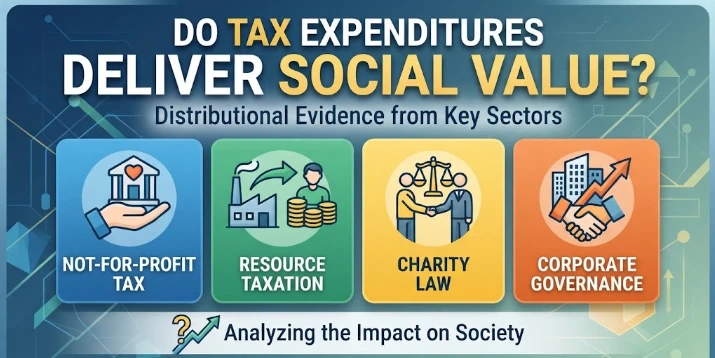
The question which is of practical importance is whether the instrument will provide measurable public value, when compliance costs, distribution costs and opportunity costs are added in. Transparent governance transforms that into a repeatable process, rather than a one-time justification when introducing it. This is an integrated view that helps minimize the likelihood that a technically sound rule yields poor results when households, firms and administrators act in response to the actual incentives. The better way to evaluate statutory design, however, is by measuring actual incentives, administrative capacity, and distributional impacts, and not by labeling.
That same view also allows you to see uncertainty, and helps with decision making when you can't precisely estimate behavioural responses or implementation costs. Another precaution is that assumptions, definitions and evaluation criteria should be published prior to a policy becoming politically unpopular that can be changed. A single discussion of fiscal cost, fairness, behaviour and administrative burden is the most informative evidence, as opposed to having a separate narrative for each. For long-run credibility, review processes are needed that have the ability to modify thresholds, eligibility criteria, or reporting procedures over time as economic conditions and technology evolve.
So the key issue is: does the instrument bring any measurable public benefit once the cost of following the instrument, the cost of distributing the instrument and the cost of the opportunity are taken into account?
CITE THIS ARTICLE
Sultana, K. R. (2025). BEPS 2.0, Digital Commerce, and Transfer-Pricing Risk: Evidence from International taxation, transfer pricing, treaty policy, tax reform. https://researchbysultana.com/article/a5af4f52-747c-5298-8874-93bfcdc390ae
K. R. Sultana, “BEPS 2.0, Digital Commerce, and Transfer-Pricing Risk: Evidence from International taxation, transfer pricing, treaty policy, tax reform,” 2025. [Online]. Available: https://researchbysultana.com/article/a5af4f52-747c-5298-8874-93bfcdc390ae
Sultana, K. R. (2025) ‘BEPS 2.0, Digital Commerce, and Transfer-Pricing Risk: Evidence from International taxation, transfer pricing, treaty policy, tax reform’. Available at: https://researchbysultana.com/article/a5af4f52-747c-5298-8874-93bfcdc390ae
Sultana, Kazi Rukaiya. “BEPS 2.0, Digital Commerce, and Transfer-Pricing Risk: Evidence from International taxation, transfer pricing, treaty policy, tax reform.” 2025, https://researchbysultana.com/article/a5af4f52-747c-5298-8874-93bfcdc390ae.
Kazi Rukaiya Sultana. “BEPS 2.0, Digital Commerce, and Transfer-Pricing Risk: Evidence from International taxation, transfer pricing, treaty policy, tax reform.” (2025). https://researchbysultana.com/article/a5af4f52-747c-5298-8874-93bfcdc390ae.
Sultana KR. BEPS 2.0, Digital Commerce, and Transfer-Pricing Risk: Evidence from International taxation, transfer pricing, treaty policy, tax reform. 2025. https://researchbysultana.com/article/a5af4f52-747c-5298-8874-93bfcdc390ae
@misc{article_a5af4f52747c5298887493bfcdc390ae,
  title = {BEPS 2.0, Digital Commerce, and Transfer-Pricing Risk: Evidence from International taxation, transfer pricing, treaty policy, tax reform},
  author = {Kazi Rukaiya Sultana},
  year = {2025},
  url = {https://researchbysultana.com/article/a5af4f52-747c-5298-8874-93bfcdc390ae},
}
TY  - GEN
AU  - Kazi Rukaiya Sultana
TI  - BEPS 2.0, Digital Commerce, and Transfer-Pricing Risk: Evidence from International taxation, transfer pricing, treaty policy, tax reform
PY  - 2025-08-17
UR  - https://researchbysultana.com/article/a5af4f52-747c-5298-8874-93bfcdc390ae
ER  -
This article uses institutional economics and applied microeconomics to show why tax-transfer reform cannot be evaluated from policy rules alone. Household disposable income reflects earnings, taxes, contributions, benefits, housing support and withdrawal schedules, but the effectiveness of those rules also depends on institutions that administer them. Different data systems, delayed appeals, inconsistent local delivery and administrative capacity can cause a theoretically efficient policy to wo
This article presents tax transparency as a governance and accounting issue rather than a simple disclosure exercise. Boards oversee tax outcomes that are influenced by risk appetite, capital allocation, internal controls, remuneration and significant transactions, while accounting systems provide the common record connecting financial profit, taxable income, deferred tax, cash tax and uncertain positions. IFRS S1 and IFRS S2 are used to show how sustainability-related financial information can
This article evaluates tax expenditures in not-for-profit, charity and resource-tax settings through distribution, governance and public value. Preferential treatment for charities and similar organisations is justified by public or community benefit, so reporting and governance should show whether concessions expand valued services, improve access or instead accumulate as private or organisational advantage. The article warns that annual income alone is an incomplete equity measure because life