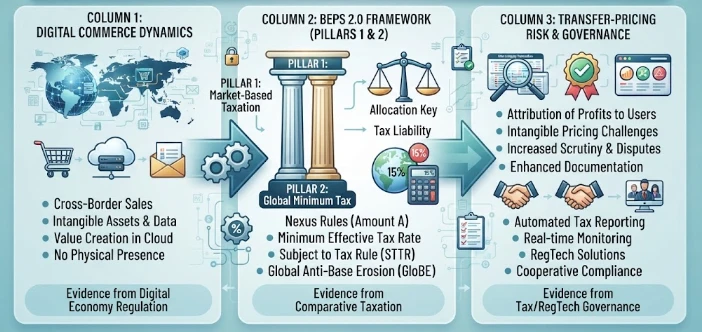
This article examines BEPS 2.0 through comparative taxation, digital-economy regulation and tax/regtech governance. Digital businesses can separate sales, intellectual property, financing, data, marketing and operational functions across jurisdictions, making transfer pricing and the location of value creation difficult to assess. Different countries respond through corporate tax rules, treaty reform, digital levies, platform reporting, withholding systems and transaction-level data, creating compliance complexity and potential double taxation. The article argues that multinational groups need integrated governance combining reliable entity data, transfer-pricing methodologies, Pillar Two calculations, documented assumptions and board-level risk reporting. Pillar Two changes the value of low-tax incentives but does not eliminate competition or transfer-pricing disputes. Regtech adds another dimension through APIs, digital identity, e-invoicing, automated validation and standardised data. These tools can reduce routine errors and strengthen risk detection, but they require data quality, security, access controls, correction rights and human oversight. The article concludes that international tax compliance in the digital economy depends on both sound legal rules and governable technology, with consistent data architecture connecting business systems, tax calculations and regulatory review.
In the digital commerce era, mapping the location of value creation onto traditional tax concepts is no longer easy. Multinational groups are able to sell, coordinate their intellectual property, finance, data, marketing and distribution in multiple jurisdictions, while legal entities report on different taxable results. Hence, transfer pricing is at the core of today's international tax risk. The key problem is telling apart a commercially defensible allocation from those that are being engineered mainly to funnel profit into lower-tax regions.
Comparative taxation demonstrates that the institutional model for regulation of digital-economy seldom is the same. Some jurisdictions heavily depend on the corporate income-tax rules and treaty reform, others have introduced special digital levies, or tightened platform reporting, withholding or transaction-level data-systems. Divergence means that firms can face compliance headaches when they operate in multiple markets, and creates a risk of double taxation claims. The BEPS 2.0 sits then within a broader framework of tax law, technological architecture, consumer markets and administrative capabilities that evolve at different paces.
The strongest and most resilient multinationals reaction is therefore an integrated one. Tax teams require high-quality data about entities, detailed transfer pricing methodologies, Pillar Two calculations, governance tools, and escalation procedures for areas of uncertainty. Boards require risk reporting that is easy to understand and finance systems require easy to trace adjustments and reconcilations. That architecture decreases the possibilities of compliance becoming an end-of-the-year construction job created using inconsistent spreadsheets and unrecorded hypotheses.
The OECD and G20 BEPS project has reshaped the international tax landscape with an emphasis on reporting, strengthening anti-avoidance rules, and fostering greater coordination. In 2021, the Two-Pillar agreement put in place a global minimum-tax structure under Pillar Two with an effective minimum tax rate of 15 percent for large multinational groups. Administrative guidance issued in 2023 and 2024 brought implementation closer to jurisdictional calculations, safe harbours questions, information systems and coordinated rules. That change introduced a new layer of significance in the realm of data quality and operational governance between the high-level tax policy and the level of significance.
Essentially, Pillar Two does not end competition, rather it modifies the games people play when it comes to tax incentives. While a jurisdiction may provide grants, accelerated deduction, refundable credits, infrastructure or regulation benefits, low effective tax results may lead to a top-up tax in another jurisdiction. This diminishes some of the incentives to provide benefits, and places a greater focus on substance-based or expenditure-based support. Therefore, when developing their corporate tax strategy, companies should take into account the effective-rate implications at a group level arising from global minimum tax rules as well as the statutory incentives.
The issue of transfer pricing risk still is important because minimum tax and arm's length pricing address different issues. The arm's-length principle takes into account whether related-party conditions are similar to those between independent parties, and Pillar Two is based on a different effective tax framework. When a group pays at least the minimum effective rate, disputes can arise due to intangibles, financing, services, distribution, and business restructures. Transfer pricing analysis and global minimum-tax calculations are thus required for strong compliance.
Regtech is changing the game side of the picture. The use of standardised data, application programming interfaces, e-invoicing, digital identity, and automated validation can help push compliance towards business systems, instead of just year-end returns. OECD Tax Administration 2024 noted that electronic filing and payment have become widespread and were growing, and a higher level of digital transformation was being sought. While the technology may help minimize routine errors and enhance risk detection, governance requires data quality and security, access controls, data correction rights, and human oversight of results.
The evidence problems are exacerbated by digital business models. This can be achieved without any traditional physical presence through customer data, network effects, brand, algorithms, local brand marketing, and remote delivery. The right of legal ownership is not necessarily indicative of where critical functions and risks lie in an intangible. Documentation, country-by-country information, financial statements, contracts, and operational evidence are now used to test how reported profit allocation is distributed to reflect economic activity, with increased reliance on these tools by tax authorities.
Financial information is the starting point for international tax calculations, and then tax adjustments are applied, thus making accounting governance critical. A lack of control over entity data, intercompany charges, deferred tax, or uncertain positions may give rise to compliance risk and reporting risk. Audit Committees and Boards should have visibility of tax governance, not just the technical filing of tax. A coherent control structure links accounting systems, transfer pricing policies, legal agreements, and the tax return procedures.
The tax behaviour can be indirectly affected by executive remuneration, as reflected in their performance targets. Incentives that are strongly linked to post-tax income, cash flow and/or earnings per share can drive high pressure in aggressive planning with low governance protection. That is not sufficient proof of misconduct in the design of compensation. It does warrant directors' consideration of whether there is a match between tax-risk appetite, clawback provisions, internal assurance, and long-term reputation, and remuneration.
Transparency is a discipline and complexity. Patterns can be detected that warrant explanation through country-by-country reporting, or through public tax disclosures, but simple ratios can be misleading if the patterns are the result of losses, timing differences, tax credits, or sector-specific rules. Responsible communication is the bridge between accounting profit, taxable income, current tax, deferred tax and cash tax. Only with better disclosure, there is less suspicion when it gives context, not a snappy headline without reconciling.
Transfer pricing is still a distinctive issue since technology will not solve the economic judgment question regarding functions, assets, risks, intangibles or comparable conditions. For 2024, Amount B targeted simplified defined baseline marketing and distribution efforts that are valued for lower complexity cases. Comparative policy is thus a two-track process: digital administration to enhance information flow, and substantive rules to allocate income coherently. Only legal standards that are intelligible and contestable can support tax governance through regtech.
Transfer pricing is especially difficult for developing and lower-capacity jurisdictions because specialist expertise is costly and it can be challenging to acquire multinationals. Routine activities can be handled with simplified approaches in order to minimize conflicts when facts are recognizable and laid out in clearly defined categories. Capacity building, exchange of information, and regular documentation standards are important, as well. International coordination is worth only if the rules can be enforced by officials who have different staff, data and litigation capabilities.
Anti-avoidance design should maintain business activity in accordance with the law. Too general rules may lead to double taxation, uncertainty and deferred investments, particularly when the same transaction is taxed differently under different sets of rules. Conflicts can be minimized with mutual agreement procedures, advance pricing arrangements, safe harbours and clear guidance. Good rules focus on obvious profit shifting without causing unwarranted administrative burden for ordinary cross-border trade.
Tax debate is increasingly involving corporate social responsibility (CSR) since tax payment is linked to social licence and public infrastructure. Even with a legal minimum, there may be reputational risk if structures “don't look like structures”. Meanwhile, vague expectations can lead to uncertainty if the tax obligation is to be turned into public opinion. Effective governance is well structured to avoid the mixing of the legal compliance, policy risk, reputational judgement and voluntary disclosure, and to appreciate the impact of each element on corporate actions.
International tax competition and transfer pricing judgment have not been extirpated by BEPS 2.0. It has increased the importance of consistency in the relationship of the form of the transactions, the accounting records and the substance of those transactions and the resulting tax consequences. Digital commerce continues to challenge traditional business models, and international minimum tax regimes introduce a new wrinkle into calculation and reporting. The directions of the policy suggest increased transparency and coordination but credible facts, good governance and rules that can be administered are still necessary to sustain the compliance.
Regular evaluation is important because the technologies, market structure, household situations and administrative capacity are evolving at a much faster rate than many statutes. Fostering credibility is important when public authorities communicate uncertainty instead of confidence in estimates as predictions. For long-term reform to be possible, it is necessary to have institutions that will adapt thresholds, procedures, and reporting, when the evidence changes. A workable system is one that is robust, but not so rigid that it prevents access, is a familiar process, and provides clear accountability for public and private actors.
A good assessment thus maintains a consistent analytical perspective on legal design, behavioural response, administrative capacity and distribution.
CITE THIS ARTICLE
Sultana, K. R. (2025). BEPS 2.0, Digital Commerce, and Transfer-Pricing Risk: Evidence from Comparative taxation, digital economy regulation, tax/regtech governance. https://researchbysultana.com/article/1114cf71-540d-5e16-ab9c-7877100e89c0
K. R. Sultana, “BEPS 2.0, Digital Commerce, and Transfer-Pricing Risk: Evidence from Comparative taxation, digital economy regulation, tax/regtech governance,” 2025. [Online]. Available: https://researchbysultana.com/article/1114cf71-540d-5e16-ab9c-7877100e89c0
Sultana, K. R. (2025) ‘BEPS 2.0, Digital Commerce, and Transfer-Pricing Risk: Evidence from Comparative taxation, digital economy regulation, tax/regtech governance’. Available at: https://researchbysultana.com/article/1114cf71-540d-5e16-ab9c-7877100e89c0
Sultana, Kazi Rukaiya. “BEPS 2.0, Digital Commerce, and Transfer-Pricing Risk: Evidence from Comparative taxation, digital economy regulation, tax/regtech governance.” 2025, https://researchbysultana.com/article/1114cf71-540d-5e16-ab9c-7877100e89c0.
Kazi Rukaiya Sultana. “BEPS 2.0, Digital Commerce, and Transfer-Pricing Risk: Evidence from Comparative taxation, digital economy regulation, tax/regtech governance.” (2025). https://researchbysultana.com/article/1114cf71-540d-5e16-ab9c-7877100e89c0.
Sultana KR. BEPS 2.0, Digital Commerce, and Transfer-Pricing Risk: Evidence from Comparative taxation, digital economy regulation, tax/regtech governance. 2025. https://researchbysultana.com/article/1114cf71-540d-5e16-ab9c-7877100e89c0
@misc{article_1114cf71540d5e16ab9c7877100e89c0,
  title = {BEPS 2.0, Digital Commerce, and Transfer-Pricing Risk: Evidence from Comparative taxation, digital economy regulation, tax/regtech governance},
  author = {Kazi Rukaiya Sultana},
  year = {2025},
  url = {https://researchbysultana.com/article/1114cf71-540d-5e16-ab9c-7877100e89c0},
}
TY  - GEN
AU  - Kazi Rukaiya Sultana
TI  - BEPS 2.0, Digital Commerce, and Transfer-Pricing Risk: Evidence from Comparative taxation, digital economy regulation, tax/regtech governance
PY  - 2025-05-04
UR  - https://researchbysultana.com/article/1114cf71-540d-5e16-ab9c-7877100e89c0
ER  -
This article uses institutional economics and applied microeconomics to show why tax-transfer reform cannot be evaluated from policy rules alone. Household disposable income reflects earnings, taxes, contributions, benefits, housing support and withdrawal schedules, but the effectiveness of those rules also depends on institutions that administer them. Different data systems, delayed appeals, inconsistent local delivery and administrative capacity can cause a theoretically efficient policy to wo
This article presents tax transparency as a governance and accounting issue rather than a simple disclosure exercise. Boards oversee tax outcomes that are influenced by risk appetite, capital allocation, internal controls, remuneration and significant transactions, while accounting systems provide the common record connecting financial profit, taxable income, deferred tax, cash tax and uncertain positions. IFRS S1 and IFRS S2 are used to show how sustainability-related financial information can
This article evaluates tax expenditures in not-for-profit, charity and resource-tax settings through distribution, governance and public value. Preferential treatment for charities and similar organisations is justified by public or community benefit, so reporting and governance should show whether concessions expand valued services, improve access or instead accumulate as private or organisational advantage. The article warns that annual income alone is an incomplete equity measure because life