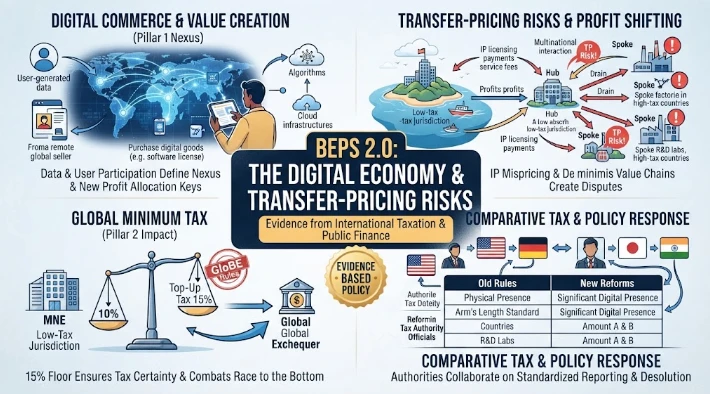
This article analyses BEPS 2.0 using international taxation, comparative tax policy and public finance. It argues that the effective burden on multinational activity depends on far more than the statutory corporate tax rate, including tax bases, loss rules, depreciation, withholding taxes, incentives, resource rents, payroll taxes, consumption taxes and administrative enforcement. Countries also differ in how strongly they rely on corporate tax revenue and in their capacity to absorb losses from tax competition. Pillar Two limits the value of very low effective tax rates but does not end competition through grants, infrastructure, credits or other support tied to real investment. Transfer pricing remains a separate challenge because minimum taxation does not resolve questions about arm’s-length pricing, intangibles, financing or business restructures. Digital business models further complicate evidence about where functions, risks and economic activity occur. The article therefore emphasises comparable information, robust administration, dispute-resolution mechanisms and alignment between legal form, accounting records and operational substance. International tax reform is presented as a public-finance issue requiring both revenue protection and administrable rules that preserve legitimate cross-border investment.
The creation of value digitally is more difficult to trace. Multinational groups have the ability to coordinate sales, intellectual property, financing, data, marketing and distribution across multiple jurisdictions, while legal entities report separate taxable results. Thus, transfer pricing is the focal point of today's international tax risk. The issue is to identify successfully commercializable allocation from structures that are built mainly to shift the profits to lower-tax jurisdictions.
Comparative public finance demonstrates that international tax policy is not an issue of just the statutory corporate tax rate. Effective burdens are determined by tax bases, loss rules, depreciation, withholding taxes, incentives, resource rents, consumption taxes, payroll taxes and administrative enforcement. There are also differences in the extent to which countries rely on corporate tax revenue and in their ability to offset this loss of revenue due to competition. Pillar Two does not stop wider competition for grants, infrastructure, credits or conditions of real investment among large groups, but it does curtail the incentive for very low effective tax rates.
Transfer pricing risk is not an issue to be ignored, as minimum tax and arm's length pricing address different issues. The arm's length principle relies on the premise that related-party conditions would be the same as those of an unrelated party, and Pillar Two employs a different set of effective tax rules. A group can still have disputes due to intangibles, financing, services, distribution and business restructures even if the group pays at least the minimum effective rate. To ensure good compliance, it is necessary to combine transfer pricing analysis and calculation of the global minimum tax.
Evidence problems are exacerbated in digital businesses. This is because they can generate revenue without necessarily creating the typical brick-and-mortar footprint, through the use of customer data, network effects, brand, algorithms, local marketing and remote delivery. The location of key functions and risks is not necessarily revealed by the legal rights of ownership of an intangible. Documentation, country-by-country information, financial statements, contracts, and operational evidence are increasingly being used by tax authorities to challenge the reported profit allocation to reflect economic activity.
The importance of accounting governance is enhanced by the fact that international tax calculations start with accounting information and then tax adjustments are made to it. Poor control over entity data, intercompany charges, deferred tax, or uncertain positions can result in compliance risk and reporting risk. Audit committees and boards should thus have an overview of tax governance and not see tax as a filing exercise. A well-designed control system relates accounting systems, transfer-pricing policies, legal arrangements and tax-return procedures.
Performance targets are one indirect way in which executive remuneration might affect tax behaviour. When governance protections are lacking, incentives can be strong related to post-tax earnings, cash flow or earnings per share. This is not enough to prove misconduct because of the design of compensation. It does suggest that the board needs to be concerned over the relationship between the appetite for tax risk, clawback provisions, internal assurance, and reputation, and pay structures.
The public-finance implications of the global minimum-tax framework also include public-finance decision-making regarding domestic top-up taxes and the tax treatment of incentives. The tax advantage of a concession may be offset if another jurisdiction imposes a "top up tax" which affects the fiscal impact of the concession, but not the investment project. So governments must weigh tax incentives against direct spending, refundable support, infrastructure, and even regulation. A clear comparison can identify an instrument that provides extra investment with the lowest public cost.
There is discipline and complexity when it comes to transparency. Patterns that can be explained by country-by-country reporting and public tax disclosures may be distorted by losses, timing differences, tax credits, and sector-specific rules.Losses, timing differences, tax credits, and sector-specific rules can obscure patterns, so that they fail to be explained by a simple ratio. Responsible communication is the link between accounting profit, taxable income, current tax, deferred tax and cash tax. Better disclosure only makes suspicion go away when it contains context instead of a pretty headliner with no reconciliation.
Transfer pricing problems are especially difficult for developing and lower capacity jurisdictions where the expertise of specialists is costly and verification of data from multinationals is not always easy. In cases of simple facts, that fit neatly into easy-to-understand categories, simplified approaches to routine activities can help minimize disputes. Capacity building and exchange of information are also important as well as standard documentation practices. International coordination is useful only when rules can be enforced by officials possessing different staffing, data and litigative resources.
Anti-avoidance design needs to ensure that valid business transactions are not prevented. Vagueness can lead to double taxation, uncertainty and delayed investment, particularly if the different jurisdictions interpret the same transaction in different ways. Muddy waters can be avoided through the application of mutual agreement procedures, advance pricing agreements, safe harbours and straightforward guidance. Effective rules aim at combating the artificial shifting of profits, yet do not make routine cross-border trade impractical.
As companies have become more aware of corporate social responsibility issues, they have increasingly become involved in the tax debate because stakeholders have come to associate taxes with social licence and public services. A legal minimum approach can still lead to reputational risk, if structures seem out of sync with real activity. However, expectations can be vague and a source of doubt when tax matters become a public opinion issue. Good governance differentiates between compliance and policy risk, reputation and voluntary disclosure and takes into account the interconnectedness of all three aspects with corporate decisions.
Different development strategies must be respected for comparative tax policy to remain relevant. The structure of revenues, and bargaining power, of a capital importing economy, resource exporter, financial centre and large consumer market are different. While there may be some benefits to uniformity, it should not eliminate domestic policy space. As opposed to taking an economy-as-a-whole approach, the sound public-finance test considers revenue resilience, investment impacts, administrative costs, distribution and international spillover.
An integrated rather than a reactive approach to the most resilient multi-national response is therefore required. Tax teams require trustworthy entity information, agreed upon transfer pricing strategies, pillar two calculations, governance controls and escalation processes for the unknown. Boards must have comprehensible risk reporting and finance must have auditable changes and recon. That design minimizes the risk of compliance being a year-end exercise of piecing together disparate spreadsheets and un-documented assumptions.
The OECD and G20 BEPS project was a major transformation of the international tax landscape, with a focus on more reporting, stronger anti-avoidance measures and improved coordination. In 2021, the Two-Pillar agreement introduced a new global minimum-tax framework under Pillar Two, which is grounded in an effective 15 percent global minimum tax for large multinationals. Administrative guidance released in 2023 and 2024 took implementation one step closer to jurisdictional calculations, safe-harbour questions, information systems and coordinated rules. That transition turned data quality and operational governance into a priority as high as the major tax policy.
Instead of moving away from competition, Pillar Two alters the rules of the game for tax incentives. Despite offering grants, accelerated deductions, refundable credits, infrastructure, or regulatory payback, a jurisdiction can still see low effective tax results, which can lead to top up tax elsewhere. That diminishes the pull of some profit-based incentives, and heightens focus on substance-based or expenditure-based support. Corporate tax strategy should consequently factor statutory incentives and the resulting group-level effective-tax-rate effect of global minimum-tax rules.
BEPS 2.0 hasn't taken the competition or the judgment out of the international tax world. It has brought consistency among legal form, accounting records, operational substance and tax results. Digital commerce has been putting traditional ideas to the test and global minimum-tax rules create another layer of calculation and reporting. The policy focus is towards increased transparency and coordination, however, long-term compliance will rely on trustworthy evidence, effective governance, and implementable rules.
Whether the rule yields measurable public benefit after taking into account fiscal costs, compliance requirements, and unintended incentives is the test to be asked. Transparency can be most helpful when assumptions, definitions, limitations, and review criteria precede a policy when making changes is difficult. The integrated approach also helps prevent the adoption of one headline measure as being the proof of fairness, efficiency or responsible behaviour. Regular evaluation is important because the technical, market, household, and administrative conditions evolve quicker than much of the legislation.
The more transparency over uncertainty, the more creditable it is when presented by the public authorities as an explanation instead of an estimate as a forecast of behaviour or revenue.
CITE THIS ARTICLE
Sultana, K. R. (2025). BEPS 2.0, Digital Commerce, and Transfer-Pricing Risk: Evidence from International taxation, tax policy, comparative tax, public finance. https://researchbysultana.com/article/007a460d-aef4-5b1a-9c55-089ae200a013
K. R. Sultana, “BEPS 2.0, Digital Commerce, and Transfer-Pricing Risk: Evidence from International taxation, tax policy, comparative tax, public finance,” 2025. [Online]. Available: https://researchbysultana.com/article/007a460d-aef4-5b1a-9c55-089ae200a013
Sultana, K. R. (2025) ‘BEPS 2.0, Digital Commerce, and Transfer-Pricing Risk: Evidence from International taxation, tax policy, comparative tax, public finance’. Available at: https://researchbysultana.com/article/007a460d-aef4-5b1a-9c55-089ae200a013
Sultana, Kazi Rukaiya. “BEPS 2.0, Digital Commerce, and Transfer-Pricing Risk: Evidence from International taxation, tax policy, comparative tax, public finance.” 2025, https://researchbysultana.com/article/007a460d-aef4-5b1a-9c55-089ae200a013.
Kazi Rukaiya Sultana. “BEPS 2.0, Digital Commerce, and Transfer-Pricing Risk: Evidence from International taxation, tax policy, comparative tax, public finance.” (2025). https://researchbysultana.com/article/007a460d-aef4-5b1a-9c55-089ae200a013.
Sultana KR. BEPS 2.0, Digital Commerce, and Transfer-Pricing Risk: Evidence from International taxation, tax policy, comparative tax, public finance. 2025. https://researchbysultana.com/article/007a460d-aef4-5b1a-9c55-089ae200a013
@misc{article_007a460daef45b1a9c55089ae200a013,
  title = {BEPS 2.0, Digital Commerce, and Transfer-Pricing Risk: Evidence from International taxation, tax policy, comparative tax, public finance},
  author = {Kazi Rukaiya Sultana},
  year = {2025},
  url = {https://researchbysultana.com/article/007a460d-aef4-5b1a-9c55-089ae200a013},
}
TY  - GEN
AU  - Kazi Rukaiya Sultana
TI  - BEPS 2.0, Digital Commerce, and Transfer-Pricing Risk: Evidence from International taxation, tax policy, comparative tax, public finance
PY  - 2025-03-30
UR  - https://researchbysultana.com/article/007a460d-aef4-5b1a-9c55-089ae200a013
ER  -
This article uses institutional economics and applied microeconomics to show why tax-transfer reform cannot be evaluated from policy rules alone. Household disposable income reflects earnings, taxes, contributions, benefits, housing support and withdrawal schedules, but the effectiveness of those rules also depends on institutions that administer them. Different data systems, delayed appeals, inconsistent local delivery and administrative capacity can cause a theoretically efficient policy to wo
This article presents tax transparency as a governance and accounting issue rather than a simple disclosure exercise. Boards oversee tax outcomes that are influenced by risk appetite, capital allocation, internal controls, remuneration and significant transactions, while accounting systems provide the common record connecting financial profit, taxable income, deferred tax, cash tax and uncertain positions. IFRS S1 and IFRS S2 are used to show how sustainability-related financial information can
This article evaluates tax expenditures in not-for-profit, charity and resource-tax settings through distribution, governance and public value. Preferential treatment for charities and similar organisations is justified by public or community benefit, so reporting and governance should show whether concessions expand valued services, improve access or instead accumulate as private or organisational advantage. The article warns that annual income alone is an incomplete equity measure because life