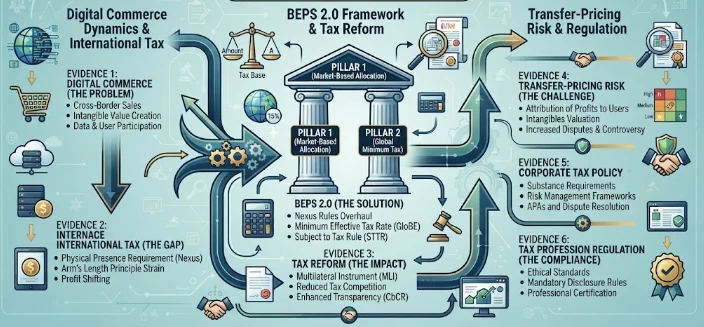
This article explores how international tax reform has expanded the responsibilities of tax professionals and corporate governance systems. Digital commerce makes value creation difficult to locate, while multinational groups must manage transfer pricing, Pillar Two calculations, country-by-country data, treaty analysis, deferred tax and domestic anti-avoidance rules. Professional advisers can improve compliance and certainty, but the article notes potential conflicts between aggressive planning, commercial objectives and broader public-interest expectations. Competence, confidentiality, ethical standards, independence where appropriate and consequences for serious misconduct are therefore presented as important elements of professional regulation. Accounting governance is equally important because international tax calculations begin with financial data and adjustments, so weak controls over entity information, intercompany charges and uncertain positions can create both tax and reporting risk. Executive remuneration may also influence tax behaviour when short-term targets reward after-tax results without adequate risk controls. The article favours integrated oversight linking boards, finance, legal teams, transfer pricing, disclosures and escalation processes. Effective reform should protect the tax base without creating unnecessary uncertainty or double taxation for ordinary cross-border commerce.
The geographies of value creation have become more difficult to align with old tax thinking in the digital world.In the digital world the place creation of values has become elusive to the old tax concepts. Multinational groups can make sales, distribute, finance, coordinate IP rights protection, data collection and marketing efforts, and provide separate taxable results in several jurisdictions. Transfer pricing is thus in the middle of the current international tax risk. The fundamental issue is between allocation that is defensible commercially and allocation that is made principally to lower-tax jurisdictions.
The role of tax professionals has grown with the advent of International tax reform. Enforcement of the calculations for Pillar Two, country-by-country data, transfer pricing documentation, treaty analysis, deferred tax accounting and domestic anti-avoidance rules require specialist interpretation. Professional advisers can help minimise uncertainty and enhance compliance, but there is a risk of conflicts of interests between aggressive planning and commercial objectives and public-interest considerations. Competence, ethical standards, confidentiality, independence (where needed), and clear consequences for severe misconduct are therefore all needed in regulation.
The management of tax accounting becomes important because international tax computation is based on financial data and tax adjustments are made to this figure. Poor controls over entity data, intercompany charges, deferred tax or uncertain positions can present a compliance risk and reporting risk. Audit committees and boards should therefore be kept informed on tax governance and not on the approach of filing tax returns. A unified control system that links accounting systems, transfer pricing strategies, legal dealings and tax return procedures.
The influence on tax behaviour can be indirect via the performance targets set by an executive's remuneration. When governance protection is low, pressures for aggressive planning can be higher when the incentives are strong and based on post-tax earnings, cash flow, or earnings per share. That is not enough to prove the misconduct of the compensation design. It does merit attention by the board on the alignment of tax-risk appetite, clawback provisions, internal assurance and long-term reputation with remuneration structures.
Transparency imparts discipline and complexity. Simple ratios can mislead when results are influenced by losses, timing differences, tax credits or sector specific rules; country by country reporting and public tax disclosures can reveal trends that need to be explained. The bridge between accounting profit, taxable income, current tax, deferred tax and cash tax is responsible communication. Better disclosure dulls the suspicion it conjures up only if it also helps to explain or give context.
The lower capacity jurisdictions have unique transfer pricing issues, given the scarcity of specialist expertise and the fact that data from multinationals can be costly and hard to come by. Where there are clear categories to facts, a simplified approach to routine activities can help minimize dispute. Capacity building, sharing of information and establishing uniform documentation procedures are also of importance. International co-ordination works only as long as the rules can be enforced by authorities that have widely varying resources of staff, data and litigation.
The quality of corporate tax policy implementation within firms is also a key determinant of corporate tax policy. To have visibility into tax risk appetite, material disputes, uncertain positions, governance controls, and the connection between tax strategy and broader business decisions, boards must also be provided with this information. If the repayment to the company is linked to a policy of responsible tax behaviour, then it has little impact if approval to make transactions is based on remuneration. Good internal governance ensures that legal counsel, finance, transfer pricing, public disclosure and escalation processes are integrated meaning that no parts of complex rules are separated across departments.
Anti-avoidance design should ensure that legitimate trading is not inhibited. Rules that are too general can lead to double taxation, uncertainties and late investments when there are different interpretations of the same transaction between jurisdictions. Conflict can be minimised through mutual agreement procedures, advance pricing arrangements, safe harbours and with guidance. Effective rules focus on eliminating artificial profit shifting without unduly constraining ordinary cross-border trade.
The concept of corporate social responsibility has become increasingly part of the tax debate as tax payments are linked to social licence and public infrastructure. Even a legal-minimum strategy can lead to reputational risk issues if buildings seem to be disconnected from business. Meanwhile, unfocussed hopes can create uncertainty when tax burden is an issue of opinion. Good governance distinguishes between compliance, policy risk, reputation and voluntary disclosure and understands that these all have an impact on corporate decisions.
Integrating, not reacting, is the most resilient multinational response. Tax teams must have accurate entity information, clear transfer pricing documentation, Pillar Two computations, certain controls, and escalation procedures for areas of uncertainty. Boards require risk reporting in a format that is easy to understand, and finance systems require processes that allow for traceable adjustments and reconciliation. That kind of architecture minimizes the risk of compliance being a year-end “reconstruction” based on disparate spreadsheets and unrecorded assumptions.
The OECD and G20 BEPS project has transformed the international tax environment through the enhancement of reporting requirements, strengthening of anti-avoidance principles and greater cooperation. In 2021, the Pillar Two agreement reached included a new global minimum-tax framework, with a 15 percent effective rate for large multinational companies. Guidance in 2023 and 2024, at an administrative level, brought implementation closer to the calculations of the jurisdictions, the "safe-harbour" questions, information systems and coordinated rules. This change brought data quality and operational governance to the forefront alongside the tax policy issues.
The goal of reform should not be to make professional advice "suspicious. Cross-border regulations are complicated, and there are many benefits to having sound advice that can ensure revenue is not lost and taxpayer rights are not infringed upon, especially through better documentation and early detection of issues. Regulation is proportionate, it is the difference between legitimate interpretation and concealing or abusing it. The robust model brings together professional expertise and clear criteria, regulatory engagement and corporate governance that sees tax as a topic on the agenda of the board of directors, not a technical matter handled by tax specialists in lockstep.
Pillar Two restates the "rules of the game" in the tax incentives game without removing the game. There may be grants available, accelerated deductions, tax refunds, infrastructure and/or regulatory benefits available, but low effective tax results may cause top-up tax elsewhere. This creates less incentive for some financial incentives and more focus on substance-based or expenditure-based support. The impact of global minimum taxes (GMT) on group level effective tax rates should be taken into account in corporate tax strategy.
Despite that, the transfer pricing risk is not negligible because minimum tax and arm's length pricing are for addressing different issues. The arm's length principle and Pillar Two each apply a different approach to the effective tax rate, and both ask the question of whether related-party conditions are the same as what would be applied to independent parties. Even if a group pays the minimum effective rate, disputes may arise from intangibles, financing, services, distribution and business restructures. In order to achieve strong compliance, one has to rely on transfer-pricing analysis and on calculations of global minimum taxes.
The nature of the evidence problem is exacerbated in digital business models. There's no typical physical presence when it comes to revenue, because it can come in the form of customer data, network effects, brand, local marketing, and remote delivery. Important functions and risks may not be located in legal ownership of an intangible. Documentation, country-by-country information, financial statements, contracts and operational evidence are the resources increasingly being used by tax authorities to challenge the reported allocation of profit to reflect economic activity.
International tax competition and transfer pricing judgment have not been extirpated by BEPS 2.0. It has made consistency in legal form, accounting records, operation and tax result more valuable. New ideas in digital commerce challenge old paradigms, and minimum tax rules throughout the world introduce a layer of complexity to calculating and reporting. The policy orientation is towards more transparency and coordination, yet ongoing compliance can only be achieved through reliable facts, effective governance and manageable rules.
When public bodies communicate uncertainty, as opposed to estimates that become forecasts of behaviour or revenue, then their credibility is enhanced. It is therefore necessary to have institutions that can adjust thresholds, processes, and reporting requirements in light of new evidence when it arises in order to ensure long-term reform. A sustainable system must achieve a balance between revenue protection and accessibility, predictability of procedures, and clarity of accountability, both for public and private actors. A good evaluation thus maintains the unity of legal design, behavioural response, administrative capacity and distribution within a single analytical sphere.
The test of the rule is whether there is measurable value to the public when fiscal cost, compliance burden and unintended incentives are taken into account. The usefulness of transparency is maximized when assumptions, definitions, limitations, and review criteria are presented ahead of time before a policy becomes difficult to change.
CITE THIS ARTICLE
Sultana, K. R. (2025). BEPS 2.0, Digital Commerce, and Transfer-Pricing Risk: Evidence from International tax, tax reform, tax profession regulation, corporate tax policy. https://researchbysultana.com/article/e7f085e3-c3dd-52bd-ad51-16ff7bb97bca
K. R. Sultana, “BEPS 2.0, Digital Commerce, and Transfer-Pricing Risk: Evidence from International tax, tax reform, tax profession regulation, corporate tax policy,” 2025. [Online]. Available: https://researchbysultana.com/article/e7f085e3-c3dd-52bd-ad51-16ff7bb97bca
Sultana, K. R. (2025) ‘BEPS 2.0, Digital Commerce, and Transfer-Pricing Risk: Evidence from International tax, tax reform, tax profession regulation, corporate tax policy’. Available at: https://researchbysultana.com/article/e7f085e3-c3dd-52bd-ad51-16ff7bb97bca
Sultana, Kazi Rukaiya. “BEPS 2.0, Digital Commerce, and Transfer-Pricing Risk: Evidence from International tax, tax reform, tax profession regulation, corporate tax policy.” 2025, https://researchbysultana.com/article/e7f085e3-c3dd-52bd-ad51-16ff7bb97bca.
Kazi Rukaiya Sultana. “BEPS 2.0, Digital Commerce, and Transfer-Pricing Risk: Evidence from International tax, tax reform, tax profession regulation, corporate tax policy.” (2025). https://researchbysultana.com/article/e7f085e3-c3dd-52bd-ad51-16ff7bb97bca.
Sultana KR. BEPS 2.0, Digital Commerce, and Transfer-Pricing Risk: Evidence from International tax, tax reform, tax profession regulation, corporate tax policy. 2025. https://researchbysultana.com/article/e7f085e3-c3dd-52bd-ad51-16ff7bb97bca
@misc{article_e7f085e3c3dd52bdad5116ff7bb97bca,
  title = {BEPS 2.0, Digital Commerce, and Transfer-Pricing Risk: Evidence from International tax, tax reform, tax profession regulation, corporate tax policy},
  author = {Kazi Rukaiya Sultana},
  year = {2025},
  url = {https://researchbysultana.com/article/e7f085e3-c3dd-52bd-ad51-16ff7bb97bca},
}
TY  - GEN
AU  - Kazi Rukaiya Sultana
TI  - BEPS 2.0, Digital Commerce, and Transfer-Pricing Risk: Evidence from International tax, tax reform, tax profession regulation, corporate tax policy
PY  - 2025-04-27
UR  - https://researchbysultana.com/article/e7f085e3-c3dd-52bd-ad51-16ff7bb97bca
ER  -
This article uses institutional economics and applied microeconomics to show why tax-transfer reform cannot be evaluated from policy rules alone. Household disposable income reflects earnings, taxes, contributions, benefits, housing support and withdrawal schedules, but the effectiveness of those rules also depends on institutions that administer them. Different data systems, delayed appeals, inconsistent local delivery and administrative capacity can cause a theoretically efficient policy to wo
This article presents tax transparency as a governance and accounting issue rather than a simple disclosure exercise. Boards oversee tax outcomes that are influenced by risk appetite, capital allocation, internal controls, remuneration and significant transactions, while accounting systems provide the common record connecting financial profit, taxable income, deferred tax, cash tax and uncertain positions. IFRS S1 and IFRS S2 are used to show how sustainability-related financial information can
This article evaluates tax expenditures in not-for-profit, charity and resource-tax settings through distribution, governance and public value. Preferential treatment for charities and similar organisations is justified by public or community benefit, so reporting and governance should show whether concessions expand valued services, improve access or instead accumulate as private or organisational advantage. The article warns that annual income alone is an incomplete equity measure because life