BEPS 2.0, Digital Commerce, and Transfer-Pricing Risk: Evidence from International taxation, digital economy, comparative tax, tax competition, cooperation
Kazi Rukaiya Sultana (Master of Public Policy & Master of Social Welfare and Research)
This article examines digital commerce and BEPS 2.0 through comparative taxation, tax competition and international cooperation. It explains that digital businesses can create value through customers, data, intellectual property and remote services across multiple jurisdictions, while tax systems remain nationally based. The original BEPS programme addressed treaty abuse, transfer pricing, interest deductions, hybrid mismatches and country-by-country reporting, while the two-pillar framework added new approaches to nexus, profit allocation and minimum taxation. Pillar Two changes tax competition because very low effective rates may trigger top-up taxation elsewhere, encouraging governments to reconsider whether incentives genuinely support local investment. The article compares how countries differ in tax bases, rates, depreciation, incentives, treaties and administrative capacity. Transfer pricing and dispute resolution remain central because arm’s-length analysis and tax certainty are still needed even under minimum-tax rules. Developing economies face additional capacity challenges, making information exchange and simplified approaches important. The article concludes that effective international coordination requires common floors, transparent information, workable dispute mechanisms and enough domestic flexibility to reflect different economic circumstances.
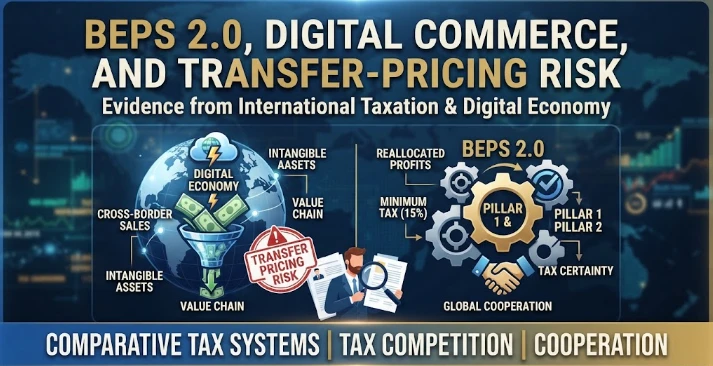
Digital commerce has revealed a fundamental conflict between international taxes. While tax systems are national, value creation, customers, data, the intellectual property, financing, and the management can be distributed across multiple jurisdictions simultaneously. A platform can have a broad market without an old fashioned permanent establishment, and multinational groups can distribute functions and intangibles between countries. By 31-05-2026, international tax policy is thus constrained by three conflicting forces: firstly, countries want to safeguard revenue; secondly, businesses want a consistent tax policy; and thirdly, governments still want the autonomy to offer investment incentives.
The initial BEPS project was on base erosion and profit shifting, with coordinated work on treaty abuse, transfer pricing, interest deductions, harmful tax practices, hybrid mismatches, country by country reporting and dispute resolution. That agenda enhanced transparency and filled some gaps, but would have been more challenging to digitalise, due to the fact that the tax system has traditionally been tied to physical presence and legal entity. In a modern economy, a jurisdiction can create substantial sales and user involvement and participation without similar local assets or employees. Intangible assets may also focus profit in a manner that poses challenges to traditional transfer-pricing analysis.
BEPS 2.0 evolved as a two-pillar response. Pillar One tackles nexus and profit allocation issues of the largest and most profitable multinational groups with the aim of providing market jurisdictions with a larger share of a fraction of profits. Pillar Two provides a minimum effective taxation system for large multinationals. The Global Anti-Base Erosion rules introduce a minimum tax system, opening up for groups with consolidated revenue over EUR 750 million in a 15% tax system, with detailed rules, exclusions and ordering mechanisms. The two pillars are thus tackling different aspects of the same international issue.
Pillar Two introduces a new regime for tax competition, as it lowers the value of very low effective rates for in-scope groups. A coordinated rule can also add to the burden, if income is taxed at less than the minimum rate in one jurisdiction.A qualified domestic minimum top-up tax or other coordinated rule can add to burden if income taxed below minimum in one jurisdiction. A concession which provided a clear tax benefit can thus become a source of revenue for another government, and not a permanent saving for the investor. This does not mean that there is no competition. Infrastructure, skills, legal stability, grants, research support, accelerated deductions, energy costs and market access continue to be strong investment drivers, as do regulatory quality.
In such a scenario, comparative tax policy gains significance. There are variations in the tax rates and bases of taxation that countries impose on corporations, as well as in the depreciation rules, loss treatment, withholding taxes, investment incentives, treaty networks, administration, and reliance on consumption taxes or labour taxes. A reform which is successful in a big consumer market can have different consequences in a small open economy. Exporters of resources, financial centres, manufacturing centres and developing economies also have various revenue models. International coordination should be sufficiently consistent to minimise arbitrage opportunities and be sufficiently different to allow for the existence of economic differences within domestic systems.
Balancing the scales is hard to do in the case of digital-services taxes. Prior to the progress of the multilateral agreement, some jurisdictions introduced or considered unilateral taxes based on revenues generated from digital activities. These measures were a reaction to concerns from the public over the possibility that high-tech companies might be able to generate substantial market revenues without a traditional presence. When multiple overlapping regimes were in effect, critics highlighted issues of trade conflict, double taxation and complexity. The debate highlighted the importance of cooperation – and unilateral action can be more revenue recovery efficient in the short term, but there can be more uncertainty in the same cross-border transaction with fragmented solutions.
One of the areas of comparison and cooperation continues to be transfer pricing. The arm's length principle is an international principle that is used for pricing transactions between related parties, but the principles of administration vary between jurisdictions. Tax Administrations may have limited capacity and/or lack specialist teams. Disagreements about "intangibles," financing, risk, and integrated operations can last for years. Standardisation of approaches to routine tasks can minimize cost, but there must be limits on how far it can go so that tasks that are truly complex cannot be crammed into the wrong formula.
An improvement in country-by-country reporting has led to better information available to tax administrations. Large multinational groups show revenue, profit, taxes, employees, tangible assets and others by jurisdiction, within the BEPS Action 13 framework. The data can be used by the authorities for high level risk assessment, especially in cases where profit doesn't seem to correlate with operating substance. International exchange allows a tax administration to no longer consider an international subsidiary without taking into account the rest of the group. Nevertheless the information is still a risk tool and detailed audit evidence is still required.
Cooperation also can contribute to tax certainty. Where there is disagreement between two nations over the same transaction, both may seek to tax the same profit. Mutual agreement procedures and advance pricing arrangements are mechanisms for addressing and preventing such issues.
The rules for preventing tax avoidance create more opportunities for the jurisdictions to have competing claims, and effective dispute resolution is critical. A coordinated system is undermined if businesses would be taxed twice in perpetuity, despite providing full information. Indeed, certainty should not be on the periphery of the BEPS agenda but on its core.
The developing economies offer a different point of view. While corporate income tax can be a large percentage of revenue, international tax rules can be complex and require costly data, economic and legal expertise. Capacity building, information sharing, simplified transfer pricing methods and practical assistance will support efforts to strengthen enforcement. Meanwhile, developing nations are increasingly looking for tax breaks when it comes to attracting capital, which exposes delicate dilemmas in a minimum-tax era. If the difference is collected in another jurisdiction, an incentive that reduces the effective rate below the global floor can result in an investment benefit that is less than anticipated.
Political economy can be eliminated only through cooperation. Each of the countries, from a residence, market, source, investment hub, and smaller economies, has different interests in allocating taxing rights. The negotiation over Pillar One has been particularly difficult due to the fact that reallocation has clear winners and losers. Many factors can also influence the movement of tax funds, including minimum taxation based on the order in which taxes are imposed. Comparative analysis must then consider the revenue impact, investments reactions, administrative capacity and treaty relations, not only the one common standard.
There is an analogous coordination problem within the business. International tax teams require uniformity in data across legal entities, transfer pricing documentation, financial reporting and minimum tax calculations. Even if a commercial model remains the same, a structure built with preexisting rules may generate new compliance expenses. Cooperation with functions such as finance, legal, treasury, sustainability and operations is becoming a key part of tax departments' needs. Good governance minimizes the chances of a conflict over transactions in public disclosures, local filings and global calculations.
The digital economy also increases the value of tax-administration technology. Patterns can be enhanced through e-invoicing, online reporting, automatic exchange, data matching, and advanced risk analytics. If the reporting requirements are interoperable, then technology can help to decrease administrative burden, and duplicate formats and incompatible definitions can have the opposite effect. The substantive tax rules should be complemented by the data architecture aspect of international cooperation. Clear and secure definitions can enhance both enforcement and compliance efforts with standardized information.
The development of international taxation is heading toward more coordination with no full harmonisation by 31-05-2026. Difficult allocation questions remain unanswered and tax competition is still a reality at the national level. However, BEPS 2.0, country-by-country reporting, minimum taxation, transfer pricing cooperation and better dispute resolution frameworks have set a new baseline.
The best comparison is that neither full tax sovereignty nor full uniformity is a plausible solution. Any policy must have the following four elements: coordinated floors, transparent information, a workable dispute resolution mechanism and adequate domestic flexibility for legitimate policy choices. In the digital economy, cooperation is also part of tax sovereignty as individual rules are unable to fully reign over a tax base that transcends borders.
CITE THIS ARTICLE
Sultana, K. R. (2026). BEPS 2.0, Digital Commerce, and Transfer-Pricing Risk: Evidence from International taxation, digital economy, comparative tax, tax competition, cooperation. https://researchbysultana.com/article/a17ee706-b2dd-5477-b488-5b3a3b9d5f23
K. R. Sultana, “BEPS 2.0, Digital Commerce, and Transfer-Pricing Risk: Evidence from International taxation, digital economy, comparative tax, tax competition, cooperation,” 2026. [Online]. Available: https://researchbysultana.com/article/a17ee706-b2dd-5477-b488-5b3a3b9d5f23
Sultana, K. R. (2026) ‘BEPS 2.0, Digital Commerce, and Transfer-Pricing Risk: Evidence from International taxation, digital economy, comparative tax, tax competition, cooperation’. Available at: https://researchbysultana.com/article/a17ee706-b2dd-5477-b488-5b3a3b9d5f23
Sultana, Kazi Rukaiya. “BEPS 2.0, Digital Commerce, and Transfer-Pricing Risk: Evidence from International taxation, digital economy, comparative tax, tax competition, cooperation.” 2026, https://researchbysultana.com/article/a17ee706-b2dd-5477-b488-5b3a3b9d5f23.
Kazi Rukaiya Sultana. “BEPS 2.0, Digital Commerce, and Transfer-Pricing Risk: Evidence from International taxation, digital economy, comparative tax, tax competition, cooperation.” (2026). https://researchbysultana.com/article/a17ee706-b2dd-5477-b488-5b3a3b9d5f23.
Sultana KR. BEPS 2.0, Digital Commerce, and Transfer-Pricing Risk: Evidence from International taxation, digital economy, comparative tax, tax competition, cooperation. 2026. https://researchbysultana.com/article/a17ee706-b2dd-5477-b488-5b3a3b9d5f23
@misc{article_a17ee706b2dd5477b4885b3a3b9d5f23,
  title = {BEPS 2.0, Digital Commerce, and Transfer-Pricing Risk: Evidence from International taxation, digital economy, comparative tax, tax competition, cooperation},
  author = {Kazi Rukaiya Sultana},
  year = {2026},
  url = {https://researchbysultana.com/article/a17ee706-b2dd-5477-b488-5b3a3b9d5f23},
}
TY  - GEN
AU  - Kazi Rukaiya Sultana
TI  - BEPS 2.0, Digital Commerce, and Transfer-Pricing Risk: Evidence from International taxation, digital economy, comparative tax, tax competition, cooperation
PY  - 2026-05-31
UR  - https://researchbysultana.com/article/a17ee706-b2dd-5477-b488-5b3a3b9d5f23
ER  -
This article uses institutional economics and applied microeconomics to show why tax-transfer reform cannot be evaluated from policy rules alone. Household disposable income reflects earnings, taxes, contributions, benefits, housing support and withdrawal schedules, but the effectiveness of those rules also depends on institutions that administer them. Different data systems, delayed appeals, inconsistent local delivery and administrative capacity can cause a theoretically efficient policy to wo
This article presents tax transparency as a governance and accounting issue rather than a simple disclosure exercise. Boards oversee tax outcomes that are influenced by risk appetite, capital allocation, internal controls, remuneration and significant transactions, while accounting systems provide the common record connecting financial profit, taxable income, deferred tax, cash tax and uncertain positions. IFRS S1 and IFRS S2 are used to show how sustainability-related financial information can
This article evaluates tax expenditures in not-for-profit, charity and resource-tax settings through distribution, governance and public value. Preferential treatment for charities and similar organisations is justified by public or community benefit, so reporting and governance should show whether concessions expand valued services, improve access or instead accumulate as private or organisational advantage. The article warns that annual income alone is an incomplete equity measure because life