This article presents tax transparency as a governance and accounting issue rather than a simple disclosure exercise. Boards oversee tax outcomes that are influenced by risk appetite, capital allocation, internal controls, remuneration and significant transactions, while accounting systems provide the common record connecting financial profit, taxable income, deferred tax, cash tax and uncertain positions. IFRS S1 and IFRS S2 are used to show how sustainability-related financial information can complement tax transparency through governance, strategy, risk management, metrics and targets. The article stresses that corporate communication should explain why statutory and effective tax rates differ, how losses and timing influence current tax and how public incentives affect investment. Impact investing and social enterprises raise similar issues because grants, concessions and tax preferences can influence reported returns and mission performance. Auditing adds discipline by testing evidence, estimates and controls, but an unmodified audit opinion does not prove that every tax position is low risk. Corporate finance decisions involving leverage, acquisitions, intangibles, restructuring and dividends can also change tax outcomes. Credible responsibility therefore requires consistency across accounting, audit, finance, tax and sustainability reporting.
Tax transparency has moved from the simple issue of on-time filing of returns to a more complex one. Investors, employees, customers, governments and communities are increasingly looking at how tax strategy aligns with corporate governance, sustainability statements, public support, and the economic impact of a company. A transparent approach is one that helps to clarify the linkage between statutory requirements, effective tax results, incentives, losses, and cross-border arrangements, but doesn't oversimplify a complicated position with a single headline tax ratio. Tax is in the middle of the corporate social responsibility landscape because it plays a major role in the financing of institutions and infrastructure which underlie commercial activity.
The extent to which tax transparency is a communications exercise or becomes decision-useful information is shaped by corporate governance. The extent of a company's risk appetite, how capital is allocated, the effectiveness of internal control, remuneration and significant transactions may all influence the tax outcome that boards oversee, as may the tax outcome itself. Accounting information provides the common record for taxable income, financial profit, deferred tax, cash tax, and uncertain positions. Good governance increases when directors are able to develop and explain material differences and not just the headline effective-tax-rate.
Sustainability reporting offers a more comprehensive information system. 2023's IFRS S1 and IFRS S2 define sustainability-related financial information, including around governance, strategy, risk management, metrics and targets, and the climate standard provides a separation of physical and transition risk. The standards are about information about enterprise opportunities and not every social impact. That model can be supported by tax transparency, which should illustrate how public incentives, geographic profit (or growth) distribution and tax governance relate to the sustainability strategy presented to the capital providers.
There are opportunities and risks in corporate communication. Clear narrative to explain why effective tax rate is different from statutory tax rate, how losses and timing differences impact current tax, and how incentives facilitate investment. When there is no quantitative evidence, the opposite is true of the ambiguously worded "responsible tax" statements. Readers should be provided with sufficient detail to differentiate between structural and discretionary planning. Thus, uniformity in annual reports, sustainability reports, country disclosures, investor presentations and regulatory reports are more convincing than single statements.
In impact investing, a higher bar is set as it's not only capital is dedicated to achieve measurable social or environmental outcomes, but capital is invested with a clear goal to bring about positive social or environmental change. There is more emphasis on objectives, indicators, baselines, contribution and risk of shortfall in impact frameworks, and an SDG label is no longer considered a proof in itself. Tax takes its place in this, because money can be given as a subsidy, exemption or credit and change the reported returns. Market performance should be disassociated from value added by the public fiscal support, in transparent reporting.
A similar problem occurs for social enterprises. Ordinary profit figures are not a good measure of performance when the missions are hybrid, in which trading revenue, grants, concessionary capital and tax preferences can all be included. Social-impact reporting can help to define the people who benefit, the changes that will occur, and how it will be measured, but there must be credible baselines and consistent boundaries. Financial information, tax treatment, and impact indicators are more compelling when they all support public-benefit claims. It is unfair to brand a divergence between those records as "additional, because it requires an explanation.
The discipline that auditing brings comes from testing evidence, estimates, controls, and financial-statement assertions, but statutory audit does not ensure that any tax position is indisputable. Even if good governance is practiced, there can be complex groups with uncertain tax treatments or large deferred-tax balances. Audit committee oversight aids in separating accounting judgment from aggressive tax strategy. Corporate finance comes into play, too, as leverage, acquisition, intangible assets, restructuring, and dividend policy are significant factors that can impact tax results and reported performance.
Even if the SDGs offer a shared language, it can be difficult to decipher the meaning of the general "alignments" when nearly everything is associated with multiple SDGs. Better practice sets specific targets, has measurable indicators and links activity to outcome. Tax transparency is appropriate for that discipline, because a fiscal incentive is a resource that the public must make use of, and as such has opportunity costs. A firm that is a net gain from a concession can describe the investment or employment gained, and a government can report the revenue lost and the policy goal to which the concession is tied.
Another significant intersection between sustainability and corporate responsibility and public finance is public procurement. OECD evidence demonstrates that procurement is a significant component of economic activity in member economies, and thus that procurement rules can have a major impact on environmental performance, labour standards, integrity and innovation. Sustainability clauses can be motivating as long as they are well set up, but if they are not, they can be demotivating and lead to a decrease in competition or to a “tick and tick” activity. But transparent tendering criteria, verifiable evidence and monitoring of the contract are required for ESG language to drive delivery, not just paper.
There is an increased long-term contractual complexity with public-private partnerships. Infrastructure projects may be decades long and involve construction, financing, obligations for services, guarantees and transfers of risk. Requirements for sustainability are thus required to be reflected in measurable performance standards instead of as general aspirations. Disclosure of contingent liabilities, tax assumptions, procurement decisions and performance indicators aid accountability. If that information is not provided, a project can look cheap when they sign the contract, and then be a big expense in the future for the public balance sheet.
Social disclosure requires a cautious interpretation, as seen in the workplace context. Numbers don't tell the full story of recruitment, promotion, compensation, job security, or leadership opportunities. Reporting is strong, and links representation with employment outcomes and governance processes, safeguarding legitimate privacy interests. Moving into a similar category, tax offsets for work or training should be subject to the same concerns as they do not guarantee extra jobs or quality jobs. Workforce claims that are tied to measurable results and the financial investments attached to those results are transparent enhance the credibility of corporate responsibility.
Tax behaviour is a credible component of CSR if it becomes part of the overall governance story. Where disputes over legality are not resolved, it is clear that the companies that are making strong commitments to the community while implementing opaque structures in exchange for artificial tax benefits are doing an inconsistent job. Public tax information requires context, comparability and safeguards against simple interpretations. The most robust approach is to combine board oversight, financial reporting that is subject to auditing, tax governance, sustainability reporting and capital strategy into a single framework, thus enabling a holistic assessment of responsibility within the business model.
Social licence expresses the kind of acceptance that goes beyond the legal right. It is very common in companies in resource, infrastructure, finance and digital industries to require trust from communities and regulators, and rights under contract. That trust can be affected by tax behaviour since profits can be dependent on public infrastructure, highly trained workforces, legal systems, and governmental backing. The lack of transparency in tax governance does not mean that all confidential information should be published, but it does mean that there must be enough information to demonstrate that legal compliance and declared social goals are not working against each other.
Inclusive capitalism centers upon the distribution of value creation, as the point of governance. Different channels of corporate activity reaching the stakeholders are wages, payment to suppliers, taxes, investment, dividends and impacts to communities. ESG reporting can shed light on those pathways, but attention can be drawn to specific metrics of each that can mask trade-offs. Tax transparency brings a tangible fiscal aspect, by revealing contributions and incentives on the jurisdictional level. The best disclosure does not include any celebratory number of taxes paid in total, or any simple, effective rate comparisons; it is done to provide context to material drivers in a manner that enables informed review.
Corporate governance shapes the potential for transparency to be seen as genuine monitoring or as a “communication mania.” Boards require clarity about the responsibilities, clear escalation paths for any areas of uncertainty, and information that bridges the link between tax planning and strategy and reputation. Audit committees may verify that disclosures collate with underlying accounting records, and that aggressive structures pose risks that do not correspond to the disclosed values. Strong governance also distinguishes between legitimate use of incentives and strategies that rely on opacity, artificial separation and/or assumptions that are unlikely to withstand regulatory scrutiny.
Comparability, assurance, and consequence are therefore all elements of credible transparency. Metrics should be consistently defined, boundaries of reports should be explained, and significant changes of metrics should be reconciled from one period to another. Independent assurance can add to confidence, however governance is a concern as assurance will not fix a false strategy narrative. There is also a need for public agencies to have reporting systems that allow tax expenditures, procurement commitments, and corporate disclosures to be comparable, wherever possible. Transparency is about public value, i.e., it is about changing decisions, making inconsistencies public, and enabling accountability, not simply generating more publications.
CITE THIS ARTICLE
Sultana, K. R. (2025). Tax Transparency as Corporate Social Responsibility: Evidence from Corporate governance, accounting information, auditing, corporate finance, CSR. https://researchbysultana.com/article/f10b6417-8186-5362-908c-274b4d20879c
K. R. Sultana, “Tax Transparency as Corporate Social Responsibility: Evidence from Corporate governance, accounting information, auditing, corporate finance, CSR,” 2025. [Online]. Available: https://researchbysultana.com/article/f10b6417-8186-5362-908c-274b4d20879c
Sultana, K. R. (2025) ‘Tax Transparency as Corporate Social Responsibility: Evidence from Corporate governance, accounting information, auditing, corporate finance, CSR’. Available at: https://researchbysultana.com/article/f10b6417-8186-5362-908c-274b4d20879c
Sultana, Kazi Rukaiya. “Tax Transparency as Corporate Social Responsibility: Evidence from Corporate governance, accounting information, auditing, corporate finance, CSR.” 2025, https://researchbysultana.com/article/f10b6417-8186-5362-908c-274b4d20879c.
Kazi Rukaiya Sultana. “Tax Transparency as Corporate Social Responsibility: Evidence from Corporate governance, accounting information, auditing, corporate finance, CSR.” (2025). https://researchbysultana.com/article/f10b6417-8186-5362-908c-274b4d20879c.
Sultana KR. Tax Transparency as Corporate Social Responsibility: Evidence from Corporate governance, accounting information, auditing, corporate finance, CSR. 2025. https://researchbysultana.com/article/f10b6417-8186-5362-908c-274b4d20879c
@misc{article_f10b641781865362908c274b4d20879c,
  title = {Tax Transparency as Corporate Social Responsibility: Evidence from Corporate governance, accounting information, auditing, corporate finance, CSR},
  author = {Kazi Rukaiya Sultana},
  year = {2025},
  url = {https://researchbysultana.com/article/f10b6417-8186-5362-908c-274b4d20879c},
}
TY  - GEN
AU  - Kazi Rukaiya Sultana
TI  - Tax Transparency as Corporate Social Responsibility: Evidence from Corporate governance, accounting information, auditing, corporate finance, CSR
PY  - 2025-03-16
UR  - https://researchbysultana.com/article/f10b6417-8186-5362-908c-274b4d20879c
ER  -
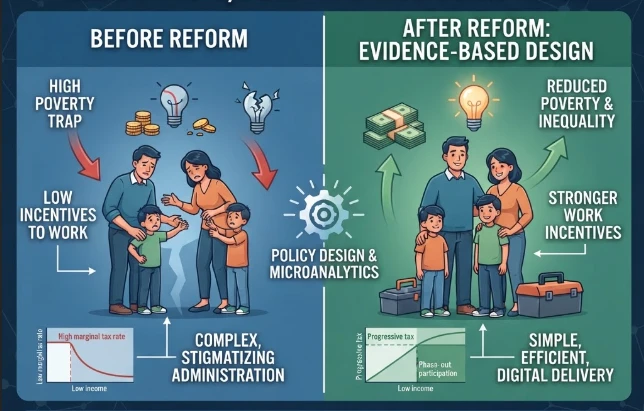
This article uses institutional economics and applied microeconomics to show why tax-transfer reform cannot be evaluated from policy rules alone. Household disposable income reflects earnings, taxes, contributions, benefits, housing support and withdrawal schedules, but the effectiveness of those rules also depends on institutions that administer them. Different data systems, delayed appeals, inconsistent local delivery and administrative capacity can cause a theoretically efficient policy to wo
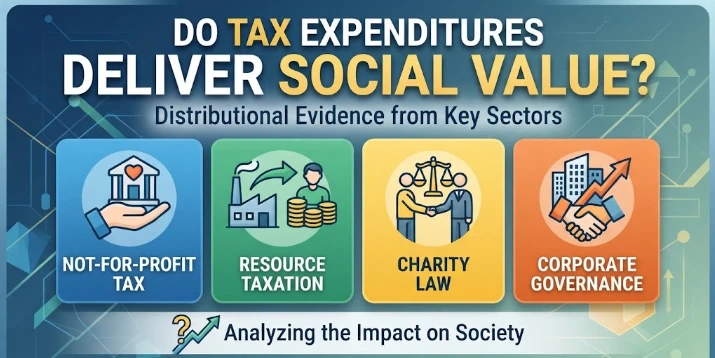
This article evaluates tax expenditures in not-for-profit, charity and resource-tax settings through distribution, governance and public value. Preferential treatment for charities and similar organisations is justified by public or community benefit, so reporting and governance should show whether concessions expand valued services, improve access or instead accumulate as private or organisational advantage. The article warns that annual income alone is an incomplete equity measure because life
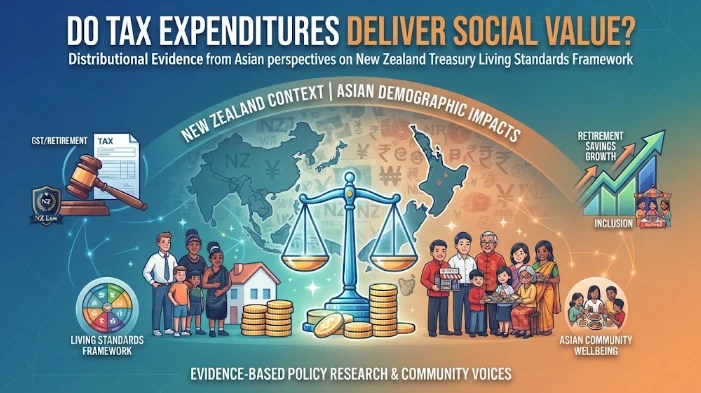
This article evaluates tax expenditures through a broader wellbeing and distributional framework, drawing on New Zealand’s Living Standards Framework, GST and retirement policy. It argues that fiscal analysis should not stop at annual income, revenue or GDP because concessions can affect consumption, saving, retirement security, housing, work, culture and resilience across generations. Distribution should therefore be examined by age, income, wealth and long-term wellbeing. Consumption taxes ill