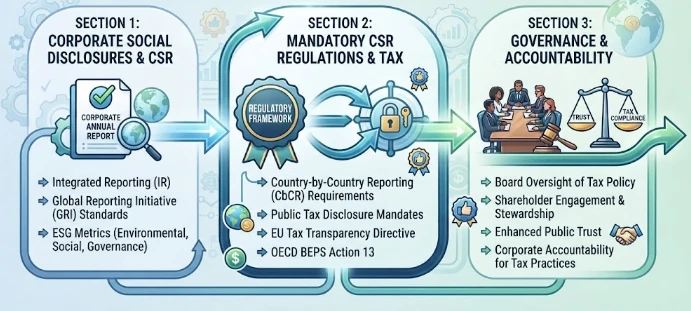
This article examines tax transparency as corporate social responsibility in an environment of mandatory sustainability reporting. It argues that tax strategy should be interpreted alongside governance, public support, stakeholder impact and corporate disclosures rather than reduced to a single effective-tax-rate figure. The discussion highlights the Corporate Sustainability Reporting Directive and European Sustainability Reporting Standards as part of the shift from voluntary sustainability narratives toward regulated information systems connected to materiality, controls, board responsibility and assurance. IFRS S1 and IFRS S2 provide a related framework focused on governance, strategy, risk management, metrics and targets. The article stresses that mandatory disclosure alone does not guarantee useful information: unstable definitions, changing boundaries and generic commitments can create volume without accountability. Boards and audit committees therefore need clear responsibilities for tax risk, data quality, internal controls and escalation of uncertainty. Social licence and inclusive-capitalism perspectives add the question of how taxes, wages, suppliers, investment, dividends and community impacts distribute value. Credible transparency requires consistent financial, tax and sustainability narratives that can be tested against underlying records and real corporate behaviour.
Tax transparency has stepped up from the simple question of whether or not a company submits a return on time. Investors, employees, customers, governments and communities increasingly look at tax strategy in the context of corporate governance, sustainability claims, public support and the economic impact of a company. A clear view is provided of the statutory requirements, and the impact of these on the effective tax position, incentives, losses and cross-border arrangements is explained without a single headline tax ratio. The context is central to the corporate social responsibility because tax is an important contributor to commercial activity depending institutions and infrastructures.
Sustainability reporting is a transformation of corporate social responsibility as it becomes both legally mandated and legally connected to governance and assurance systems and becomes non-voluntary. European Sustainability Reporting Standards were adopted in 2023 and come into force on 1 January 2024, and the Corporate Sustainability Reporting Directive (CSRD) was adopted in 2022 and will be effective from 1 January 2024. The first wave of reporting was for the 2024 fiscal year and for reporting in 2025. That transition put data controls, materiality assessment, board responsibilities and sustainability claims uniformity in corporate reporting into focus.
Social licence refers to the reputational acceptance in addition to legal authorization. Trust from communities and regulators and contractual rights are often essential for companies in resource, infrastructure, finance and digital industries. Good tax transparency does not have to include all of the details of the tax system, but it does need to provide enough information to demonstrate that compliance with the law does not conflict with public statements of social obligations.
Capitalism is inclusive and the emphasis of governance is on distributing value creation. The various ways in which corporate activity impacts stakeholders are through wages, supplier payments, taxes, investment, dividends, and community impacts. Selective metrics can obscure trade-offs, but ESG reporting can shed light on those channels. Tax transparency introduces a tangible fiscal element by revealing the fiscal aspects of contributions and incentives around different jurisdictions. Ideally, a disclosure that is tailored to provide a strong message will neither boast of tax figures nor present easy-to-understand effective rate comparisons, but rather give a clear explanation of material drivers that can be easily evaluated in light of the disclosure.
The reality of transparency is driven by corporate governance, which can either be a sign of effective monitoring or a smarmy facade. Boards should have clear responsibilities for tax risk, clarity on escalation processes for ambiguity, and information that links tax planning to strategy and reputation. Audit committees can determine if disclosures are consistent with accounting records, and if aggressive structures present risks that are not consistent with disclosures. Good governance also distinguishes credible use of incentives from opaque, artificial separation or assumptions that are not likely to be supported by regulators.
Sustainability reporting offers a more comprehensive information structure. The IFRS Sustainability Reporting Standards (S1 and S2) 2023 focus on sustainability-related financial information through four elements: governance, strategy, risk management, metrics and targets, and the IFRS climate standard separates physical and transition risks. These standards are about information that is relevant to enterprise prospects, rather than all social impacts. Tax transparency can work alongside that approach by providing an illustration of the interactions between public incentives, geographic profit patterns and tax governance and the sustainability strategy communicated to capital providers.
Even with mandatory rules, there are not useful information. Complex disclosure can generate volume without clarity, when definitions of metrics are not stable, boundaries are moving or when sections of the narrative repeat generic commitments. So much so that governance is as important as the reporting template. Boards and audit committees should have clear accountabilities for information systems, internal controls, escalation of poor data and readiness for assurance, with management incentives tied to published targets rather than short-term presentation targets.
The opportunity and risk of corporate communication. Effective tax rates vary from statutory tax rates; losses and timing differences influence current tax; incentives encourage investment. When there is no concrete data, the words "responsible tax" can have the opposite effect. Readers should have sufficient information to identify structural features from discretionary planning. So, it is more convincing than any single statement when there is consistency in annual reports, sustainability reports, country disclosures, investor presentations, and regulatory filings.
Because impact investing takes it further, money is invested with a clear purpose of achieving measurable social or environmental impact on top of financial returns. The use of a SDG label is no longer a proof in itself, but objective, indicators, baselines, contribution and risk of shortfall are becoming a part of the focus of impact frameworks. This is also a tax context, given that the subsidies, exemptions and credits can affect reported returns. Market performance should be distinguished from value added as a result of public fiscal support, in a transparent manner.
There is a similar challenge for social enterprises. Ordinary profit statistics are not necessarily adequate measures of performance because hybrid missions can involve trading revenue, grants, concessionary capital and tax preferences. Social-impact reporting can help to explain the target population, the changes, and how results are measured—however, baselines and boundaries must be credible. When these three sources give a consistent picture of a public-benefit claim, that claim has more substance. If there is any record divergence, it should be explained, not added to the branding.
The SDGs offer a shared language, however, vague alignment with several of the SDGs can render the meaning and intent of the goals hollow. In better practice, specific targets are identified and measurable indicators are found and the mechanism linking activity to outcome is identified. Tax transparency is a subpart of that area, which is public resources with opportunity costs. A concession-holding company could report the number of jobs or investments created through the concession, and governments can report their revenue lost, and what policy they are supporting.
Tax transparency naturally belongs into that accountability system since tax is linked to corporate activity, and therefore public finance. How a company engages with the societies that provide infrastructure, education, regulation and markets may be understood through the prism of effective tax rates, incentives, geographic profit patterns, disputes and tax governance. Responsible disclosure does not mandate disclosure of all private tax information. It involves sufficient stable data to determine if CSR language, business substance, tax strategy and governance reinforce each other.
Sustainability and corporate responsibility find other ways to connect with public funds in public procurement. OECD evidence indicates that procurement accounts for significant parts of economic activity in OECD economies and has the potential to shape the environmental performance, labour standards, integrity and innovation of economies. Sustainability clauses can incentivize responsible suppliers but poorly formulated criteria can lead to a decrease in competition or to a ‘tick the box’ situation. To make the ESG language create change in the delivery, it is necessary to have transparent tender criteria, verifiable evidence and monitoring of the contract.
The contractual complexity of PPs is further added to the long term dimension. Infrastructure contracts can be for decades with all of the elements of construction, financing, service, guarantees, and risk transfer. Sustainability criteria must therefore be integrated into measurable performance criteria and not simply as aspirations. Contingent liabilities, tax assumptions, procurement decisions, and performance indicators are disclosed, providing an account of the business. If not, a project might look cheap when a contract is signed, and shift significant future risk to the public balance sheet.
The workplace is an illustration of the importance of having to interpret social disclosure. Just by the numbers, there's not much to be learned about recruitment, promotion, pay, retention, safety or leadership access. Reliable reporting links representation with employment outcomes and governance procedures whilst safeguarding legitimate privacy rights. Job creation or quality-of-job incentives should also be subject to the same analysis as they do not demonstrate new jobs or improved job quality. When workforce claims are tied to measurable results and the monetary resources that go into them are made apparent, corporate responsibility looks more credible.
Transparency is therefore credible when it is comparable, assured and consequential. The definitions of metrics must be stable, reported boundaries must be explained, and significant changes in reported boundaries must be reconciled over time. Independent assurance can have a positive impact on confidence, but the role of governance is paramount as assurance is not a cure-all for a misleading strategy narrative. There must also be reporting systems to enable public agencies to compare tax expenditures, procurement commitments and corporate disclosures whenever possible. Transparency generates public value when information affects decision-making, brings to light inconsistencies, enables accountability, does not just fill the published record, and is transparent.
CITE THIS ARTICLE
Sultana, K. R. (2025). Tax Transparency as Corporate Social Responsibility: Evidence from Mandatory CSR regulations, corporate social disclosures, governance/accountability. https://researchbysultana.com/article/9e0a9ea3-7b41-536d-9a6c-8df6d44062c5
K. R. Sultana, “Tax Transparency as Corporate Social Responsibility: Evidence from Mandatory CSR regulations, corporate social disclosures, governance/accountability,” 2025. [Online]. Available: https://researchbysultana.com/article/9e0a9ea3-7b41-536d-9a6c-8df6d44062c5
Sultana, K. R. (2025) ‘Tax Transparency as Corporate Social Responsibility: Evidence from Mandatory CSR regulations, corporate social disclosures, governance/accountability’. Available at: https://researchbysultana.com/article/9e0a9ea3-7b41-536d-9a6c-8df6d44062c5
Sultana, Kazi Rukaiya. “Tax Transparency as Corporate Social Responsibility: Evidence from Mandatory CSR regulations, corporate social disclosures, governance/accountability.” 2025, https://researchbysultana.com/article/9e0a9ea3-7b41-536d-9a6c-8df6d44062c5.
Kazi Rukaiya Sultana. “Tax Transparency as Corporate Social Responsibility: Evidence from Mandatory CSR regulations, corporate social disclosures, governance/accountability.” (2025). https://researchbysultana.com/article/9e0a9ea3-7b41-536d-9a6c-8df6d44062c5.
Sultana KR. Tax Transparency as Corporate Social Responsibility: Evidence from Mandatory CSR regulations, corporate social disclosures, governance/accountability. 2025. https://researchbysultana.com/article/9e0a9ea3-7b41-536d-9a6c-8df6d44062c5
@misc{article_9e0a9ea37b41536d9a6c8df6d44062c5,
  title = {Tax Transparency as Corporate Social Responsibility: Evidence from Mandatory CSR regulations, corporate social disclosures, governance/accountability},
  author = {Kazi Rukaiya Sultana},
  year = {2025},
  url = {https://researchbysultana.com/article/9e0a9ea3-7b41-536d-9a6c-8df6d44062c5},
}
TY  - GEN
AU  - Kazi Rukaiya Sultana
TI  - Tax Transparency as Corporate Social Responsibility: Evidence from Mandatory CSR regulations, corporate social disclosures, governance/accountability
PY  - 2025-04-20
UR  - https://researchbysultana.com/article/9e0a9ea3-7b41-536d-9a6c-8df6d44062c5
ER  -
This article uses institutional economics and applied microeconomics to show why tax-transfer reform cannot be evaluated from policy rules alone. Household disposable income reflects earnings, taxes, contributions, benefits, housing support and withdrawal schedules, but the effectiveness of those rules also depends on institutions that administer them. Different data systems, delayed appeals, inconsistent local delivery and administrative capacity can cause a theoretically efficient policy to wo
This article presents tax transparency as a governance and accounting issue rather than a simple disclosure exercise. Boards oversee tax outcomes that are influenced by risk appetite, capital allocation, internal controls, remuneration and significant transactions, while accounting systems provide the common record connecting financial profit, taxable income, deferred tax, cash tax and uncertain positions. IFRS S1 and IFRS S2 are used to show how sustainability-related financial information can
This article evaluates tax expenditures in not-for-profit, charity and resource-tax settings through distribution, governance and public value. Preferential treatment for charities and similar organisations is justified by public or community benefit, so reporting and governance should show whether concessions expand valued services, improve access or instead accumulate as private or organisational advantage. The article warns that annual income alone is an incomplete equity measure because life