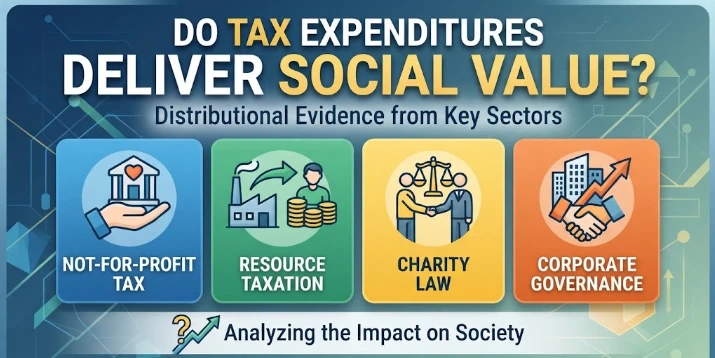
Tax expenditures are easy to ignore because tax dollars are never cashed in at a ministry. A deduction, exemption, credit, reduced rate, deferral or special allowance may also have the same fiscal impact as spending – that is, the government collects less money to encourage a specific activity or group of people. This so called "hidden quality" makes tax expenditures very appealing and very hard to attack. These can lead to social value provision. The more difficult question is whether benefits are delivered to target households, influence behavior, and are worth the loss of revenue to government versus direct transfer payments.
The first one is the definition. Tax expenditure is a term used compared to a normal tax system and estimates of tax expenditures can differ based on what is considered a normal tax system. Immediately after setting the benchmark, governments can estimate how much they will lose in revenues due to giving special favors.
Those estimates are not necessarily the same as the revenue which would be collected if the concession were to be eliminated - taxpayers can change their behaviour. Nevertheless, tax-expenditure reports are a useful stepping-stone. Transparency is the key to enabling legislators and the public to compare fiscal concessions with traditional spending programmes which are subjected to the annual budget.
The following issue is distribution. A deduction based on taxable income can provide a greater absolute benefit to a higher income taxpayer, particularly if the tax rate is graduated. A non-refundable credit is unlikely to offer much short-term assistance to low-income households.
Treatment over time that does not qualify as a concession could result in significant gains for groups of people who own assets. Thus a policy may be "social" and at the same time have most of the fiscal value attributed to it going up. To demonstrate the beneficiaries of the action, incidence analysis is required.
An example of this is the consumption-tax concession. Discounts or exemptions for necessities are frequently considered to be "for the poor" because essentials take up more of limited budgets. However, if the higher income groups can spend a lot more in absolute terms, they can benefit from a generous concession. When administrative systems are effective, a targeted cash transfer can provide support more effectively. It's not about a lower tax rate versus no assistance, it's about how the same tax dollars can be spent differently.
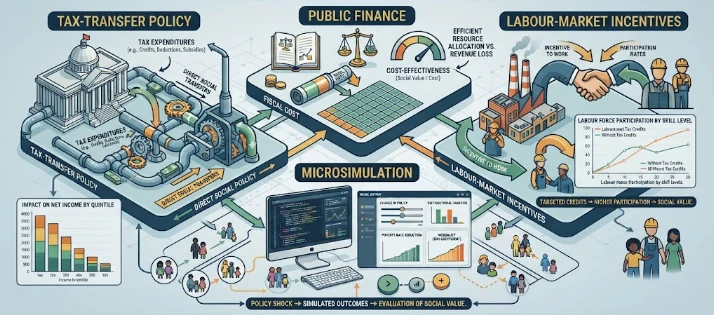
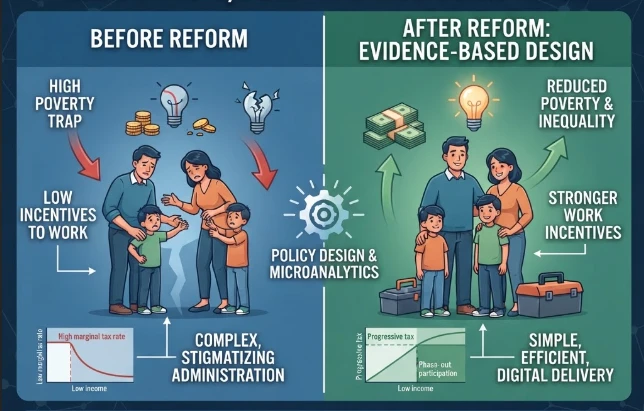
Labour-market incentives are another cause of tax expenditures. Financial benefits of entering into employment and staying in the labour market can be boosted through in-work credits and earnings-related tax relief. This is why these tools are important, as illustrated by the OECD tax-benefit analysis: additional earnings can result in high effective marginal tax rates and lower marginal benefit rates. A well-designed credit can help break a participation trap, particularly one that affects low-income individuals or families with child care expenses. The benefit must be phased out so that there is not a disincentive to work for longer hours.
Evaluating these effects is one of the strongest aspects of microsimulation. A microsimulation model with taxes and benefits incorporates policy rules onto the individual household level and calculates how much income individuals will have after taxes and benefits, given a particular policy. Analysts can look at effects by income decile, family type, employment, age or region. A model can illustrate whether a tax credit is likely to decrease poverty, the proportion of the cost at the bottom of the poverty distribution, and the change in the effective top and bottom marginal rates. This is more beneficial than a concession's face value.
The interactions between these are also identified in microsimulation that don't always make it into the policy documents. Introducing a new tax credit may lead to a reduction in one other means tested benefit and consequently a reduction in the level of disposable income. The deduction could change the taxable income and eligibility for a separate programme. It is possible that a payroll-tax cut might impact employers' costs but not necessarily give workers a corresponding increase in their take-home pay. Modelling the entire tax-transfer system helps to avoid the appearance of being generous in isolation, while also generating a significantly lower net gain after other rules react.
There are still some restrictions on static models. Behavior can be altered if incentives are altered. Employees can adjust working hours, employers can restructure pay scales, fund managers can reorganize their holdings, and citizens can group income for tax purposes.Employees can change working hours, employers can adjust pay structures, investors can rearrange holdings, and citizens can classify income for tax purposes.
Some of these responses can be estimated using extensions, such as dynamic extensions, but there is uncertainty. Hence sensitivity analysis plays an important role. A credible evaluation indicates outcomes based on various behavioral scenarios, not as definitive truth.
Another test is public finance. All tax expenditures represent a lost benefit. For every concession sacrificed, there is no other tax reduction, cash transfer, hospital, school, transport or housing programme or debt reduction.
Social value is thus a comparative value, relating to the next best alternative use of public funds. This is because a modest transfer to a large middle income group can be accepted by the electorate while a smaller transfer to a targeted group can result in greater impoverishment per dollar. That should be reflected in budget processes.
The administrative cost is also a factor. Tax expenditures can leverage existing filing processes and do not require the establishment of a new spending agency, thus facilitating efficient delivery. With the availability of income data, automatic tax credits can be distributed to large populations at low transaction cost.
That can be turned upside down by complexity. Specific eligibility requirements, special forms, valuation rules and documentation requirements can increase the cost for the taxpayers and administrations. Provisions needing specialist advice can also create an access problem, in favour of the more well-resourced households and firms.
Another important measure is take-up. For the eligible household that doesn't claim an entitlement, there is no distributional effect. Poor awareness and confusing rules, stigma, digital barriers and the low perceived value of a benefit compared to the effort of applying are all causes for not taking up. These may be minimized by the use of refundable credits that are automatically issued or filled out. It needs to then be evaluated in relation to who is actually receiving and who should be receiving, particularly in relation to lower income and marginalised groups.
There is a need for an alternative additionality analysis in the case of business tax incentives. The current approaches to incentivising economically valuable activity, such as accelerated depreciation, investment allowances, research credits and location incentives, can achieve this. Some subsidised projects would continue without any incentive. High take up does not equal successful. There is a need for supporting evidence for further investments, jobs, productivity, innovation, spillovers and geographic impacts. Governments must also consider whether certain income-based incentives carry the same meaning or whether they are just top-up tax elsewhere, under global minimum-tax arrangements for large multinational groups.
Using sunset clauses may help to create accountability by requiring a re-evaluation at periodic intervals. Fiscal costs of tax expenditures are spread throughout the budget, while the benefits of the tax expenditure are concentrated among the beneficiaries. Review can ask: have objectives become outmoded, can objectives be achieved using better instruments and has distribution changed? Estimating the cost of your child's care and showing the beneficiaries also gives greater scope for review. Tax expenditures ought not to be treated more lightly simply because they are contained in the revenue legislation instead of the spending bill.
Horizontal effects must be considered in terms of equity. Two families with the same financial means may have different tax liabilities due to the fact that one family may be able to take advantage of a concession, while the other may not. Eligibility may be based on homeownership, job type or employer-provided benefits, or saving ability. Such an effect of preferential treatment may therefore have some effects that seem random in terms of capacity-to-pay. A change from neutral treatment requires a sound justification for the change that is robust enough.
The best measure of tax expenditures is evidence of net social value by 03-05-2026. A realistic provision will be one that addresses a legitimate problem, reaches the intended population, fosters behaviour in a useful direction, minimizes the windfall gains, maintains administrative burden at a proportionate level and is more effective than realistic alternatives. Distribution and work incentives can be tested using microsimulation, additionality and longer-term outcomes using programme evaluation.
The framework is completed with transparent costing and regular review. Tax expenditures are not a hidden subsidy, nor are they automatically winners. They are public interventions, and should be treated as such, including in terms of distributional and fiscal responsibility and performance assessment, like direct government spending.