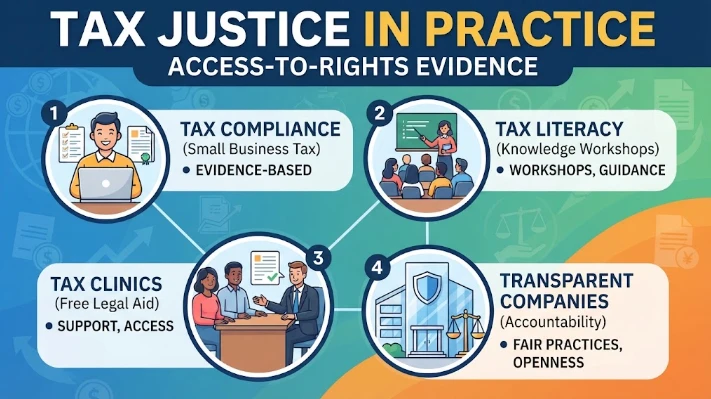
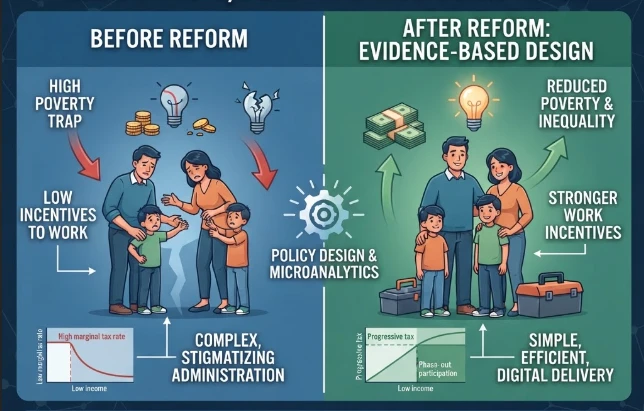
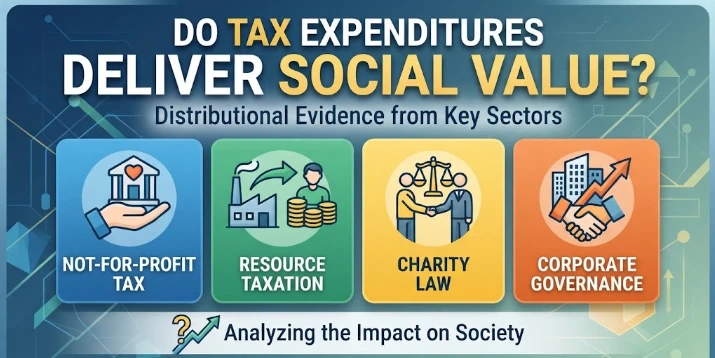
The article links tax justice with compliance, tax literacy, tax clinics, corporate transparency and the practical difficulties faced by small businesses. Access to rights requires more than formal legal equality: taxpayers must understand obligations, obtain records, communicate with authorities, challenge assessments and secure review without excessive cost. Tax clinics provide a direct response for individuals and small firms that cannot easily obtain professional advice, while recurring cases can reveal confusing rules, digital barriers or systemic administrative problems. Tax literacy can prevent avoidable penalties and debt, but the article warns that education should not substitute for simpler law. Procedural fairness also matters because clear reasons, credible review and respectful communication can strengthen voluntary compliance. Gender budgeting and public-finance analysis broaden the assessment of who benefits from concessions and who bears tax burdens. Corporate reporting and governance influence the visibility of tax risk and aggressive strategies. Small businesses face cumulative burdens from GST, payroll, deductions, records and entity choices. The article supports proportionate enforcement, accessible guidance and routine measurement of complaints, digital exclusion, debt persistence and recurring errors.
Tax justice is first concerned with procedure, and is often talked about in terms of rates and redistribution. A taxpayer must have an understanding of an obligation, access to records, contact with an authority, an opportunity to challenge an assessment, and an opportunity to review all without undue burden. Formal equality can become real inequality with the increasing necessity for professional advice for basic participation in the case of complex law. The question of access-to-rights thus concerns whether the safeguards included in tax law are effective for ordinary individuals and for small entities.
Normalizing the reporting of tax positions, governance, and obligations can help make tax literacy more transparent; and can be a benefit for transparent companies. While small businesses do not typically have a reporting team that has the same size, public guidance and clinic support are particularly significant. A clinic can be a good solution to an immediate problem with filing and/or debt, and can also reveal a pattern that may point to overall reform. Confusion, which is repeated on the same rule, is evidence about the design of the rule, not just about taxpayer capacity.
The gap is being addressed by tax clinics. The National Tax Clinic program, funded by the Government of Australia, offers free tax clinic services for people and small business who require assistance with tax matters. Clinics also provide learning opportunities for supervised students, and evidence of ongoing administrative challenges. This is because, in individual cases, systemic barriers to the use of legal notices can be found, such as debt, record keeping, registration, family situations, access to the internet or ignorance of legal notices.
Tax literacy is the second layer of 'justice'. Avoidable debt and penalties can be avoided with knowledge of filing dates, deductible expenses, business registration, instalments and the rights to review. Don't use literacy to replace simple law because even knowledgeable taxpayers have a hard time figuring out the multiple definitions and exceptions in a rule. Effective systems include clear instructions and appropriate responsibilities, as well as readily available professional or community resources.
Voluntary compliance is also influenced by procedural fairness. When there are clear reasons, the evidence is taken into account, there are effective review systems and communication is respectful, then people will be more likely to accept an adverse outcome. The fear of an audit is thus not the only way of looking at behavioural tax research. Enforcement is not a replacement for trust, but it can be more legitimate and less about resources or connections through consistency of process.
Formal neutrality of the rules can have different consequences for labour-market and household patterns, as the gender budgeting lens broadens the tax-justice lens. Incidence can be influenced by the differences in paid work, unpaid care, retirement saving, property ownership and consumption. A budget can thus be distributionally unequal and not have a gender component. Gender-aware analysis includes who benefits from concessions, who pays consumption taxes, who is eligible for credits, and how policy affects siblings and lifetime earnings.
The fairness of public finance comes into play through the spending side. The question of who pays is only part of the equation of Tax justice as revenue is used to provide for health, education, infrastructure, income support, security, and administration. Fiscal incidence analysis connects taxes and benefits to show the overall impact on household resources. This way, one-sided statements that a tax is right or wrong or fair or unfair are avoided, because they do not take into account the services and transfers provided by the tax structure.
Compliance education is most effective when tied to decision points. Errors can be avoided and a targeted support can be provided throughout the registration process, at first employment, at the thresholds for GST, when the business closes and when debt notices are given. While generic education campaigns are good, timing and relevance has an impact on how information affects behaviour. Digital prompts are helpful, if offline pathways are available for those who have access barriers.
Disclosure and governance is an area of overlap between company law and securities regulation and tax justice. The information that can be seen by the boards, investors, auditors, regulators and tax authorities is controlled by the corporate reporting process. There may be a need for related party transactions, executive incentives, provisions, deferred tax, and uncertain tax positions to be considered for risk assessment. Aggressive tax planning does not mean there's no good governance, it merely means that clear duties and effective oversight make it more difficult for tax planning to go undetected.
Businesses with fewer than 100 employees have a unique problem with access as legal requirements may be similar to larger companies but may lack the internal experience of those companies. The cumulative burden can come from GST registration, payroll, deductions, record keeping and entity selection. Tax clinics and readily available guidance can prevent minor issues from developing into a long-standing debt. The long run answer is that support services shouldn't be permanent compensation for an avoidable level of complexity, and so simplification is the better answer.
Another side to access and distribution is exposed in the retirement policy. The fiscal value of tax concessions for superannuation or retirement saving products can also be highly sensitive to contribution capacity, tax rates and account balances, and thus should be used to promote long-term income security. Deductions that depend on current contributions may help lower income workers to a limited extent. Refundable offsets, caps on contributions, preservation rules, age, housing costs and interaction with public pensions are therefore taken into account in fair design.
The principle of certainty also has implications for advanced tax matters: certainty should not apply only to those that can afford to get tax law interpreted by a specialist. Access should be wide, and reasoning consistent, to minimise uncertainty through private rulings, public guidance, safe harbours, published administrative positions. Too much discretion can create risk as similar facts can result in different outcomes. Transparent interpretation is therefore at the same time a justice mechanism and an administrative efficiency tool.
The enforcement has to continue to be proportionate. Effective measures to combat intentional underreporting benefit honest taxpayers and the tax base, but the use of enforcement mechanisms can have serious repercussions if it's imposed on those in real need or those who have some misinterpretation. Debt collection, penalties, garnishment, and litigation must be protected, reviewed and have clear escalation guidelines. A system of rights is not monochromatic, but rather it is able to distinguish between inability, mistake, avoidance and fraud.
Access indicators placed next to revenue indicators lend credibility to the reform. Administrations can monitor complaint resolving, examine results, processing time, debt staying, digital exclusion, clinic referrals, and reoccurring error types. This data can show if the law changes helps to lower friction or move it elsewhere. Tax justice can thus be quantified as a function of institutions – it can be manifested in the normal functioning of institutions, not just in abstract arguments concerning rates.
The practical criterion is equal ability to engage in the tax system. In order to meet that standard, the rules must be comprehensible, the support must be accessible, the decisions must be clear, the review must be effective, and the analysis of the consequences of the reform must be distributional. Collecting revenue is important as public services rely on it, but the legitimacy of collection increases if rights can be put into practice. A tax system has the confidence of those who pay when it is not too complicated, too intrusive, or too rigid in the application of the tax and the method of collecting it.
The distinction is important because, following some adjustment to the household or firm, the legal form and economic incidence may differ. Another protection is to state assumptions explicitly in such a way that the central result can be repeated or disputed by independent analysts. This is also even strengthened when distribution, administration, and behaviour are looked at as a whole, rather than having separate reports. If evaluation criteria are determined prior to beneficiaries and administrators adjusting to a permanent policy, then that policy is more likely to be durable.
The test comes down to whether or not a reform can still be defended following the placement of fiscal cost, distribution, complexity and uncertainty on the same level. Good design, then, does not only involve communicating a policy with transparency, but making transparency an element of policy architecture. One benefit of this is that any hidden trade-offs will become apparent prior to thresholds, exemptions, or enforcement settings becoming routine practice. The deeper thought is that the fiscal design should be challenged through experiments in real behaviour, not beliefs based on what is written in the statute books.
That is important because legal and economic incidence may differ, depending on the response of households and firms. One should go one step farther and make the assumptions explicit to allow another analyst to replicate or examine the central finding. The strength of the evidence is enhanced when you consider distribution, administration and behaviour together, not in separate reports. The more durable the policy, the more time spent on reaching consensus in advance of beneficiaries and administrators adapting around the policy.
CITE THIS ARTICLE
Sultana, K. R. (2026). Tax Justice in Practice: Access-to-Rights Evidence from Tax compliance, tax literacy, tax clinics, transparent companies, small-business tax. https://researchbysultana.com/article/e05d5337-013c-54fe-a9c1-a70e37f5a10e
K. R. Sultana, “Tax Justice in Practice: Access-to-Rights Evidence from Tax compliance, tax literacy, tax clinics, transparent companies, small-business tax,” 2026. [Online]. Available: https://researchbysultana.com/article/e05d5337-013c-54fe-a9c1-a70e37f5a10e
Sultana, K. R. (2026) ‘Tax Justice in Practice: Access-to-Rights Evidence from Tax compliance, tax literacy, tax clinics, transparent companies, small-business tax’. Available at: https://researchbysultana.com/article/e05d5337-013c-54fe-a9c1-a70e37f5a10e
Sultana, Kazi Rukaiya. “Tax Justice in Practice: Access-to-Rights Evidence from Tax compliance, tax literacy, tax clinics, transparent companies, small-business tax.” 2026, https://researchbysultana.com/article/e05d5337-013c-54fe-a9c1-a70e37f5a10e.
Kazi Rukaiya Sultana. “Tax Justice in Practice: Access-to-Rights Evidence from Tax compliance, tax literacy, tax clinics, transparent companies, small-business tax.” (2026). https://researchbysultana.com/article/e05d5337-013c-54fe-a9c1-a70e37f5a10e.
Sultana KR. Tax Justice in Practice: Access-to-Rights Evidence from Tax compliance, tax literacy, tax clinics, transparent companies, small-business tax. 2026. https://researchbysultana.com/article/e05d5337-013c-54fe-a9c1-a70e37f5a10e
@misc{article_e05d5337013c54fea9c1a70e37f5a10e,
  title = {Tax Justice in Practice: Access-to-Rights Evidence from Tax compliance, tax literacy, tax clinics, transparent companies, small-business tax},
  author = {Kazi Rukaiya Sultana},
  year = {2026},
  url = {https://researchbysultana.com/article/e05d5337-013c-54fe-a9c1-a70e37f5a10e},
}
TY  - GEN
AU  - Kazi Rukaiya Sultana
TI  - Tax Justice in Practice: Access-to-Rights Evidence from Tax compliance, tax literacy, tax clinics, transparent companies, small-business tax
PY  - 2026-01-07
UR  - https://researchbysultana.com/article/e05d5337-013c-54fe-a9c1-a70e37f5a10e
ER  -
This article uses institutional economics and applied microeconomics to show why tax-transfer reform cannot be evaluated from policy rules alone. Household disposable income reflects earnings, taxes, contributions, benefits, housing support and withdrawal schedules, but the effectiveness of those rules also depends on institutions that administer them. Different data systems, delayed appeals, inconsistent local delivery and administrative capacity can cause a theoretically efficient policy to wo
This article presents tax transparency as a governance and accounting issue rather than a simple disclosure exercise. Boards oversee tax outcomes that are influenced by risk appetite, capital allocation, internal controls, remuneration and significant transactions, while accounting systems provide the common record connecting financial profit, taxable income, deferred tax, cash tax and uncertain positions. IFRS S1 and IFRS S2 are used to show how sustainability-related financial information can
This article evaluates tax expenditures in not-for-profit, charity and resource-tax settings through distribution, governance and public value. Preferential treatment for charities and similar organisations is justified by public or community benefit, so reporting and governance should show whether concessions expand valued services, improve access or instead accumulate as private or organisational advantage. The article warns that annual income alone is an incomplete equity measure because life