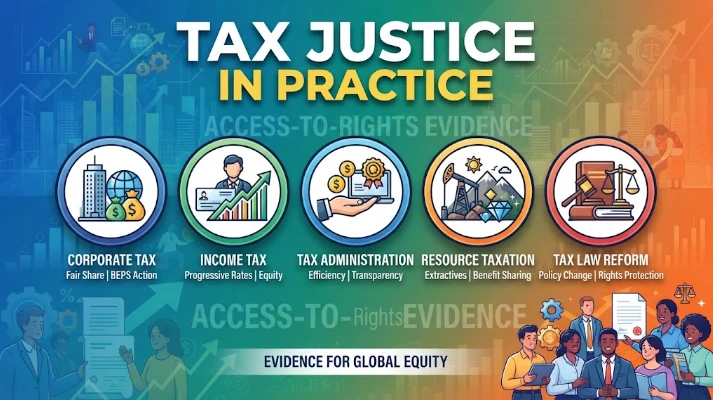
This article examines tax justice across corporate tax, income tax, resource taxation, tax administration and law reform. It begins with procedural access: taxpayers need to understand obligations, obtain records, communicate with authorities, challenge assessments and obtain review without disproportionate cost. Resource taxation adds a distinct public-value question because royalties, rent taxes, company income tax, deductions and project losses interact over long investment cycles. Fairness therefore depends not only on the headline corporate rate but also on economic rents, commodity prices, depletion, environmental responsibilities, public infrastructure and how investment risk is shared. The article also stresses tax literacy while warning that education cannot substitute for clear law. Small businesses and ordinary taxpayers need understandable guidance, affordable support and practical review mechanisms. Advanced tax issues raise a rule-of-law concern when certainty is effectively available only to those who can pay for specialist interpretation. Proportional enforcement should distinguish inability, mistake, avoidance and fraud. The article supports law reform that combines distributional analysis, transparent administration, accessible rights and evidence about whether fiscal rules deliver a fair public return.
When talking about tax justice one usually talks about rates and redistribution, but access to rights starts with procedure. The requirements for a taxpayer to grasp the obligation, get records, communicate with any authority, contest an assessment, and get it reviewed must not be disproportionately costly or otherwise impose an undue burden. When professional advice is needed to participate in basic activities, formal equality can become practical inequality and lead to a complex law. Access-to-rights analysis thus involves asking if ordinary citizens and small businesses can access the rights that are embodied in the tax law.
Resource taxation examines the link between public ownership and corporate tax and economic rent. Over long investment cycles, royalties, rent taxes, company income tax, deductions, and project losses can interplay. Reform must maintain signals of investment and ensure there is a fair public return from limited resources. Tax justice in this context is not just reflected in the company tax rate; factors such as the distribution of risk, commodity prices, depletion, environmental responsibilities, and public infrastructure are also considered.
Tax knowledge is the second level of justice. Understanding of filing dates, deductible expenses, business registration and instalments and review rights can help avoid unnecessary debt and penalties. Don't take literacy for granted, because even the most informed taxpaying patrons find it difficult to follow the rules with multiple definitions and exceptions. Effective systems have clear instructions and are fair in terms of the demands placed on them, and provide professional or community-based support that can be easily accessed.
Voluntary compliance is also influenced by procedural fairness. However, when reasons are clear, evidence is taken into account, there are effective review mechanisms and communication is respectful, people are more willing to accept an adverse outcome. Behavioural tax research has shifted, therefore, from the fear-of-audit model. While trust can't be a substitute for enforcement, consistency in the process can make enforcement more legitimate, and minimize the perception of results being determined by resources or connections.
Gender budgeting extends the tax-justice lens, as there can be differential impacts of what is formally neutral. Incidence can be influenced by disparities in working life, unpaid care giving, saving for retirement, housing ownership, and consumption. A sexed budget is not the only way to achieve a distributionally fair budget. Gender-aware analysis questions who benefits from the concessions, who pays consumption taxes, who is eligible for policy credits, and how policy affects caregiving and lifetime earnings.
Financing enters the fairness equation as it comes from public funds. Tax justice cannot be viewed just in terms of "who pays," as it is financed by revenue.Tax justice can be seen only in terms of "who pays," since revenue funds health, education, infrastructure, income support, security, and administration. Fiscal-incidence analysis relates taxes and benefits to show a net impact on household resources. This also helps to avoid the simplistic notions that a particular tax is fair or unfair without taking into account the services and transfers provided by the tax system.
The convergence of company law and securities regulation and tax justice is at the point of disclosure and governance. The information boards, investors, auditors, regulators and the tax authorities can observe is determined by corporate reporting. For risk assessment, related-party transactions, executive incentives, provisions, deferred tax and uncertain tax position may be relevant. Aggressive tax planning will not be eliminated by strong corporate governance, but responsibility will be made explicit and the oversight of the company is credible so that tax planning strategies will be more difficult to hide.
Where resource projects include cross-border ownership, complex financing, rehabilitation provisions and transfer pricing, the administration of taxes is the focal point. Without specialist audit capacity, there is the potential for significant uncertainty in practice when dealing with strong law. Guidance and access to data have improved, rules are coordinated and clear, and there are transparent dispute processes that boost legitimacy. Another reason for the need for transition rules is that if it is sudden, it can impact on investment already made based on prior expectations. Durable tax law entails a mix of base protection and procedural justice and credible long-term administration.
The access issue is unique for small companies as the obligations of the law may be similar to those for larger businesses, but without the expertise internally. Various factors such as registration for GST, accounting for payroll, payroll deductions, keeping records, and entity decisions can add up to overall burden. Simple issues can escalate into a debt that can be prevented by tax clinics and readily available advice. While it is important to recognize the complexities and offer support services to compensate, the better long-term option is to simplify.
Another dimension of access and distribution is revealed in the issue of retirement policy. Long-term income security can be helped by tax concessions for saving in superannuation or retirement saving but the fiscal value of these can be very different depending on the level of contribution, tax rates and account balances. Only limited benefit is offered to low-income earners through deductions which need to be paid now. Fair design thus takes into account refundable offsets, contribution ceilings, preservation rules, age, housing costs and the interaction between public pensions.
There is also a rule-of-law question to be raised concerning the advanced tax issues of certainty: certainty should only be present when the parties can afford to hire specialist interpretation. Uncertainty can be smoothed out through private rulings, public guidance, safe harbours and published administrative positions, but they must be broad and consistently reasoned. Risks of giving too much discretion arise from the potential variations in results from the same facts. Transparent interpretation is thus not only a justice mechanism, but also an administrative efficiency tool.
Enforcement should continue to be proportionate. Preventing tax cheats helps fair taxpayers and helps the revenues grow, but the use of pressure can have serious repercussions for those who are in a difficult or confusing situation. Debt collection, penalties, garnishment and litigation must be protected, examined, and have specific escalation criteria. A rights-based system categorises and separates inability, mistake, avoidance and fraud, rather than lumping them all into one moral category.
Access indicators placed next to revenue indicators lend credibility to reform. Administration can monitor the resolution of complaints, review results, processing time, debt resilience, digital exclusion, clinic referral and reoccurring types of error. This information can be helpful in determining if legal modifications actually alleviate friction or divert it. Tax justice is measurable in the day-to-day functioning of institutions, not just in terms of the rates set in legislation.
Tax clinics fill that need. Australia's National Tax Clinic program is government funded and provides tax advice to those who are eligible and small businesses requiring assistance with tax affairs. Clinics also provide opportunities to learn with supervised students and provide evidence of persistent administrative issues. That mix is significant because casework can uncover barriers to accessing the justice system, such as debt, record keeping, registration, family needs, access to technology, or lack of understanding of legal notices.
The practical standard shall be the same ability to engage in tax system. This standard calls for clear rules, reasonable support, clear decision making, effective evaluation, and distribution analysis prior to reform. While it is crucial to collect revenue for the public services, its legitimacy increases with the actual use of the rights to collect. A tax system is believed if it is complex, has enforcement authority and is subject to review at income and organizational levels.
Evidence that combines fiscal cost, fairness, behaviour and administrative burden in a single assessment is most informative, as it is in the same policy narrative. For long run credibility, thresholds, eligibility, and reporting rules need to be subject to review processes that can modify them as circumstances and technology evolve. The real question is then whether the instrument adds measurable value to the public, when compliance costs, distribution and opportunity costs are added. Transparent governance transforms that question into a process that can be repeated, rather than a one-off justification at the time of introduction.
This holistic perspective minimizes the likelihood of a sound rule yielding sub-optimal results after households, firms and administrators react to actual incentives. A more powerful analysis is to compare the incentives, administrative capacity and distributional impacts of the statute as it is implemented, not as it is labelled. The same view also enables uncertainty to be seen, aiding decisions where the behavioural response or implementation costs are not known with certain precision. Another protection is to publish assumptions, definitions and evaluation criteria prior to when a policy may become politically untenable.
Fiscal cost, fairness, behaviour and administrative burden should not be presented in isolation of one another, but in one fiscal assessment.
CITE THIS ARTICLE
Sultana, K. R. (2025). Tax Justice in Practice: Access-to-Rights Evidence from Corporate tax, income tax, tax administration, resource taxation, tax law reform. https://researchbysultana.com/article/6ff951df-c163-5674-8cc7-b2b408a0b4df
K. R. Sultana, “Tax Justice in Practice: Access-to-Rights Evidence from Corporate tax, income tax, tax administration, resource taxation, tax law reform,” 2025. [Online]. Available: https://researchbysultana.com/article/6ff951df-c163-5674-8cc7-b2b408a0b4df
Sultana, K. R. (2025) ‘Tax Justice in Practice: Access-to-Rights Evidence from Corporate tax, income tax, tax administration, resource taxation, tax law reform’. Available at: https://researchbysultana.com/article/6ff951df-c163-5674-8cc7-b2b408a0b4df
Sultana, Kazi Rukaiya. “Tax Justice in Practice: Access-to-Rights Evidence from Corporate tax, income tax, tax administration, resource taxation, tax law reform.” 2025, https://researchbysultana.com/article/6ff951df-c163-5674-8cc7-b2b408a0b4df.
Kazi Rukaiya Sultana. “Tax Justice in Practice: Access-to-Rights Evidence from Corporate tax, income tax, tax administration, resource taxation, tax law reform.” (2025). https://researchbysultana.com/article/6ff951df-c163-5674-8cc7-b2b408a0b4df.
Sultana KR. Tax Justice in Practice: Access-to-Rights Evidence from Corporate tax, income tax, tax administration, resource taxation, tax law reform. 2025. https://researchbysultana.com/article/6ff951df-c163-5674-8cc7-b2b408a0b4df
@misc{article_6ff951dfc16356748cc7b2b408a0b4df,
  title = {Tax Justice in Practice: Access-to-Rights Evidence from Corporate tax, income tax, tax administration, resource taxation, tax law reform},
  author = {Kazi Rukaiya Sultana},
  year = {2025},
  url = {https://researchbysultana.com/article/6ff951df-c163-5674-8cc7-b2b408a0b4df},
}
TY  - GEN
AU  - Kazi Rukaiya Sultana
TI  - Tax Justice in Practice: Access-to-Rights Evidence from Corporate tax, income tax, tax administration, resource taxation, tax law reform
PY  - 2025-07-06
UR  - https://researchbysultana.com/article/6ff951df-c163-5674-8cc7-b2b408a0b4df
ER  -
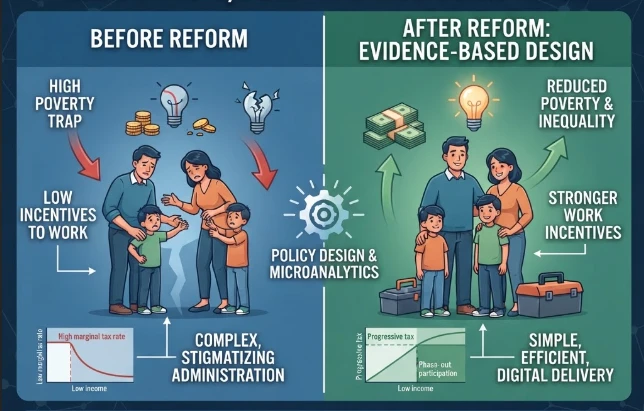
This article uses institutional economics and applied microeconomics to show why tax-transfer reform cannot be evaluated from policy rules alone. Household disposable income reflects earnings, taxes, contributions, benefits, housing support and withdrawal schedules, but the effectiveness of those rules also depends on institutions that administer them. Different data systems, delayed appeals, inconsistent local delivery and administrative capacity can cause a theoretically efficient policy to wo
This article presents tax transparency as a governance and accounting issue rather than a simple disclosure exercise. Boards oversee tax outcomes that are influenced by risk appetite, capital allocation, internal controls, remuneration and significant transactions, while accounting systems provide the common record connecting financial profit, taxable income, deferred tax, cash tax and uncertain positions. IFRS S1 and IFRS S2 are used to show how sustainability-related financial information can
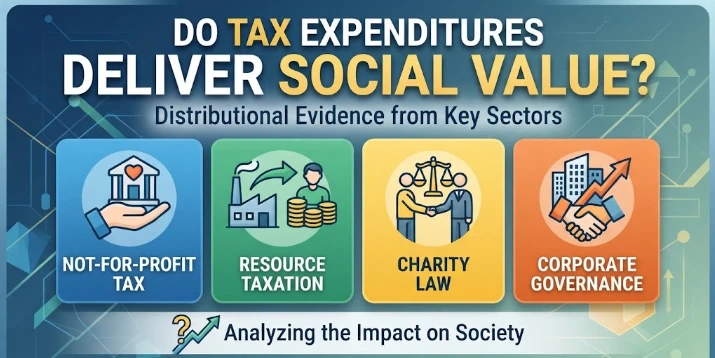
This article evaluates tax expenditures in not-for-profit, charity and resource-tax settings through distribution, governance and public value. Preferential treatment for charities and similar organisations is justified by public or community benefit, so reporting and governance should show whether concessions expand valued services, improve access or instead accumulate as private or organisational advantage. The article warns that annual income alone is an incomplete equity measure because life