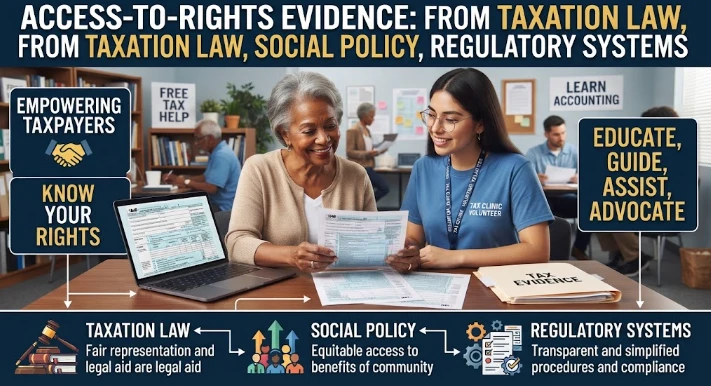
This article examines the relationship between tax law, social policy and regulatory systems, arguing that households experience these systems together even when governments administer them separately. Different definitions of income, reporting periods and eligibility rules can create uncertainty when taxes, social benefits, housing support, employment regulation and business obligations interact. Timing is especially important for workers with variable hours, bonuses, casual jobs or self-employment because annual tax calculations may not align with more frequent benefit assessments. The article discusses real-time data, benefit tapers, withholding, data sharing and automation as possible tools for coordination, while warning that faster systems do not automatically create fairer outcomes. Administrative burden, digital access, identity requirements and correction rights are treated as important policy results in their own right. Tax clinics and community services are presented as practical navigators across institutional boundaries. The article also stresses proportionality, privacy and human oversight in automated decisions. Overall, fiscal justice requires coordinated definitions, accessible review processes and analysis of the combined effect of taxes, benefits and regulation on real household resources.
Tax law is regarded as a specialised form of financial regulation, and social policy is seen in another sphere of welfare provision, housing, health, family assistance and labour schemes. Everyday life doesn't observe that institutional demarcation. A household could earn wages, pay tax, be eligible for cash support, be subject to a benefit taper, and access childcare support services in the same month and communicate with multiple agencies in the same month. Rights are dependent on the ways in which these systems are interconnected. For lower income or administrative vulnerable taxpayers, poor coordination can cause what is legally a right to become a practical barrier.
Income definitions are the key to the link. Income can be defined in different ways in different tax systems and different social programmes, because they perform different functions. Taxable income may be excluded from the benefit programme, and the social policy may look at household resources rather than individual taxable income. This is made more complicated by the fact that business deductions, cash flow, and economic capacity are not synonymous for self-employment. Households can find it difficult to anticipate eligibility or why the same payment may be counted as eligibility under one agency and not the other when agency definitions vary without explanation.
Another area of conflict is timing. Income tax is normally reconciled on an annual basis and social benefits may be reviewed monthly/fortnightly/weekly. If a worker has variable hours then they may cross over thresholds prior to the end of an annual period, meaning that their income may not be definite at the end of an annual period. It's a volatility that can be compounded by seasonal work, bonuses, overtime, casual jobs, and platform earnings. When real wages change, a steady income system can result in overpayments and underpayments, repayments, or unexpected benefit shifts.
Tax-withholding systems can help alleviate some of that uncertainty by withholding liability when it is earned, and real-time payroll reporting can help with more up-to-date calculations of benefits. Digital integration isn't a way of eliminating policy decisions. If the taper rules are high, then there can be fast benefit reductions with fast data. There must be sensible thresholds, earnings disregards, reconciliation rules and protection from sudden hardship to ensure better coordination. Technological solutions should enable to better administer rights, not speed up all changes.
The combined tax/benefit schedule is also an important element of social policy affecting work incentives. Let's dispense with the one-size-fits-all income-tax rate. Participating in the work or wage earners may be subject to additional tax which reduces housing benefits, family payments or minimum-income support.
This effective marginal rate can be significantly higher than what is taxed when it appears on a payslip. To account for this interaction in OECD tax-benefit analysis, indicators like the participation tax rate and financial disincentives to work are used. Those policies illustrate the need for joint modelling of tax and welfare reform.
There are additional layers of regulatory systems. Employment law influences minimum wages, leave and working conditions and classification. Rules used for social insurance plan governs the benefits and contribution rates. Registration and licensing, reporting and insolvency are all regulated by the law for businesses.
Consumer and financial regulation has the potential to impact on debt and payment arrangements. It means that, along with payroll, superannuation payments, licensing costs, and debt repayments, a low income small-business owner may have to pay tax. Advice, if it is not all in one place, may solve one problem and cause another.
In that setting, it becomes particularly critical to have access to justice. Formal rights can involve objections, appeals, hardship provisions, benefit reviews, complaint mechanisms and administrative reconsideration. However, the deadlines, the forms of evidence, the evidence standards, and the responsible agencies for each process can vary. The length and complexity of the process can be daunting to a person who is sick, disabled, moving or struggling financially. Independent support, tax clinics, community legal services, financial counsellors and social-service navigators can link up two sets of rights that are institutionally distinct, but practically bound together.
The administrative burden should consequently be considered as a policy result. A programme may be generous in the abstract, but burdensome in terms of documentation, multiple identity checks, regular reporting, and challenging digital practices. Burden is not shared equally.
The ability to handle complexity is easier for individuals who have stable residences, access to a reliable Internet connection, flexible work hours, effective literacy, and professional advice. The same condition can lead to major conflict without the resources. Equal access isn't necessarily equal procedure.
Improper duplication of reporting and error detection can be achieved through verification of income data shared between tax and social-policy agencies.Verification of income information shared by tax and social-policy agencies can prevent improper duplication of reporting and detect errors earlier. Automatic calculations can help decrease non-take up on entitlement based benefits. Meanwhile, personal data must be controlled by clear legal basis, the security of these data, limitation of purpose and the rights of correction, as well as an explanation of these data. An erroneous data match can cascade around systems within connected systems rapidly. So there must be equally effective mechanisms for getting the underlying record right if integration is going to be effective.
The same issue arises with automation. Although there are many aspects of social and tax law that can be processed consistently, there are also exceptions that rely on facts and judgement. If the reasons behind the automated decision are not clear, it may be hard to challenge. Human oversight is still crucial in more intricate instances, particularly when information is insufficient or where conditions deviate from established expectations. The principle of procedural fairness means that there must be a clear pathway from the automated outcome to the explanation, correction and independent review.
These issues can be mitigated prior to administration through the design of policy. Governments have the opportunity to define income in a similar way when policy goals allow, to report income in the same time period, and to eliminate benefit cliffs, and to employ common evidence standards. Legislation may mandate the reasons behind adverse decisions and means of review. Administrative burden can be measured in addition to fiscal cost through impact assessment, which can test burden as it affects administrative processes of varying household types. Organisations that engage with vulnerable taxpayers should also be involved in consultation as barriers may be identified in frontline service before they are identified in aggregate data.
Tax Clinics are an example of system navigation. While a clinic can help with tax debt, the problem itself may stem from business failure, social-security involvement or financial difficulties. It is often necessary to refer to them for good support, but not necessarily using a tax based solution. Clinical services also produce evidence on common administrative issues, such as misunderstanding notices or access issues to digital accounts. That feedback can help to enhance regulation.
These systems work together to create fiscal justice. Hardship is still possible with a progressive tax rate, if indirect taxes, housing costs or benefit withdrawal take up a lot of a household's income. A well-designed social programme can fail if the individuals who are eligible for it are not taking advantage of it. If error correction is not possible, then a strict compliance regime can be unlegitimate. Therefore, the distributional analysis should assess both the disposable income and the outcomes of the process of accessing services, as well as the burden of administration.
Accountability of institutions is also significant. Typically, agencies will report on processing times, collections, expenditure on benefits, or the number of errors. That is joined up policy, but joined up measures are needed. Governments can monitor the frequency of tax and benefit changes to households, the timeliness of cross-agency data error corrections, and vulnerability household groups' rates of unresolved debt and/or benefit interruptions. These signs show if integration is really a burden reduction.
The best regulatory regime is a balance between standardisation and discretion. The standard rules provide consistency and limit the chance for favouritism, and limited, transparent discretion may be used to deal with hardship or unusual situations. Excessive discretion leads to uncertainty, insufficient discretion can lead to mechanical injustice. That balance is maintained through guidance, review, oversight, and published criteria that support it. Professional/community support can also be used to have individuals present relevant evidence and have discretion exercised on the accurate facts.
Recognising tax law as part of a broader social and regulatory system is becoming more important to tax justice by 10-05-2026. Households do not have separate policy silos but experience net income. Definitions, timing, digital processes, data sharing, review mechanisms and support services are all necessary for rights to be put into practice.
No need to integrate all institutions together to coordinate better. It involves the conscious design of interfaces, the measurement of the combined effects, and avoiding the compromising of administrative efficiency with regard to accessibility. A tax system can be effective at raising revenue and at supporting a decent standard of living, but they are better when they are like one unified system and not a labyrinth of different rules to navigate.
CITE THIS ARTICLE
Sultana, K. R. (2026). Tax Justice in Practice: Access-to-Rights Evidence from Taxation law, social policy, regulatory systems. https://researchbysultana.com/article/d52cb963-1c91-57b0-b909-81828347e236
K. R. Sultana, “Tax Justice in Practice: Access-to-Rights Evidence from Taxation law, social policy, regulatory systems,” 2026. [Online]. Available: https://researchbysultana.com/article/d52cb963-1c91-57b0-b909-81828347e236
Sultana, K. R. (2026) ‘Tax Justice in Practice: Access-to-Rights Evidence from Taxation law, social policy, regulatory systems’. Available at: https://researchbysultana.com/article/d52cb963-1c91-57b0-b909-81828347e236
Sultana, Kazi Rukaiya. “Tax Justice in Practice: Access-to-Rights Evidence from Taxation law, social policy, regulatory systems.” 2026, https://researchbysultana.com/article/d52cb963-1c91-57b0-b909-81828347e236.
Kazi Rukaiya Sultana. “Tax Justice in Practice: Access-to-Rights Evidence from Taxation law, social policy, regulatory systems.” (2026). https://researchbysultana.com/article/d52cb963-1c91-57b0-b909-81828347e236.
Sultana KR. Tax Justice in Practice: Access-to-Rights Evidence from Taxation law, social policy, regulatory systems. 2026. https://researchbysultana.com/article/d52cb963-1c91-57b0-b909-81828347e236
@misc{article_d52cb9631c9157b0b90981828347e236,
  title = {Tax Justice in Practice: Access-to-Rights Evidence from Taxation law, social policy, regulatory systems},
  author = {Kazi Rukaiya Sultana},
  year = {2026},
  url = {https://researchbysultana.com/article/d52cb963-1c91-57b0-b909-81828347e236},
}
TY  - GEN
AU  - Kazi Rukaiya Sultana
TI  - Tax Justice in Practice: Access-to-Rights Evidence from Taxation law, social policy, regulatory systems
PY  - 2026-05-10
UR  - https://researchbysultana.com/article/d52cb963-1c91-57b0-b909-81828347e236
ER  -
This article uses institutional economics and applied microeconomics to show why tax-transfer reform cannot be evaluated from policy rules alone. Household disposable income reflects earnings, taxes, contributions, benefits, housing support and withdrawal schedules, but the effectiveness of those rules also depends on institutions that administer them. Different data systems, delayed appeals, inconsistent local delivery and administrative capacity can cause a theoretically efficient policy to wo
This article presents tax transparency as a governance and accounting issue rather than a simple disclosure exercise. Boards oversee tax outcomes that are influenced by risk appetite, capital allocation, internal controls, remuneration and significant transactions, while accounting systems provide the common record connecting financial profit, taxable income, deferred tax, cash tax and uncertain positions. IFRS S1 and IFRS S2 are used to show how sustainability-related financial information can
This article evaluates tax expenditures in not-for-profit, charity and resource-tax settings through distribution, governance and public value. Preferential treatment for charities and similar organisations is justified by public or community benefit, so reporting and governance should show whether concessions expand valued services, improve access or instead accumulate as private or organisational advantage. The article warns that annual income alone is an incomplete equity measure because life