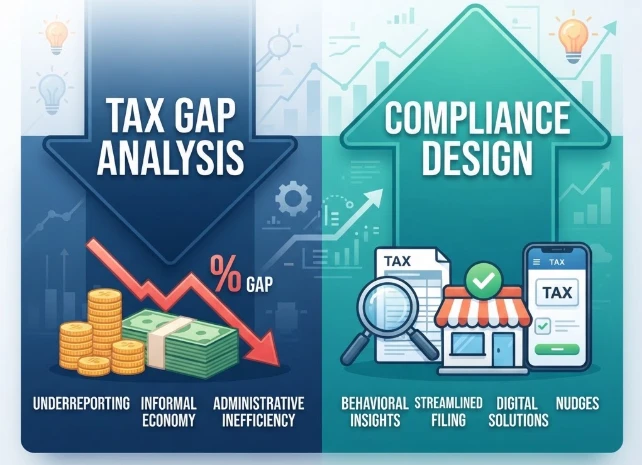
This article focuses on small-business taxation as a meeting point between public economics and compliance design. Tax-gap estimates identify where legally due revenue is not collected, but they do not reveal whether the cause is poor records, misunderstanding, cash-flow stress, informality or deliberate concealment. Small firms face distinctive pressures because registration, filing, bookkeeping and digital requirements impose fixed costs that consume a larger share of managerial resources. Thresholds and simplified regimes can reduce burden but may also encourage bunching, fragmentation or inequity between similar businesses. The article supports risk segmentation, combining education and correction for simple mistakes, workable arrangements for temporary payment problems and stronger verification for intentional concealment. GST and VAT transaction trails, e-invoicing and data matching can improve visibility, provided privacy and data-quality safeguards are maintained. Corporate avoidance, fiscal federalism, governance and corruption risks require different tools. Behavioural evidence also shows that trust, clarity and perceived fairness influence compliance. A modern strategy therefore combines service, nudges, data matching and targeted enforcement, judging each intervention by revenue, administrative burden, fairness and longer-term behavioural effects.
A tax gap is more than just a revenue number. It is the measure of the difference between the amount of tax that would be collected under the current law and the amount of tax that is actually collected, according to an administration's estimation method. OECD Tax Administration 2024 highlights that many jurisdictions are now estimating gaps to gain a better understanding of the extent and type of non-compliance. The policy value lies in diagnosis; gap analysis and treatments, data sources, service strategies and enforcement responses vary according to the gaps.
When it comes to the taxation of small businesses, it's a place where public economics and administrative reality intersect. Thresholds can ease the burden for micro-enterprises, but can also lead to 'bunching', hinder enterprise expansion, or may generate an incentive to fragment activity. Simplified regimes will help improve compliance, but overly generous presumptive rules will create inequity between similar businesses. The problem of design is to achieve lower taxes for the little man, but it is also a system that balances multiple factors: revenue, neutrality, growth, and manageable record keeping.
The risk segmentation model is more proportional. There is a need to educate and correct taxpayers with simple mistakes, provide workable arrangement for taxpayers under temporary payment stress, and strengthen verification for intentional concealment. Treat all discrepancies as fraud, and save enforcement resources and risk losing voluntary compliance. If every discrepancy is benign, another problem arises when taxpayers without prompting are not deterred or treated fairly.
Special rules also add to boundaries of compliance—tax expenditures. Questions of classification and planning opportunities arise from deductions, exemptions, reduced rates and sector concessions. Each subsequent line of demarcation can create real ambiguity and interpretation. The fiscal authorities should thus consider tax expenditures somewhat from an administrative perspective: a concession that may have limited policy significance but has a high complexity may have costs higher than the revenue amount stated in a budget announcement.
It is easy to see that the transaction trail is an advantage in GST and VAT. While invoice chains can facilitate evidence for verification, there is a risk of refund fraud, missing traders, cash transactions and classification dispute. When legal and technical infrastructure is in place, e-invoicing and data matching can be used to enhance visibility. Despite this, robust protection is still required because errors can be amplified in large datasets, privacy can become an issue and false positives can occur where there is a lack of context in risk models.
Another layer is added with fiscal federalism, which involves several governments sharing tax bases or administration. Compliances burden can be expanded for businesses with inter-jurisdictional operations due to differences in definitions, rates, exemptions and data systems. Co-ordinated processes can minimize duplication by sharing registration processes, sharing information, harmonising definitions, or arrangements for central information collection. Institutional designs rely on constitutional responsibilities, revenue autonomy, etc., and the importance of local policy flexibility.
Corporate tax avoidance calls for a different set of tools than errors on small business tax returns. Financing techniques, intangible assets, transfer pricing, entity chains, and cross-border mismatches can be deployed by large groups, and require expertise and international information. Disclosure and tax transparency can promote accountability, but raw disclosure without context can be misleading due to the different rules governing book profit and taxable profit. Effective assurance is a mix of accounting analysis, legal interpretation, economic substance and risk based engagement.
ATO tax-gap evidence, released prior to this cut-off, also highlights the need to focus more directly on small-business compliance than generic enforcement. Complex multinational planning is only one risk; the others include cash transactions, under-represented income, poor records and misunderstood deductions. The opportunity-cost view is included in the Public Economics view: administrative resources devoted to low-value corrections can't be devoted to larger risks. Services, nudges, data matching, education and enforcement must align with the expected revenue and behavioural impact.
The credibility of administration is also impacted by governance and corruption risks. A lack of willingness to comply can stem from selectiveness in enforcement, murky settlements, lax procurement procedures or conflicts of interest, even when statutory rules appear to be sound. Legitimacy is supported by the rights of independence, review, documented procedures, and published aggregate performance information. Compliance design should be considered within a larger rule of law context, not in a narrow collection context.
Measurement should be able to distinguish gross and net gaps, model uncertainty, and the impact of administration. Even if risks are high, a net gap after compliance activity may be created, and economic shocks may alter both liabilities and ability to pay. There should be stable methods or explicit revisions for time-series interpretation. The uncertainties and methodology surrounding the publication of the gap estimates enhance, rather than detract, from the utility of the gap estimates because stakeholders understand what the gap estimates assert and do not assert.
Estimation should be within the compliance design and not outside Australia's published tax-gap work. In November 2024, ATO released estimates for the 2022–23 net GST gap of approximately 7.9 billion Australian dollars, which represents nearly 9 per cent of the theoretical GST. The agency also said the GST gap had a high level of small-business activity, which is a historical characteristic of the non-compliant segment, and that increases in record quality, cash transactions and registration behaviour are key risk factors. The gap estimate is not evidence of motive and administration must have other evidence in order to consider an error, a payment issue or intentional concealment as the same behaviour.
The traditional deterrence model is complicated by behavioural evidence. While penalties and audit risk are important, so too are clarity, trust, perceived fairness, social norms, cash-flow pressure, and ease of completion when it comes to compliance. The rise in the use of behavioural researchers and targeted communications is reported in OECD tax-administration work. A timely reminder of some rule can avoid an error, and complicated rules can result in errors that look like evasion in aggregate data.
Compliance costs are also worthy of consideration, as administrative hassles might lead small businesses to make mistakes or engage in informality. When there is no tax to be paid, there is still an economic cost of interpreting rules, recording the tax data, reconciling GST and correcting returns. Digital filing has the potential to save the time of routine filing, but only if software, identity systems and data standards are reliable. Inadequately designed digital obligations might just shift the expense from government offices to businesses and professional advisers.
An improved compliance approach is then a blend of prevention, facilitation, verification and enforcement. Omissions are prevented, errors are reduced with clear guidance, targeted analytics can identify high risk cases and robust sanctions can catch deliberate evasion. All interventions need to be assessed in terms of revenue, burden, fairness and trust. The aim is not to enforce to the utmost, but to achieve sustainable compliance at the lowest reasonable social and administrative cost.
The most informative evidence is that where fiscal cost, fairness, behaviour and administrative burden are all present rather than being separated into policy stories. Long run credibility relies on a process of review that allows thresholds, eligibility or reporting requirements to be modified when economic conditions and technology evolve. It is, then, a practical question whether the instrument provides quantifiable public benefit, when compliance costs, distribution and opportunity cost are added. Transparent governance transforms that question into a process that can be repeated instead of a justification at a single point of introduction.
This comprehensive perspective minimizes the odds of a technically sound rule yielding sub-optimal results given that the interaction of households, firms, and administrators with actual incentives is taken into account. A more powerful analytical strategy is to consider the incentives, administrative capacity and distributional effects of a design, not its label. That view also brings uncertainty out into the open, and this enhances decision-making in cases where there is less precise information about behavioural responses or costs of implementation. Before a policy becomes politically unappealing to change, assumptions, definitions, and evaluation criteria should be published as another safeguard.
Fiscal cost, fairness, behaviour and administrative burden are most helpful when considered together, in one assessment, rather than in isolation in separate policy programmes. Long run credibility requires review procedures to allow thresholds, eligibility, or reporting procedures to be changed when economic conditions and technology vary. However, the question is, when compliance costs, distribution costs and opportunity costs are taken into account, does the instrument provide measurable public value?
CITE THIS ARTICLE
Sultana, K. R. (2025). From Tax Gap to Compliance Design: Behavioural and Administrative Evidence on Tax compliance, tax policy, small business taxation, public economics. https://researchbysultana.com/article/d4cd6fe4-5d77-5a5e-9a54-0ad5557067a1
K. R. Sultana, “From Tax Gap to Compliance Design: Behavioural and Administrative Evidence on Tax compliance, tax policy, small business taxation, public economics,” 2025. [Online]. Available: https://researchbysultana.com/article/d4cd6fe4-5d77-5a5e-9a54-0ad5557067a1
Sultana, K. R. (2025) ‘From Tax Gap to Compliance Design: Behavioural and Administrative Evidence on Tax compliance, tax policy, small business taxation, public economics’. Available at: https://researchbysultana.com/article/d4cd6fe4-5d77-5a5e-9a54-0ad5557067a1
Sultana, Kazi Rukaiya. “From Tax Gap to Compliance Design: Behavioural and Administrative Evidence on Tax compliance, tax policy, small business taxation, public economics.” 2025, https://researchbysultana.com/article/d4cd6fe4-5d77-5a5e-9a54-0ad5557067a1.
Kazi Rukaiya Sultana. “From Tax Gap to Compliance Design: Behavioural and Administrative Evidence on Tax compliance, tax policy, small business taxation, public economics.” (2025). https://researchbysultana.com/article/d4cd6fe4-5d77-5a5e-9a54-0ad5557067a1.
Sultana KR. From Tax Gap to Compliance Design: Behavioural and Administrative Evidence on Tax compliance, tax policy, small business taxation, public economics. 2025. https://researchbysultana.com/article/d4cd6fe4-5d77-5a5e-9a54-0ad5557067a1
@misc{article_d4cd6fe45d775a5e9a540ad5557067a1,
  title = {From Tax Gap to Compliance Design: Behavioural and Administrative Evidence on Tax compliance, tax policy, small business taxation, public economics},
  author = {Kazi Rukaiya Sultana},
  year = {2025},
  url = {https://researchbysultana.com/article/d4cd6fe4-5d77-5a5e-9a54-0ad5557067a1},
}
TY  - GEN
AU  - Kazi Rukaiya Sultana
TI  - From Tax Gap to Compliance Design: Behavioural and Administrative Evidence on Tax compliance, tax policy, small business taxation, public economics
PY  - 2025-08-31
UR  - https://researchbysultana.com/article/d4cd6fe4-5d77-5a5e-9a54-0ad5557067a1
ER  -
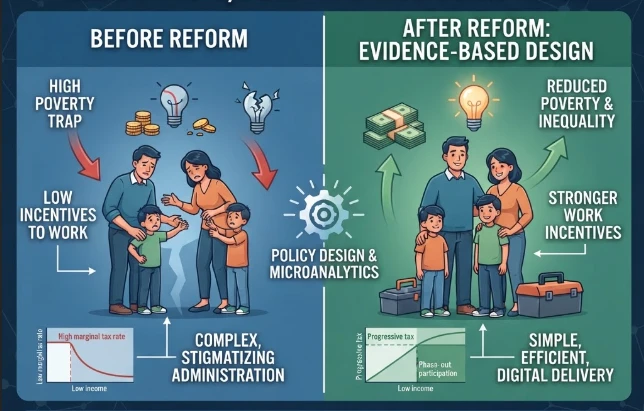
This article uses institutional economics and applied microeconomics to show why tax-transfer reform cannot be evaluated from policy rules alone. Household disposable income reflects earnings, taxes, contributions, benefits, housing support and withdrawal schedules, but the effectiveness of those rules also depends on institutions that administer them. Different data systems, delayed appeals, inconsistent local delivery and administrative capacity can cause a theoretically efficient policy to wo
This article presents tax transparency as a governance and accounting issue rather than a simple disclosure exercise. Boards oversee tax outcomes that are influenced by risk appetite, capital allocation, internal controls, remuneration and significant transactions, while accounting systems provide the common record connecting financial profit, taxable income, deferred tax, cash tax and uncertain positions. IFRS S1 and IFRS S2 are used to show how sustainability-related financial information can
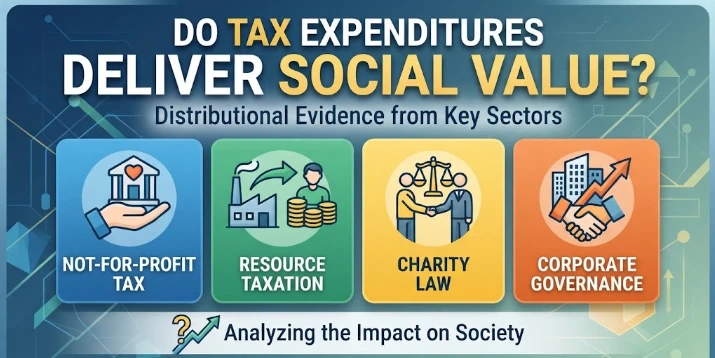
This article evaluates tax expenditures in not-for-profit, charity and resource-tax settings through distribution, governance and public value. Preferential treatment for charities and similar organisations is justified by public or community benefit, so reporting and governance should show whether concessions expand valued services, improve access or instead accumulate as private or organisational advantage. The article warns that annual income alone is an incomplete equity measure because life