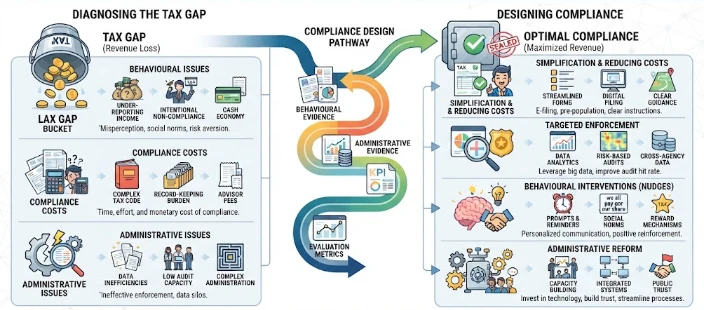
The article moves from tax-gap measurement to practical compliance design, emphasizing that administration must distinguish between error, temporary payment difficulty and deliberate concealment. Compliance costs are especially important for small firms because record keeping, filing, GST reconciliation and digital obligations consume a larger share of limited managerial resources. Transaction trails in GST and VAT can support verification through invoices, e-invoicing and data matching, but large datasets also create privacy, error and false-positive risks. Fiscal federalism can add duplication when jurisdictions use different definitions, rates, exemptions and systems. Corporate tax avoidance requires a different toolbox involving specialist analysis of financing, intangibles, entity chains and cross-border arrangements. The article also highlights governance, corruption risk and the need for transparent tax-gap methodology. Behavioural evidence shows that penalties and audit probability work alongside trust, clarity, social norms and cash-flow pressure. Risk segmentation is therefore preferred to one-size-fits-all enforcement. The recommended compliance model integrates prevention, facilitation, verification and sanctions, with performance judged by revenue, burden, fairness and trust.
A tax gap is more than just a statistic. It is the gap between the amount of tax that is actually collected and what it is to be collected according to the law, as measured by the estimation method of the administration. According to OECD Tax Administration 2024, more jurisdictions are starting to estimate gaps in order to better comprehend the magnitude and scope of non-compliance. Policy value is based on diagnosis – the approach to closing policy gaps is different depending on the gap.
Compliance-cost analysis is a special concern for the smaller firm, since a portion of fixed administrative costs is a larger percentage of the limited resources. Even a simple reporting rule, when applied to a big corporation, can take a significant amount of owner time in a micro business. Errors can be minimised using reminders, default options, pre-filled data and clearer sequence. The best interventions take away the idle decisions instead of sending more messages about the still needless decisions.
The benefit of transaction trails is illustrated in the two tax systems: GST and VAT. While invoice chains can be useful in providing third-party data to assist with verification, there are a number of potential risks, including refund fraud, missing traders, cash transactions, classification disputes. Where legal and technical infrastructure is developed and mature, the data matching and e-invoicing can provide added visibility. Despite these benefits, there remains a need for robust protection measures, as the potential for magnifying errors, privacy concerns, and false positives through large datasets, and contexts missing from risk models, means that strong safeguards are necessary.
Fiscal federalism is another layer with several governments having overlapping tax bases or tax administration authority. There can be variations in definitions, rates, exemptions, and data systems that make compliance more complex for companies that are doing business between jurisdictions. Coordinated registration, information sharing, or harmonisation of definitions and/or central collection of information can eliminate duplication. The appropriate institutional structure is determined by constitutional duties, local revenue autonomy, and the importance of local policy autonomy.
This is a different toolkit than what's needed for small business record errors. Financing structures, intangible assets, entity chains and cross-border mismatches are all areas that require sophisticated knowledge and information across the borders where large groups of people can use these to their benefit. Disclosure and transparency in accounting can help promote accountability, but uncontextualized disclosure can mislead as book profit is not the same as taxable profit. Assurance is a blend of accounting analysis, legal interpretation, economic substance and risk based engagement.
The credibility of administration is also influenced by governance risks and corruption risks. Even if the statutory rules appear sound, a lack of will to comply can result from selective enforcement, settlement that is not transparent, or lax procurement oversight, or conflicts of interest. Legitimacy is protected with independence, review rights, documented procedures and publication of aggregate performance information. Compliance design should be embedded in a larger rule of law regime, not a strictly collection orientated regime.
Measurement should differentiate gross and net gaps, model uncertainty and administration's effects. Payment capacity can shift due to an economic shock, even if underlying risks have stayed the same, and a net gap after compliance activity can arise even if the underlying risks have stayed high. There should be consistent methods or clear changes in the time-series. Sharing uncertainty and methodology is a way to reinforce, not detract from, the usefulness of the gap estimates, as stakeholders will be able to understand what the numbers can and cannot do.
Administration also has to differentiate between situations where the payment is difficult and those where the payment is not being made for some reason. Escalation is necessary when businesses are continually hidden, but instalment arrangements and early contact are ways of keeping viable businesses alive and keeping revenue intact. Data can help make that distinction, but it is important to have human input when models are not observing illness, disasters, family disruption, or unusual commercial events. Proportionality has two dimensions: one as a principle of fairness and one as a means of allocating resources.
Australia's tax-gap program is an example of that with very specific estimates of the public facing tax gaps. In November 2025, the overall net gap was estimated at approximately 58.2 billion Australian dollars (9.1 percent) and small business accounted for 27.2 billion of this net gap. People, who were not in business or engaged in GST, also contributed big numbers. Those numbers are not necessarily reflective of the same behavior in all groups, but they underscore the need to have more than one approach to enforcement to deal with all aspects of noncompliance.
The traditional deterrence model is complicated by behaviour. Penalties and audit probability are important but compliance is also affected by clarity, trust, perceived fairness, social norms, cash-flow pressure and ease of fulfilling obligations. Increasing use of behavioural researchers and targeted communications in OECD tax-administration work. The right message at the right time can avoid an error – cheaply – and complex rules can produce errors that are similar to those with aggregate data.
As well as compliance costs should be considered, as administrative hassles may encourage small businesses to make mistakes or to become informal. There is an economic cost of time in interpreting rules, preparing documentation, reconciling the GST and fixing the returns even where there is no additional tax. All of these are important elements that need to be in place and reliable to eliminate the routine burden with digital filing. Unwarranted burdens imposed on the information industry by poorly crafted obligations can merely shift costs from government agencies to businesses and other professional advisers.
A more proportionate model is that of risk segmentation. Education and correction of the simple taxpayer is required, workable arrangements for the temporary payment stress need to be put in place and greater verification for deliberate concealment is required. Every discrepancy is a misuse of enforcement resources and may impair the willing compliance of the public. By blaming each error, you are still setting up the opposite problem, which is to make it less likely to deter and treat fairly those who do the right thing without your help.
Special rules also create tax compliance boundaries that tax expenditures have an impact on. Classification questions and planning opportunities are caused by deductions, exemptions, reduced rates and sector concessions. Each extra boundary can generate a real murky situation and aggressive reading. It is therefore important for fiscal authorities to consider tax expenditures, at least in a part of an administrative perspective: a small policy effect but high complexity tax concession may have costs that are much higher than those estimated in a budget statement.
A contemporary compliance approach then integrates prevention, facilitation, verification and enforcement in one approach. Pre-filled data eliminates omissions, clear guidance minimises errors, specific analytics identify cases for higher risk and robust sanctions deal with deliberate evasion. Revenue, burden, fairness and trust are the standards by which each intervention should be assessed. The purpose is to strive for maximum compliance, not maximum enforcement.
That difference is significant because legal form and economic incidence can differ, as households and firms adjust. Another way of providing this protection is to state the assumptions clearly, so that an independent analysis can be done or the central result challenged. Where distribution, administration and behaviour are considered together, evidence is strengthened as well. Evaluation criteria that are agreed beforehand and beneficiaries and administrators adapt to a permanent rule will enhance the durability of the policy.
The test of the defensibility of a reform is the extent to which fiscal cost, distribution, complexity, and uncertainty are put on the same page. Good design thus does not just involve communicating the transparency of a policy after it has been put in place but as a part of the policy architecture. One benefit of this is that any hidden trade-offs become apparent before thresholds, exemptions or enforcement settings are ingrained in the routine. The deeper meaning is that the fiscal design should be evaluated using the actual behavior and not based on the statute labels.
The distinction is important because the economic incidence of the shocks can differ from the legal form of the shocks once households or firms adjust. Another way of providing this protection is to state the assumptions clearly, so that an independent analysis can be done or the central result challenged. Distribution, administration and behaviour are also strengthened by looking at them together, rather than individually in reports. It is easier to establish a durable policy when the criteria for evaluation are negotiated prior to beneficiaries and administrators adapting around a permanent policy.
The litmus test is whether a reform can stand up to fiscal cost, distribution, complexity and uncertainty. Good design thus does not just involve communicating the transparency of a policy after it has been put in place but as a part of the policy architecture.
CITE THIS ARTICLE
Sultana, K. R. (2026). From Tax Gap to Compliance Design: Behavioural and Administrative Evidence on Tax administration, tax compliance, behavioural issues, compliance costs. https://researchbysultana.com/article/dc727f0c-a058-5900-9f5f-f742d542a7e4
K. R. Sultana, “From Tax Gap to Compliance Design: Behavioural and Administrative Evidence on Tax administration, tax compliance, behavioural issues, compliance costs,” 2026. [Online]. Available: https://researchbysultana.com/article/dc727f0c-a058-5900-9f5f-f742d542a7e4
Sultana, K. R. (2026) ‘From Tax Gap to Compliance Design: Behavioural and Administrative Evidence on Tax administration, tax compliance, behavioural issues, compliance costs’. Available at: https://researchbysultana.com/article/dc727f0c-a058-5900-9f5f-f742d542a7e4
Sultana, Kazi Rukaiya. “From Tax Gap to Compliance Design: Behavioural and Administrative Evidence on Tax administration, tax compliance, behavioural issues, compliance costs.” 2026, https://researchbysultana.com/article/dc727f0c-a058-5900-9f5f-f742d542a7e4.
Kazi Rukaiya Sultana. “From Tax Gap to Compliance Design: Behavioural and Administrative Evidence on Tax administration, tax compliance, behavioural issues, compliance costs.” (2026). https://researchbysultana.com/article/dc727f0c-a058-5900-9f5f-f742d542a7e4.
Sultana KR. From Tax Gap to Compliance Design: Behavioural and Administrative Evidence on Tax administration, tax compliance, behavioural issues, compliance costs. 2026. https://researchbysultana.com/article/dc727f0c-a058-5900-9f5f-f742d542a7e4
@misc{article_dc727f0ca05859009f5ff742d542a7e4,
  title = {From Tax Gap to Compliance Design: Behavioural and Administrative Evidence on Tax administration, tax compliance, behavioural issues, compliance costs},
  author = {Kazi Rukaiya Sultana},
  year = {2026},
  url = {https://researchbysultana.com/article/dc727f0c-a058-5900-9f5f-f742d542a7e4},
}
TY  - GEN
AU  - Kazi Rukaiya Sultana
TI  - From Tax Gap to Compliance Design: Behavioural and Administrative Evidence on Tax administration, tax compliance, behavioural issues, compliance costs
PY  - 2026-03-04
UR  - https://researchbysultana.com/article/dc727f0c-a058-5900-9f5f-f742d542a7e4
ER  -
This article uses institutional economics and applied microeconomics to show why tax-transfer reform cannot be evaluated from policy rules alone. Household disposable income reflects earnings, taxes, contributions, benefits, housing support and withdrawal schedules, but the effectiveness of those rules also depends on institutions that administer them. Different data systems, delayed appeals, inconsistent local delivery and administrative capacity can cause a theoretically efficient policy to wo
This article presents tax transparency as a governance and accounting issue rather than a simple disclosure exercise. Boards oversee tax outcomes that are influenced by risk appetite, capital allocation, internal controls, remuneration and significant transactions, while accounting systems provide the common record connecting financial profit, taxable income, deferred tax, cash tax and uncertain positions. IFRS S1 and IFRS S2 are used to show how sustainability-related financial information can
This article evaluates tax expenditures in not-for-profit, charity and resource-tax settings through distribution, governance and public value. Preferential treatment for charities and similar organisations is justified by public or community benefit, so reporting and governance should show whether concessions expand valued services, improve access or instead accumulate as private or organisational advantage. The article warns that annual income alone is an incomplete equity measure because life