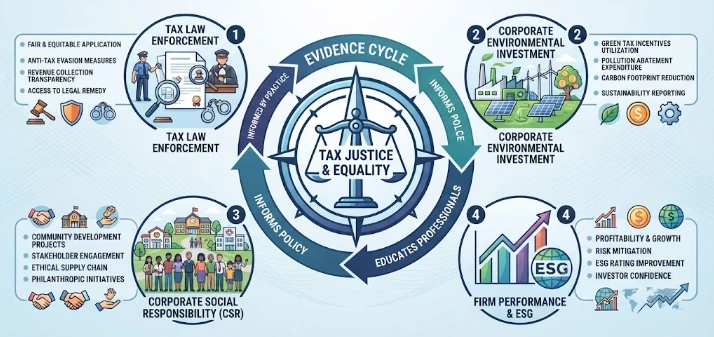
This article examines tax justice where enforcement, corporate environmental investment, corporate social responsibility and firm performance intersect. It begins from access to rights, arguing that taxpayers need understandable obligations, affordable review and practical ways to challenge decisions. Environmental tax incentives create an additional enforcement problem because qualifying expenditure and performance must be verified without making legitimate projects unnecessarily difficult to claim. Clear eligibility rules, standard evidence and risk-based review can help distinguish genuine green investment from relabelled routine spending. The article also warns against simple causal claims that CSR or environmental investment automatically improves firm performance, because financing conditions, tax support and underlying governance can influence observed results. Wider tax-justice themes include tax clinics, tax literacy, gender budgeting, public-finance incidence, corporate disclosure and proportionate enforcement. Small businesses may face cumulative burdens from GST, payroll, deductions and record keeping, while advanced taxpayers may have greater access to specialist certainty. The article’s practical standard is equal ability to engage with the tax system, supported by transparent decisions, effective review and measurable public value from fiscal incentives.
Tax justice is talked about in terms of rates and redistribution but it all starts with the procedures of access to rights. A tax payer must not only have an understanding of an obligation, they also need a way to obtain records, they must communicate with the authority, they must have a mechanism to challenge an assessment, and there must be a mechanism for the tax payer to get a review without having to pay excessive amounts. When professional advice is needed for basic participation, formal equality may become real inequality as a result of complex law. The first question that access-to-rights analysis poses is whether the protections that are included in tax law can be used by the general public and by small entities.
The point of intersection between tax-law enforcement and corporate environmental investment occurs when incentives are based on evidence of qualifying expenditure and/or performance. Weak verification may mean that routine maintenance will be reclassified as green capital, and overly onerous proof might deter valid projects. Clear eligibility definitions, standard documentation, review focused on risk and robust review when claims are unusually high or don't align with operational data provides a middle ground in risk-based enforcement. The quality of enforcement has an impact on revenue integrity and confidence in environmental policy.
Tax clinics fill that void. The National Tax Clinic program is a government-funded initiative to help eligible individuals and small businesses who require help with tax matters. Clinics also provide evidence of common administrative issues and opportunities for supervised students to learn. That's because systemic issues such as debt, record keeping, registration, family situation, digital access and/or lack of understanding of legal notices can emerge in individual cases.
Tax literacy is a second level of justice. Avoidable debt and penalties can be avoided if you know the filing dates, deductible expenses, business registration, instalments and rights of review. Don't replace simple law with literacy, because even well-informed taxpayers have trouble with the rules that have multiple definitions and exceptions. Good systems include clear instructions and appropriately matched responsibilities and community/ professional support.
Voluntary compliance is influenced by procedural fairness as well. When there are reasons, the consideration of evidence, the credibility of review channels and communication that is respectful, people are more likely to accept an adverse outcome. So, behavioural tax research has come into the world of something more than just fear of audit. No trust can replace enforcement, but regular and consistent process can make enforcement more legitimate and eliminate the perception that results are based on resources or connections.
Gender budgeting extends the tax-justice lens as male and female effects can arise from apparently gender-neutral governance arrangements. Incidence can be affected by the variation in paid work, unpaid care, retirement saving, property ownership and consumption. A budget can thus be "distributionaly unequal" without a mention of gender. Gender-aware analysis includes questions of who benefits from concessions, who pays consumption taxes, who gets credits, and how policy affects caregiving and lifetime earnings.
Public finance brings fairness into the spending equation. Tax justice is not about who pays, as tax revenues are used to fund health, education, infrastructure, income support, security and administration. Fiscal-incidence analysis is a method of connecting taxes and benefits to see the overall impact on household resources. This method also helps avoid simplistic assertions of a 'fair' or 'unfair' tax, both on the ground of what is being taxed and what is being provided by the tax system.
Care needs to be taken in making causal interpretations of the relationship between CSR and firm performance. Simple correlations between the level of governance and profitability are hard to make since the firms with better governance can be more successful in their environmental investments. There's another layer of complexity with tax incentives as well, since reported returns can improve, in part, through fiscal support. The effect of the financing, the market response, and the tax benefits are clearly distinguished from operational savings in a credible analysis. That discipline ensures that CSR reporting does not go overboard in claiming success in the marketplace and that a sustainable investment in the environment does not simply intensify risk but enhance long-term resilience.
The relationship between company law and securities regulation and tax justice are tied to disclosure and governance. In corporate reporting, the information available to boards, investors, auditors, regulators and tax authorities is the information that is reported. Risk assessment can involve related party transactions, executive incentives, provisions, deferred tax and uncertain tax positions. Aggressive tax planning is not prohibited by strong governance, but strong governance makes it more difficult to maintain strategies that are not clearly disclosed to the company's responsible persons and are not properly supervised.
The legal requirements are different for small businesses than for large businesses, and can often seem like they are the same, which can create a unique access issue. The process of registering for GST, processing payroll, processing deductions, record maintenance, and business decision making around entity selection can all add up and cause a burden. Small issues can turn into bad debts if tax clinics and user-friendly guidance prevent them. The long run solution is still simpler, as support services shouldn't be a permanent remedy for unnecessary complexity.
Yet another dimension of access and distribution is revealed with retirement policy. Aside from the tax benefits of the superannuation or retirement savings, there can be significant fiscal values depending on the amount of contribution, tax rates and account balance. The poorest workers will benefit only in a small way from deductions which necessitate current contributions. Fair design thus takes into account refundable offsets, contribution cap, preservation rules, age, housing costs, and interaction with public pensions.
There is also a rule of law issue in this advanced tax sphere: certainty is not allowed where the parties can afford to hire experts to interpret. Broad access to and consistent reasoning behind private rulings, public guidance, safe harbours and published administrative positions can minimise uncertainty. Too much discretion can lead to risks, as the same facts can yield varying results. Interpretation, then, is a mechanism for justice rather than administration efficiency – transparency is required.
Enforcement should not be disproportionate. Deliberate evasion should be taken seriously and punished to preserve the integrity of the tax system and the tax base, but may be harshly applied to those who are not deliberately evading the tax. There is a need for protection, evaluation, and well-defined escalation protocols for debt collection, penalties, garnishment, and litigation. A rights-based system is able to distinguish between inability, mistake, avoidance and fraud, rather than lumping all the problems together into one moral category.
Access indicators, when placed next to revenue indicators, bring credibility to reform. Administrations can monitor the resolution of complaints, review results, processing time, debt continuity, digital exclusion, clinic referral, and types of recurring errors. This information can uncover if legal adjustments decrease the friction or simply move it. Tax justice is then measurable, not just in terms of the abstract arguments about statutory rates, but as a day-to-day function of institutions.
The practical test is for equal ability to engage in the tax system. Before reforms, that standard demands that rules be understandable, assistance be affordable, decisions be made transparently, decisions be reviewed effectively, and distributional analysis be conducted. Rights usability increases the legitimacy of collection, while collection is still necessary for services to be provided. A tax system gains the trust of its citizens when it is not too complex, its enforcement is not too strong, and fiscal policy is not closed to public review on the income and organisational level.
Long-run credibility requires mechanisms to review thresholds, eligibility, and reporting rules to change with economic conditions and technology. This question is, of course, whether the instrument provides measurable public value when compliance costs, distribution and opportunity costs are considered. Transparent governance converts that question into a repeatable process instead of a one-off justification at the point of introduction. This integrated perspective minimizes the likelihood that a technically correct rule yields sub-optimal results in the face of actual incentives for households, firms and administrators.
Labels are not a proper way to test against observed incentives, administrative capacity and distributional effects. The better analytical approach is to test the statutory design itself. The same way of thinking also introduces uncertainty into the picture which helps to make decisions when uncertainty cannot be precisely calculated through behavioural responses or implementation costs. Another protection is the release of assumptions, definitions, and evaluations criteria prior to when a policy might be politically unpalatable. If fiscal cost, fairness, behaviour and administrative burden are present in the same assessment, rather than in distinct policy narratives, this is most informative.
Long-run credibility requires review procedures that have the ability to respond to changing economic circumstances and technology in terms of eligibility, thresholds, and reporting requirements.
CITE THIS ARTICLE
Sultana, K. R. (2025). Tax Justice in Practice: Access-to-Rights Evidence from Tax law enforcement, corporate environmental investment, CSR, firm performance. https://researchbysultana.com/article/cd7e38e1-14f6-5597-b573-305b2a180573
K. R. Sultana, “Tax Justice in Practice: Access-to-Rights Evidence from Tax law enforcement, corporate environmental investment, CSR, firm performance,” 2025. [Online]. Available: https://researchbysultana.com/article/cd7e38e1-14f6-5597-b573-305b2a180573
Sultana, K. R. (2025) ‘Tax Justice in Practice: Access-to-Rights Evidence from Tax law enforcement, corporate environmental investment, CSR, firm performance’. Available at: https://researchbysultana.com/article/cd7e38e1-14f6-5597-b573-305b2a180573
Sultana, Kazi Rukaiya. “Tax Justice in Practice: Access-to-Rights Evidence from Tax law enforcement, corporate environmental investment, CSR, firm performance.” 2025, https://researchbysultana.com/article/cd7e38e1-14f6-5597-b573-305b2a180573.
Kazi Rukaiya Sultana. “Tax Justice in Practice: Access-to-Rights Evidence from Tax law enforcement, corporate environmental investment, CSR, firm performance.” (2025). https://researchbysultana.com/article/cd7e38e1-14f6-5597-b573-305b2a180573.
Sultana KR. Tax Justice in Practice: Access-to-Rights Evidence from Tax law enforcement, corporate environmental investment, CSR, firm performance. 2025. https://researchbysultana.com/article/cd7e38e1-14f6-5597-b573-305b2a180573
@misc{article_cd7e38e114f65597b573305b2a180573,
  title = {Tax Justice in Practice: Access-to-Rights Evidence from Tax law enforcement, corporate environmental investment, CSR, firm performance},
  author = {Kazi Rukaiya Sultana},
  year = {2025},
  url = {https://researchbysultana.com/article/cd7e38e1-14f6-5597-b573-305b2a180573},
}
TY  - GEN
AU  - Kazi Rukaiya Sultana
TI  - Tax Justice in Practice: Access-to-Rights Evidence from Tax law enforcement, corporate environmental investment, CSR, firm performance
PY  - 2025-10-19
UR  - https://researchbysultana.com/article/cd7e38e1-14f6-5597-b573-305b2a180573
ER  -
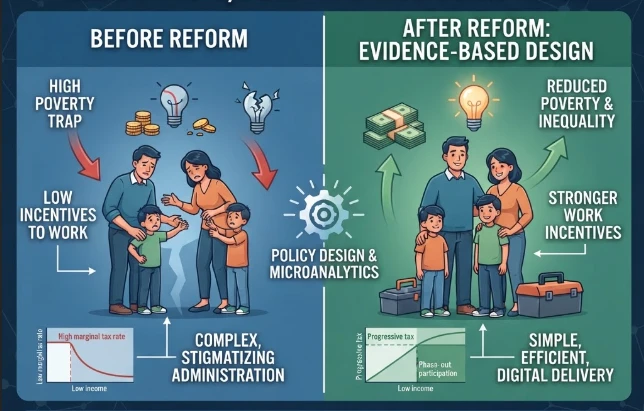
This article uses institutional economics and applied microeconomics to show why tax-transfer reform cannot be evaluated from policy rules alone. Household disposable income reflects earnings, taxes, contributions, benefits, housing support and withdrawal schedules, but the effectiveness of those rules also depends on institutions that administer them. Different data systems, delayed appeals, inconsistent local delivery and administrative capacity can cause a theoretically efficient policy to wo
This article presents tax transparency as a governance and accounting issue rather than a simple disclosure exercise. Boards oversee tax outcomes that are influenced by risk appetite, capital allocation, internal controls, remuneration and significant transactions, while accounting systems provide the common record connecting financial profit, taxable income, deferred tax, cash tax and uncertain positions. IFRS S1 and IFRS S2 are used to show how sustainability-related financial information can
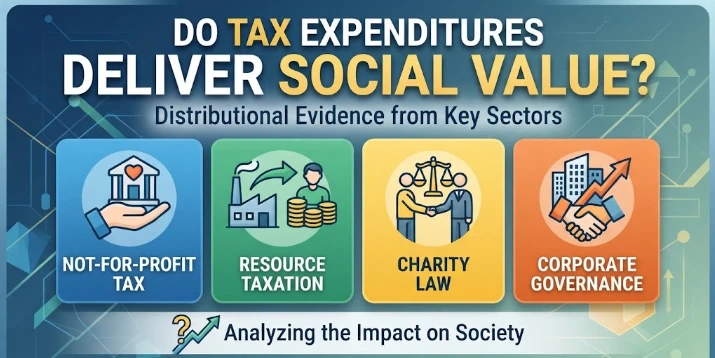
This article evaluates tax expenditures in not-for-profit, charity and resource-tax settings through distribution, governance and public value. Preferential treatment for charities and similar organisations is justified by public or community benefit, so reporting and governance should show whether concessions expand valued services, improve access or instead accumulate as private or organisational advantage. The article warns that annual income alone is an incomplete equity measure because life