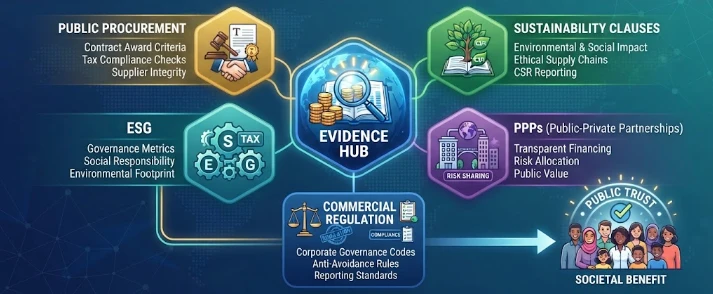
This article links tax transparency with public procurement, sustainability clauses, ESG, public-private partnerships and commercial regulation. Governments purchase infrastructure, health services, technology, transport and everyday goods, so procurement rules can influence environmental performance, labour standards, integrity and innovation. Sustainability requirements are useful only when they are tied to measurable contract performance; vague clauses can become symbolic barriers or reduce competition. Public-private partnerships add long-term complexity through financing, guarantees, service obligations and risk transfer, making disclosure of contingent liabilities, tax assumptions and performance indicators important for accountability. The article connects these public-sector issues with corporate tax governance, arguing that responsible businesses should explain material tax drivers, incentives and cross-border structures without relying on simplistic ratios. Social licence and inclusive capitalism broaden the perspective by asking how value is distributed through wages, suppliers, taxes, investment and community impacts. Sustainability reporting, impact investing and social enterprises reinforce the need for comparable metrics and credible baselines. Effective transparency requires consistent definitions, monitoring, governance and consequences so information changes decisions and improves accountability rather than simply increasing reporting volume.
Tax transparency has gone beyond simple compliance and is about whether a business is transparent. The role of tax in corporate governance, sustainability commitments, public approval, and the impact a company has on the economy is being a growing consideration for investors, staff, customers, governments, and communities. A clear approach clarifies the linkage between statutory requirements, tax effectiveness, incentives, losses, and cross-border set-ups without simplifying a complicated situation to one ratio per headline. Tax is central to corporate social responsibility as it contributes to the institutions and infrastructure on which commercial activity depends.
In the case of public procurement, sustainability clauses hold special power because governments spend on infrastructure, health services, technology, transport, and on a daily basis on goods. Before mid-2025, the OECD published procurement principles on transparency, integrity, access, efficiency, risk management, accountability and integration in its work. Environmental and social criteria might be able to affect suppliers' actions, but the criteria must be linked to the performance of the contract. Non-measurable and non-monitored requirements will become symbolic barriers and not effective sustainability tools.
The other important link between sustainability and corporate responsibility is public procurement. OECD data reveals that procurement accounts for a significant portion of economic activity in most OECD member economies, and that the rules governing procurement can have an impact on environmental performance, labour standards, integrity, and innovation. Sustainability clauses can incentivize ethical suppliers, but if poorly drafted, the clauses can stifle competition or become a formality. Through transparent tender criteria, verifiable evidence and contract monitoring, ESG language needs to be implemented as a driver for delivery, not just a piece of paperwork.
Long term contractual complexity associated with the public-private partnerships. Infrastructure contracts are often multi-decade contracts that include construction, financing, obligations to provide services, guarantees, and transferring risk. The sustainability requirements thus must be anchored in measurable performance specification instead of being aspirations. Accountability is achieved by disclosure of contingent liabilities, tax assumptions, procurement decisions and performance indicators. A project that may be cheap at the time of the contract signature may be a huge burden on the public balance sheet without that information.
The workplace diversity highlights the need for caution with social disclosure. Numbers do not tell the story of recruitment, promotion, pay, retention, safety or leadership. There is good reporting that links representation to employment outcomes and governance processes, yet also safeguards legitimate privacy interests. Tax breaks for jobs or training should also be analysed, as they do not guarantee higher employment or higher quality jobs. The credibility of corporate responsibility is enhanced when claims by the workforce are related to measurable results and the financial support associated with these results is visible.
Social licence goes beyond legal permission and represents a sense of the public's acceptance of a policy. Trust with communities and regulators and contractual rights can be critical for companies in the resource, infrastructure, finance and digital industries. That trust can be affected by tax behaviour as profits can be based on the support of public infrastructure, trained workforces, legal systems, and governments. A transparent tax regime does not mean that all details of tax affairs must be made public, but it does mean that enough context should be provided to demonstrate that the law and the stated social obligations are not being pursued in ways that undermine each other.
In inclusive capitalism, value creation is placed in the heart of governance. There are various ways by which a company's action influences its stakeholders, including through wages, payments to suppliers, taxes, investment, dividends and impacts on the community. While ESG reporting can shed light on those channels, a selective approach to metrics can also cloud trade-offs. Tax transparency includes a tangible fiscal aspect through contributions and incentives by jurisdiction. The best disclosures don't lead to celebratory figures of the total taxes paid and don't make easy comparisons of the effective tax rates, but provide a meaningful explanation of material drivers that can be subject to informed examination.
The pressure from commercial discipline is heightened by PPFs because commitments to sustainability can have interactions with financing, tax assumptions, demand risk and obligations for services over the long term. ESG criteria should thus be incorporated into measurable outcomes, accountability, remedies and review. Transparency in procurement also aids smaller suppliers in knowing how to bid. A sustainable procurement system that is best implemented when competition, lifecycle value, integrity and responsible-business objectives are linked together and not listed as separate checklists.
Transparency is a function of corporate governance, the question is whether it is genuine oversight or communication in the right way. Boards must have clarity of responsibility for tax risk, escalation pathways when uncertainty exists, and a linkage between tax planning and strategy/reputation. Audit committees can conduct tests to ensure that disclosures are accurate with respect to accounting records and that aggressive structures present risks that are inconsistent with disclosures. Good governance also ensures that alternatives to incentives are not confused with incentives themselves, or that the separation is only artificial or that there are assumptions which are not likely to pass regulatory tests.
A sustainability reporting offers a more comprehensive information framework. In 2023, the IFRS S1 and IFRS S2 standards provided a framework for sustainability-related financial information, which includes governance, strategy, risk management, metrics and targets, and separates physical and transition risks within the climate standard. Those standards are centered on information about enterprise possibilities, instead of all of social impacts. Tax transparency can help complement that model, revealing how the public incentives, geographic profit patterns and tax governance are interacting with the sustainability strategy that is communicated to capital providers.
Corporate communication is a risk and an opportunity. Understand why effective tax rates vary from statutory tax rates, how the timing of income and expenditures impact current tax, and how tax incentives encourage investment. When there is no quantitative evidence and there are only vague statements about responsible tax, it will do the opposite. The reader must have sufficient detail to make them distinguish between the structural and the discretionary planning aspects. This uniformity is more convincing than standalone statements in annual, sustainability, and country reports, investor presentations, and regulatory filings.
What makes impact investing even better is the fact that capital is invested with a specific purpose of achieving measurable social or environmental impact as well as financial return. The importance of an SDG label alone is being replaced by increasingly talking about objectives, indicators, baselines, contribution and risk of shortfall. Tax issues arise in this context because the effects of subsidies, exemptions, and tax credits may affect returns. A clear accountancy should distinguish between the performance of the market and value added in the performance of public fiscal resources.
A similar issue exists with social enterprises. Ordinary profit can be a poor indicator of mission performance, given that hybrid missions may involve a combination of trading income, grants, concessionary capital and tax preferences. Social-impact reporting can be used to help define who is benefited, what is being changed and how results are measured, but requires credible baselines and consistent boundaries. Financial information, tax treatment, and impact indicators are more persuasive when they all support public-benefit claims. What makes these records diverge is of interest, not a reason for further labeling.
The Sustainable Development Goals are intended to give them a common language, but the general statements of alignment can be nebulous when virtually anything can be connected to multiple goals. Good practice establishes specific objectives, measurable indicators and the relationship between the activity and the outcome. Tax transparency belongs to that discipline since fiscal incentives are a resource that must be allocated and have an opportunity cost. A company that has received a concession can describe the investments or employment created, and governments can report on the revenues lost and the policy goal linked to the concession.
Comparability, assurance, and consequence are therefore necessary for credible transparency. Definitions of metrics must be consistent, reported limits must be explained, and significant changes in reported limits must be reconciled over time. Independent assurance has the ability to add to confidence but governance remains important since assurance cannot fix a 'strategic story' that is misleading. There is a need for reporting systems, too, that can bring tax provisions, government procurement commitments and corporate reportable disclosures into some measure of uniformity where possible, to the benefit of public agencies. Transparency is for public value—it is information that alters decisions, brings to light inconsistencies, makes people accountable, and is not just more information that is published.
From that perspective, uncertainty can be seen, and better decisions can be made when behavioural responses, or costs of implementation, is not precisely known. Another protection is publishing assumptions, definitions and evaluation criteria prior to when a policy gets into a political holding pattern.
CITE THIS ARTICLE
Sultana, K. R. (2025). Tax Transparency as Corporate Social Responsibility: Evidence from Public procurement, sustainability clauses, ESG, PPPs, commercial regulation. https://researchbysultana.com/article/c706d0dc-0b71-5df3-94a2-96deab89f7fa
K. R. Sultana, “Tax Transparency as Corporate Social Responsibility: Evidence from Public procurement, sustainability clauses, ESG, PPPs, commercial regulation,” 2025. [Online]. Available: https://researchbysultana.com/article/c706d0dc-0b71-5df3-94a2-96deab89f7fa
Sultana, K. R. (2025) ‘Tax Transparency as Corporate Social Responsibility: Evidence from Public procurement, sustainability clauses, ESG, PPPs, commercial regulation’. Available at: https://researchbysultana.com/article/c706d0dc-0b71-5df3-94a2-96deab89f7fa
Sultana, Kazi Rukaiya. “Tax Transparency as Corporate Social Responsibility: Evidence from Public procurement, sustainability clauses, ESG, PPPs, commercial regulation.” 2025, https://researchbysultana.com/article/c706d0dc-0b71-5df3-94a2-96deab89f7fa.
Kazi Rukaiya Sultana. “Tax Transparency as Corporate Social Responsibility: Evidence from Public procurement, sustainability clauses, ESG, PPPs, commercial regulation.” (2025). https://researchbysultana.com/article/c706d0dc-0b71-5df3-94a2-96deab89f7fa.
Sultana KR. Tax Transparency as Corporate Social Responsibility: Evidence from Public procurement, sustainability clauses, ESG, PPPs, commercial regulation. 2025. https://researchbysultana.com/article/c706d0dc-0b71-5df3-94a2-96deab89f7fa
@misc{article_c706d0dc0b715df394a296deab89f7fa,
  title = {Tax Transparency as Corporate Social Responsibility: Evidence from Public procurement, sustainability clauses, ESG, PPPs, commercial regulation},
  author = {Kazi Rukaiya Sultana},
  year = {2025},
  url = {https://researchbysultana.com/article/c706d0dc-0b71-5df3-94a2-96deab89f7fa},
}
TY  - GEN
AU  - Kazi Rukaiya Sultana
TI  - Tax Transparency as Corporate Social Responsibility: Evidence from Public procurement, sustainability clauses, ESG, PPPs, commercial regulation
PY  - 2025-07-20
UR  - https://researchbysultana.com/article/c706d0dc-0b71-5df3-94a2-96deab89f7fa
ER  -
This article uses institutional economics and applied microeconomics to show why tax-transfer reform cannot be evaluated from policy rules alone. Household disposable income reflects earnings, taxes, contributions, benefits, housing support and withdrawal schedules, but the effectiveness of those rules also depends on institutions that administer them. Different data systems, delayed appeals, inconsistent local delivery and administrative capacity can cause a theoretically efficient policy to wo
This article presents tax transparency as a governance and accounting issue rather than a simple disclosure exercise. Boards oversee tax outcomes that are influenced by risk appetite, capital allocation, internal controls, remuneration and significant transactions, while accounting systems provide the common record connecting financial profit, taxable income, deferred tax, cash tax and uncertain positions. IFRS S1 and IFRS S2 are used to show how sustainability-related financial information can
This article evaluates tax expenditures in not-for-profit, charity and resource-tax settings through distribution, governance and public value. Preferential treatment for charities and similar organisations is justified by public or community benefit, so reporting and governance should show whether concessions expand valued services, improve access or instead accumulate as private or organisational advantage. The article warns that annual income alone is an incomplete equity measure because life