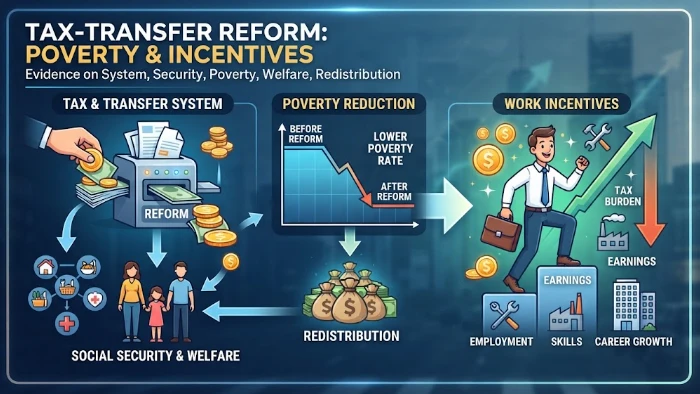
This article examines how tax-transfer systems can reduce poverty while preserving clear incentives to work and progress in employment. It focuses on the interaction of income tax, social contributions, cash benefits, housing support, family payments and in-work credits in shaping household disposable income. The discussion highlights effective marginal tax rates and benefit-withdrawal cliffs, showing how several programmes can combine to make extra earnings produce only a small net gain. Household composition matters, particularly for single parents and second earners facing childcare and housing costs. The article supports gradual benefit tapers, coordinated in-work support, accessible administration and better treatment of volatile earnings. It also stresses fiscal sustainability, arguing that reforms should be tested through microsimulation, distributional analysis and realistic household scenarios rather than isolated tax changes. Administrative simplicity, digital access and predictable reconciliation are presented as essential parts of fairness. Overall, the article argues that redistribution and employment incentives are compatible when policy is coordinated around disposable income, predictable returns to work and accessible social protection.
Until a household is out of a job, a rent shock or finds that a second job yields less additional income than they had hoped, tax-transfer systems are seldom noticed. However, the interplay between in-work benefits, housing assistance, social security contributions, income tax and cash benefits affects people's living conditions on a daily basis across advanced economies. By 2026, the debate on a choice between generous welfare and more robust employment incentives has become more complicated. A more relevant question is design: how can public support help to alleviate poverty without creating substantial additional work, with a resulting clear, predictable increase in disposable income?
There's evidence from the OECD tax-benefit analysis that explains why that problem of design is important. There are multiple lines of work for redistribution, as the disposable household income is defined as the income available after the market income and public cash transfer, with the income tax and social contribution deducted. OECD research has always demonstrated that taxes and transfers have a significant impact on inequality, but the magnitude varies considerably from one economy to another. There was also a significant range in income inequality and after-tax and transfer poverty across society in 2024, as recorded in Society at a Glance 2024. This variation suggests that the pattern of economic development may lead to starkly different social results across policy architectures, eligibility criteria, benefit levels, and tax burden distribution, among others.
So, poverty reduction is not a solely fiscal matter. Even if income taxes are relatively small, a low-income household may find itself in a precarious situation due to the pressures of rent, food, transportation and childcare. In addition to income support, family benefits, rent support, unemployment insurance and refundable credits can ensure a minimum standard of living, depending on the conditions of access. In particular, coverage gaps are of significant concern for the workers who move from one short contract to another, or to platform work, to self-employment, or to irregular hours, as contribution-based systems may fit the stable employment pattern more comfortably than the fragmented patterns of the labour market. The modern safety net must be flexible enough to adjust to the evolving nature of work and deploy without creating a permanent safety net for the insecure.
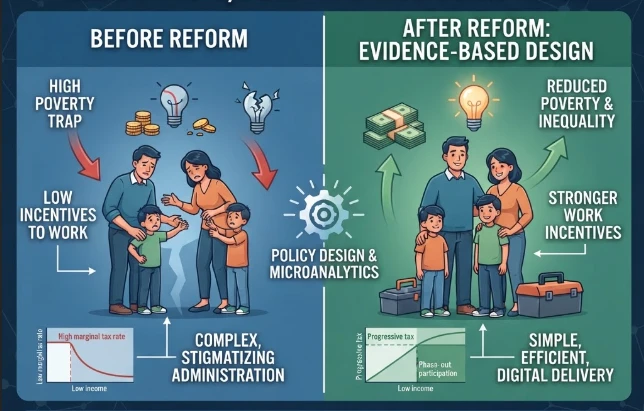
Another layer of work incentives. The question isn't just whether jobs are more profitable than being unemployed, it's how much of every extra job dollar is left after taxes increase and benefits decrease. This is captured in OECD indicators by the effective tax rate and indicators of financial disincentives to re-enter the labour market or to work more. When many benefits are withdrawn at the same income level, a household can find its effective marginal rate to be high. In addition to having a high statutory rate, the combined withdrawal of housing support, family payments, and income assistance may create a high financial cliff, which may make adding hours, promotion, or formal work less appealing.
The presence of such cliffs also introduces fairness issues, as households with comparable gross incomes may end up with very different disposable incomes, depending on who is in their family and their eligibility for benefits. Single parents may have a harder time to deal with the child care costs, benefit withdrawal and lack of scheduling options. Indeed, there are tax and benefit advantages that are unique to second earners in couples, according to analysis of OECD Taxing Wages data. Policy design that fails to account for the composition of the household can thus have unintended labour-market effects. The goal is not a system of employment by suffering, but a system of a visible improvement in financial conditions for the progress in the process of employment along with a credible protection of basic income.
One way to achieve that balance is via in-work benefits. A well-designed credit might not withdraw support just after starting work, but would be a gradual withdrawal as earnings increase, to complement lower earnings. This option can improve the participation incentives and direct the resources to households near the poverty line.
The important part of gradual tapering is that an abrupt withdrawal can result in re-entering the same trap with a different name. Coordination with minimum wages and payroll contributions, childcare subsidies and housing support is also an important factor, as a policy in isolation can simply push back the cliff. Realistic reform will thus need to involve modelling an entire household budget, not just one specific tax or benefit.
Administrative ease is also a key consideration. A theoretically generous entitlement is only as valuable as the ability to access it, as complicated forms, uncertain income reporting, long processing times and fragmented agencies limit access. Automated or pre-filled calculations, up-to-the-minute income data, straightforward eligibility messaging, and integrated digital service can minimize non-take-up and errors. Meanwhile, digital administration requires human assistance for households with challenges because of language barriers, disability, unstable housing, limited connectivity, or family situation complexity. An efficient system of automation that is still easy to access is also a fair system, as administrative burden is another form of exclusion.
The fiscal sustainability goes hand-in-hand with fiscal adequacy. Population ageing, health expenditure, housing pressures, and declining productivity growth, are all drivers of increased demands on budgets and public social spending is high in many OECD countries. There are thus choices to make in reform with regards to targeting, tax bases, contribution structures and programme overlap.
A fiscal balance might be improved on the paper, but lead to higher levels of poverty, the risk of homelessness, poor health or lack of employment, thus generating costs elsewhere. Poor targeting of support can, on the other hand, utilize resources without benefiting the poorest households. Improved design takes a broader perspective on net gains and losses, not just gross programme expenditure.
The adoption of microsimulation has become key to that task. Tax-benefit models can provide estimates of disposable income for various groups of households before and after a proposed tax benefit and distributional analysis can reveal impact by income decile. These tools also provide information on participation tax rates, replacement rates and financial gains from more hours. A progressive policy on the face of it might have a substantial impact on a smaller number of individuals.A progressive policy can be examined by scenario testing and reveal that it has a significant impact on a smaller number of individuals. The best reform process is a mixture of modelling and administration, labour market evidence, and lived experience, because an average of incomes can conceal volatile incomes, high transport costs, debt, and care responsibilities.
Time is crucial, too. Income is also measured by benefit systems over time periods that do not necessarily reflect the income stream that is more volatile, leading to overpayments, repayment requirements, or a sudden drop in income. An individual whose income varies from one week to another, or from month to month, may seem healthy in one reporting period, and weak in the next.
Smoother rules for reconciliation, earnings disregards, transition payments, and well thought-out taper rates can dampen that volatility. These mechanisms can help to transition into employment without it being a monetary risk. Predictability is an incentive in itself as households are more likely to take on extra work if they can confidently predict its net earnings.
A more robust framework of reform also takes poverty seriously as a multiple income level. While relative poverty measures are still useful for comparing households' resources with the wider living standard, they offer some useful information about material deprivation, housing stress, energy costs and access to essential services. These pressures are unevenly distributed between regions and household types, and interact with tax-transfer policy. While some of the cost increase can be addressed with cash assistance, the lack of housing supply or childcare support can't be addressed by tax credits. It is thus important to coordinate fiscal, labour, housing, education and social policy to ensure sustainable poverty reduction.
The main concept in 2026 is that redistribution and work incentives are not mutually exclusive. A lack of coordination between the rules may lead to dependency traps, administrative hassles, and poor employment outcomes, while well-coordinated rules may preserve income support and support employees while simultaneously promoting advancement. A plausible tax-transfer reform program begins with household disposable income and tracks all tax and benefit linkages, assesses distributional implications, eliminates needless cliffs and maintains corner cases as necessary. Success is not a single factor of a reduced welfare budget or lower tax rate. Success manifests when poverty declines, there's a predictable return on effort, the system is easy to understand, easy to access, and financially sustainable.
CITE THIS ARTICLE
Sultana, K. R. (2026). Tax-Transfer Reform, Poverty Reduction, and Work Incentives: Evidence from Tax-transfer system, social security, poverty, welfare, redistribution. https://researchbysultana.com/article/b038bd64-03a2-5864-b5d7-9cec066a1831
K. R. Sultana, “Tax-Transfer Reform, Poverty Reduction, and Work Incentives: Evidence from Tax-transfer system, social security, poverty, welfare, redistribution,” 2026. [Online]. Available: https://researchbysultana.com/article/b038bd64-03a2-5864-b5d7-9cec066a1831
Sultana, K. R. (2026) ‘Tax-Transfer Reform, Poverty Reduction, and Work Incentives: Evidence from Tax-transfer system, social security, poverty, welfare, redistribution’. Available at: https://researchbysultana.com/article/b038bd64-03a2-5864-b5d7-9cec066a1831
Sultana, Kazi Rukaiya. “Tax-Transfer Reform, Poverty Reduction, and Work Incentives: Evidence from Tax-transfer system, social security, poverty, welfare, redistribution.” 2026, https://researchbysultana.com/article/b038bd64-03a2-5864-b5d7-9cec066a1831.
Kazi Rukaiya Sultana. “Tax-Transfer Reform, Poverty Reduction, and Work Incentives: Evidence from Tax-transfer system, social security, poverty, welfare, redistribution.” (2026). https://researchbysultana.com/article/b038bd64-03a2-5864-b5d7-9cec066a1831.
Sultana KR. Tax-Transfer Reform, Poverty Reduction, and Work Incentives: Evidence from Tax-transfer system, social security, poverty, welfare, redistribution. 2026. https://researchbysultana.com/article/b038bd64-03a2-5864-b5d7-9cec066a1831
@misc{article_b038bd6403a25864b5d79cec066a1831,
  title = {Tax-Transfer Reform, Poverty Reduction, and Work Incentives: Evidence from Tax-transfer system, social security, poverty, welfare, redistribution},
  author = {Kazi Rukaiya Sultana},
  year = {2026},
  url = {https://researchbysultana.com/article/b038bd64-03a2-5864-b5d7-9cec066a1831},
}
TY  - GEN
AU  - Kazi Rukaiya Sultana
TI  - Tax-Transfer Reform, Poverty Reduction, and Work Incentives: Evidence from Tax-transfer system, social security, poverty, welfare, redistribution
PY  - 2026-08-16
UR  - https://researchbysultana.com/article/b038bd64-03a2-5864-b5d7-9cec066a1831
ER  -
This article uses institutional economics and applied microeconomics to show why tax-transfer reform cannot be evaluated from policy rules alone. Household disposable income reflects earnings, taxes, contributions, benefits, housing support and withdrawal schedules, but the effectiveness of those rules also depends on institutions that administer them. Different data systems, delayed appeals, inconsistent local delivery and administrative capacity can cause a theoretically efficient policy to wo
This article presents tax transparency as a governance and accounting issue rather than a simple disclosure exercise. Boards oversee tax outcomes that are influenced by risk appetite, capital allocation, internal controls, remuneration and significant transactions, while accounting systems provide the common record connecting financial profit, taxable income, deferred tax, cash tax and uncertain positions. IFRS S1 and IFRS S2 are used to show how sustainability-related financial information can
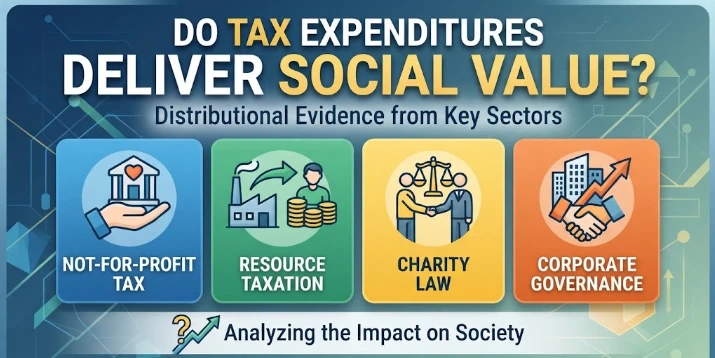
This article evaluates tax expenditures in not-for-profit, charity and resource-tax settings through distribution, governance and public value. Preferential treatment for charities and similar organisations is justified by public or community benefit, so reporting and governance should show whether concessions expand valued services, improve access or instead accumulate as private or organisational advantage. The article warns that annual income alone is an incomplete equity measure because life