Tax-Transfer Reform, Poverty Reduction, and Work Incentives: Evidence from Development economics, labour, welfare, migration, poverty, household economics
Kazi Rukaiya Sultana (Master of Public Policy & Master of Social Welfare and Research)
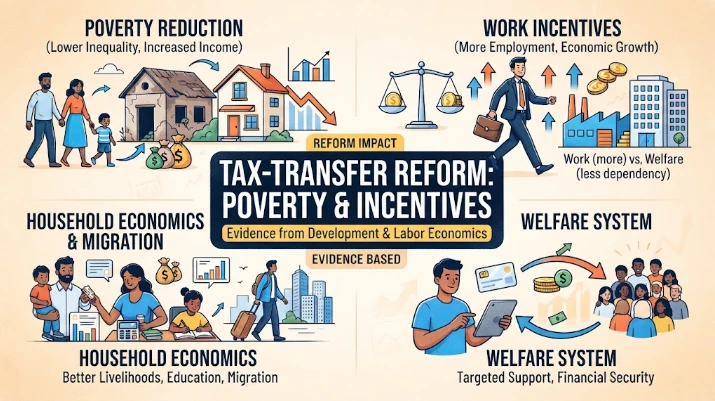
This article examines tax-transfer reform through development economics, labour, welfare, migration and household economics. It argues that policy works through disposable income rather than isolated tax rates, because earnings, taxes, contributions, cash benefits, housing support and withdrawal rules combine in the same household budget. Poverty is treated as more than a temporary income shortfall: health, education, housing, care responsibilities, employment security, migration status and shocks shape capability and future earnings. The article therefore warns that higher employment does not necessarily create greater welfare if childcare, transport or housing costs absorb the gain. Progressivity should be evaluated across the whole fiscal system, including consumption taxes, payroll contributions and benefit withdrawal. Administrative design also affects outcomes through forms, reassessments, debt recovery, digital access and take-up. Fiscal sustainability is incorporated so that poverty reduction, incentives and public-service funding are considered together. Microsimulation can reveal effects by income group, family type and labour-market position. Migration adds further issues involving residency, portability, waiting periods and access to family benefits, requiring tax and welfare rules that reflect mobile households.
The tax-transfer policy operates on the basis of the level of the disposable income of workers and not on the base of the tax rates themselves. This is a household budget that includes earning, income tax, social contributions, cash benefits, housing support, family payments and withdrawal rules. A tax cut, even that of a smaller rate, may yield a small benefit when another tax is deducted. Thus the object for poverty and work incentives is the full budget constraint of the household at various earnings levels.
Development economics considers poverty to be more than a short-term lack of funds. Household capability and future earnings are influenced by health, education, housing, employment security, care responsibilities, migration status, and shocks. Each channel can be affected through disposable income, work incentives, as well as access and financing of public services, by tax-transfer reform. An employment win that comes with an increase in childcare or transport costs or housing pressure may not result in the welfare benefit that it would appear in the job numbers.
Assessment of progressivity should thus be made at the level of the overall fiscal system. Personal income tax can be progressive and consumption taxes, payroll taxes, housing subsidies and benefit withdrawals can change the final pattern. New Zealand fiscal-incidence work shows the benefits of tracking taxes and benefits across household incomes, rather than individual instruments. The same kind of analysis shows whether an apparently progressive reform leads to an increase or a decrease in inequality over the life cycle or in any given year, or whether it has no effect.
The impact of a design for administration is as important as the impact of a statute of generosity. A complicated form, postponed reassessments, debt recovery and irregular reconciliation may lead to a decrease in take-up or to hardship. While automatic data matching and pre-filled information can streamline access, there are still alternatives to digital systems for individuals who struggle with language, disability, connectivity or record keeping. If eligible households are unable to access or access to welfare is not uniform and responsive, then the intended welfare effect of a reform cannot be achieved.
The fiscal sustainability continues to be part of the equity calculation. Poorly-targeted tax cuts can lead to a drop in the revenue required to pay for high value services, and transfers, financed from continuing deficits, can redistribute costs between generations. Sustainable reform recognizes a stable financing basis and establishes distributional decisions explicitly. With that approach, poverty reduction, incentives, and funding for public services are not competing slogans, but are measured as conjoined goals.
The average has been replaced by microsimulation in that analysis, as it obscures the people that interact with the rules. New Zealand Treasury's TAWA model is a tax and welfare treatment of representative microdata, and has been used for distributional analysis, fiscal incidence analysis and effective marginal-rate analysis. The OECD work on inequality budgeting also records the wide-spread adoption of microsimulations for tax-and-spending purposes in advanced administrations. These tools can help put reform discussions into perspective by highlighting the effects of reforms at different income deciles, family types and in different labour-market statuses.
Another layer of complexity is migration, where households can shift from one region to another, from one labour market to another and from one eligibility system to another. In most cases, migrant workers participate in production and consumption and experience varying family structures, remittance expectations, qualification recognition and qualification access. So there is a need to pay attention to definitions of residency, portability, waiting periods, family benefits, and administrative evidence in the design of tax and welfare policies. The introduction of the migrant status and household composition variable along with the income decile, rather than being lost in the national averages, enhances distributional analysis.
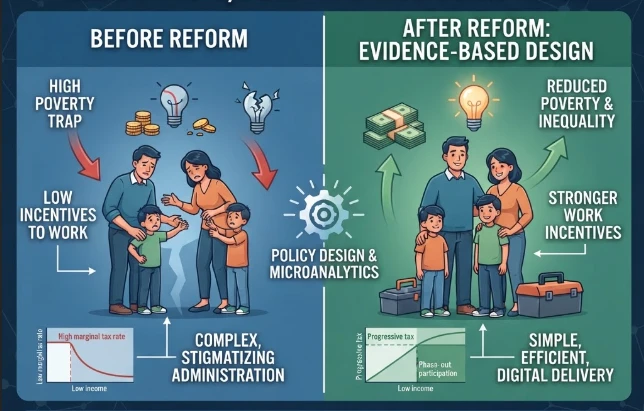
Tightly-targeted support can have a tension between poverty reduction and work incentives. A generous benefit provides income protection at the low end, but can lead to a high effective marginal tax rate due to fairly steep withdrawal rates at higher income levels. This is the percentage of each additional dollar of income lost due to increased taxes and reduced transfers. High rates do not necessarily indicate that jobs will not be created, but rather where there are significant opportunities for increasing output with a relatively small disposable income benefit.
Generosity is no guarantee of design quality, however.But design quality is not necessarily the result of generosity alone. Gradual tapers can soften the transitions to work, abrupt thresholds can form cliffs that affect hours, timing, and formal reporting. In some contexts, individual taxing may be more effective to strengthen the incentives for secondary earners than family-based taxing; in other contexts, there may be a stronger rationale for family-based transfer targeting the needs of the household. Policy is, however, a balancing act between equity, fiscal cost, targeting and administrative simplicity.
Economic welfare is a more encompassing measure than jobs. Household welfare may be affected by commuting, child care, health limitations, and lost leisure, in addition to extra work. A reform that boosts employment with a harsh cut in benefits may appear to be successful in terms of employment, but may negatively affect income security for a targeted population. Strong evaluation thus follows the employment, hours, disposable income, poverty depth, and fiscal cost.
The importance of mobility is that over time households move along the income distribution. A low income may be temporary related to studies, caregiving, unemployment, business flux, or early career stages or may be persistent and present a other policy challenge. Using tax-transfer modelling for a single year can detect immediate incidence, but not all lifetime effects. Longitudinal evidence helps explain whether support stabilises the temporary shock, is a deterrent to persistent poverty or affects opportunities for moving up.
The withdrawal of benefits and taxes also depend on the effectiveness of the work incentives, which are influenced by the calculation of the marginal rates. As several supports start to decrease, the return from additional income can be substantial, even if there is not a high income tax rate. There are tradeoffs for smoother targeting and fiscal cost; and between smoother withdrawal and improved incentives. Development-oriented reform is then a mixture of microsimulation, labour evidence, poverty metrics and access to services to ensure that packages are designed to assist with mobility without exposing households to an increase in poverty during transitions.
The design of welfare systems also introduces one more link between welfare and long-run productivity via human capital. Transfers that promote nutrition, housing stability and access to childcare and education, can benefit future earnings even though fiscal accounts may appear to be a cost in the short term. On the other hand, benefit rules which discourage training income or provide uncertainty about study can be detrimental to the incentive to invest in skills. A more serious work incentive system must not only look at the supply of labour now, but it must also ask the question: Do existing rules enhance future earning power?
A second is the word of caution from public economics: not all behavioral responses are "socially valuable. A tax adjustment that raises the supply of labour in the formal sector of the economy may affect unpaid care within a household, affect the demand for childcare, or affect market power through a combination of the above. Two-sided markets introduce additional complexities around the tax since a tax on the platform or provider may impact prices in more than one part of the transaction. Incidence rather than legal taxpayers in legislation is determined by elasticities and market structures.
The distributional tension is clearly captured by consumption taxes. Efficient and effective revenues can be collected by broad consumption taxes, but low income groups may spend more of their current income. That burden can be cushioned by lower rates on necessities, but large absolute benefits can also be obtained for high spending households. When administrative systems successfully identify eligible households, and payment rules are understood, targeted transfers can more directly reduce regressivity.
The best reform packages involve modelling as a tool to make decisions, not as a decorations piece at the end of the process when policy decisions are made. Before the drafting of legislation, distributional tables, effective-marginal-rate profiles, behavioural sensitivity tests, and fiscal scenarios can be created. Once results are obtained, thresholds and tapers, refundable credits, and transition rules can then be designed. But there is no way evidence can eliminate political options, it can reveal hidden trade-offs, and limit the danger of a simple headline creating a complex household reality.
A proper evaluation, thus, retains the legal design, behavioral response, administrative capability, and distribution within a common analytical frame. The test is whether the rule creates public value (measured in some way) after taking into account the fiscal cost, burden of compliance, and unintended incentives. Transparency is most helpful when assumptions, definitions, limitations and review criteria are provided prior to a policy becoming hard to change. This holistic approach also prevents giving the impression of fairness, efficiency or responsible behaviour, by simply focusing on one headline measure.
The frequency of the evaluation is important because technology, market structure, household situation and administrative capacity evolve more quickly than do many statutes.
CITE THIS ARTICLE
Sultana, K. R. (2025). Tax-Transfer Reform, Poverty Reduction, and Work Incentives: Evidence from Development economics, labour, welfare, migration, poverty, household economics. https://researchbysultana.com/article/4a5cd49a-a097-5f2a-99d6-00d048864d2a
K. R. Sultana, “Tax-Transfer Reform, Poverty Reduction, and Work Incentives: Evidence from Development economics, labour, welfare, migration, poverty, household economics,” 2025. [Online]. Available: https://researchbysultana.com/article/4a5cd49a-a097-5f2a-99d6-00d048864d2a
Sultana, K. R. (2025) ‘Tax-Transfer Reform, Poverty Reduction, and Work Incentives: Evidence from Development economics, labour, welfare, migration, poverty, household economics’. Available at: https://researchbysultana.com/article/4a5cd49a-a097-5f2a-99d6-00d048864d2a
Sultana, Kazi Rukaiya. “Tax-Transfer Reform, Poverty Reduction, and Work Incentives: Evidence from Development economics, labour, welfare, migration, poverty, household economics.” 2025, https://researchbysultana.com/article/4a5cd49a-a097-5f2a-99d6-00d048864d2a.
Kazi Rukaiya Sultana. “Tax-Transfer Reform, Poverty Reduction, and Work Incentives: Evidence from Development economics, labour, welfare, migration, poverty, household economics.” (2025). https://researchbysultana.com/article/4a5cd49a-a097-5f2a-99d6-00d048864d2a.
Sultana KR. Tax-Transfer Reform, Poverty Reduction, and Work Incentives: Evidence from Development economics, labour, welfare, migration, poverty, household economics. 2025. https://researchbysultana.com/article/4a5cd49a-a097-5f2a-99d6-00d048864d2a
@misc{article_4a5cd49aa0975f2a99d600d048864d2a,
  title = {Tax-Transfer Reform, Poverty Reduction, and Work Incentives: Evidence from Development economics, labour, welfare, migration, poverty, household economics},
  author = {Kazi Rukaiya Sultana},
  year = {2025},
  url = {https://researchbysultana.com/article/4a5cd49a-a097-5f2a-99d6-00d048864d2a},
}
TY  - GEN
AU  - Kazi Rukaiya Sultana
TI  - Tax-Transfer Reform, Poverty Reduction, and Work Incentives: Evidence from Development economics, labour, welfare, migration, poverty, household economics
PY  - 2025-04-06
UR  - https://researchbysultana.com/article/4a5cd49a-a097-5f2a-99d6-00d048864d2a
ER  -
This article uses institutional economics and applied microeconomics to show why tax-transfer reform cannot be evaluated from policy rules alone. Household disposable income reflects earnings, taxes, contributions, benefits, housing support and withdrawal schedules, but the effectiveness of those rules also depends on institutions that administer them. Different data systems, delayed appeals, inconsistent local delivery and administrative capacity can cause a theoretically efficient policy to wo
This article presents tax transparency as a governance and accounting issue rather than a simple disclosure exercise. Boards oversee tax outcomes that are influenced by risk appetite, capital allocation, internal controls, remuneration and significant transactions, while accounting systems provide the common record connecting financial profit, taxable income, deferred tax, cash tax and uncertain positions. IFRS S1 and IFRS S2 are used to show how sustainability-related financial information can
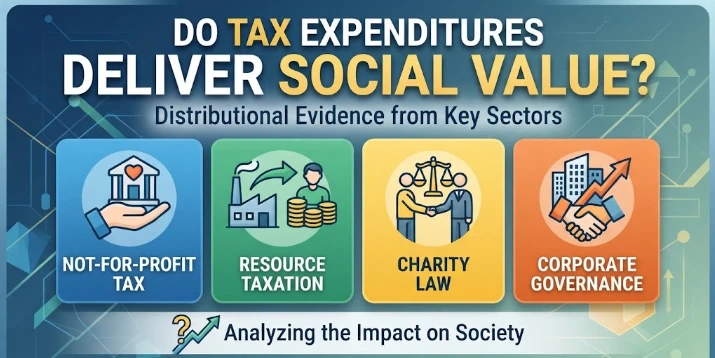
This article evaluates tax expenditures in not-for-profit, charity and resource-tax settings through distribution, governance and public value. Preferential treatment for charities and similar organisations is justified by public or community benefit, so reporting and governance should show whether concessions expand valued services, improve access or instead accumulate as private or organisational advantage. The article warns that annual income alone is an incomplete equity measure because life