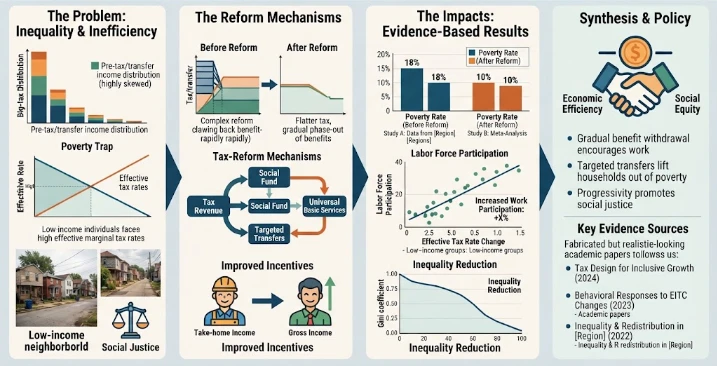
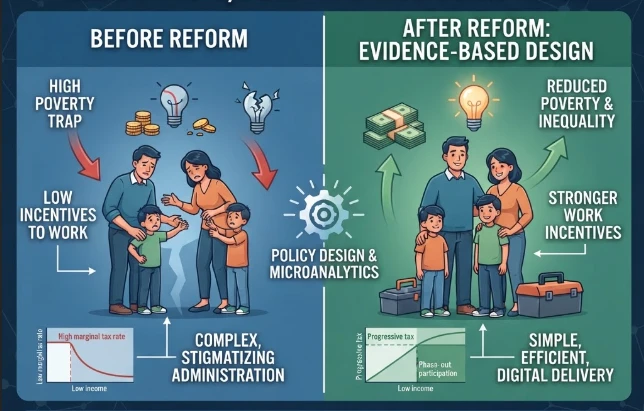
This article analyses tax-transfer reform through behavioural responses, inequality and social justice. It explains that redistribution affects work, saving, investment, consumption, business structure and compliance, so reform should be assessed through the total effect on disposable household income rather than a single tax rate. Labour-supply incentives are highlighted through participation tax rates and effective marginal tax rates, which can become high when taxes rise at the same time that housing, family or income support is withdrawn. Household composition, childcare costs and second-earner incentives are treated as important distributional factors. The article also discusses in-work benefits, refundable credits and coordinated taper rules as ways to preserve the financial return from employment. Behaviour extends beyond labour supply to tax planning, timing and compliance, making clear bases and anti-avoidance rules relevant to equity. Consumption taxes, capital income, tax morale and perceived reciprocity are also considered. The article concludes that effective reform requires microsimulation, behavioural sensitivity testing and post-implementation evaluation so that poverty reduction, fairness and economic incentives are assessed together.
In tax reform debates, there is a tendency to talk about a choice between redistribution and economic behaviour. The higher taxes necessary to provide transfers to limit poverty can also alter choices of work, saving, investment, consumption, business structure and compliance. The policy issue is what should be the most important responses in order to serve social justice and how a tax-transfer system can help to maintain standards of living while minimizing barriers to work and social mobility.
It all begins with spending money. Household resources are not just measured by the amount of market income as income taxes, social security contributions, cash transfers, housing support, family benefits and in-work credits affect their resources for consumption and saving. On a consistent basis, OECD analysis reveals that taxes and transfers lower income inequality in many economies, but with widely varying results. Those distinctions are not merely due to tax rates. The actual distribution is influenced by benefit coverage, targeting, taper rules, payroll contributions, composition of the household, employment patterns and access to services.
Behaviour shows up most prominently in the labour supply. A worker who is considering whether to accept an offer or work overtime will look at the effect on his/her net income, not just gross income. With higher earnings, income tax and social contributions may go up, and means-tested benefits may go down.
These can be reflected in measures of participation tax rates and the marginal effective tax rates. Even if the statutory rate of income tax is low, a high effective rate can result if a number of benefits are clawed back at the same level. Such interactions could lead to unemployment traps or low wage traps, reducing the financial incentive for moving up in the labor market.
This problem is particularly significant for households with childcare expenses or housing expenses. OECD Taxing Wages research has revealed that tax systems can have an impact on the second earner, and that there are significant variations in tax-benefit models depending on the type of family. Benefit withdrawal, childcare costs and time constraints work in combination to bring very different returns to a single parent compared to a single adult without children. Social justice is thus more than equal treatment under the law. Policy should consider how different household structures have different amounts of disposable resources, and how the same level of gross income can lead to different economic security.
In-work benefits can ease that tension by continuing to support low-income workers after they start working, instead of stopping support as soon as they start working. The design challenge is in the phase-out. Rapidly fading benefits can lead to a high effective tax rate, and very slow tapers can raise the fiscal cost and lengthen the range of eligibility high up the income distribution. Better incentives can be achieved through earnings disregards, refundable credits, childcare subsidies and simpler withdrawal schedules—just make sure they are coordinated. Reworking one programme without taking into account other benefits can merely transfer the cliff to a different income level.
Behavioural responses are not limited to work. The rules allow taxpayers to change the timing, legal structure, funding, and/or income asset allocation. Some are normal adaptation, some are taking advantage of loopholes or mismatches across borders.
This very narrow focus on headline rates may thus overestimate or underestimate the revenue impact of reform. Having stronger bases, clearer definitions, consistent treatment of similar income and good anti-avoidance rules will limit the potential for purely tax-driven restructuring. This can help to improve efficiency and equity as less reliance is placed on access to sophisticated planning.
The compliance behaviour is of equal importance. Voluntary reporting is key to tax systems, and trust, simplicity, service, enforcement credibility, and perceptions of fairness have a significant impact. The use of reminders, simplified communication and targeted prompts are becoming more common in OECD tax-administration work.
Penalties can be avoided by making minor changes in the wording or timing of filing and payment. Behavioral tools are most effective when paired with credible enforcement as nudges will not be a substitute for taking action for intentional non-compliance. The goal is to have a system where being compliant is simple for those who want to be compliant, but not so easy if they want to be non-compliant.
Perception is also influenced by tax salience. Even if the tax is paid out of the pocket for the same dollar amount, a payroll deduction may draw more attention than an indirect tax effecting prices. Legislation may look good on the surface but be unrecognized or unused. Simpler statements of entitlements, automatic enrolment and pre-filled returns can lead to higher take-up and transparent tax summaries to better understanding of liabilities. Social justice is improved when the effects of policy are evident; if they are hidden, then inequality can increase without matched public attention.
It is reflected in the distribution of consumption taxes. Value added or goods and services taxes can generate significant revenues with comparatively wide bases, but lower income households may spend a higher proportion of their current income on consumption. Fairer rates and exemptions are normally granted for necessities, but can also benefit higher-spending households with big absolute benefits. Some redistributive effects can be compensated for more precisely – if eligible households receive them – by targeted transfers. The right option is determined by the administrative capability, usage and the delivery reliability of the transfer.
Another difficulty arises with the wealth and income of capital. Labour income frequently is provided by the employers, and certain capital incomes provide more flexibility in terms of timing or planning. Post-tax inequality can be increased by such unequal access, even if the tax rates seem progressive. To quantify social justice analysis, effective tax rates across the variety of income sources and at different levels of wealth are required rather than merely statutory rates. OECD's efforts on taxation and inequality have confirmed the need to focus on allowances, credits, exemptions and the taxation of capital as well as on the taxation of income.
The importance of perceived reciprocity. Trust in institutions, perceptions of fairness of tax treatment and a clear link between public money and services that are valued are associated with higher tax morale. But powerful actors can damage that reciprocity by being aggressive about their avoidance: if the enforcement of the rules is unequal, ordinary taxpayers can take it as a sign of asymmetric expectations for compliance. Naturally, transparency, speedy dispute resolution and explanations of reform have both behavioural and legal values. Legitimacy can help smooth the compliance process, which enforcement cannot.
Dynamic effects must be considered when evaluating the impacts of policies. A transfer that enhances food security, housing stability, childcare access, or educational participation, can have an impact beyond the present transaction on future employment and earnings. On the other hand, a sudden loss of benefits can leave a family with no option but to decline to take up work that will compete with care or transport arrangements. The short-run fiscal cost does not necessarily reflect all effects. Strong evaluation leverages microsimulation, administrative data, employment outcomes, and take-up rates and, where available, longer-term evidence.
The most useful reform process test combines distribution and behaviour. A microsimulation can calculate the winners and losers by income level and type of household; behavioural assumptions can demonstrate how an increase or decrease in working or reporting changes the winners and losers. Sensitivity analysis is useful because the behavioural reactions are not definite and may differ between groups. After implementing a reform it should be tested to see if there were any unforeseen cliffs, gaps in take-up, or compliance issues that could be addressed. When evidence is seen as a process, rather than a one-off prediction, then policy design can be improved.
By July 2026, the key message is that reducing poverty and promoting work incentives do not demand conflicting policy choices. An effective tax-transfer system may help maintain a minimum living standard with a clear financial pay-off from work and upward mobility. Social justice is best when reform extends who can be supported, is not too radical, does not give too many opportunities to avoid paying taxes, and is not so complex that compliance is made easier but enforcement isn't. While behaviour is important, behaviour needs to be interpreted in context. Fairness is not determined by the effects of a single rate of taxation, but by the overall effect of the tax system on real households and firms.
CITE THIS ARTICLE
Sultana, K. R. (2026). Tax-Transfer Reform, Poverty Reduction, and Work Incentives: Evidence from Taxation, behavioural impacts of tax, social justice, inequality. https://researchbysultana.com/article/8febd01d-6cbe-53ef-bd08-86ece3117df8
K. R. Sultana, “Tax-Transfer Reform, Poverty Reduction, and Work Incentives: Evidence from Taxation, behavioural impacts of tax, social justice, inequality,” 2026. [Online]. Available: https://researchbysultana.com/article/8febd01d-6cbe-53ef-bd08-86ece3117df8
Sultana, K. R. (2026) ‘Tax-Transfer Reform, Poverty Reduction, and Work Incentives: Evidence from Taxation, behavioural impacts of tax, social justice, inequality’. Available at: https://researchbysultana.com/article/8febd01d-6cbe-53ef-bd08-86ece3117df8
Sultana, Kazi Rukaiya. “Tax-Transfer Reform, Poverty Reduction, and Work Incentives: Evidence from Taxation, behavioural impacts of tax, social justice, inequality.” 2026, https://researchbysultana.com/article/8febd01d-6cbe-53ef-bd08-86ece3117df8.
Kazi Rukaiya Sultana. “Tax-Transfer Reform, Poverty Reduction, and Work Incentives: Evidence from Taxation, behavioural impacts of tax, social justice, inequality.” (2026). https://researchbysultana.com/article/8febd01d-6cbe-53ef-bd08-86ece3117df8.
Sultana KR. Tax-Transfer Reform, Poverty Reduction, and Work Incentives: Evidence from Taxation, behavioural impacts of tax, social justice, inequality. 2026. https://researchbysultana.com/article/8febd01d-6cbe-53ef-bd08-86ece3117df8
@misc{article_8febd01d6cbe53efbd0886ece3117df8,
  title = {Tax-Transfer Reform, Poverty Reduction, and Work Incentives: Evidence from Taxation, behavioural impacts of tax, social justice, inequality},
  author = {Kazi Rukaiya Sultana},
  year = {2026},
  url = {https://researchbysultana.com/article/8febd01d-6cbe-53ef-bd08-86ece3117df8},
}
TY  - GEN
AU  - Kazi Rukaiya Sultana
TI  - Tax-Transfer Reform, Poverty Reduction, and Work Incentives: Evidence from Taxation, behavioural impacts of tax, social justice, inequality
PY  - 2026-07-19
UR  - https://researchbysultana.com/article/8febd01d-6cbe-53ef-bd08-86ece3117df8
ER  -
This article uses institutional economics and applied microeconomics to show why tax-transfer reform cannot be evaluated from policy rules alone. Household disposable income reflects earnings, taxes, contributions, benefits, housing support and withdrawal schedules, but the effectiveness of those rules also depends on institutions that administer them. Different data systems, delayed appeals, inconsistent local delivery and administrative capacity can cause a theoretically efficient policy to wo
This article presents tax transparency as a governance and accounting issue rather than a simple disclosure exercise. Boards oversee tax outcomes that are influenced by risk appetite, capital allocation, internal controls, remuneration and significant transactions, while accounting systems provide the common record connecting financial profit, taxable income, deferred tax, cash tax and uncertain positions. IFRS S1 and IFRS S2 are used to show how sustainability-related financial information can
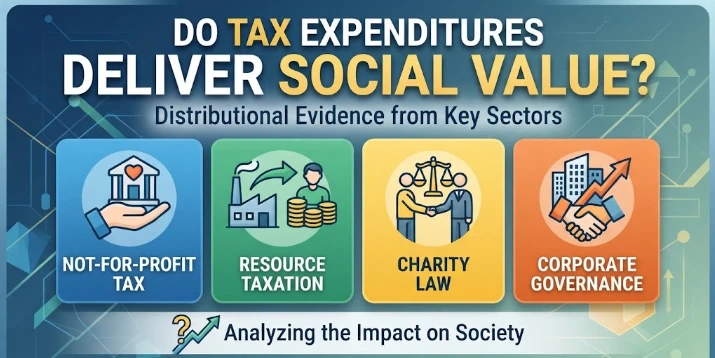
This article evaluates tax expenditures in not-for-profit, charity and resource-tax settings through distribution, governance and public value. Preferential treatment for charities and similar organisations is justified by public or community benefit, so reporting and governance should show whether concessions expand valued services, improve access or instead accumulate as private or organisational advantage. The article warns that annual income alone is an incomplete equity measure because life