From Tax Gap to Compliance Design: Behavioural and Administrative Evidence on Tax compliance, tax administration, tax evasion, taxpayer behaviour, tax policy
Kazi Rukaiya Sultana (Master of Public Policy & Master of Social Welfare and Research)
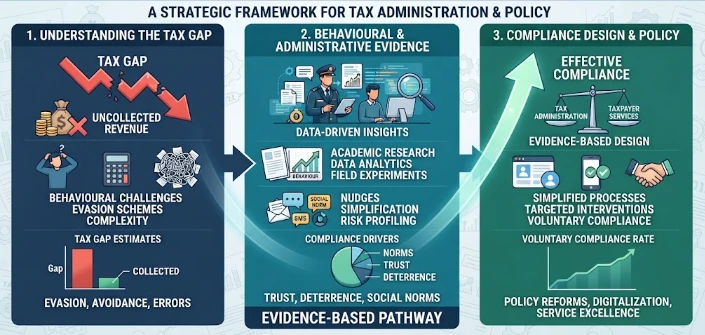
This article explains why tax administration should distinguish deliberate evasion from error, disputed interpretation and temporary inability to pay. A single tax-gap figure cannot reveal motive, so compliance policy needs diagnostic evidence and proportionate responses. Fiscal federalism can increase complexity when several governments use different definitions, rates, exemptions or data systems, while corporate evasion and avoidance require specialist tools for financing, intangibles, transfer pricing and cross-border structures. Governance and corruption risks also affect compliance if enforcement appears selective or settlements are opaque. The article recommends transparent tax-gap methodology, stable measurement and clear communication of uncertainty. Simplification can itself be a compliance intervention because each special rule creates additional boundaries that must be understood, recorded and verified. Behavioural evidence shows that penalties and audit probability interact with trust, fairness, social norms, cash-flow pressure and ease of filing. Digital systems can reduce routine burden only when software, identity and data standards are reliable. Risk segmentation therefore supports education for simple mistakes, workable payment arrangements for hardship and strong verification for intentional concealment.
The tax gap is more than a revenue figure. It is the gap between tax that would be collected if there was no change in the law and the amount of tax that is actually collected, as per the estimation method adopted by an administration. According to OECD Tax Administration 2024, more jurisdictions are now estimating gaps to gain insights into the extent and characteristics of non-compliance. The policy derives from the diagnosis – the nature of the gap dictates the type of treatment, data sources, service strategies and responses to enforcement.
The deliberate withholding of payments is tax evasion, but non-compliance can also be due to errors, conflicting interpretations and payment issues. If every hole is equated with taxpayer behaviour, one is left with no clue as to what it is. Administration requires diagnostic tools that will differentiate concealment from confusion/ability. Such a distinction would help ensure proportionality of enforcement and provide robust sanctions against deliberate fraud.
Fiscal federalism is adding another layer in which several governments share tax bases or administrative functions. Variability in definitions, rates, exemptions and data systems can add to the complexity of complying with multiple jurisdictions. Coordination can help limit duplication by having a common registration system, exchanging information, having harmonised definitions, or central collection systems. The appropriate institutional structure is determined by constitutional duties, revenue autonomy and the importance attached to local policy autonomy.
Corporate tax evasion demands a distinct toolbox to the small-business record errors. Financing structures, intangible assets, transfer pricing, entity chains and cross-border mismatches, which require specialist knowledge and international information, can be used to finance large groups. While the public disclosure (and tax transparency) may enhance accountability, raw disclosure without context can mislead as book profit and taxable profit is done differently. The proper blend of accounting analysis, legal interpretation, economic substance and risk-based engagement.
Governance and corruption risks also impact on the credibility of administration. Even when the statutory rules appear to be good, they may fail to improve the compliance rate because of "selective enforcement," "opaque settlements," weak procurement controls, or "conflicts of interest. Legitimacy is promoted by having a right to independence, documented procedures, reviewing rights, and publishing aggregated performance information. Compliance design exists within a larger rule of law context and not within a narrow collection function.
There should be a distinction between gross and net gaps, between model uncertainty and the impact of administration. Even if the underlying risks are significant, a net gap after compliance activity can be negative, and economic shocks can shift both liabilities and payment capacity. If you are interpreting a time-series, you should use stable methods or make transparent revisions. Stakeholders can appreciate uncertainty and methodology as they get stronger, not weaker, as it increases the utility of the gap estimates.
The examples of Australia's tax-gap program show that with unusual detail, the public can be given estimates of how much tax is expected to be uncollected. The overall gap, earmarked to be approximately 58.2 billion Australian dollars, or 9.1 percent, was led by the net gap in small business, which is approximately 27.2 billion Australian dollars. Large amounts of people outside of business and GST also. Those are not the same numbers for each group - they indicate why addressing all of non-compliance with one enforcement approach is not possible.
Easing enforcement pressure through tax policy would include making taxation bases simpler, and minimizing excess exemptions. For each special rule, another fact boundary is established that needs to be known, recorded, and checked. Simplification can thus be used as a form of compliance action without the need for extra audit personnel. The consequences of compliance are key to the proper functioning of policy and administration.
Deterrence is complicated by behavioural evidence. Penalties and audit probability are important but compliance is also affected by clarity, trust, perceived fairness, social norms, cash-flow pressure and ease of completion of obligations. OECD tax administration work indicates a rise in the number of behavioural researchers and targeted communications used. A well-timed reminder will save an error, and many rules will be able to produce errors, just like evasion in aggregate data.
Compliance costs must be considered as well, as administrative hassles can lead small businesses to make mistakes or become informal. When there is no tax due, the economic cost of time that is spent interpreting rules, on records, on GST reconciliation and then on GST returns corrections is still there. Reducing routine burden with digital filing can only be achieved with software, identity systems and data standards that work effectively and reliably. Seemingly bad “digital obligations” can just shift the cost from government offices to businesses and professional advisers.
A more proportional approach is the risk segmentation model. There is a need for education and correction for taxpayers who have committed simple errors, workable arrangements for those who are struggling with their tax payment, and robust verification for those who have deliberately concealed their error. Inaccuracies should not be considered fraud, which will cause enforcement efforts to be diverted and reduce voluntary compliance. Equating every discrepancy with "innocent" means that deterrence and fairness of those who pay taxes without being checked are undermined, which causes the opposite problem.
Special rules also create additional boundaries to complicate compliance, and tax expenditures are a factor in that. Deductions/exemptions, reduced rates and sector concessions give rise to classification issues and planning opportunities. Additional boundaries can create true ambiguity and aggressive reading. Fiscal authorities must therefore approach these tax expenditures with some degree of administrative skepticism; a concession that has relatively low policy impact can still be very complex, and incur costs that exceed the revenue projection that is included in a budget statement.
The transaction trails benefit are demonstrated in the GST and VAT regime. Whilst invoice chains can add third-party data which may help with verification, refund fraud, missing traders, cash transactions, and classification disputes are still relevant risks. Invoicing and data matching can enhance visibility in cases where the legal and technical framework is developed. Even with large data sets, there remains a need for strong measures to ensure data accuracy, privacy, and the absence of false positives in risk models without context.
The modern approach to compliance as a result is a blend of prevention, facilitation, verification and enforcement. Reliable, pre-filled data can help avoid omissions; comprehensive instructions can help minimize misentry; focused analysis can lead to the identification of high-risk situations; and robust sanctions can ensure that instances of intentional misentry are addressed. Revenue, burden, fairness and trust should all be assessed in all the interventions. The aim should not be to have the greatest possible number of boys and girls removed from the classroom; it should be to ensure that they are compliant with the standards at the least possible social and administrative expense.
The more durable the policy, the more effective the evaluation criteria will be if they are mutually agreed upon before beneficiaries and administrators adapt to a permanent policy. The test of any reform is whether it's defendable when fiscal cost, distribution, complexity and uncertainty are all on the table. Thus, good design takes transparency as much as a component of the policy architecture as it is a communication exercise after the policy has been implemented. Another benefit of this is that the potential trade-offs will become apparent before thresholds, exemptions, or enforcement limits are established as the norm.
What is intended to be deeper is that fiscal design should be challenged by the actual behaviour of the system, and not just depend on statutory labels. This is an important distinction as legal form and economic incidence can vary in opposite directions after adjustment. Another protection is to make assumptions clearly known to others so that they can generate their own analysis or question the central finding. The strength of evidence is also enhanced when distribution, administration and behaviour are analysed together, not separately.
Restoring the durability of a policy can be achieved by establishing the conditions for evaluation in advance of adaptation by beneficiaries and administrators around a permanent rule. The test of a reform is whether the fiscal cost, distribution, complexity and uncertainty are all on equal footing. Good design will therefore consider transparency as an element of policy architecture, not just a communication tool after the policy is in place. One benefit of this is that hidden aspects of trade-offs are brought to light before thresholds, exemptions, or enforcement settings become part of the day-to-day routine.
The subtler message is that fiscal design should be evaluated based on observed behaviour, not just presumed from statutory labels. This is important because the legal form and economic incidence may in fact go in opposite directions when households or firms adjust. Another precaution is to state assumptions explicitly so that they can be repeated or disputed by other independent researchers.
CITE THIS ARTICLE
Sultana, K. R. (2025). From Tax Gap to Compliance Design: Behavioural and Administrative Evidence on Tax compliance, tax administration, tax evasion, taxpayer behaviour, tax policy. https://researchbysultana.com/article/8b2c1c64-a5cc-518e-a1ba-17b2cbed8b35
K. R. Sultana, “From Tax Gap to Compliance Design: Behavioural and Administrative Evidence on Tax compliance, tax administration, tax evasion, taxpayer behaviour, tax policy,” 2025. [Online]. Available: https://researchbysultana.com/article/8b2c1c64-a5cc-518e-a1ba-17b2cbed8b35
Sultana, K. R. (2025) ‘From Tax Gap to Compliance Design: Behavioural and Administrative Evidence on Tax compliance, tax administration, tax evasion, taxpayer behaviour, tax policy’. Available at: https://researchbysultana.com/article/8b2c1c64-a5cc-518e-a1ba-17b2cbed8b35
Sultana, Kazi Rukaiya. “From Tax Gap to Compliance Design: Behavioural and Administrative Evidence on Tax compliance, tax administration, tax evasion, taxpayer behaviour, tax policy.” 2025, https://researchbysultana.com/article/8b2c1c64-a5cc-518e-a1ba-17b2cbed8b35.
Kazi Rukaiya Sultana. “From Tax Gap to Compliance Design: Behavioural and Administrative Evidence on Tax compliance, tax administration, tax evasion, taxpayer behaviour, tax policy.” (2025). https://researchbysultana.com/article/8b2c1c64-a5cc-518e-a1ba-17b2cbed8b35.
Sultana KR. From Tax Gap to Compliance Design: Behavioural and Administrative Evidence on Tax compliance, tax administration, tax evasion, taxpayer behaviour, tax policy. 2025. https://researchbysultana.com/article/8b2c1c64-a5cc-518e-a1ba-17b2cbed8b35
@misc{article_8b2c1c64a5cc518ea1ba17b2cbed8b35,
  title = {From Tax Gap to Compliance Design: Behavioural and Administrative Evidence on Tax compliance, tax administration, tax evasion, taxpayer behaviour, tax policy},
  author = {Kazi Rukaiya Sultana},
  year = {2025},
  url = {https://researchbysultana.com/article/8b2c1c64-a5cc-518e-a1ba-17b2cbed8b35},
}
TY  - GEN
AU  - Kazi Rukaiya Sultana
TI  - From Tax Gap to Compliance Design: Behavioural and Administrative Evidence on Tax compliance, tax administration, tax evasion, taxpayer behaviour, tax policy
PY  - 2025-12-17
UR  - https://researchbysultana.com/article/8b2c1c64-a5cc-518e-a1ba-17b2cbed8b35
ER  -
This article uses institutional economics and applied microeconomics to show why tax-transfer reform cannot be evaluated from policy rules alone. Household disposable income reflects earnings, taxes, contributions, benefits, housing support and withdrawal schedules, but the effectiveness of those rules also depends on institutions that administer them. Different data systems, delayed appeals, inconsistent local delivery and administrative capacity can cause a theoretically efficient policy to wo
This article presents tax transparency as a governance and accounting issue rather than a simple disclosure exercise. Boards oversee tax outcomes that are influenced by risk appetite, capital allocation, internal controls, remuneration and significant transactions, while accounting systems provide the common record connecting financial profit, taxable income, deferred tax, cash tax and uncertain positions. IFRS S1 and IFRS S2 are used to show how sustainability-related financial information can
This article evaluates tax expenditures in not-for-profit, charity and resource-tax settings through distribution, governance and public value. Preferential treatment for charities and similar organisations is justified by public or community benefit, so reporting and governance should show whether concessions expand valued services, improve access or instead accumulate as private or organisational advantage. The article warns that annual income alone is an incomplete equity measure because life