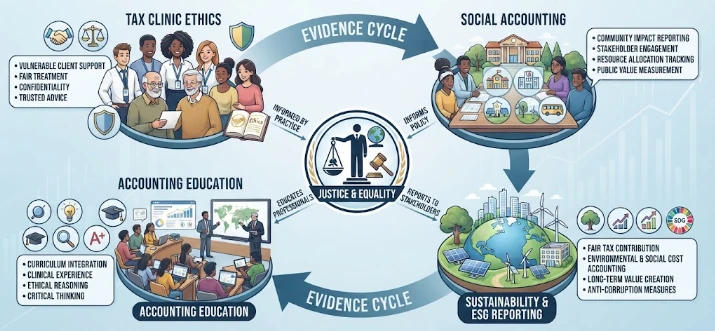
This article approaches tax justice through access to rights, tax-clinic ethics, social accounting and accounting education. It argues that formal rights have limited value when taxpayers cannot understand obligations, collect records, communicate with authorities or obtain affordable review. Tax clinics make these issues visible because clients may arrive with incomplete records, debt, language barriers or fear of enforcement, requiring confidentiality, conflict checks, informed consent and realistic advice. The article links procedural fairness to voluntary compliance and explains why consistent reasons, review pathways and respectful communication strengthen legitimacy. It also broadens the fairness lens through gender budgeting, public finance, retirement concessions and corporate disclosure. Social and sustainability accounting add questions about environmental and social costs that may sit outside traditional tax calculations. Clinics provide both taxpayer support and a supervised learning environment where future professionals confront ethics, digital access, professional limits and referral needs. The article concludes that tax justice should be measured through understandable rules, affordable assistance, transparent decisions, proportional enforcement and evidence about how institutions work in practice.
Tax justice is often talked about in terms of rates and redistribution but the perception of rights starts with procedure. An obligation must be explained to a taxpayer; the taxpayer must be able to get records; the taxpayer must be able to communicate with a authority; the taxpayer must be able to challenge an assessment; and the taxpayer must be able to get a review at an affordable cost. Professional advice can be a necessary component to participation and turn a formal equality into a practical inequality. Access to rights analysis is concerned with the question of whether 'ordinary people' and 'small entities' are able to avail of the rights which are enshrined in tax law.
Tax-clinic ethics is a confluence of professional responsibility and justice. Records are incomplete, debt pressures often exist, there are language barriers and fears of enforcement so there is a need for careful confidentiality, conflict checking, informed consent and realistic explanation of options. The clinic should never be a way to circumvent compliance rules, but the ethical practice also does not allow to assume that any mistake is an indication of dishonesty. Students have the opportunity to experience the human impact of tax administration in the educational environment, where they are supervised and subject to professional expectations.
Voluntary compliance is also influenced by procedural fairness. When reasons are clear, evidence is taken into account, there are review mechanisms that are credible, and communication is respectful, then people tend to accept the adverse outcome. So, the study of behavioural tax has evolved beyond a limited view based on the fear of being audited. Enforcement is not the end goal here and won't eliminate the need for trust, but a consistent process can make enforcement more legitimate and minimize the impression that it is somehow based on resources or connections.
A gender budgeting approach extends the tax-justice prism because a rule that is neutral on the face of it may have different impacts on patterns of labour and household. Incidence can be influenced by disparities in paid work, unpaid care, retirement saving, property ownership and consumption. It is, however, possible to have a budget that is distributionally unequal without having a specific gender dimension. Gender-aware analysis questions: Who gets concession, who pays consumption taxes, who is eligible for tax credits, and how do policy decisions relate to earning and care responsibilities?
The spending side of the fairness equation is added by public finance. Tax justice is not just about who pays; because, funds for health, education, infrastructure, income support, security and administration requires revenue. Fiscal-incidence analysis is a technique which connects taxes and benefits, showing the overall impact on household resources. Such an argument also prevents a simplistic argument of 'fairness' or 'unfairness' of a single tax without taking into account the services and transfers that the tax supports.
The intersections between company law and securities regulation and tax justice are related to disclosure and governance. The information that boards, investors, auditors, regulators and tax authorities can see is a matter of corporate reporting. There are a number of factors to consider for risk assessment, including related party transactions, executive incentives, provisions, deferred tax and uncertain tax positions. Aggressive tax planning will not go away if you have strong governance, but clear accountability and trustworthy governance make it more difficult to maintain hidden strategies.
Small businesses often have a unique access problem as legal obligations can seem similar to those of larger businesses, but without the built-up know-how. Cumulative burden can occur when an entity's choices and record retention, payroll and deductions, and GST registration are all considered. Clinics and easy-to-understand information can help prevent small issues from turning into an invasive debt. The better long run option is to simplify due to the fact that support services should not be a reward for unnecessary complexity.
Social accounting and sustainability accounting expand that education, by asking who bears the costs that are not included in the standard calculation of taxes. A legally deductible business decision may result in a transfer of environmental or social costs to communities, and a tax concession may fund mixed public outcomes. Statutory technique is reinforced when linked to distribution, externalities, governance and evidence in the context of accounting education. That link also enables future advisers to identify the areas where technically correct advice can generate a broader reputational or policy issue.
An additional layer of access and distribution is revealed in retirement policy. Tax breaks for superannuation or retirement savings may help with the security of their income over time, but the fiscal value may differ significantly depending on their capacity to make contributions, tax rates, and account balances. Deductions that have to be made now will only benefit lower income workers to a limited extent. Taking account of interaction with public pensions, age, housing costs, preservation rules, contribution caps and refundable offsets are part of fair design.
There is also a rule-of-law question as to the level of certainty that can only apply to parties who have the means to afford specialist interpretation on advanced tax issues. Uncertainty can be minimised through private rulings, public guidance, safe harbours, and published administrative positions, as long as they are broadly accessible and consistently reasoned. More discretion means more risk as similar facts might yield different results. Transparent interpretation is then a tool of justice, and a tool of administrative efficiency.
Enforcement should not be disproportionate. Combating intentional tax avoidance will benefit those who pay their taxes on time, but injudicious enforcement of these measures can have harsh repercussions for those who are experiencing a hardship or lack of understanding. Debt collection, penalties, garnishment and litigation must be protected, and be subject to review and unequivocated escalation rules. A rights-based system does not sweep all issues under the single rubric of 'moral' but distinguishes between 'inability' and 'mistake' and between 'avoidance' and 'fraud'.
The believability of reform is enhanced when access indicators are placed next to revenue indicators. Administrations can monitor the resolution of complaints, review results, processing time, debt persistence, digital exclusion, referral to clinics, and the nature and frequency of errors. This information can help determine if the legal changes are helping to smooth out friction or simply moving it elsewhere. Tax justice is thus measurable not just on the back of abstract arguments about statutory rates but on a day-to-day basis, through the functioning of institutions.
Tax clinics fill this need. The National Tax Clinic program is funded by the Government and provides assistance on tax matters to eligible individuals and small businesses. Clinics also provide learning experiences to supervised students and provide information on common administrative issues. What that combination is important is that what might happen with individual casework could be identified as systemic barriers to accessing services or services to access, such as debt, record keeping, registration, family circumstances, digital access, legal notice misunderstanding etc.
Tax Literacy is a second layer of justice. Understanding the filing dates, deductible expenses, business registration, instalments and review rights can avoid unnecessary debt and penalties. Literacy should not be a replacement for simple law, as even the well-informed tax-payers find it difficult to understand the rules that have several definitions and exceptions. Effective systems feature clear instructions and fair responsibilities and are supported by professional or community resources that are easily available.
The practical test is the ability to engage in the tax system. It calls for rules that are understandable, assistance that is affordable, decisions that are transparent, effective review, and distributional analysis prior to reforms being implemented. Although revenue collection is crucial for the provision of public services, its legitimacy increases if the rights are put into practice. A tax system is only as popular as it is comperable, easily enforced, and subject to debate by both individuals and organizations over income and organisational lines.
The same attitude also means that uncertainty is revealed, thereby enhancing decision-making when there is no possibility of calculating behavioural responses or implementation costs accurately. Another protection is to have assumptions, definitions, and criteria for evaluation published prior to a policy becoming politically challenging to change. The fiscal cost, fairness, behaviour and administrative burden are more informative if they are all included in the same assessment, and not all in separate policy narratives. Long-run credibility requires a system of review procedures with the ability to change eligibility, thresholds, or reporting requirements as economic conditions and technology evolve.
So the question is really, does the instrument provide measurable public value when compliance costs, distribution, and opportunity costs are taken into account? Transparent governance transforms that question into repeatable governance, rather than a one-off justification at the moment of introduction. This 'all-in-one' approach minimizes the chances that a technically valid rule will fail to deliver a good result when households, firms and administrators react to lived incentives. Rather than relying on labels, the better analytical approach is to examine the incentives and distributional impacts of statutory design in light of administration needs.
CITE THIS ARTICLE
Sultana, K. R. (2025). Tax Justice in Practice: Access-to-Rights Evidence from Tax clinic ethics, social accounting, sustainability, accounting education. https://researchbysultana.com/article/82ca5f1b-aa2b-5ca0-86d7-b98ca4929bcd
K. R. Sultana, “Tax Justice in Practice: Access-to-Rights Evidence from Tax clinic ethics, social accounting, sustainability, accounting education,” 2025. [Online]. Available: https://researchbysultana.com/article/82ca5f1b-aa2b-5ca0-86d7-b98ca4929bcd
Sultana, K. R. (2025) ‘Tax Justice in Practice: Access-to-Rights Evidence from Tax clinic ethics, social accounting, sustainability, accounting education’. Available at: https://researchbysultana.com/article/82ca5f1b-aa2b-5ca0-86d7-b98ca4929bcd
Sultana, Kazi Rukaiya. “Tax Justice in Practice: Access-to-Rights Evidence from Tax clinic ethics, social accounting, sustainability, accounting education.” 2025, https://researchbysultana.com/article/82ca5f1b-aa2b-5ca0-86d7-b98ca4929bcd.
Kazi Rukaiya Sultana. “Tax Justice in Practice: Access-to-Rights Evidence from Tax clinic ethics, social accounting, sustainability, accounting education.” (2025). https://researchbysultana.com/article/82ca5f1b-aa2b-5ca0-86d7-b98ca4929bcd.
Sultana KR. Tax Justice in Practice: Access-to-Rights Evidence from Tax clinic ethics, social accounting, sustainability, accounting education. 2025. https://researchbysultana.com/article/82ca5f1b-aa2b-5ca0-86d7-b98ca4929bcd
@misc{article_82ca5f1baa2b5ca086d7b98ca4929bcd,
  title = {Tax Justice in Practice: Access-to-Rights Evidence from Tax clinic ethics, social accounting, sustainability, accounting education},
  author = {Kazi Rukaiya Sultana},
  year = {2025},
  url = {https://researchbysultana.com/article/82ca5f1b-aa2b-5ca0-86d7-b98ca4929bcd},
}
TY  - GEN
AU  - Kazi Rukaiya Sultana
TI  - Tax Justice in Practice: Access-to-Rights Evidence from Tax clinic ethics, social accounting, sustainability, accounting education
PY  - 2025-11-09
UR  - https://researchbysultana.com/article/82ca5f1b-aa2b-5ca0-86d7-b98ca4929bcd
ER  -
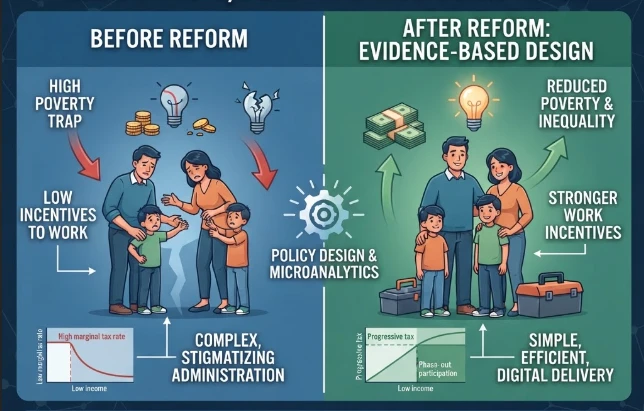
This article uses institutional economics and applied microeconomics to show why tax-transfer reform cannot be evaluated from policy rules alone. Household disposable income reflects earnings, taxes, contributions, benefits, housing support and withdrawal schedules, but the effectiveness of those rules also depends on institutions that administer them. Different data systems, delayed appeals, inconsistent local delivery and administrative capacity can cause a theoretically efficient policy to wo
This article presents tax transparency as a governance and accounting issue rather than a simple disclosure exercise. Boards oversee tax outcomes that are influenced by risk appetite, capital allocation, internal controls, remuneration and significant transactions, while accounting systems provide the common record connecting financial profit, taxable income, deferred tax, cash tax and uncertain positions. IFRS S1 and IFRS S2 are used to show how sustainability-related financial information can
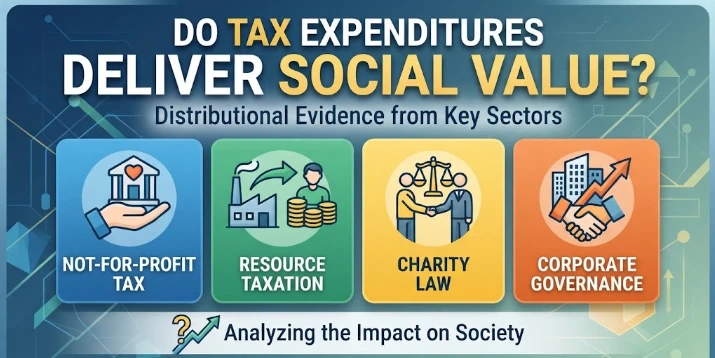
This article evaluates tax expenditures in not-for-profit, charity and resource-tax settings through distribution, governance and public value. Preferential treatment for charities and similar organisations is justified by public or community benefit, so reporting and governance should show whether concessions expand valued services, improve access or instead accumulate as private or organisational advantage. The article warns that annual income alone is an incomplete equity measure because life