This article uses institutional economics and applied microeconomics to show why tax-transfer reform cannot be evaluated from policy rules alone. Household disposable income reflects earnings, taxes, contributions, benefits, housing support and withdrawal schedules, but the effectiveness of those rules also depends on institutions that administer them. Different data systems, delayed appeals, inconsistent local delivery and administrative capacity can cause a theoretically efficient policy to work poorly in practice. The article treats these institutional constraints as part of policy design rather than an implementation afterthought. It examines benefit tapers, work incentives, household targeting, mobility, human capital and broader welfare outcomes that include commuting, childcare, health and lost leisure. Consumption taxes and fiscal incidence demonstrate why progressivity must be considered across the whole fiscal system. Microsimulation can identify distributional effects and effective marginal rates, while longitudinal evidence helps distinguish temporary low income from persistent disadvantage. Administrative access, digital alternatives and fiscal sustainability are also necessary. The article concludes that durable reform requires transparent assumptions, pre-legislative modelling and evaluation that combines behavioural response, institutional capacity, distribution and fiscal cost.
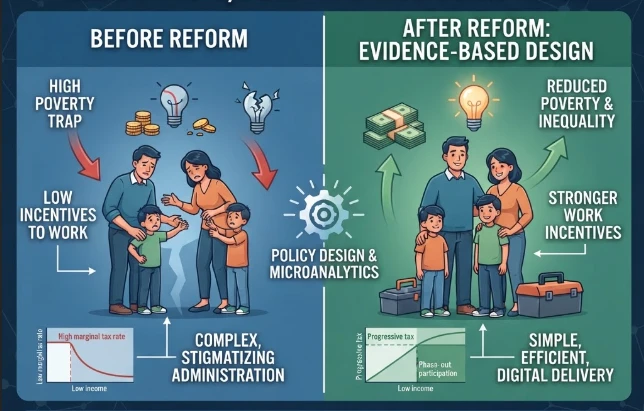
Tax-transfer policy does not operate directly on the tax rate, but through a change in the level of disposable income. Several income categories are merged to form a household budget: earnings, income tax, social contributions, cash benefits, housing support, family payments and withdrawal rules. The reduction of one tax rate can lead to a small benefit after another payment has been deducted. Thus, for poverty and work incentives, the object of interest is the global household budget constraint at varying levels of household earnings.
Institutional economics focuses on the rules, organisations and incentives which influence policy outcomes. Even the best of models can appear efficient in the abstract, but fail to work well in practice when agencies rely on different data sources, appeals are delayed, or local delivery brings inconsistent access. Household, firm and administrative evidence is used to test those mechanisms with the help of applied microeconomics. The robust design of the policy is achieved by making institutional restrictions variables and not a detail of the implementation of the policy which is written into the legislation once the law is drafted.
Generosity is not the sole determinant of the quality of a design. Transitions may be gradual, creating smooth slopes to work; or abrupt, which can affect hours, timing, and formal reporting. What is true is that individual taxation can reinforce the incentive for the second earner relative to the need of the family, in certain contexts, while the family-based transfer can focus directly on the need of the family. Trade-offs exist in policy in the areas of equity, fiscal cost, targeting and administrative simplicity.
Economic welfare is a more general measure than jobs. Household welfare can be impacted by extra work, which is related to increases in output and income, but also by the impacts of commuting, child care, health effects, and lost leisure time. A reform that boosts employment by cutting benefits can appear to be successful in one sense of the word, but to the detriment of a vulnerable group in the other. Strong evaluation thus addresses three additional dimensions of employment and hourly income, poverty depth, and fiscal cost in tandem.
Households move around in their income distribution over time, which is why mobility is important. Low income is temporary in some cases, as when a student or caregiver, or when a person is out of the labor market for a period, or when a business is volatile or early in its development, or when a person is young early in their career, or for many other reasons.Low income is temporary in many cases (e.g. a student or caregiver, or a person who is out of the labor market for a time, or a business that is volatile or early in its development, a young person early in his or her career, for many other reasons, etc.). It is important to note that tax-transfer modelling for a single year can only detect immediate incidence, not all lifetime impacts. Longitudinal evidence helps to clarify the impact of support, whether it is stabilising temporary shocks, preventing the persistence of poverty or altering opportunity for mobility.
The role of human capital is a second connection between welfare design and long-term productivity.There is a second link between welfare design and long-term productivity, through human capital. Transfers that facilitate access to childcare, education, housing, or a nutrition benefit can pay off in the longer run, even if short-term fiscal accounts would appear to take a hit. Adverse benefit rules, on the other hand, can discourage skill investment if they penalise the training income or if they are not clear in regard to study. A serious work-incentive framework, therefore, extends beyond the current supply of labour and examines whether the existing rules have the effect of enhancing future earning ability.
Public economics also cautions against the social worth of each and every behavioural response. A tax increase which raises formal labour supply may result in a shift in informal care within a household, affect the demand for childcare, or affect market power. Complications arise with two sided markets as a tax on a platform or provider can impact more than one side of the market. The incidence of tax does not only depend on who is the legal taxpayer in legislation, but also on the elasticity of supply and demand, and on market structures.
Another question within public economics is whether the intervention addresses a market failure or a resource redistribution, or whether it provides financing for public goods, or whether it serves multiple purposes at the same time. It may be hard to evaluate, if objectives are mixed in one instrument. Eligibility rules for a tax credit that intended to support work incentives, poverty alleviation, and regional development can be conflicting. There is clear objective hierarchy to facilitate measurement and reform. Once the instrument has been chosen, design of institutions will determine if it can be implemented accurately, timely, and at acceptable costs.
The distributional tension is clearly represented in the consumption taxes. Broad consumption taxes have a potential for efficient revenue collection, but tend to be a higher percentage of present income for low-income groups. Lower rates on necessities can diminish that burden, but also yield huge absolute benefits for higher spending households. The direct offset of regressivity can be more direct with targeted transfers where there is reliable identification of eligible households and rules on payment remain understandable in the administrative systems.
Progressivity should be measured throughout the overall fiscal system. Personal income tax may be progressive and consumption taxes, payroll contributions, housing subsidies and restrictions on benefit withdrawal change the end effect. New Zealand fiscal-incidence work illustrates the importance of following taxes and benefits as they move through income, and not making judgements about any individual tax. Analysis of this kind can determine whether an ostensibly progressive reform makes inequality across the lifetime, across a year, or neither.
The effectiveness of the outcomes is just as much a reflection of administrative design as statutory generosity. Delayed reassessments, complex forms and debt recovery can affect take-up and may cause hardship, as can unpredictable reconciliation. While automatic data matching and pre-filled information can make things easier for some, digital services must offer alternatives for those who are unable to access information due to language barriers, disability, connectivity, or not being able to keep records. A reform is not able to provide the desired welfare benefits if households eligible for the benefits are unable to receive or comprehend the benefits.
Fiscal sustainability is still considered in equity calculation. Sustained budget deficits can result in the transfer of costs from one generation to the next; and poorly designed tax cuts can lead to a loss of revenue to fund high-value services. Sustainable reform establishes a credible funding source and strikes distributional decisions.Sustainable reform builds on a stable financing source and brings distributional decisions to the forefront. That way, poverty reduction, incentives, and public-service funding can be evaluated as interrelated goals instead of conflicting rallying calls.
That's because microsimulation is now at the heart of the analysis, since averages mask the impact of interacting rules on people. New Zealand Treasury's TAWA model is an application of the tax and welfare settings to representative microdata, and can be used for distributional analysis, fiscal incidence analysis, and effective marginal tax rate analysis. The OECD also reports extensively on the widespread application of tax-and-spending microsimulation in advanced governments in its work on inequality budgeting. These tools provide a more tangible picture of the impacts of reform by presenting them on income deciles, family types and labour market status.
Targeted poverty reduction could drive policy in opposing directions for poverty and work incentives. This generous benefit pays out income at the bottom while paying less as income goes up, setting up a high effective marginal tax rate. That figure represents the proportion of an additional dollar of income that is lost from taxes and benefits. High rates do not mean that employment declines but rather they indicate where the employment gain may be very small for the dollar in disposable income.
The best reform packages employ modelling as a decision-making tool, not as a decorative plop-on-top of policy decisions. There are four types of distributional tables that can be generated ahead of legislation, effective-marginal-rate profiles, behavioural sensitivity tests and fiscal scenarios. Based on the results, thresholds, taper rates, refundable credits, and transition rules can be designed. While evidence will not eliminate political decisions, it can reveal underlying trade-offs and minimize the danger of a simple headline creating a complex household reality.
The credibility of the long run relies on the ability to adjust thresholds, eligibility, and/or reporting rules in response to changing economic conditions and/or technology. The real issue is then what kind of public value does the instrument provide, once compliance costs, distribution, and opportunity cost are taken into account. Transparent governance transforms that question into a process that can be repeated rather than a one-time justification of introducing it. This holistic perspective minimizes the possibility that a technically correct rule yields sub-optimal results after households, firms, and administrators react to the actual incentives.
A more robust way of testing statutory design is to measure the statutory design against increased incentives, administrative capacity, and distributional impacts, not by label. That's also the view of uncertainty, which can aid decision making when behavioral responses and implementation costs can't be known precisely. One more protection is publishing assumptions, definitions, and evaluation criteria in advance of a policy becoming politically impractical to change. Evidence is best delivered when the fiscal cost, equity, and behaviour, administrative burden are discussed together and not separately in policy narratives.
CITE THIS ARTICLE
Sultana, K. R. (2025). Tax-Transfer Reform, Poverty Reduction, and Work Incentives: Evidence from Public, institutional economics, policy design, applied microeconomics. https://researchbysultana.com/article/82bd8c84-d3c7-5797-8661-50a375a1b53a
K. R. Sultana, “Tax-Transfer Reform, Poverty Reduction, and Work Incentives: Evidence from Public, institutional economics, policy design, applied microeconomics,” 2025. [Online]. Available: https://researchbysultana.com/article/82bd8c84-d3c7-5797-8661-50a375a1b53a
Sultana, K. R. (2025) ‘Tax-Transfer Reform, Poverty Reduction, and Work Incentives: Evidence from Public, institutional economics, policy design, applied microeconomics’. Available at: https://researchbysultana.com/article/82bd8c84-d3c7-5797-8661-50a375a1b53a
Sultana, Kazi Rukaiya. “Tax-Transfer Reform, Poverty Reduction, and Work Incentives: Evidence from Public, institutional economics, policy design, applied microeconomics.” 2025, https://researchbysultana.com/article/82bd8c84-d3c7-5797-8661-50a375a1b53a.
Kazi Rukaiya Sultana. “Tax-Transfer Reform, Poverty Reduction, and Work Incentives: Evidence from Public, institutional economics, policy design, applied microeconomics.” (2025). https://researchbysultana.com/article/82bd8c84-d3c7-5797-8661-50a375a1b53a.
Sultana KR. Tax-Transfer Reform, Poverty Reduction, and Work Incentives: Evidence from Public, institutional economics, policy design, applied microeconomics. 2025. https://researchbysultana.com/article/82bd8c84-d3c7-5797-8661-50a375a1b53a
@misc{article_82bd8c84d3c75797866150a375a1b53a,
  title = {Tax-Transfer Reform, Poverty Reduction, and Work Incentives: Evidence from Public, institutional economics, policy design, applied microeconomics},
  author = {Kazi Rukaiya Sultana},
  year = {2025},
  url = {https://researchbysultana.com/article/82bd8c84-d3c7-5797-8661-50a375a1b53a},
}
TY  - GEN
AU  - Kazi Rukaiya Sultana
TI  - Tax-Transfer Reform, Poverty Reduction, and Work Incentives: Evidence from Public, institutional economics, policy design, applied microeconomics
PY  - 2025-08-24
UR  - https://researchbysultana.com/article/82bd8c84-d3c7-5797-8661-50a375a1b53a
ER  -
This article presents tax transparency as a governance and accounting issue rather than a simple disclosure exercise. Boards oversee tax outcomes that are influenced by risk appetite, capital allocation, internal controls, remuneration and significant transactions, while accounting systems provide the common record connecting financial profit, taxable income, deferred tax, cash tax and uncertain positions. IFRS S1 and IFRS S2 are used to show how sustainability-related financial information can
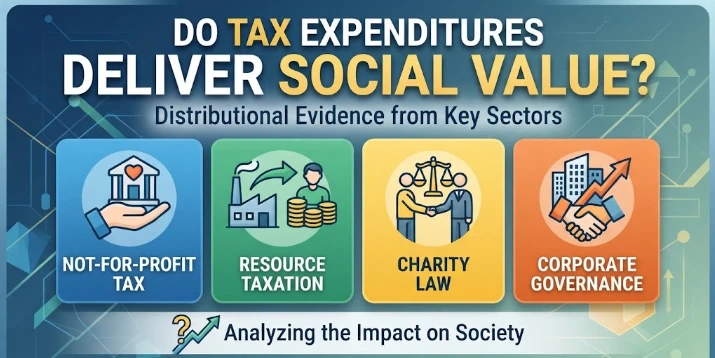
This article evaluates tax expenditures in not-for-profit, charity and resource-tax settings through distribution, governance and public value. Preferential treatment for charities and similar organisations is justified by public or community benefit, so reporting and governance should show whether concessions expand valued services, improve access or instead accumulate as private or organisational advantage. The article warns that annual income alone is an incomplete equity measure because life
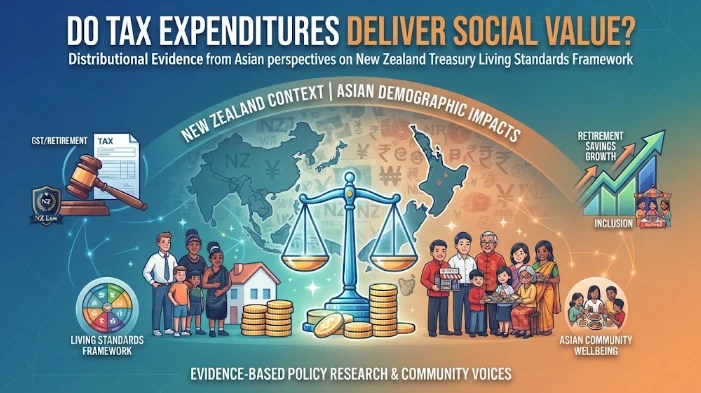
This article evaluates tax expenditures through a broader wellbeing and distributional framework, drawing on New Zealand’s Living Standards Framework, GST and retirement policy. It argues that fiscal analysis should not stop at annual income, revenue or GDP because concessions can affect consumption, saving, retirement security, housing, work, culture and resilience across generations. Distribution should therefore be examined by age, income, wealth and long-term wellbeing. Consumption taxes ill