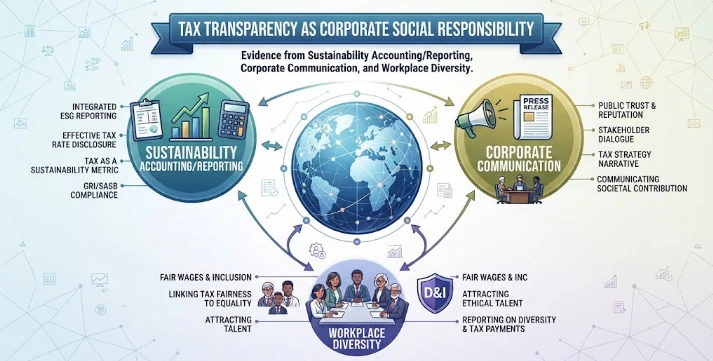
Tax Transparency as Corporate Social Responsibility: Evidence from Sustainability accounting/reporting, corporate communication, and workplace diversity
Kazi Rukaiya Sultana (Master of Public Policy & Master of Social Welfare and Research)
This article examines tax transparency as part of corporate social responsibility, sustainability accounting and corporate communication. It argues that tax strategy should be understood alongside governance, public support and broader economic impact rather than reduced to a single effective-rate comparison. Sustainability reporting increasingly asks organisations to connect narrative commitments with measurable risks, performance and governance processes. Workplace diversity provides a parallel example: headline representation figures can hide differences in pay, seniority, promotion, retention and leadership access, so responsible communication requires context. The article links these ideas to public-private partnerships, procurement, social licence and inclusive capitalism, where taxes, public guarantees and long-term contractual obligations affect how value and risk are distributed. Corporate governance determines whether transparency reflects genuine oversight or only polished communication. Boards and audit committees need consistent tax information, escalation processes and alignment between public claims and accounting records. Impact investing, social enterprises and SDG reporting further reinforce the need to distinguish market performance from public fiscal support. Credible transparency depends on comparability, clear boundaries, reconciliation over time and reporting that changes decisions rather than merely producing more disclosure.
The notion of tax transparency has transcended the simple issue of whether a company submits its return on time. There is a growing trend for investors, employees, customers, governments and communities to consider tax strategy in relation to corporate governance, sustainability claims, public support and the economic impact of a company. A clear approach elucidates the effect of statutory requirements and effective tax rates, incentives and losses, and the impact of cross-border arrangements – while not simplifying a complicated position to a single headline ratio. It's that context, which is at the heart of corporate social responsibility, that tax plays a vital role in funding the institutions and infrastructure that are essential to commercial activity.
Investors are demanding narrative claims to be related to measurable risks and performance, causing sustainability accounting and corporate communication to become more intermingled. The integration is enhanced for sustainability-related financial information and climate risk in the IFRS S1 and IFRS S2. Workplace diversity injects a social element into simple representation percentages, such as numbers expressed as percentages, which may mask certain differences in seniority, salary, tenure and career trajectory. Responsible communication requires both headline indicators and context to provide an explanation of change, its underlying causes and governance' response.
Public-Private Partnerships introduce complexity in the contracts for a long-term period. Infrastructure contracts may last for decades and include construction, financing, service requirements, guarantees and risk sharing. Sustainability needs to be part of the measurable performance, and not just included as a general aspiration. The disclosure of contingent liabilities, tax assumptions, procurement decision making and performance indicators are all part of accountability. A project can be cheap on the day of signing the contract but end up costing much more to the public's balance sheet as the project progresses.
Social disclosure, workplace diversity. The numbers don't tell the story of recruitment, promotion, pay, safety, or access to leadership. Effective reporting links representation and employment outcomes and governance processes to address legitimate privacy concerns. Tax benefits linked to jobs or training should be subject to a comparable test as eligibility does not guarantee an increase in jobs or job quality. Workforce claims that are tied to tangible results and associated funding is more likely to be taken seriously as corporate responsibility.
Social licence refers to the acceptance of, and not just a legal right for, a particular use. Trust from communities and regulators as well as contractual rights are often essential for businesses in the resource, infrastructure, finance and digital industries. The trust can be affected by tax behavior, as profits can be dependent on the public infrastructure, educated workforces, legal systems, and government support. Transparent tax governance doesn't mean that all confidential information should be released, but enough context must be provided for transparency to demonstrate that legal obligations and avowed social commitments are not conflicting.
Inclusive capitalism positions the distribution of the creation of value at the heart of governance. The various ways in which corporate activity interacts with stakeholders include wages, supplier payments, taxes, investment, dividends, and the impacts on the community. ESG reporting can shine a light on those avenues, but the right metrics can also create blind spots to trade-offs. Tax transparency incorporates a tangible fiscal aspect by revealing contributions and incentives by jurisdiction. The best disclosure doesn't brag about tax numbers, nor does it just make a simple effective-rate comparison; it provides material drivers in a way that enables informed review.
The degree to which transparency is a true sign of oversight or a polished communication is driven by corporate governance. Boards must have very clear responsibility for tax risk, escalation procedures for ambiguous matters and information that ties tax planning to strategy and reputation. Audit committees can perform checks on whether disclosures correspond to the underlying accounting records and if there are aggressive structures that would pose risks in a manner not in line with the values presented. Strong governance can also distinguish between transparent incentive programs from opaque, artificial separation, or assumptions that are not likely to stand up to the test of regulation.
Transparency around tax falls under the same genre of communication. The accountability narrative is incomplete when the company's social commitments are stated in a wide and general manner and there is little explanation given about material tax incentives, geographic profit dynamics, or tax governance. Conversely, a single good rate can be deceptive if losses or deferred tax, investment allowances or one-off transactions are significant for the period. Improved reporting provides drivers and links them to strategy instead of seeing tax as a standalone metric to report on.
Sustainability reporting offers a more comprehensive information framework. The IFRS S1 and IFRS S2, published in 2023, provide a framework for sustainability-related financial information, organizing it into governance, strategy, risk management, metrics and targets, and the climate standard is the only one that breaks down physical and transition risks. Those standards are about information relevant to enterprise prospects, rather than all social impacts. That model can be complemented with tax transparency, which can demonstrate the relationships among public incentives, geographic profit flows, and tax governance, and the interactions between them and the sustainability strategy communicated to capital providers.
Corporate communication is a blessing and a threat. Clear narrative will explain why effective tax rates are not equal to statutory rates, the impact of losses and timing differences on current tax, and the impact of incentives on investment. When there is no quantitative evidence, then general statements about responsible tax can go the opposite way. Readers should be given sufficient detail to allow them to distinguish between structural and discretionary planning. It makes more sense to see consistency across the annual report, sustainability report, country disclosure, investor presentation and regulatory disclosures.
When we talk about “impact investing” we're talking about elevating the bar even more; it also involves using funds with the conscious purpose of creating a tangible social or environmental impact in addition to a monetary one. The emphasis on SDG labels as evidence is increasingly being replaced by objective, indicators, baselines, contribution and risk of shortfall in impact frameworks. Tax issues are relevant in this context because subsidies, exemptions, and credits have the potential to impact returns reported. It is important to ensure that there is transparent separation between the performance of the market and value added from the public fiscal support.
There are also similar issues for social enterprises. Ordinary profit figures are a poor indicator of performance - hybrid missions can incorporate trading revenue, grants, concessionary capital and tax preferences. While some possibilities of social-impact reporting exist for explaining who benefits, what is modified and how, they require credible baselines and consistent boundaries. Public-benefit claims are more compelling when financial, tax, and impact measures support the claim. The differences in those records requires an explanation, not another branding.
The SDGs offer a common language but claims of broad alignment end up verifying little when nearly everything is associated with multiple goals. Good practice focuses on identifying targets, measurable indicators and the link between activity and outcomes. Fiscal transparency belongs to that discipline because there are opportunity costs of fiscal incentives, which are public resources. A company that receives a concession can provide an explanation of the investment or employment it creates, and governments can report revenue that is foregone and the policy goal for the concession.
The intersection of sustainability and public finance also happens at the market of public procurement. OECD evidence indicates that procurement accounts for a high proportion of economic activity in member economies, and that procurement rules have the potential to affect environmental performance, labour standards, integrity and innovation. Sustainability clauses can be used to encourage responsible suppliers, but not if they are poorly structured because they can serve to the detriment of competition and become a box-thing. To drive change in delivery, tender wording needs to be transparent, there must be evidence, and there should be a process of monitoring on contracts.
For credible transparence it is therefore important that the information is comparable, assured and consequential. There must be consistent definitions of metrics, explained boundaries of reported metrics and reconciliation of major changes over time. Independent assurance can enhance confidence, but it is also important to remember that assurance itself is not a solution to a strategy narrative that misled. Reporting systems must also be established to provide public agencies with comparable information on tax expenditures, procurement obligations and corporate information, where appropriate. The key is transparency is to change decisions, expose inconsistency, and enable accountability, not to just add to the published material.
One additional safeguard is ensuring that assumptions, definitions and evaluation criteria are published ahead of a politically challenging policy.
CITE THIS ARTICLE
Sultana, K. R. (2025). Tax Transparency as Corporate Social Responsibility: Evidence from Sustainability accounting/reporting, corporate communication, and workplace diversity. https://researchbysultana.com/article/6e59fe01-0da8-57a8-b8be-ff1223de239d
K. R. Sultana, “Tax Transparency as Corporate Social Responsibility: Evidence from Sustainability accounting/reporting, corporate communication, and workplace diversity,” 2025. [Online]. Available: https://researchbysultana.com/article/6e59fe01-0da8-57a8-b8be-ff1223de239d
Sultana, K. R. (2025) ‘Tax Transparency as Corporate Social Responsibility: Evidence from Sustainability accounting/reporting, corporate communication, and workplace diversity’. Available at: https://researchbysultana.com/article/6e59fe01-0da8-57a8-b8be-ff1223de239d
Sultana, Kazi Rukaiya. “Tax Transparency as Corporate Social Responsibility: Evidence from Sustainability accounting/reporting, corporate communication, and workplace diversity.” 2025, https://researchbysultana.com/article/6e59fe01-0da8-57a8-b8be-ff1223de239d.
Kazi Rukaiya Sultana. “Tax Transparency as Corporate Social Responsibility: Evidence from Sustainability accounting/reporting, corporate communication, and workplace diversity.” (2025). https://researchbysultana.com/article/6e59fe01-0da8-57a8-b8be-ff1223de239d.
Sultana KR. Tax Transparency as Corporate Social Responsibility: Evidence from Sustainability accounting/reporting, corporate communication, and workplace diversity. 2025. https://researchbysultana.com/article/6e59fe01-0da8-57a8-b8be-ff1223de239d
@misc{article_6e59fe010da857a8b8beff1223de239d,
  title = {Tax Transparency as Corporate Social Responsibility: Evidence from Sustainability accounting/reporting, corporate communication, and workplace diversity},
  author = {Kazi Rukaiya Sultana},
  year = {2025},
  url = {https://researchbysultana.com/article/6e59fe01-0da8-57a8-b8be-ff1223de239d},
}
TY  - GEN
AU  - Kazi Rukaiya Sultana
TI  - Tax Transparency as Corporate Social Responsibility: Evidence from Sustainability accounting/reporting, corporate communication, and workplace diversity
PY  - 2025-09-07
UR  - https://researchbysultana.com/article/6e59fe01-0da8-57a8-b8be-ff1223de239d
ER  -
This article uses institutional economics and applied microeconomics to show why tax-transfer reform cannot be evaluated from policy rules alone. Household disposable income reflects earnings, taxes, contributions, benefits, housing support and withdrawal schedules, but the effectiveness of those rules also depends on institutions that administer them. Different data systems, delayed appeals, inconsistent local delivery and administrative capacity can cause a theoretically efficient policy to wo
This article presents tax transparency as a governance and accounting issue rather than a simple disclosure exercise. Boards oversee tax outcomes that are influenced by risk appetite, capital allocation, internal controls, remuneration and significant transactions, while accounting systems provide the common record connecting financial profit, taxable income, deferred tax, cash tax and uncertain positions. IFRS S1 and IFRS S2 are used to show how sustainability-related financial information can
This article evaluates tax expenditures in not-for-profit, charity and resource-tax settings through distribution, governance and public value. Preferential treatment for charities and similar organisations is justified by public or community benefit, so reporting and governance should show whether concessions expand valued services, improve access or instead accumulate as private or organisational advantage. The article warns that annual income alone is an incomplete equity measure because life