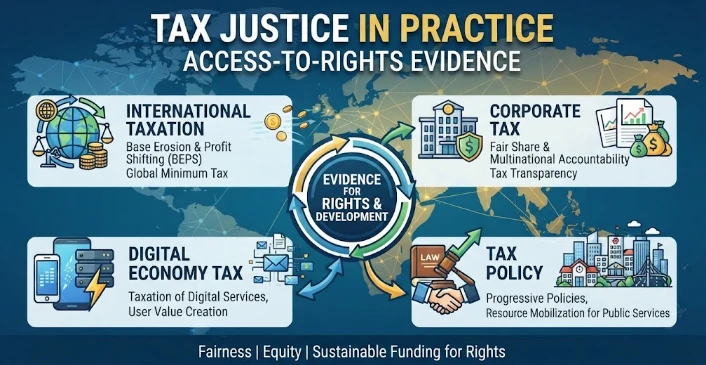
This article frames international tax justice as a question of usable rights, not only tax rates or redistribution. As digital business expands, taxpayers and smaller entities need clear rules on source, residence, profit allocation, minimum taxation, transfer pricing and dispute procedures when more than one jurisdiction claims taxing rights. The article argues that legal certainty should not depend on expensive specialist advice, so public guidance, safe harbours, published administrative positions and consistent reasoning are important. Proportional enforcement is equally central: deliberate underpayment should be addressed firmly, while hardship, error and misunderstanding require different treatment. Access indicators such as complaint resolution, review outcomes, digital exclusion and recurring error types should sit beside revenue measures. Tax clinics are presented as practical institutions that help taxpayers navigate debt, registration and digital administration while also generating evidence about systemic barriers. The discussion also places Pillar Two and the Subject to Tax Rule within this rights-based framework, emphasizing that cross-border revenue protection should be matched by predictable procedure and credible avenues for review.
There are many ways to discuss tax justice, such as rates and redistribution, but first there is procedure and access to rights. A taxpayer should be aware of an obligation, the need to obtain records, communicate with an authority, challenge an assessment and obtain review without undue burden. Formal equality can be a practical inequality in the context of professional advice needed to participate in basic activities in the context of complex law. Access to rights analysis thus asks the questions: Can rights, which are written into tax law, actually be accessed by ordinary individuals and small entities?
As digital business continues to expand, it is becoming increasingly critical for international tax justice that cross-border rules are comprehensible and subject to challenge. Older concepts of taxation requirements based on source and residence are still valid, and corporate groups can generate significant revenues in a market without having a physical presence there. The OECD and G20 reform process responded with a combination of work on profit allocation, the introduction of minimum-tax rules, transfer pricing guidance and increased information exchange. Access to rights thus also implies certainty of jurisdiction, evidence and the choice of dispute path in the event of overlaps.
But there is the related rule of law issue of certainty being available only to those who can afford to hire specialist interpretation. Private rulings, public guidance, safe harbours and published positions taken by the administration can help minimize uncertainty, as long they are available on a wide basis and are given a consistent reason. Too much discretion can lead to risk as there are multiple possibilities for similar facts. The transparent interpretation is thus a justice mechanism as well as the tool of administrative efficiency.
Enforcement should continue to be proportionate. Tough enforcement of intentional underpayment or underreporting will help maintain compliance and preserve the tax base, but a harsh response to those who may have documented hardship or misunderstanding can have serious repercussions. Debt collection, penalties, garnishment and litigation should be protected, reviewed and have documented escalation procedures. The rights-based system is able to distinguish between inability, mistake, avoidance, and fraud, and avoid assigning all problems to one moral category.
Access indicators are more believable when placed next to revenue indicators. Admins can monitor complaint resolution, outcome, processing time, debt retention, digital exclusion, clinic referral and error types. This data can highlight if legal changes will lower friction or transfer it elsewhere. The daily functioning of institutions—rather than abstract discussions about taxation rates—then becomes the measure for tax justice.
That's why tax clinics are so important. National Tax Clinic is a government-funded program to assist eligible persons and small businesses in need of help with their tax matters. Another benefit of Clinics is that they provide learning experiences for supervised students and provide data on the recurring administrative issues. That's important because what happens on a case-by-case basis may be an issue of debt, record keeping, registration, family situations, digital access or lack of understanding of legal notices.
Pillar Two highlighted that question by adding a coordinated minimum-tax regime for large multinational groups at 15 percent effective rate. By 2024, the guidance made a shift from the political level of agreement to jurisdictional calculations, safe harbours, data fields, and filing systems. The Subject to Tax Rule also came about because of concerns of lower value-added source jurisdictions to be better protected when certain related party payments are taxed at very low rates. A level playing field requires these fundamental safeguards, but not in the form of a perpetual compliance battle in the realm of cross-border trade.
Tax understanding is a 2nd layer of justice. Understanding the filing dates, deductible expenses, review rights, business registration, instalments, and more can save unnecessary penalties and debt. Literacy should not replace simple law, and even well-informed taxpayers have trouble with the rules that have numerous definitions and exceptions. Effective systems include clear direction and a fair expectation of responsibilities as well as available professional and community resources.
Another component of the voluntary compliance is procedural fairness. People are more likely to accept adverse outcomes when reasons are explained, evidence is provided, there are review channels that are trusted, and communication is respectful. Thus, the behavioral tax research has transcended the fear of tax audit approach. Enforcement cannot be replaced by trust, but if processes are consistent and outcomes are real, then they can make enforcement more legitimate and less reliant on source of funds or connections.
Gender budgeting widens the tax-justice lens by highlighting that the same rules may have different effects on the labour-market and household patterns, and that the effects are not necessarily formal. Incidence can be affected by differences in paid work, unpaid care, retirement saving, property ownership and consumption. A budget may thus be distributionally inequitable even if it does not include an explicit gender difference. Gender-Informed analysis considers the distribution of benefits in the form of concessions, the levy of consumption taxes, eligibility for tax credits, and the effect of policy on caregiving and lifetime earnings.
The spending side to the fairness equation is added by public finance. Tax justice cannot be measured only by who pays; who pays is just the beginning because the money for health, education, infrastructure, income support, security, and administration comes from taxes. The combined impact of taxes and benefits on household resources is highlighted in fiscal-incidence analysis. This method also argues against simplistic arguments that a particular tax is fair or unfair, without taking account of services and transfers that stem from the rest of the system.
Taxation of the digital economy also creates a mismatch in capacities between larger multi-jurisdictional groups and smaller market jurisdictions. The resources required to perform transfer pricing specialists, treaty experts, to collect evidence regarding value, and to interpret and utilize advanced data systems, are costly, and vary from country to country. Widespread anti-avoidance language is not as effective as simplification, published guidance, coordinated exchange, and effective mutual agreement procedures in reducing that imbalance more sustainably. Transparent tax administration in international trade is most effective when there is a degree of public authority protection of the revenue and a degree of genuine access to explanation, review and relief from double taxation by the businesses.
The interface between company law and tax justice is the disclosure and governance. Who can see what on boards depends on the information that is reported by the corporation. For risk assessment – related party transactions, executive incentives, provisions, deferred tax and uncertain tax positions can all be important. Aggressive tax planning cannot be avoided with good governance however clear accountability and effective oversight will make it more difficult to justify hidden strategies.
The access problem is unique to small businesses because their legal requirements can be similar to those of bigger businesses, but they don't have the same internal resources. The process of registration of gst, payroll, deduction, record keeping, entity selection may lead to cumulative burden. Tax clinics and easy guidance may prevent minor issues from turning into deep-seated debt. While the long run is the simpler option, that is not the better answer: support services should not be a permanent solution to preventable complexity.
Another facet of access and distribution is the retirement policy. While tax benefits for saving for retirement or superannuation may contribute to long-term income security, the fiscal value of such saving can be significantly different depending on the level of contributions, tax rates and account balances. Deductions which accredit present contributions may be of limited value to low-income workers. In fair design, what matters as well as refundable offsets, caps on contributions, preservation, age, housing costs, and the interaction with public pensions.
The practical standard is ability to enjoy equal opportunity in the tax system. The standard calls for rules that are understandable, assistance that is affordable, decisions that are transparent, effective review, and distributional analysis prior to enacting reforms. Revenue is still needed since the public services have a need for it, but the legitimacy of the collections increases when the rights are usable in practice. A tax regime gains credibility when it is not too complicated, too powerful to enforce, and too opaque about fiscal decision making to be open to public review on the margins of income and organisation.
Gaining trust is enhanced by public authorities communicating uncertainty instead of claims that estimate future behaviour or revenue. Long-term reform relies on institutions that are able to adapt thresholds, processes, and reporting obligations in response to evidence. A viable system will not only generate revenue, but will also be accessible, the process will be predictable, and there will be clear accountability for both public and private actors. This means that a sound evaluation does not split legal design, behavioural response, administrative capacity and distribution into different analysis frames.
CITE THIS ARTICLE
Sultana, K. R. (2025). Tax Justice in Practice: Access-to-Rights Evidence from International taxation, corporate tax, digital economy tax, tax policy. https://researchbysultana.com/article/6bd3620b-71ea-57ee-9d3f-00e20c4f7951
K. R. Sultana, “Tax Justice in Practice: Access-to-Rights Evidence from International taxation, corporate tax, digital economy tax, tax policy,” 2025. [Online]. Available: https://researchbysultana.com/article/6bd3620b-71ea-57ee-9d3f-00e20c4f7951
Sultana, K. R. (2025) ‘Tax Justice in Practice: Access-to-Rights Evidence from International taxation, corporate tax, digital economy tax, tax policy’. Available at: https://researchbysultana.com/article/6bd3620b-71ea-57ee-9d3f-00e20c4f7951
Sultana, Kazi Rukaiya. “Tax Justice in Practice: Access-to-Rights Evidence from International taxation, corporate tax, digital economy tax, tax policy.” 2025, https://researchbysultana.com/article/6bd3620b-71ea-57ee-9d3f-00e20c4f7951.
Kazi Rukaiya Sultana. “Tax Justice in Practice: Access-to-Rights Evidence from International taxation, corporate tax, digital economy tax, tax policy.” (2025). https://researchbysultana.com/article/6bd3620b-71ea-57ee-9d3f-00e20c4f7951.
Sultana KR. Tax Justice in Practice: Access-to-Rights Evidence from International taxation, corporate tax, digital economy tax, tax policy. 2025. https://researchbysultana.com/article/6bd3620b-71ea-57ee-9d3f-00e20c4f7951
@misc{article_6bd3620b71ea57ee9d3f00e20c4f7951,
  title = {Tax Justice in Practice: Access-to-Rights Evidence from International taxation, corporate tax, digital economy tax, tax policy},
  author = {Kazi Rukaiya Sultana},
  year = {2025},
  url = {https://researchbysultana.com/article/6bd3620b-71ea-57ee-9d3f-00e20c4f7951},
}
TY  - GEN
AU  - Kazi Rukaiya Sultana
TI  - Tax Justice in Practice: Access-to-Rights Evidence from International taxation, corporate tax, digital economy tax, tax policy
PY  - 2025-06-22
UR  - https://researchbysultana.com/article/6bd3620b-71ea-57ee-9d3f-00e20c4f7951
ER  -
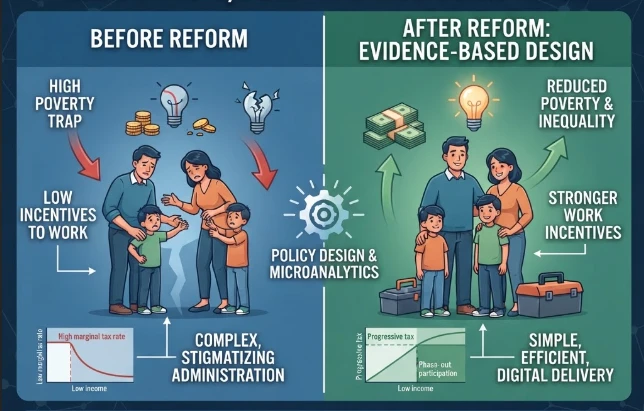
This article uses institutional economics and applied microeconomics to show why tax-transfer reform cannot be evaluated from policy rules alone. Household disposable income reflects earnings, taxes, contributions, benefits, housing support and withdrawal schedules, but the effectiveness of those rules also depends on institutions that administer them. Different data systems, delayed appeals, inconsistent local delivery and administrative capacity can cause a theoretically efficient policy to wo
This article presents tax transparency as a governance and accounting issue rather than a simple disclosure exercise. Boards oversee tax outcomes that are influenced by risk appetite, capital allocation, internal controls, remuneration and significant transactions, while accounting systems provide the common record connecting financial profit, taxable income, deferred tax, cash tax and uncertain positions. IFRS S1 and IFRS S2 are used to show how sustainability-related financial information can
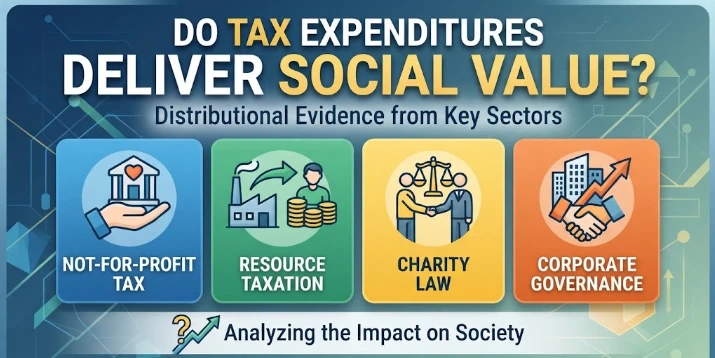
This article evaluates tax expenditures in not-for-profit, charity and resource-tax settings through distribution, governance and public value. Preferential treatment for charities and similar organisations is justified by public or community benefit, so reporting and governance should show whether concessions expand valued services, improve access or instead accumulate as private or organisational advantage. The article warns that annual income alone is an incomplete equity measure because life