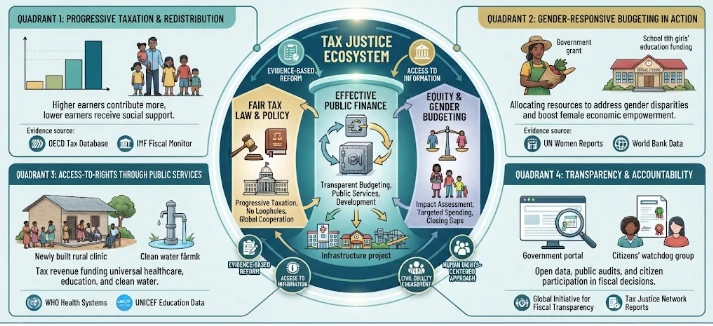
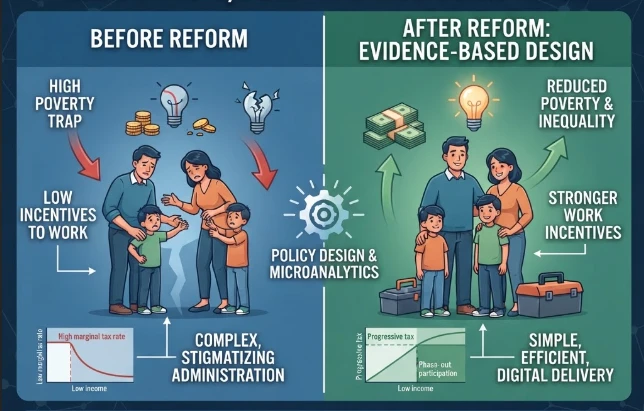
The article presents tax justice as a practical question of whether taxpayers can understand obligations, access records, challenge decisions and obtain review without disproportionate cost. It extends this access-to-rights framework through gender budgeting, public finance and tax reform. Formally neutral thresholds, credits, consumption taxes, childcare rules and retirement concessions can affect groups differently because paid work, unpaid care, savings, property ownership and household structures are unevenly distributed. Gender-aware analysis therefore asks who benefits, who bears consumption taxes and how fiscal choices affect caregiving and lifetime earnings. The article also links tax justice to public spending because revenue finances health, education, infrastructure, income support and administration. Corporate disclosure, governance and advanced tax interpretation raise related rule-of-law concerns about certainty and access to specialist knowledge. Tax clinics and clear guidance can reduce barriers for small businesses and vulnerable taxpayers. Proportional enforcement, understandable notices, effective review and access indicators should sit beside revenue measures. The article concludes that reform is stronger when distribution, administration, behaviour and uncertainty are evaluated together.
The focus on rates and redistribution in discussions of tax justice starts with access to rights, which in turn, starts with procedure. A taxpayer must be aware of an obligation, have records, communicate with an authority, challenge an assessment and receive an review without undue burden. The intersection of complex law can create real inequities in the awareness and experience of equality, if professional advice becomes a prerequisite to basic participation. Access-to-rights analysis is thus the question of whether those protections that are incorporated into the tax law can actually be used by the common people and small entities.
Gender budgeting is a practical way of connecting rights and financial proof. The different impacts of tax thresholds and tax credits, as well as consumption taxes, childcare support and retirement concessions, can be evaluated by the analysts, based on the earnings and caregiving experiences of the groups. It is not necessary for all policies to provide the same benefits. It demands that decision-makers appreciate that there are reasonably foreseeable distributional disparities in advance of reform becomes entrenched in legislation and administration.
In addition to affecting compliance, procedural fairness plays an important role in voluntary compliance. If there are clear reasons, evidence is taken into account, there are credible reviews and there is respect in communication to consider an adverse outcome more likely to be accepted. Behavioural tax research has therefore shifted away from a fear of an audit approach. Enforcement is not always a function of trust, but a consistent process can increase the legitimacy of enforcement and will decrease perceptions that outcomes are a function of resources or connections.
Gender budgeting is an extension of the tax-justice lens since rules that are formally neutral can have different impacts on labour-market and household patterns. Incidence can be influenced by variations in paid employment, unpaid care, saving for retirement, ownership of housing and consumption. A budget may thus be distributionally skewed without mentioning women. Who gets concessions, who pays consumption taxes, who gets credits, how does policy affect caregiving and lifetime earnings, etc., are part of the gender-aware analysis.
The fairness element comes in with public finance – public spending. It is not possible to comprehend tax justice only in terms of who pays as it is the revenue that pays for health, education, infrastructure, income support, security and administration. Fiscal-incidence analysis involves analysing the impact of tax and benefit changes together, as they have a combined impact on household resources. It also prevents simple statements of 'fairness' or 'unfairness' based on a single tax but not taking into account the services and transfers provided by the tax system.
Disclosure and governance are common areas of overlap between company law and securities regulation and tax justice. The information that boards, investors, auditors, regulators and tax authorities can see is dictated by corporate reporting. Some of the risk factors that may be relevant include related parties, executive incentives, provisions, deferred tax, and uncertain tax positions. Effective governance is not enough to prevent aggressive tax planning, but clear accountability and effective monitoring will make it more difficult to continue.
Small companies have a unique access problem as the legal requirements are similar to that of a larger company, yet do not have the same internal expertise. The cumulative burden can occur when considering registration for GST, payroll, deductions, record keeping, and entity options. Small issues can become big debt problems, but tax clinics and easy-to-understand advice can prevent that from happening. But the longer-term approach is still simplification – support services shouldn't be forever versus an unnecessary complexity.
Process design is another way access can be enhanced through tax reform. Simple notices, easy objection routes, published decision criteria and funding for clinics can lessen the edge specialists have. The administrative allocation of public funds then becomes a part of rights protection as it becomes crucial to make decision on time and to review meaningfully. For many taxpayers, the right is incomplete until it is obtained following the costly effort of litigation.
Another aspect of access and distribution is evident in the retirement policy. While tax benefits might help to provide long-term income security, they can have a wide range of fiscal values, depending on the amount of saving that can be done, the tax rates, and the size of any superannuation or retirement savings account. Deductions that will only benefit if you make current contributions will not be of significant benefit to lower income workers. Fair design, in this case, takes into account refundable offsets, contribution caps, preservation rules, age, housing costs, and the interaction between public pensions and the offsets.
There is also a rule-of-law question relating to advanced tax issues, which is that certainty must only be available for those who can afford a specialist interpretation. Accessibility and uniformity of the reasoning should help minimize uncertainty with only a few private rulings, guidance to the public, safe harbours and published administrative positions. Too much discretion makes it risky as the same facts could generate different results. Thus transparent interpretation can be considered as a mechanism of justice and also an administrative efficiency tool.
Enforcement needs to be proportionate. Enforceable measures prevent tax evasion by others and preserve the integrity of the tax structure and revenue base, but when used against individuals suffering from hardship or lack of understanding, coercive measures can have serious repercussions. Guard, review and establish clear escalation procedures for debt collection, penalties, garnishment and litigation. A rights based system distinguishes between inability, mistake, avoidance and fraud rather than lumping in all problems as moral issues.
Access indicators placed next to revenue indicators bring credibility to a reform. Administrations can monitor complaint resolution, review results of a complaint, processing time, debt continued, digital exclusion, clinic referrals, and recurred error type. This information can provide insight into the legal impacts on friction or non-friction impacts. Tax justice is then measured on a day-to-day basis in the work of institutions, rather than by the abstract logic of what is written in the legislation.
Tax clinics serve to fill that void. The National Tax Clinic program is government-funded, and provides tax assistance to eligible individuals and small businesses who are in need of help relating to their tax affairs. Clinics also provide learning experiences for supervised students, and provide information on persistent administrative issues. This is important because these systemic barriers may be debt, record keeping, registration, family issues, access to digital devices, or a misunderstanding of legal notices in individual cases.
Tax literacy is another justice. Avoiding unnecessary debt and penalties can be achieved by being aware of the filing dates, the deductible expenses, the registration of business, instalments, and rights of review. The idea that literacy should replace a simple law is unfounded, for even the most conscientious of taxpayers find it hard to deal with rules that have several definitions and exceptions. Good systems are comprehensible with commensurate responsibilities and available community or professional assistance.
The test is degree of ability to use the tax system. That standard calls for understandable rules, affordable assistance, transparent decisions, effective review and distributional analysis prior to enacting reforms. The legitimacy of the revenue collection increases with the ease of rights usability, but it is still necessary as public services rely on it. A tax system is trusted when it is easily understood, is enforceable, and when the tax policy is subject to open discussion, both within and between income and organisational groups.
The subtler lesson is that the design of the fiscal system must be treated with caution and must be tested against observed behaviour, not taken for granted according to its statutory name. It is important because legal form and economic incidence may be moving in opposite directions once adjustments have taken place. An additional protection is to make explicit assumptions that are sufficiently precise that they can be exactly duplicated or contradicted by a third party. When distribution, administration and behaviour are considered together, evidence also becomes stronger, instead of in separate reports.
If evaluation criteria are established in advance of beneficiaries and administrators devising strategies around an enduring policy, the policy is more likely to endure. The ultimate question when assessing a reform is, "Is the reform defensible when fiscal costs, distribution, complexity, and uncertainty are put on the same page? Transparency is thus not a communication of after-the-fact design, but a component of the design itself. One benefit of this is that the hidden trade-offs become apparent prior to the point that thresholds, exemptions or enforcement settings become routine practice.
The underlying concept is that fiscal design should be tested on actual behavior, not taken for granted based on the fiscal label. This is important because, once adjusted, the legal form and economic incidence may be different. Another security measure is to explicitly and distinctly state the assumptions so that other analysts can verify or dispute the main conclusion.
CITE THIS ARTICLE
Sultana, K. R. (2026). Tax Justice in Practice: Access-to-Rights Evidence from Tax law, policy, tax justice, public finance, gender budgeting, tax reform. https://researchbysultana.com/article/5120ddaf-cc7e-557f-ad56-92832dae5319
K. R. Sultana, “Tax Justice in Practice: Access-to-Rights Evidence from Tax law, policy, tax justice, public finance, gender budgeting, tax reform,” 2026. [Online]. Available: https://researchbysultana.com/article/5120ddaf-cc7e-557f-ad56-92832dae5319
Sultana, K. R. (2026) ‘Tax Justice in Practice: Access-to-Rights Evidence from Tax law, policy, tax justice, public finance, gender budgeting, tax reform’. Available at: https://researchbysultana.com/article/5120ddaf-cc7e-557f-ad56-92832dae5319
Sultana, Kazi Rukaiya. “Tax Justice in Practice: Access-to-Rights Evidence from Tax law, policy, tax justice, public finance, gender budgeting, tax reform.” 2026, https://researchbysultana.com/article/5120ddaf-cc7e-557f-ad56-92832dae5319.
Kazi Rukaiya Sultana. “Tax Justice in Practice: Access-to-Rights Evidence from Tax law, policy, tax justice, public finance, gender budgeting, tax reform.” (2026). https://researchbysultana.com/article/5120ddaf-cc7e-557f-ad56-92832dae5319.
Sultana KR. Tax Justice in Practice: Access-to-Rights Evidence from Tax law, policy, tax justice, public finance, gender budgeting, tax reform. 2026. https://researchbysultana.com/article/5120ddaf-cc7e-557f-ad56-92832dae5319
@misc{article_5120ddafcc7e557fad5692832dae5319,
  title = {Tax Justice in Practice: Access-to-Rights Evidence from Tax law, policy, tax justice, public finance, gender budgeting, tax reform},
  author = {Kazi Rukaiya Sultana},
  year = {2026},
  url = {https://researchbysultana.com/article/5120ddaf-cc7e-557f-ad56-92832dae5319},
}
TY  - GEN
AU  - Kazi Rukaiya Sultana
TI  - Tax Justice in Practice: Access-to-Rights Evidence from Tax law, policy, tax justice, public finance, gender budgeting, tax reform
PY  - 2026-03-11
UR  - https://researchbysultana.com/article/5120ddaf-cc7e-557f-ad56-92832dae5319
ER  -
This article uses institutional economics and applied microeconomics to show why tax-transfer reform cannot be evaluated from policy rules alone. Household disposable income reflects earnings, taxes, contributions, benefits, housing support and withdrawal schedules, but the effectiveness of those rules also depends on institutions that administer them. Different data systems, delayed appeals, inconsistent local delivery and administrative capacity can cause a theoretically efficient policy to wo
This article presents tax transparency as a governance and accounting issue rather than a simple disclosure exercise. Boards oversee tax outcomes that are influenced by risk appetite, capital allocation, internal controls, remuneration and significant transactions, while accounting systems provide the common record connecting financial profit, taxable income, deferred tax, cash tax and uncertain positions. IFRS S1 and IFRS S2 are used to show how sustainability-related financial information can
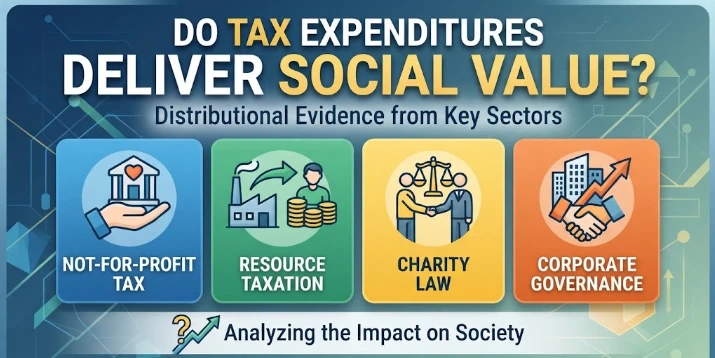
This article evaluates tax expenditures in not-for-profit, charity and resource-tax settings through distribution, governance and public value. Preferential treatment for charities and similar organisations is justified by public or community benefit, so reporting and governance should show whether concessions expand valued services, improve access or instead accumulate as private or organisational advantage. The article warns that annual income alone is an incomplete equity measure because life