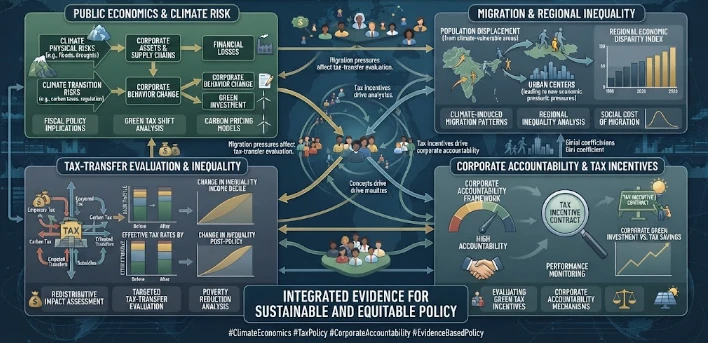
This article examines climate risk, tax incentives and corporate accountability through public economics, inequality, migration and tax-transfer evaluation. It begins from the idea that climate policy is distributional because carbon pricing, clean-investment incentives, rebates, energy subsidies, disaster relief and adaptation spending shift resources across households, firms, places and generations. Lower-income households may face higher relative energy burdens and have less ability to invest in efficient housing, vehicles or renewable technologies. Revenue recycling, targeted transfers and microsimulation can therefore help evaluate compensation. Corporate tax incentives for clean investment are assessed through additionality, access and fiscal cost, with special attention to whether smaller firms can use non-refundable benefits. The article links tax concessions to corporate governance and reporting, arguing that companies receiving public support should be able to document qualifying investment and environmental results. Migration and regional resilience add further distributional dimensions, while adaptation highlights the continuing role of public infrastructure. The article concludes that effective climate tax policy combines environmental signals, equitable compensation, measurable corporate outcomes and transparent evaluation of fiscal costs and public value.
Often climate policy is referred to as an environmental project, but the most difficult decisions now are fiscal and distributional. All carbon prices, clean-investment credits, accelerated depreciation, household rebates, energy subsidies, disaster relief and adaptation spending shift resources from one firm to another, one household to another, one region to another, and one generation to another. Meanwhile, climate extremes have the potential to harm property, disrupt livelihoods, impact food and energy security, and speed up migration from climate-sensitive areas. The question of who can use them, who pays for them, and how to keep companies accountable when public support becomes private investment must also be addressed when considering tax incentives.
There is a clear rationale for climate intervention: public economics. The costs of GHGs are not captured in regular market prices, and carbon taxes or emissions trading can internalise some of this externality. A higher carbon price boosts efficiency, switching fuel, cleaner production and investment in low emission technologies.
Revenue may also be used to provide transfers or public investment. The challenge is getting this out there. Households use energy differently, have different housing structures, different transport options, incomes, geographical locations, and the capacity to replace energy intensive assets.
A carbon price can thus impose different short-run costs. A private car is essential for a rural household, imposing restrictions which are not faced by an urban household with good access to public transport. A renter may find that their energy costs are more expensive than they anticipated, and they are not allowed to replace insulation or heating devices without the owner's permission. Higher energy access costs for lower income households may mean that they are less able to afford energy-efficient equipment, EVs, or rooftop generation. The distributional aspects of climate-policy support have been central to OECD distributional work, particularly when looking at the gains or losses for households with limited resources.
Revenue recycling can help alleviate those pressures. The revenue from carbon can be directed to specific cash transfers, climate dividends, reduced labour taxes, energy efficiency initiatives, or public transportation. The choice matters.
Income tax cut can offer some direct relief to low income households that have a low proportion of taxable labour income, whereas a targeted transfer can be more accurately targeted to low income groups. Targeting is more complex and less likely to garner widespread support, but prioritizing allows resources to be more efficiently allocated to households in even more severe constraints. These alternatives can be compared through microsimulation before the policy is implemented.
Tax incentives take a different tack to the climate problem, lowering the cost of clean investment. Credits and accelerated allowances can be used for renewable power, storage, decarbonising industry, building improvements, electric transport or low-carbon production. The increasing role of subsidies and tax measures in global decarbonisation has been documented in IMF studies of decarbonisation. These can be a driver of faster deployment but fiscal cost and additionality are still key. A credit gives low public value, if most of the subsidised investment would take place without support.
Distribution is also important on the corporate level. Large profitable businesses may have more capacity to utilise non-refundable tax incentives, to be able to access investment which qualifies for them and to be able to manage compliance. Financing may be limited for smaller companies or they may not have the expert tax knowledge. Sometimes access can be expanded through the use of refundable credits, grants, loan guarantees and technical assistance, each with its own risk. Policies should thus review which companies are benefiting, where investment is flowing in, and whether public assistance is strengthening current concentration.
When tax concessions are a key driver of climate investment, then corporate accountability becomes critical. A company that is receiving significant financial aid ought to be able to record investible accommodations, eco-achievement and adherence to programme conditions. Accounting systems should be able to identify qualifying expenditure and distinguish between ordinary commercial expenditure and subsidised activity. Boards require insight into material climate incentives as public support can impact on return on investment, effective taxes, and sustainability claims. Poor governance poses threats of overclaiming, greenwashing, and public backlash.
Reports should link funding to results. A sustainability report can be written to highlight a renewable energy project, while the financial statements can include a large tax benefit in a separate note. When material incentives are supplemented with capital expenditure and emissions effects, along with project delivery, stakeholders can better envision. Aggregate programme costs and performance should be made public by public authorities as well. Transparency converts climate tax incentives into tangible public investments, not concealed cuts in the revenue.
Migration is an additional distributional dimension. Movement may be affected by climate-related hazards in different ways, such as through sudden disasters, losses to livelihoods, agricultural stress, exposure to sea level rise or repeated climate-related damages. Jobs, housing, family networks, public services and adaptation capacity are among the other factors influencing migration decisions, with climate not always being the only factor. Resilient infrastructure, insurance arrangements, social protection and local investments can alter the economic viability of staying in a vulnerable area, which is why fiscal policy remains relevant. Risks of poorly designed climate incentives include focusing benefits on places that are already flourishing and providing limited adaptation assistance for exposed communities.
Such imbalances can be uncovered through tax-transfer evaluation. Household impacts of carbon taxes, energy price changes, rebates, and income-support reforms can be estimated using microsimulation. Spatial analysis can help to pinpoint areas where transport dependence or energy poverty entails increased burdens.
Labour-market models can consider employment in carbon-intensive industries and the impact of re-training or wage support. This can be seen in corporate incentive data, which indicates where subsidised investment and new employment are happening. The use of these tools provides a more comprehensive picture of a just transition than national averages.
There is a special need to focus on employment transition. Climate policy can grow the clean energy and efficiency industry sectors and shrink carbon-intensive sectors. There are times when there is no easy transition between jobs or areas.
Adjustment is influenced by skills, age, housing, family connections and local labour demand. Tax incentives for companies can stimulate new investment, but there are other policies that aim at employees, like training, relocation incentives, income tax support, and regional development, that can be just as significant. Technology should be followed by public support.
Adaptation poses other fiscal challenges than mitigation. Public benefits such as flood protection, heat resilience, water systems, wildfire management, resilient roads, and stronger buildings typically arise that private investors cannot capture. Some tax measures can boost the capital of households or firms, which can help diversify and increase the size of the private capital stock, but the role of public investment in shared infrastructure is still critical. Distributional design is important because incentives tied to ownership can be for the benefit of those who have property, while incentives tied to value can be for the benefit of higher value properties and not lower-lying communities. An equitable adaptation strategy requires a clear understanding of exposure, vulnerability and fiscal capacity.
Subsidies on fossil fuels also should be considered in the same context. There is a positive aspect to removing a subsidy: better price signals and public finance; on the other hand, there is a negative aspect to removing a subsidy, abrupt reform can raise living costs or disrupt industries. Compensation can safeguard vulnerable households while maintaining the market-distorted energy price for all consumers. Broad price subsidies are not as transparent as targeted transfers, as there is greater visibility of fiscal costs and of the beneficiaries of the transfers. The order of the sequence is important: The house-holds must have realistic alternatives ahead of the policy's assumption of a quick behavioural shift.
The long-term fiscal sustainability should not be forgotten. Disaster spending and the impacts on tax bases can worsen due to climate change, while decarbonisation can impact revenue from fuel taxes and other carbon-related taxes. Replacement revenue and resilient budget planning is needed by governments even as incentives promote transition. As technologies develop there should be review points and sunset provisions in temporary incentives. A concession that had to be given in early deployment may end up as a rollback once a technology has reached commercial viability.
As of 19-04-2026, climate tax policy is most clearly viewed as a nexus of incentives, distribution, accountability, and resilience. None of these three tools (carbon pricing, tax policy, transfers) is effective on its own, but they can complement each other to reinforce environmental signals, spur investment, and shield households from the effects of carbon pricing. Public value is based on further emissions reduction, equitable distribution, clear corporate claims and credible assessment of the fiscal cost. A just transition doesn't happen when tax relief is labelled ‘green'. It arises as a consequence of the behaviour change climate policy brings, to the detriment of vulnerable households, in favor of workers and regions by supporting adaptation, and in order to ensure that every significant public subsidy delivers a proven return to the public.
CITE THIS ARTICLE
Sultana, K. R. (2026). Climate Risk, Tax Incentives, and Corporate Accountability: Evidence from Public economics, migration, inequality, tax-transfer evaluation. https://researchbysultana.com/article/3a905a2e-6663-5a20-ab16-249e7488611e
K. R. Sultana, “Climate Risk, Tax Incentives, and Corporate Accountability: Evidence from Public economics, migration, inequality, tax-transfer evaluation,” 2026. [Online]. Available: https://researchbysultana.com/article/3a905a2e-6663-5a20-ab16-249e7488611e
Sultana, K. R. (2026) ‘Climate Risk, Tax Incentives, and Corporate Accountability: Evidence from Public economics, migration, inequality, tax-transfer evaluation’. Available at: https://researchbysultana.com/article/3a905a2e-6663-5a20-ab16-249e7488611e
Sultana, Kazi Rukaiya. “Climate Risk, Tax Incentives, and Corporate Accountability: Evidence from Public economics, migration, inequality, tax-transfer evaluation.” 2026, https://researchbysultana.com/article/3a905a2e-6663-5a20-ab16-249e7488611e.
Kazi Rukaiya Sultana. “Climate Risk, Tax Incentives, and Corporate Accountability: Evidence from Public economics, migration, inequality, tax-transfer evaluation.” (2026). https://researchbysultana.com/article/3a905a2e-6663-5a20-ab16-249e7488611e.
Sultana KR. Climate Risk, Tax Incentives, and Corporate Accountability: Evidence from Public economics, migration, inequality, tax-transfer evaluation. 2026. https://researchbysultana.com/article/3a905a2e-6663-5a20-ab16-249e7488611e
@misc{article_3a905a2e66635a20ab16249e7488611e,
  title = {Climate Risk, Tax Incentives, and Corporate Accountability: Evidence from Public economics, migration, inequality, tax-transfer evaluation},
  author = {Kazi Rukaiya Sultana},
  year = {2026},
  url = {https://researchbysultana.com/article/3a905a2e-6663-5a20-ab16-249e7488611e},
}
TY  - GEN
AU  - Kazi Rukaiya Sultana
TI  - Climate Risk, Tax Incentives, and Corporate Accountability: Evidence from Public economics, migration, inequality, tax-transfer evaluation
PY  - 2026-04-19
UR  - https://researchbysultana.com/article/3a905a2e-6663-5a20-ab16-249e7488611e
ER  -
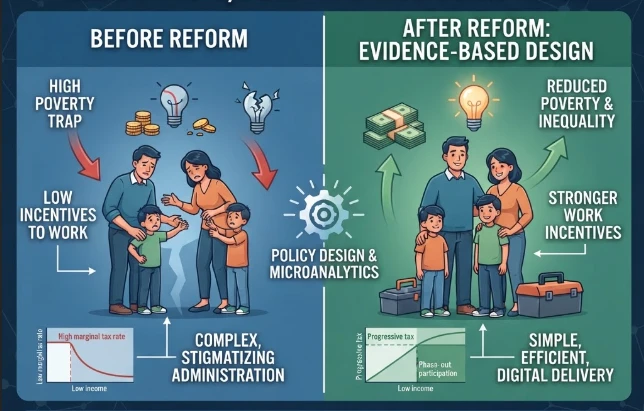
This article uses institutional economics and applied microeconomics to show why tax-transfer reform cannot be evaluated from policy rules alone. Household disposable income reflects earnings, taxes, contributions, benefits, housing support and withdrawal schedules, but the effectiveness of those rules also depends on institutions that administer them. Different data systems, delayed appeals, inconsistent local delivery and administrative capacity can cause a theoretically efficient policy to wo
This article presents tax transparency as a governance and accounting issue rather than a simple disclosure exercise. Boards oversee tax outcomes that are influenced by risk appetite, capital allocation, internal controls, remuneration and significant transactions, while accounting systems provide the common record connecting financial profit, taxable income, deferred tax, cash tax and uncertain positions. IFRS S1 and IFRS S2 are used to show how sustainability-related financial information can
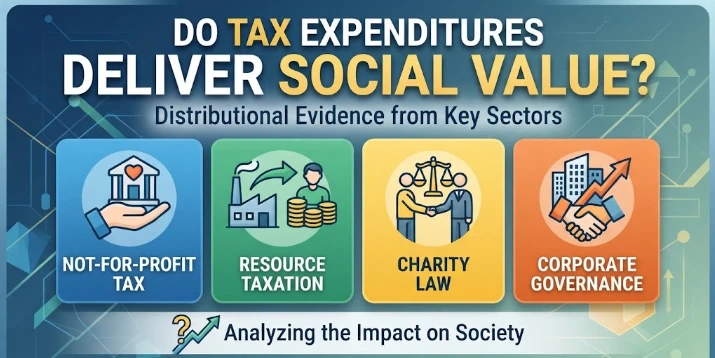
This article evaluates tax expenditures in not-for-profit, charity and resource-tax settings through distribution, governance and public value. Preferential treatment for charities and similar organisations is justified by public or community benefit, so reporting and governance should show whether concessions expand valued services, improve access or instead accumulate as private or organisational advantage. The article warns that annual income alone is an incomplete equity measure because life