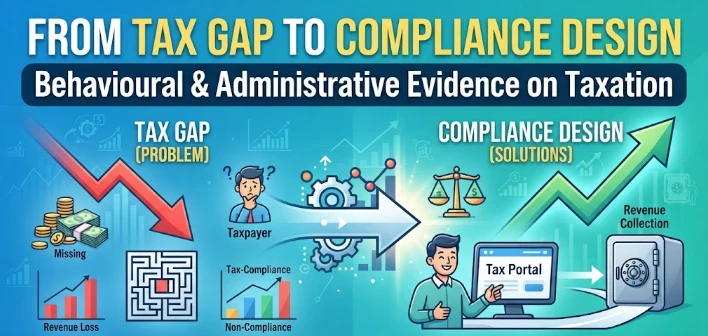
This article treats the tax gap as a diagnostic tool linking taxation law, revenue law, administration and policy design. Legal rules define liabilities, but actual compliance depends on registration, filing, payment, audit, collection, dispute resolution and the quality of records and third-party information. Using published Australian GST-gap evidence, the article shows why a gap estimate cannot by itself reveal whether non-compliance results from error, cash-flow difficulty or deliberate concealment. Behavioural factors such as clarity, trust, fairness, social norms and administrative ease interact with penalties and audit risk. Compliance costs are especially important for small businesses, where poorly designed digital obligations can simply shift administrative work from government to taxpayers and advisers. The article therefore favours risk segmentation: education and correction for simple mistakes, workable arrangements for temporary payment stress, data matching for omissions, specialist audit for complex avoidance and strong enforcement for deliberate fraud. It also stresses uncertainty in gap estimates and the compliance effects of special rules and tax expenditures. Effective compliance design begins with diagnosis and uses proportionate tools rather than assuming every shortfall reflects the same behaviour.
A tax gap is more than a revenue number. It is the amount by which tax for which there is liability, according to existing law, is not collected, based on the method of estimation employed by an administration. OECD Tax Administration 2024 reports that there are increasing examples of jurisdictions estimating gaps to gain an understanding of the extent and the nature of non-compliance. Policy value is derived from diagnosis – the response to a policy needs to vary depending on the policy gaps identified, based on the sources of information, the policy approaches, the policy service strategies and the enforcement responses.
While revenue law defines liabilities, compliance outcomes rely on administration's application of the rules in the process of registering, filing, payment, auditing, collecting and resolving disputes. While a statute is technically correct, a significant tax gap can occur when records are poor, third-party information is unavailable, or compliance costs far exceed practical capacity. On the front page of OECD Tax Administration 2024, the administrations' trend toward the convergence of service, digital channels, risk management and tax-gap analysis was highlighted. Compliance Design starts with diagnosis as opposed to assuming any failure is intentional.
It has been demonstrated in Australia's published work on tax gap that tax gap estimation should be part of the compliance design and not separate from it. If the figures are confirmed, the net GST gap for 2022–23 is estimated to be approximately 7.9 billion AUD, which is near to 9 per cent of the theoretical GST. It also said small business represented a high proportion of the GST gap in the past and that areas of concern were the quality of the record, cash transactions and registration behaviour. The gap estimate alone is not sufficient to establish motive and the administration must have independent evidence to make this determination before considering an error, a payment issue or the deliberate concealment as a form of the same behaviour.
The traditional deterrence model is complicated by behavioural evidence. Just penalties and audit risk count, but compliance is also driven by clarity, trust, perceived fairness, social norms, cash-flow pressure and ease of fulfilling the obligations. OECD tax-administration work notes a rise in the use of behavioural researchers and targeted communications. An error at the right time, at the lowest possible cost; and complex rules can yield errors like those that can occur in aggregate data.
Equal attention needs to be paid to compliance costs, since administrative complexities can drive small businesses to deviate from compliance or make them fall into informality traps. Even if there's no extra tax due, there is a cost to time spent interpreting rules, keeping records, reconciling GST and fixing returns. Digital filing may help to ease the burden of routine, but only if the software, identity systems and data standards are successful. Inappropriate digital obligations can simply transfer the cost from the government to businesses and professional advisers.
Risk segmentation provides a more proportionate model. There is a need for education and correction for taxpayers who make simple mistakes; there is a need for workable arrangements for taxpayers who are in temporary payment stress; and there is a need for greater scrutiny for deliberate concealment. Treat all discrepancies as fraud and use enforcement resources unnecessarily and risk loss of voluntary compliance. Addressing all discrepancies as benign brings up the opposite problem as it undermines taxpayer deterrence and fairness if discrepancies are not addressed.
The best estimates of the amount of tax evasion are provided when there is lingering uncertainty. A model can provide an estimation of what the liability should be, but the error band around any liability result is influenced by hidden activity, valuation decisions, timing differences, and inaccuracies in data. That is why the publishing process and revisions eliminate the possibility of a gap number being a superficial indicator of administrative shortcomings. The components must be treated differently – education for understanding, payment arrangements for cash-flow stress, data matching for omission, specialist audit for complex avoidance and strong enforcement for deliberate fraud.
Special rules also create boundaries that have an impact on tax compliance. Deductions, exemptions, reduced rates and sector concessions present classification issues and planning opportunities. Each added boundary will create authentic uncertainty as well as aggressive interpretation. It is important, therefore, to consider tax expenditures at least from an administrative perspective: a modest policy benefit concession may have significant administrative costs that exceed the revenue figure that is stated in a budget statement.
Transaction trails are seen as an advantage within the GST and VAT systems. While invoice chains may provide third party information to support verification, there are still a number of risks, such as refund fraud, missing traders, cash transactions and classification disputes. In areas of strong legal and technical infrastructure, e-invoicing and data matching may enhance the visibility. The need for robust protection remains, as large data sets can increase the chances of errors in the results, issues of privacy and false-positive results with risk models that do not have context.
Fiscal federalism adds a further level where taxes are levied on multiple governments or administrative functions are shared. Variations in definitions, rates, exemptions and data systems can add to the compliance costs for businesses that conduct activity in multiple jurisdictions. Coordination can minimise duplication in the following ways: • Common registration; • Sharing of information; • Harmonised definitions; or • Single collection mechanism. The appropriate institutional structure is dependent on constitutional arrangements, fiscal autonomy and the importance of local policy discretion.
The tools needed to deal with tax avoidance by the company are different than those needed to deal with tax record errors in small businesses. Financing structures, intangible assets, entity chains, transfer pricing, and cross-border mismatches can be utilized by large groups and require specialized skills and international information. While transparency and public disclosure can help to ensure accountability, raw disclosure without context can mislead as book profit and taxable profit are not the same. The key elements of effective assurance are analysis of the accounting process, interpretation of the law, economic substance and risk-based engagements.
Revenue law also relies on the legitimacy of the procedures. Taxpayers perceive administration as predictable when they receive guidance, get explanations of decisions, have the power to object, have their own independent review, receive debt safeguards, or are treated consistently. Studies on behaviour have consistently found that deterrence is coupled with fairness and trust. The most effective compliance architecture then is one that is based on both legal and proportional enforcement, reduces friction with normal business demands, and escalates accordingly where the risk or evidence calls for more forceful measures.
The credibility of administration is also affected by governance and corruption risks. Even when the rules seem good on the books, enforcers may have a preference for certain firms, the settlements may be hazy, and the procurement process may not be sufficiently robust, the willingness to comply may be lowered. Legitimacy is protected with independence, the rights of review, documented procedures, and the publication of aggregate performance information. Compliance design, then, is not a place to fit into a narrow collection function, but is part of a larger rule-of-law design.
Measurement should differentiate gross and net gaps, model uncertainty and the impact of administration. The net gap could deteriorate even if the underlying risks are high, and economic shocks may affect the liabilities as well as the ability to pay. Stable methods or transparent revisions are required for time-series interpretation. Stakeholders can see what gap estimates can and cannot establish, and so publishing uncertainty and methodology helps to strengthen the usefulness of gap estimates.
A contemporary compliance approach then represents a blend of prevention, facilitation, verification, and enforcement. Pre-filled data could eliminate omissions, clear guidance could minimise errors, targeted analytics could identify high-risk cases and robust sanctions could deal with any attempts at deliberate evasion. There should be a judgement of each intervention in terms of revenue, burden, fairness, and trust. It is not maximum activity that is the objective; it is minimum cost to society and administration that is sustainable.
Assumptions, definitions, limitations and review criteria are most useful if they are in front of you before a policy gets to the point where it is hard to change. The combined approach also helps to prevent one headline measure being interpreted as evidence of fairness, efficiency or responsible behaviour. The importance of regular evaluation is that technology, market conditions, the situation of households and administrative capacity evolve more quickly than many acts of Parliament. It is important to increase the credibility when public authorities communicate uncertainty, instead of a range of estimates as predictions of behaviour and revenue.
The institutions that are needed for long term reform, however, must be able to modify thresholds, procedures and reporting requirements in response to evidence. A durable system is one in which the revenue protection is matched by accessibility and a predictable procedure while also ensuring clear accountability for both public and private actors. This allows the legal design, behavioural response, administrative capacity and distribution to remain within the same analytical framework, in a sound evaluation. The real test is whether the rule achieves measurable public value in the face of counting the fiscal cost, burdens on compliance, and unintended incentives.
CITE THIS ARTICLE
Sultana, K. R. (2025). From Tax Gap to Compliance Design: Behavioural and Administrative Evidence on Taxation law, revenue law, tax administration, tax policy. https://researchbysultana.com/article/2e0a4497-d1db-5263-a655-e0f41263b7d7
K. R. Sultana, “From Tax Gap to Compliance Design: Behavioural and Administrative Evidence on Taxation law, revenue law, tax administration, tax policy,” 2025. [Online]. Available: https://researchbysultana.com/article/2e0a4497-d1db-5263-a655-e0f41263b7d7
Sultana, K. R. (2025) ‘From Tax Gap to Compliance Design: Behavioural and Administrative Evidence on Taxation law, revenue law, tax administration, tax policy’. Available at: https://researchbysultana.com/article/2e0a4497-d1db-5263-a655-e0f41263b7d7
Sultana, Kazi Rukaiya. “From Tax Gap to Compliance Design: Behavioural and Administrative Evidence on Taxation law, revenue law, tax administration, tax policy.” 2025, https://researchbysultana.com/article/2e0a4497-d1db-5263-a655-e0f41263b7d7.
Kazi Rukaiya Sultana. “From Tax Gap to Compliance Design: Behavioural and Administrative Evidence on Taxation law, revenue law, tax administration, tax policy.” (2025). https://researchbysultana.com/article/2e0a4497-d1db-5263-a655-e0f41263b7d7.
Sultana KR. From Tax Gap to Compliance Design: Behavioural and Administrative Evidence on Taxation law, revenue law, tax administration, tax policy. 2025. https://researchbysultana.com/article/2e0a4497-d1db-5263-a655-e0f41263b7d7
@misc{article_2e0a4497d1db5263a655e0f41263b7d7,
  title = {From Tax Gap to Compliance Design: Behavioural and Administrative Evidence on Taxation law, revenue law, tax administration, tax policy},
  author = {Kazi Rukaiya Sultana},
  year = {2025},
  url = {https://researchbysultana.com/article/2e0a4497-d1db-5263-a655-e0f41263b7d7},
}
TY  - GEN
AU  - Kazi Rukaiya Sultana
TI  - From Tax Gap to Compliance Design: Behavioural and Administrative Evidence on Taxation law, revenue law, tax administration, tax policy
PY  - 2025-05-18
UR  - https://researchbysultana.com/article/2e0a4497-d1db-5263-a655-e0f41263b7d7
ER  -
This article uses institutional economics and applied microeconomics to show why tax-transfer reform cannot be evaluated from policy rules alone. Household disposable income reflects earnings, taxes, contributions, benefits, housing support and withdrawal schedules, but the effectiveness of those rules also depends on institutions that administer them. Different data systems, delayed appeals, inconsistent local delivery and administrative capacity can cause a theoretically efficient policy to wo
This article presents tax transparency as a governance and accounting issue rather than a simple disclosure exercise. Boards oversee tax outcomes that are influenced by risk appetite, capital allocation, internal controls, remuneration and significant transactions, while accounting systems provide the common record connecting financial profit, taxable income, deferred tax, cash tax and uncertain positions. IFRS S1 and IFRS S2 are used to show how sustainability-related financial information can
This article evaluates tax expenditures in not-for-profit, charity and resource-tax settings through distribution, governance and public value. Preferential treatment for charities and similar organisations is justified by public or community benefit, so reporting and governance should show whether concessions expand valued services, improve access or instead accumulate as private or organisational advantage. The article warns that annual income alone is an incomplete equity measure because life