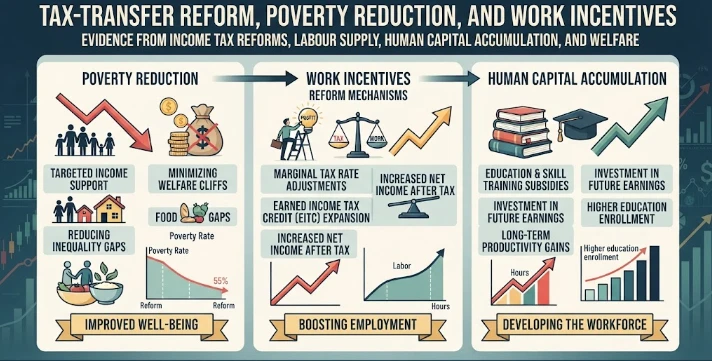
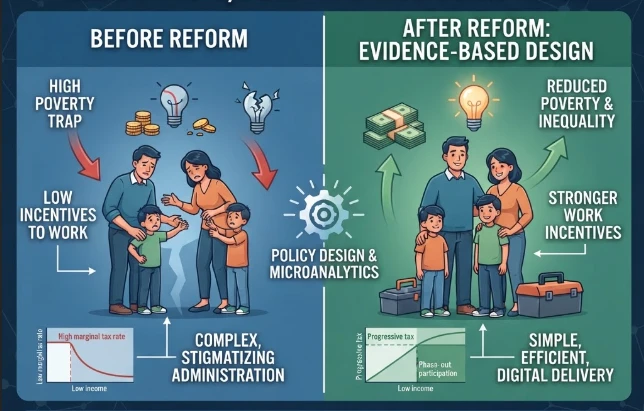
The article examines income-tax reform through labour supply, welfare and human-capital accumulation rather than assuming that lower tax rates automatically increase work. Average tax rates affect disposable income, while marginal rates influence the reward from additional hours or higher-paying employment, and these effects can operate in different directions. Benefit withdrawal is equally important: gradual tapers can smooth transitions into work, while abrupt thresholds may create cliffs that affect hours, timing or formal reporting. The article broadens economic welfare beyond employment counts by including childcare, commuting, health constraints and lost leisure. Mobility matters because temporary low income during study, caregiving, unemployment or early career differs from persistent poverty. Human-capital investment adds a longer horizon, since transfers supporting nutrition, housing, childcare or education may raise future earning capacity, while poorly designed rules can discourage training. Consumption taxes and lifetime inequality are also considered within the overall fiscal system. Microsimulation can reveal distributional effects by household type and effective marginal rates. Sustainable reform therefore requires transparent modelling, administrative accessibility and long-term evaluation of earnings, skills and welfare.
Tax-transfer policy is not an abstract tax-rate policy; it is a policy based on the effect on disposable income. Household budget merges earnings, income tax, social contributions, cash benefits, housing support, family payments with withdrawal rules. A tax rate cut can still yield a small benefit once another tax is deducted. The appropriate object for poverty and work incentives is the complete budget constraint of a household at a variety of earnings levels.
Labour supply can be affected by income-tax reform both in terms of the average rate and the marginal rate. Reducing average tax increases disposable incomes, reducing marginal tax alters the return on an additional hour or on a higher-paying job. Those impacts work in opposite directions – an increase in income can decrease the need to work more while a decrease in the marginal rate can increase the reward. The microsimulation therefore is more powerful than simply taking a behavioural assumption that all tax reductions stimulate labour supply.
Generosity is not the only factor that affects design quality. Gradual tapers can help to facilitate transitions to work, and abrupt thresholds can affect hours, timing or formal reporting. In some contexts, individual taxation can enhance the incentives for secondary earners relative to the transfer-based approach, while family-based transfers can achieve a greater targeting of the household need. Policy thus raises issues of trade-offs on equity, fiscal costs, targeting, and administrative simplicity.
The number of jobs is not the only measure of economic welfare. Additional work may increase output and income, but factors such as commuting, child care, health limitations, and lost leisure also impact household welfare. The cuts, which reduce the size of the benefits pool, may seem to be effective at the narrow employment goal, but at the broader income security goal, they can be detrimental for a vulnerable group. Strong evaluation, in other words, follows employment, hours worked, disposable income, poverty depth and fiscal cost.
The importance of mobility is due to the fact that over time households will pass through income distribution. Low income may be temporary (e.g. during studies, care-taking, in between jobs, during periods of business fluctuations, or in the early phase of a career) or permanent (a policy challenge). Single year incidence of taxes and benefits can be identified through tax-transfer modelling, but not all lifetime effects. Longitudinal evidence provides better interpretive understanding because of an ability to discern whether the support cushions temporary shocks, helps to diminish persistent pockets of poverty, or alters the likelihood of upward mobility.
The other linkage between welfare design and long run productivity is through human capital. Transfers which affect nutrition, housing stability, access to childcare or education participation can benefit future earnings even if there is a fiscal cost in the short-term. On the other hand, benefit rules that disincentivize training income or introduce ambiguity when it comes to the study can deter skill investment. A serious work-incentive program must not just focus on labour supply, but see if the rules in place are beneficial to their future earning potential.
The lesson from public economics is also that not all behavioural responses are socially desirable. Formalisation of labour supply can affect unpaid care within a household, alter childcare demand or have an interaction effect with market power. The issue of two-sided markets introduces additional complexities as a tax on a platform or provider can impact pricing on both sides of a transaction. The incidence is dependent on elasticities and market structure, rather than just to whom the law refers in the legislation.
A longer time horizon is introduced by the process of human-capital accumulation. Transitions to education, training, and low-income early career may lead to a decline in current earnings and an increase in productivity in the future. The pathway to study can be reinforced by welfare rules that facilitate study and childcare and run the risk of being undermined by sudden withdrawal. Reform impacts on skill acquisition and lifetime earnings should also be evaluated to determine if reform influences the number of individuals in employment in the first year after reform, but also other outcomes of the reform.
The distributional tension is very apparent in consumption taxes. Efficient revenue raising is achieved with broad consumption taxes, but low-income groups tend to have a higher share of current income spent on consumption. That can be alleviated by lower rates on necessities, but still yields substantial absolute benefits to those who spend more. Regressivity can be reduced more directly through targeted transfers when administrative systems can consistently determine eligibility to receive a transfer, and eligibility rules are still understood.
Progressivity should be considered in the overall fiscal system. Personal income taxes are potentially progressive, consumption taxes, payroll contributions, housing subsidies and benefit withdrawal change the final pattern. New Zealand fiscal-incidence work shows how important it is to look at the relationship between taxes and benefits through the prism of household income, rather than individually. The same analysis can tell if an apparently progressive reform affects lifetime inequality, annual inequality or both.
The results are as much the consequence of administrative design as of statutory generosity. The take-up or difficulty in take-up of complex forms and delayed reassessment, debt recovery and unpredictable reconciliation may be a negative effect. Access that relies on automatic data matching and pre-filled information can make access easier, but there are still other ways to facilitate access where language, disability, connectivity, and record-keeping barriers exist. Eligible households who can not receive or understand support will not receive intended welfare benefits from a reform.
Fiscal sustainability is still included in the equity calculation. Persistent deficits may cause transfers to be passed between generations, and poorly targeted tax cuts may cause a decrease in revenue that is required for high-value services. Sustainable reform entails defining a sustainable funding base and articulating distributional decisions. This way, the issues of poverty reduction, incentives and public-service funding can be considered as related goals rather than as two opposing catchphrases.
But averages obscure the people who are impacted by interacting rules, and microsimulation plays a key role in that analysis. New Zealand Treasury have developed a model (TAWA) that can incorporate tax/welfare reforms into representative microdata and have applied it to these subjects, including distributional, fiscal-incidence and effective-marginal-rate analysis. The OECD also presents evidence of tax and spending microsimulation being widely used in advanced administrations in its work on inequality budgeting. These tools help to bring reform discussions down to the real world by visualising impacts by income decile, family type and labour-market status.
When policies are narrowly targeted, they can be biased against or for poverty reduction and work incentives. Protects household income at the bottom, but causes a high effective marginal tax rate as income rises. That rate is the proportion of the additional unit of income sacrificed due to a rise in tax and a fall in transfer payments. A high rate doesn't imply unemployment goes down, but rather indicate areas where employment brings a surprisingly small increase in disposable income.
The best reform packages incorporate modelling as a decision-making instrument and not just as an eye-candy ornament on the end of a policy. Distributional tables, effective-marginal-rate profiles, behavioural sensitivity tests and fiscal scenarios could be created prior to legislation. These result can then inform the design of thresholds, taper rates, refundable credits, and transition rules. Political decisions can not be changed with evidence, but evidence can reveal underlying trade-offs and minimise the likelihood of creating a complex household reality from a simple headline.
Strengthening evidence is also achieved by looking at distribution, administration and behaviour collectively as one, rather than individually in reports. When evaluation criteria are agreed in advance with the beneficiaries and administrators then policy durability is enhanced when they adapt around a permanent policy. The only test to determine whether a reform is defensible is whether the fiscal cost, distribution, complexity, and uncertainty of it are all put on the same page. Good design, therefore, does not see transparency as a communication task after implementing policies but sees transparency as a component of policy design.
One benefit of this is that hidden trade-offs can be identified before thresholds, exemptions or settings for enforcement become routine practice. The deeper message is that fiscal design should be put to the test in terms of behavior, not by statutory labels. This is important as the legal form and economic incidence may differ as a result of household or firm adjustments. Another good protection is to make the assumptions explicit and clear enough to be replicated or disputed by others.
The strength of the evidence also increases if distribution, administration and behaviour are looked at as a whole, rather than in individual reports.
CITE THIS ARTICLE
Sultana, K. R. (2025). Tax-Transfer Reform, Poverty Reduction, and Work Incentives: Evidence from Income tax reforms, labour supply, human capital accumulation, welfare. https://researchbysultana.com/article/29038a1f-5312-545c-b0c6-a325f36c7712
K. R. Sultana, “Tax-Transfer Reform, Poverty Reduction, and Work Incentives: Evidence from Income tax reforms, labour supply, human capital accumulation, welfare,” 2025. [Online]. Available: https://researchbysultana.com/article/29038a1f-5312-545c-b0c6-a325f36c7712
Sultana, K. R. (2025) ‘Tax-Transfer Reform, Poverty Reduction, and Work Incentives: Evidence from Income tax reforms, labour supply, human capital accumulation, welfare’. Available at: https://researchbysultana.com/article/29038a1f-5312-545c-b0c6-a325f36c7712
Sultana, Kazi Rukaiya. “Tax-Transfer Reform, Poverty Reduction, and Work Incentives: Evidence from Income tax reforms, labour supply, human capital accumulation, welfare.” 2025, https://researchbysultana.com/article/29038a1f-5312-545c-b0c6-a325f36c7712.
Kazi Rukaiya Sultana. “Tax-Transfer Reform, Poverty Reduction, and Work Incentives: Evidence from Income tax reforms, labour supply, human capital accumulation, welfare.” (2025). https://researchbysultana.com/article/29038a1f-5312-545c-b0c6-a325f36c7712.
Sultana KR. Tax-Transfer Reform, Poverty Reduction, and Work Incentives: Evidence from Income tax reforms, labour supply, human capital accumulation, welfare. 2025. https://researchbysultana.com/article/29038a1f-5312-545c-b0c6-a325f36c7712
@misc{article_29038a1f5312545cb0c6a325f36c7712,
  title = {Tax-Transfer Reform, Poverty Reduction, and Work Incentives: Evidence from Income tax reforms, labour supply, human capital accumulation, welfare},
  author = {Kazi Rukaiya Sultana},
  year = {2025},
  url = {https://researchbysultana.com/article/29038a1f-5312-545c-b0c6-a325f36c7712},
}
TY  - GEN
AU  - Kazi Rukaiya Sultana
TI  - Tax-Transfer Reform, Poverty Reduction, and Work Incentives: Evidence from Income tax reforms, labour supply, human capital accumulation, welfare
PY  - 2025-12-24
UR  - https://researchbysultana.com/article/29038a1f-5312-545c-b0c6-a325f36c7712
ER  -
This article uses institutional economics and applied microeconomics to show why tax-transfer reform cannot be evaluated from policy rules alone. Household disposable income reflects earnings, taxes, contributions, benefits, housing support and withdrawal schedules, but the effectiveness of those rules also depends on institutions that administer them. Different data systems, delayed appeals, inconsistent local delivery and administrative capacity can cause a theoretically efficient policy to wo
This article presents tax transparency as a governance and accounting issue rather than a simple disclosure exercise. Boards oversee tax outcomes that are influenced by risk appetite, capital allocation, internal controls, remuneration and significant transactions, while accounting systems provide the common record connecting financial profit, taxable income, deferred tax, cash tax and uncertain positions. IFRS S1 and IFRS S2 are used to show how sustainability-related financial information can
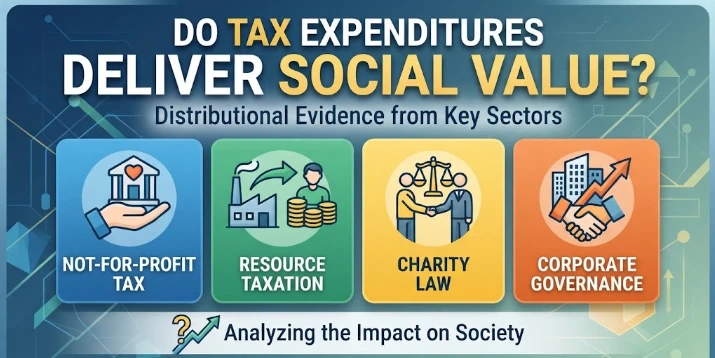
This article evaluates tax expenditures in not-for-profit, charity and resource-tax settings through distribution, governance and public value. Preferential treatment for charities and similar organisations is justified by public or community benefit, so reporting and governance should show whether concessions expand valued services, improve access or instead accumulate as private or organisational advantage. The article warns that annual income alone is an incomplete equity measure because life