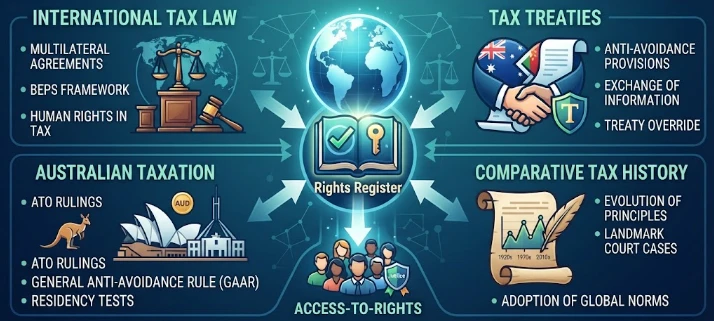
This article uses international tax law, Australian taxation and comparative tax history to frame tax justice as access to usable rights. Formal protections are insufficient if taxpayers cannot understand obligations, obtain records, challenge assessments or secure review without disproportionate expense. Australia’s international tax rules sit on a long domestic history of income taxation, corporate taxation, anti-avoidance measures and treaty development, showing that concepts such as residence, source, permanent establishment and arm’s length evolved under economic conditions different from digital commerce. The article argues that historical perspective helps explain why reform usually occurs incrementally. Tax treaties provide both taxing-right allocations and protections against double taxation, but those protections can remain difficult for smaller cross-border taxpayers to use without accessible guidance and competent-authority processes. Wider tax-justice themes include proportional enforcement, tax clinics, tax literacy, gender budgeting, public-finance incidence, corporate disclosure and retirement concessions. Advanced taxpayers should not receive certainty merely because they can afford specialist advice. Public guidance, safe harbours and consistent reasoning can improve equality of access. The practical standard is understandable law, affordable support, transparent administration and effective review.
Tax justice is frequently talked about in terms of rates and redistribution; however the starting point for access to rights is procedure. A taxpayer should know what he/she is supposed to do, obtain the records (documents), talk to an authority, argue the assessment, and have it reviewed without a disproportionate burden. This can be formal equality which becomes practical inequality if access to professional advice is a prerequisite to basic participation in the legal process. Access-to-rights analysis is an inquiry into whether ordinary people and small entities can in fact access the protections set out in tax law.
Australia's taxation system exemplifies that international tax law is located on top of an extended domestic tax history and practice of income taxation, corporate taxation, anti-avoidance measures, and treaties. Comparative tax history demonstrates that the present rules were a reaction to previous issues and are not a pristine design that was created in one fell swoop. Terms like “residence”, “source”, “permanent establishment” and “arm's length” have been created in an economic environment that is very different from digital commerce. It is helpful to gain a historical perspective of the reasons why reform typically comes in stages and by amendment.
There is also a rule-of-law question raised by the advanced tax issues: certainty should not be afforded only to those who can afford to hire a tax specialist to interpret the tax laws. Private rulings, public guidance, safe harbours and published administrative positions can help to minimize uncertainty as long as access is wide and reasoning is consistent. When there is too much discretion, there is risk, since the facts can be the same and the answers different. Transparent interpretation is a mechanism of justice and an efficiency device in administration.
Proportionality must continue to be upheld in enforcement. Aggressive enforcement of the principle of voluntary cooperation will help those who obey the law and the taxable base, but harsh measures can have serious consequences for those in actual hardship or error. There is a need for protection, review and well-defined escalation procedures in regards to debt collection, penalties, garnishment and litigation. A rights-based system does not lump all issues into one moral category, but distinguishes between inability, mistake, avoidance and fraud.
Reform becomes believable when access measures are included with revenue measures. Administration can monitor the resolution of complaints, outcomes, processing time, debt continuation, digital exclusion, clinic referrals and error types. So, that information can show us if the legislation is creating any friction or if it's just moving it to another location. The notions of tax justice are then made measurable through the daily practice of institutions, with statutory concepts of rates being a secondary issue.
Tax clinics fill that need. The National Tax Clinic program is a government initiative to provide help to people who need it and small businesses that qualify. Additionally, clinics provide opportunities to learn for supervised students and provide evidence of ongoing administrative issues. This is important because some of these individual issues may uncover systemic issues that are related to debt, record keeping, registration, family situation, digital access, and/or misunderstanding of legal notices.
Tax Literacy is a second justice. Avoiding unnecessary debt and penalties can be avoided if you have knowledge of filing dates, deductible expenses, business registration, instalments and review rights. Literacy should not be the substitute for simple law because well-informed taxpayers don't master rules that have multiple definitions and exceptions. Good systems involve clear instructions that have manageable requirements and available professional/community assistance.
Treaties come with rights and limitations. They establish taxable powers and diminish double taxation, promote information sharing and establish mechanisms to handle tax disputes. Those protections may still require documentation and specialist knowledge, and pose a tax-justice issue for smaller cross-border companies and people. Alongside the sophisticated treaty drafting, clear guidance to the public and efficient processes of competent authorities are important. The available protections are only effective at large organisations, thus rule quality is incomplete.
Voluntary compliance is also influenced by procedural fairness. When there are clear reasons, evidence is taken into account, review processes are reliable and the communication is respectful, people will accept an adverse outcome. Behavioural tax research has thus progressed far from an audit-driven paradigm. Without enforcement, there is no trust, but with consistent process, enforcement can be legitimate and decrease the perception of relying on resources or connections.
The use of a gender budgeting lens widens the tax-justice prism because the formal neutrality of the rules may have disparate effects on the labour-market and household patterns. Incidence can also vary due to differences in the paid work, unpaid care, retirement savings, property ownership and consumption. A budget may thus be 'distributional' inequal without including a gender-based inequal distinction. Gender-aware analysis includes an examination of who benefits from concessions, who pays consumption taxes, who is eligible for credits, and the implications of policy for caregiving and lifetime earnings.
The fairness equation includes spending side public finance. Who pays taxes is an important part of tax justice, but not the only part; because revenue supports health, education, infrastructure, income support, security and administration. Fiscal-incidence analysis is the linking of taxes and benefits, showing the combined effect on household resources. It also prevents simplistic statements of what is 'just' and what is 'unjust' with only a single tax being taken into account rather than services and transfers as part of the overall system.
Problems where company law and securities regulation relate to tax justice concerns with disclosure and governance. The information that is available for boards, investors, auditors, regulators and tax authorities to see is determined by corporate reporting. The risks are important for related party transactions, provisions, executive incentives, deferred tax and uncertain tax issues. Responsibilities must be made plain and credible oversight of a government will not allow aggressive tax planning to be continued.
Access is a unique issue encountered by small businesses, as legal requirements may sound the same as for larger businesses, but lack the same internal expertise. The registration and processing of GST, managing payroll, deductions, records and entity selection can add up to a burden. Small issues can easily become a mountain of debt if tax clinics and easy-to-access guidance can help prevent them. Though the long run solution is the simpler one, simplicity should not be made support services or "compensation" for unnecessary complications.
Another aspect of access and distribution is revealed in retirement policy. Superannuation or retirement saving tax concessions can help people to secure their income for the long-term, but the fiscal value of these savings may vary significantly depending on contributions, tax rates and account balances. For the lower income earner, an advantage of a deduction that is only available when the contributions are made. So, refundable offsets, contribution caps, preservation rules, age, housing costs and interaction with public pensions are part of the considerations for fair design.
The practical standard is 'equal ability to participate in the tax system. The standard sets forth requirements for creating understandable rules, providing affordable assistance, making transparent decisions, implementing effective review and distributional analysis before reforms are implemented. Although collection is necessary for the delivery of public services, its legitimacy goes up as rights are put into use. A tax system is more trusted when it is not so complicated, it is not so powerful in its enforcement and its fiscal decisions are subject to scrutiny across income and organisational lines.
Transparent governance transforms that into a repeatable process, rather than a one-time justification when introducing it. This holistic perspective can minimise the likelihood that a technically sound policy leads to suboptimal results in practice as households, firms and administrators adjust to the actual incentives. The better way to evaluate statutory design, however, is by measuring actual incentives, administrative capacity, and distributional impacts, and not by labeling. This way of thinking also brings uncertainty into sight, and helps to make better decisions when there are no precise estimates of behavioural responses or implementation costs.
Another precaution is that assumptions, definitions and evaluation criteria should be published prior to a policy becoming politically unpopular that can be changed. The fiscal cost, fairness, behaviour and administrative burden are most informative when all are contained in the same assessment as they can all be found in a single narrative of the policy. Long run credibility relies on review processes which can update thresholds, eligibility or reporting procedures in line with economic conditions and technology. The question which is of practical importance is whether the instrument will provide measurable public value, when compliance costs, distribution costs and opportunity costs are added in.
Transparent governance transforms that into a repeatable process, rather than a one-time justification when introducing it.
CITE THIS ARTICLE
Sultana, K. R. (2025). Tax Justice in Practice: Access-to-Rights Evidence from International tax law, tax treaties, Australian taxation, comparative tax history. https://researchbysultana.com/article/1f9a1010-abc8-56a0-8852-33b513c9f918
K. R. Sultana, “Tax Justice in Practice: Access-to-Rights Evidence from International tax law, tax treaties, Australian taxation, comparative tax history,” 2025. [Online]. Available: https://researchbysultana.com/article/1f9a1010-abc8-56a0-8852-33b513c9f918
Sultana, K. R. (2025) ‘Tax Justice in Practice: Access-to-Rights Evidence from International tax law, tax treaties, Australian taxation, comparative tax history’. Available at: https://researchbysultana.com/article/1f9a1010-abc8-56a0-8852-33b513c9f918
Sultana, Kazi Rukaiya. “Tax Justice in Practice: Access-to-Rights Evidence from International tax law, tax treaties, Australian taxation, comparative tax history.” 2025, https://researchbysultana.com/article/1f9a1010-abc8-56a0-8852-33b513c9f918.
Kazi Rukaiya Sultana. “Tax Justice in Practice: Access-to-Rights Evidence from International tax law, tax treaties, Australian taxation, comparative tax history.” (2025). https://researchbysultana.com/article/1f9a1010-abc8-56a0-8852-33b513c9f918.
Sultana KR. Tax Justice in Practice: Access-to-Rights Evidence from International tax law, tax treaties, Australian taxation, comparative tax history. 2025. https://researchbysultana.com/article/1f9a1010-abc8-56a0-8852-33b513c9f918
@misc{article_1f9a1010abc856a0885233b513c9f918,
  title = {Tax Justice in Practice: Access-to-Rights Evidence from International tax law, tax treaties, Australian taxation, comparative tax history},
  author = {Kazi Rukaiya Sultana},
  year = {2025},
  url = {https://researchbysultana.com/article/1f9a1010-abc8-56a0-8852-33b513c9f918},
}
TY  - GEN
AU  - Kazi Rukaiya Sultana
TI  - Tax Justice in Practice: Access-to-Rights Evidence from International tax law, tax treaties, Australian taxation, comparative tax history
PY  - 2025-08-10
UR  - https://researchbysultana.com/article/1f9a1010-abc8-56a0-8852-33b513c9f918
ER  -
This article uses institutional economics and applied microeconomics to show why tax-transfer reform cannot be evaluated from policy rules alone. Household disposable income reflects earnings, taxes, contributions, benefits, housing support and withdrawal schedules, but the effectiveness of those rules also depends on institutions that administer them. Different data systems, delayed appeals, inconsistent local delivery and administrative capacity can cause a theoretically efficient policy to wo
This article presents tax transparency as a governance and accounting issue rather than a simple disclosure exercise. Boards oversee tax outcomes that are influenced by risk appetite, capital allocation, internal controls, remuneration and significant transactions, while accounting systems provide the common record connecting financial profit, taxable income, deferred tax, cash tax and uncertain positions. IFRS S1 and IFRS S2 are used to show how sustainability-related financial information can
This article evaluates tax expenditures in not-for-profit, charity and resource-tax settings through distribution, governance and public value. Preferential treatment for charities and similar organisations is justified by public or community benefit, so reporting and governance should show whether concessions expand valued services, improve access or instead accumulate as private or organisational advantage. The article warns that annual income alone is an incomplete equity measure because life