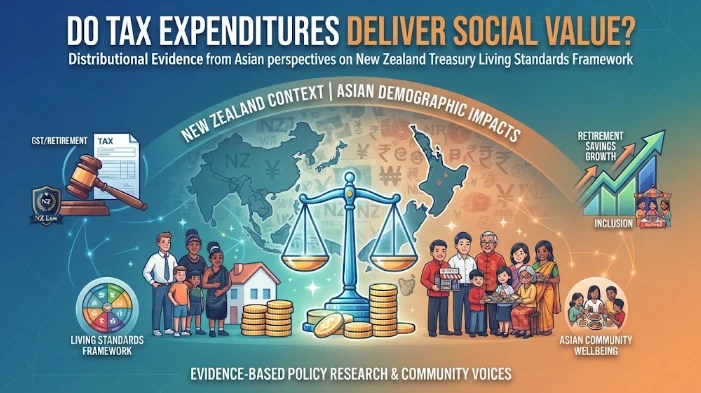
Do Tax Expenditures Deliver Social Value? Distributional Evidence from Asian perspectives on New Zealand Treasury Living Standards Framework; GST/retirement
Kazi Rukaiya Sultana (Master of Public Policy & Master of Social Welfare and Research)
This article evaluates tax expenditures through a broader wellbeing and distributional framework, drawing on New Zealand’s Living Standards Framework, GST and retirement policy. It argues that fiscal analysis should not stop at annual income, revenue or GDP because concessions can affect consumption, saving, retirement security, housing, work, culture and resilience across generations. Distribution should therefore be examined by age, income, wealth and long-term wellbeing. Consumption taxes illustrate the trade-off: a broad GST base can raise revenue efficiently and reduce classification disputes, yet lower-income households may spend a larger share of current income on taxed consumption. Targeted transfers may address regressivity more precisely when coverage and take-up are reliable. The article also stresses that behavioural responses are not automatically socially valuable and that legal incidence may differ from economic incidence. Administrative complexity, digital access and reconciliation can determine whether intended benefits are actually received. Fiscal sustainability and microsimulation are integrated into the evaluation. Overall, the article recommends testing tax expenditures against wellbeing, distribution, administrative accessibility and their interaction with the wider tax-transfer system rather than judging concessions in isolation.
Tax-transfer policy is not done by tax rates themselves but by the effect on disposable income. All this is part of one household budget: earnings, income tax, social contributions, cash benefits, housing support, family payments and withdrawal rules. Sometimes a tax rate cut can yield a small benefit even after another payment is subtracted. The object for poverty and work incentives is thus the entire budget constraint of a household at various earnings levels.
The NZ Treasury's Living Standards framework extends beyond the narrow focus of fiscal analysis on revenue and GDP. The framework for 2021 addresses individual and collective wellbeing, institutional, human capability, social cohesion, natural environment and financial or physical wealth over time. The tax-expenditure question can take on a different shape once viewed from that perspective: A concession can affect current consumption, retirement security, housing, work, saving, and inter-generational resources simultaneously. Distribution is not just measured by a single ranking of annual income, but across age, income, wealth, culture and future resilience.
Public economics also cautions against considering every behavioral response as being socially useful. Tax changes affecting the supply of formal labour can affect unpaid care within a household, demand for childcare, and/or have an interaction with market power. The two-sided market adds additional layers of complexity, as a tax on a platform or provider can impact both sides of a transaction. Incidence is a function of elasticities and market structure, rather than just a function of the legislatively named taxpayer.
The distributional conflict is well-illustrated by consumption taxes. Broad consumption taxes are an efficient way of raising revenue, but the poor tend to spend a higher percentage of their current income. Lower rates on the necessities can ease that burden, and large absolute benefits to the higher-spending households. When administrative systems are able to consistently identify eligible households, and payment rules are still easy to understand, it may be easier to mitigate regressivity directly through targeted transfers.
The progressivity should be considered on the level of the entire fiscal system. Personal income tax may be progressive, consumption taxes, payroll contributions, housing subsidies and benefit withdrawal may change the final pattern. The new Zealand fiscal incidence study reinforces the importance of following the tax and benefit through the household income stream, and not assessing individual instruments. Analysis can be similar to show the impact on lifetime inequality, annual inequality, or neither of an apparently progressive reform.
Chosen design of administration can affect outcomes just as much as statutory generosity. The complexity of the forms, delays in reconciling, debt recovery, and the variability in reconciling can make take-up rates lower or may cause hardship. Accessibility features like automatic data matching and pre-filled information can make access easier but digital systems should ensure there are alternatives for those that may have language, disability, connectivity or record-keeping concerns. If eligible households are unable to access or access and access and comprehend welfare measures, the reform cannot have its desired impact.
New Zealand's wide-spread GST has always been a good example of the efficiency argument for a relatively uniform consumption-tax base. Having a wide base minimizes classification controversy and cuts back on the ability of shifting expenditure toward preferred categories, but at the same time a broad base may result in more punitive taxes on people with a higher proportion of current income. When coverage and take-up are high, targeted transfers can be used to more effectively target distribution. An important comparison is not between no GST and GST, but between the combined effect of taxes, transfers, public services and household circumstances.
Fiscal sustainability continues to be a part of the equity calculation. Persistent deficits may result in transfers between generations, and poorly targeted tax cuts may lower the revenues required to provide high-value services. In the context of sustainable reform, a stable financing base is found and distributional decisions are made explicit. That way, poverty-reduction, incentives and public-service funding are not mutually exclusive goals and can be measured as interconnected goals.
The importance of microsimulation in that analysis stems from the fact that averages mask those touched by interacting rules. New Zealand Treasury's TAWA model is applied to representative microdata, and has been used for distributional, fiscal-incidence and effective-marginal-rate analysis. The OECD work on inequality budgeting also reveals a broad acceptance of the use of tax-and-spending microsimulation in advanced administrations. These tools enable to make the discussion about reform more tangible and illustrate the effects on income deciles, family types and labour-market status.
When support is highly targeted, poverty reduction and work incentives may drive policies to go in opposite directions. The benefit is generous at low incomes, but falls off quickly as income increases, leading to a high effective marginal tax rate. That rate reflects the proportion of additional earnings that is sacrificed due to increases in taxes and decreases in transfers. High rates, of course, do not necessarily indicate low employment, but rather reveal that there is employment at which a further unit of work yields a surprisingly low gain in disposable income.
What's important in designing a withdrawal is not just its generosity, but also its shape. Gradual tapers can help "fall" into work, and sharp thresholds can have an impact on hours, timing, or formal reporting. In some contexts, individual taxation may provide better incentives for secondary earners than a family-based approach to taxation, while family-based transfers may address household need more precisely. Policy is thus a balancing act between equity, fiscal cost, targeting and administrative simplicity.
Intergenerational equity is introduced into the same frame as retirement policy. The taxation of savings impacts incentives while the individual is working, and on-going public pensions and accumulated assets influence living standards in retirement. The benefits of giving concessions that promote saving vary widely by earnings, home ownership, and wealth. A Living Standards approach questions the degree to which financial assistance can enhance long-term wellbeing without disproportionately transferring costs or opportunity costs to other household groups, future taxpayers or those with reduced saving power.
Economic welfare is a broader measure than the number of jobs. There are other dimensions of household welfare that are not captured by output and income, such as commuting, child care responsibilities, health limitations, and the loss of leisure. A reform that boosts employment by imposing harsh labour market consequences on one group of people may appear to be a positive measure for the number of people in work, but it may not look like such a good policy for people in need of income support. Strong evaluation follows this up with tracking of employment, hours, disposable income, poverty depth and fiscal cost.
An important reason for the importance of mobility is that households change their income distribution over time. Low income may be temporary such as during study, caregiving, or in the early years of employment, or be a more enduring policy problem of persistent low income. It is possible to identify immediate incidence of taxes but not all lifetime incidence effects, using tax transfer modelling on a single year. Longitudinal evidence is helpful in interpreting whether support helps to buffer temporary shocks, helps to lower the share of persistent poverty, or alters the chances of moving up.
Another link between welfare design and long run productivity is human capital. Transfer programs that help secure nutrition, housing stability, childcare access, or participation in education can have a positive impact on the future earnings of a recipient, even if they appear to cost the government in the short run. On the contrary, benefit rules that discourage training income or leaves benefits uncertain about study will also discourage skill investment. The real work-incentive framework, in other words, must go beyond the supply of labour in the short term, and ask whether the existing incentive rules are reinforcing the earning power in the long term.
Reform packages that work best integrate modelling into decision making as a tool rather than as a tool for decoration following policy decisions. These distributional tables, effective-marginal-rate profiles, behavioural sensitivity tests and fiscal scenarios can be generated before legislation. From this, results can inform the design of threshold, taper, refundable credit, and transition rules. While evidence can point to the fact that politics must not be removed from the equation, it can also reveal hidden trade-offs, and help minimise the possibility that a single headline creates a complex household reality.
The test to see if the rule is delivering public value is whether it does so when accounting for the fiscal cost of compliance, unintended incentives, and overall public value. Transparency is most useful when assumptions, definitions, limitations and criteria for review are presented prior to the time a policy becomes difficult to change. This holistic strategy also helps to resist the temptation of single indicators of fairness, efficiency, and responsible behaviour.
CITE THIS ARTICLE
Sultana, K. R. (2025). Do Tax Expenditures Deliver Social Value? Distributional Evidence from Asian perspectives on New Zealand Treasury Living Standards Framework; GST/retirement. https://researchbysultana.com/article/1ccd67e7-8289-5963-9e94-c3bcca78cf4e
K. R. Sultana, “Do Tax Expenditures Deliver Social Value? Distributional Evidence from Asian perspectives on New Zealand Treasury Living Standards Framework; GST/retirement,” 2025. [Online]. Available: https://researchbysultana.com/article/1ccd67e7-8289-5963-9e94-c3bcca78cf4e
Sultana, K. R. (2025) ‘Do Tax Expenditures Deliver Social Value? Distributional Evidence from Asian perspectives on New Zealand Treasury Living Standards Framework; GST/retirement’. Available at: https://researchbysultana.com/article/1ccd67e7-8289-5963-9e94-c3bcca78cf4e
Sultana, Kazi Rukaiya. “Do Tax Expenditures Deliver Social Value? Distributional Evidence from Asian perspectives on New Zealand Treasury Living Standards Framework; GST/retirement.” 2025, https://researchbysultana.com/article/1ccd67e7-8289-5963-9e94-c3bcca78cf4e.
Kazi Rukaiya Sultana. “Do Tax Expenditures Deliver Social Value? Distributional Evidence from Asian perspectives on New Zealand Treasury Living Standards Framework; GST/retirement.” (2025). https://researchbysultana.com/article/1ccd67e7-8289-5963-9e94-c3bcca78cf4e.
Sultana KR. Do Tax Expenditures Deliver Social Value? Distributional Evidence from Asian perspectives on New Zealand Treasury Living Standards Framework; GST/retirement. 2025. https://researchbysultana.com/article/1ccd67e7-8289-5963-9e94-c3bcca78cf4e
@misc{article_1ccd67e7828959639e94c3bcca78cf4e,
  title = {Do Tax Expenditures Deliver Social Value? Distributional Evidence from Asian perspectives on New Zealand Treasury Living Standards Framework; GST/retirement},
  author = {Kazi Rukaiya Sultana},
  year = {2025},
  url = {https://researchbysultana.com/article/1ccd67e7-8289-5963-9e94-c3bcca78cf4e},
}
TY  - GEN
AU  - Kazi Rukaiya Sultana
TI  - Do Tax Expenditures Deliver Social Value? Distributional Evidence from Asian perspectives on New Zealand Treasury Living Standards Framework; GST/retirement
PY  - 2025-05-25
UR  - https://researchbysultana.com/article/1ccd67e7-8289-5963-9e94-c3bcca78cf4e
ER  -
This article uses institutional economics and applied microeconomics to show why tax-transfer reform cannot be evaluated from policy rules alone. Household disposable income reflects earnings, taxes, contributions, benefits, housing support and withdrawal schedules, but the effectiveness of those rules also depends on institutions that administer them. Different data systems, delayed appeals, inconsistent local delivery and administrative capacity can cause a theoretically efficient policy to wo
This article presents tax transparency as a governance and accounting issue rather than a simple disclosure exercise. Boards oversee tax outcomes that are influenced by risk appetite, capital allocation, internal controls, remuneration and significant transactions, while accounting systems provide the common record connecting financial profit, taxable income, deferred tax, cash tax and uncertain positions. IFRS S1 and IFRS S2 are used to show how sustainability-related financial information can
This article evaluates tax expenditures in not-for-profit, charity and resource-tax settings through distribution, governance and public value. Preferential treatment for charities and similar organisations is justified by public or community benefit, so reporting and governance should show whether concessions expand valued services, improve access or instead accumulate as private or organisational advantage. The article warns that annual income alone is an incomplete equity measure because life