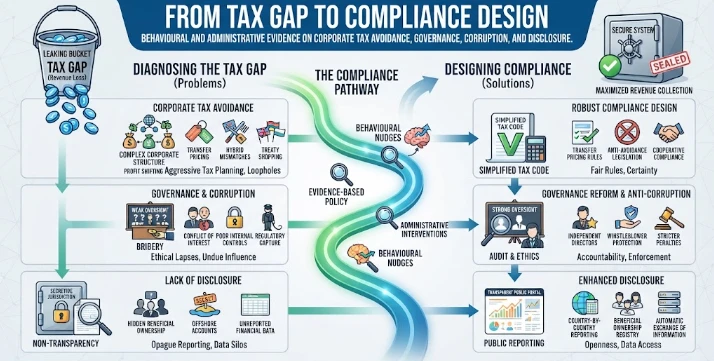
The article examines corporate tax avoidance through the combined lenses of tax-gap measurement, governance, corruption and disclosure. A tax gap identifies the difference between legal liability and estimated collections, but the policy response depends on what causes the shortfall. Behavioural evidence shows that compliance reflects clarity, trust, fairness, cash-flow pressures and administrative burden as well as sanctions. Governance and corruption matter because selective enforcement, opaque settlements, conflicts of interest or weak procurement controls can undermine willingness to comply even when statutory rules are sound. The article favours risk segmentation so simple errors receive correction, temporary payment problems receive workable arrangements and deliberate concealment receives stronger verification. Tax expenditures and special rules can create additional boundaries that generate uncertainty and planning opportunities. GST and VAT transaction data can support verification, while disclosure needs standardisation, materiality and clear responsibility for review. Large corporate avoidance requires specialist analysis of financing, intangibles, transfer pricing and cross-border structures. A modern compliance system therefore integrates prevention, facilitation, analytics, transparent governance and credible enforcement, with success measured through revenue, burden, fairness and trust.
Tax gap is more than a revenue number. It means the difference between what the tax should be according to the current law, and what the administration estimates that it will be. According to OECD Tax Administration 2024, more and more jurisdictions estimate gaps to gain an understanding of the scope and type of non-compliance. The policy value is found in diagnosis: gaps and needs vary and different services, data sources, strategies, and policy interventions are required.
Both direct leakage and indirect damage to trust are negative factors for compliance as a result of corruption. Formal rules may be negotiable because of preferential treatment, hidden settlements, political manipulation or procurement issues. Internal controls can mitigate opportunities for improper payments, and corporate disclosure and beneficial-ownership information can help shed light on relationships that should be examined. Traceable transactions, accountable discretion and credible enforcement are thus of common interest for anti-corruption policy and tax administration.
The traditional deterrence model is complicated by behavioural evidence. Penalties and the likelihood of an audit have impact, but compliance is also affected by clarity, trust, perceived fairness, social norms, pressure of cash flow and ease of fulfilling obligations. OECD tax-administration reports more use of behaviour researchers and targeted communications. Simple rules can cause errors when applied in aggregate data while a timely reminder can prevent errors from occurring at no extra expense.
Costs of compliance are equally important as administrative hassles may lead small companies to mistakes or informality. Even if there is no additional tax to pay, there is an economic cost involved in the time spent interpreting rules, maintaining records, reconciling GST and correcting returns. Documentation of routines can be minimized by electronic filing, but this is only possible if software, ID systems and data standards operate reliably. Unwittingly, ill-conceived digital obligations can simply shift costs from Government to business and professional advisers.
Risk segmentation provides a more proportionate model. Educating and correcting simple errors is essential, for those who have to pay taxes because of temporary payment burden, there must be a way to make it easier, and for those who deliberately hide and conceal, there must be increased verification. Leaking enforcement capacity and potentially harming voluntary compliance by considering every discrepancy as fraud. By treating every discrepancy as "innocent," you have the problem of the opposite end, in that it leads to a lack of deterrence and fairness for those who pay without the help of anyone.
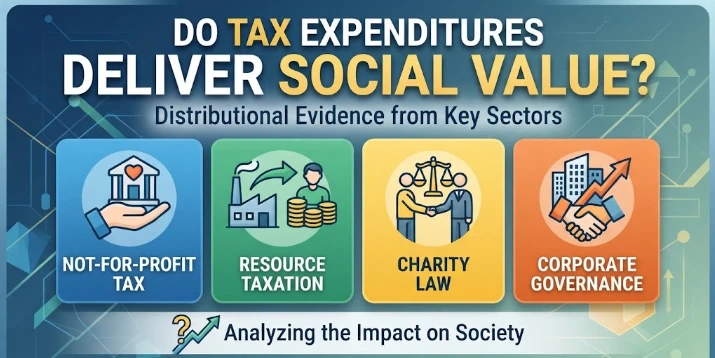
Special rules increase boundaries and tax expenditures have an impact on tax compliance as well. There are classification questions and planning opportunities based on deductions, exemptions, reduced rates and sector concessions. Each succeeding boundary can be the source of real uncertainty and aggressive interpretation. Fiscal authorities have to consider the cost of tax expenditures in some degree of an administrative perspective, a concession that may not have a large policy effect but a high policy complexity can also cost more than the revenue it generates that is included in a budget statement.
GST and VAT systems benefit from the use of transaction trails. While invoice chains may offer third party information to help verify, other concerns such as refund fraud, missing traders, cash transactions and classification disputes still exist. The adoption of e-invoicing and data matching can help enhance visibility in areas where legal and technical infrastructure are well developed. Even in such instances, there is still the need for reliable safeguards, as the large data sets could result in misaligned errors, privacy issues, and false positives due to the lack of context for the risk models.
More work is still required on the design of disclosure. While many data volumes can give the appearance of transparency, key risks can be hidden in a variety of formats. While publication is valuable, it is more valuable to have these features: standardisation, materiality, audit trails and clear responsibility for review. The quality of governance is linked to the ability of the disclosed information to allow for action by boards, regulators, revenue authorities, investors and civil society.
There is another level of fiscal federalism, with more than one government sharing tax bases or administrative powers. Definitions, rates, exemptions and data systems may vary between jurisdictions, creating a greater compliance burden for businesses conducting activities in more than one jurisdiction. Coordination can help to minimise duplication by shared registration, sharing information, and using harmonised definitions, or central collection systems. Constitutional mandates, revenue autonomy and the importance of local policy flexibility will influence the appropriate institutional arrangement.
Corporate tax avoidance demands a different toolbox than the type of record error that occurs with small businesses. Large groups can avail of financing structures, use intangibles, transfer pricing, entity chains and cross-border mismatches which require specialised knowledge and international information. Public disclosure and tax transparency can help to ensure accountability, but the same principles of disclosure do not apply to book profit and taxable profit. Effective assurance is an integration of accounting analysis, legal interpretation, economic substance and risk-based engagement.
Legitimacy of the administration also is affected by governance and corruption risks. Wherever the statutory rules appear well conceived but are not enforced in a selective way, not enforced in opaque settlements, if procurement controls are weak, or if there is a conflict of interest, there will be a decrease in "willingness to comply". Rights of independence, review, documented procedures, and publishing of aggregate performance information contribute to ensuring legitimacy. Compliance design should therefore be a part of a wider rule-of-law approach—not just be part of a narrow collection function.
Measurement needs to differentiate between gross and net gaps, uncertainty due to the model and uncertainty due to administration. A net gap after compliance activity can still be negative despite high underlying risk and economic shocks may affect the net gap and payment capacity. Stable methods and/or transparent revisions are required for time-series interpretation. Allowing uncertainty and methodology to be published enhances, not detracts from, the usefulness of gap estimates for stakeholders, as the numbers can and cannot be used to resolve uncertainty.
Australia's tax-gap program is a good example of that, with highly public estimates of the tax-gap. The overall net gap was estimated to be approximately 58.2 billion Australian dollars (9.1 percent) in November 2025, with small business accounting for the largest share of 27.2 billion Australian dollars. There were also significant amounts of taxes collected for individuals not engaged in business and not paying GST. These do not mean that there is the same pattern of behaviour across each group, but rather that there is a need to have different strategies of enforcement to tackle different aspects of non-compliance.
An up-to-date compliance approach, therefore, should be a mix of prevention, facilitation, verification and enforcement. Omissions can be avoided, errors can be minimised through guidance, the high risk cases can be identified using analytics and deliberate evasion can be tackled by effective sanctions using pre-filled data. All interventions should be assessed in terms of revenue, burden, fairness and trust. The objective isn't to enforce as much as possible, it's to have voluntary compliance at the least cost to society and administration.
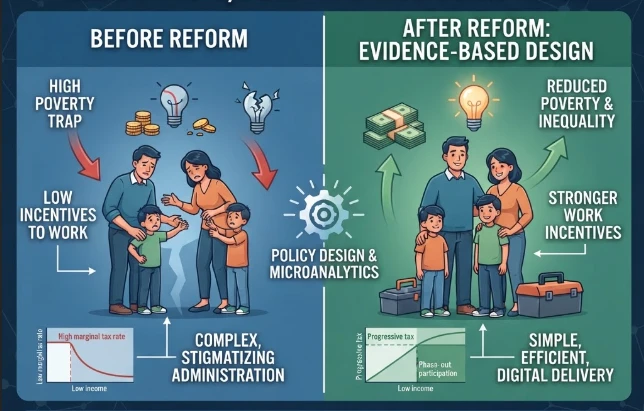
One other benefit of this is hidden trade-offs emerge before thresholds, exemptions or enforcement settings become routine. The deeper point is that fiscal design should be subject to behavioral testing, and not taken at face value off statutory labels. The difference is important because the legal form and the economic incidence may go in opposite directions as households and firms respond. Another protection is to explicitly state the assumptions so that they can be reproduced or criticized by other analysts.
The strength of the evidence also is improved when distribution, administration and behaviour are considered together, as opposed to in separate reports. Evaluation criteria is more durable when they are agreed to prior to beneficiaries and administrators adapting around a permanent rule. The real question is whether a reform is defensible when all its fiscal cost, distribution, complexity and uncertainty are laid on the table. Transparency is thus not seen as a communication activity post-scrutineering, but as a component of the design of the policy architecture.
One other benefit of this is hidden trade-offs emerge before thresholds, exemptions or enforcement settings become routine. The implications are more profound: Fiscal design should be evaluated based on real behaviour and not assumed from statutory labels. That's important because the economic incidence and legal form can go in different directions after adjustments. An additional defense is to make the assumptions explicit in such a way that other researchers would be able to replicate or critique the primary outcome.
The strength of the evidence also is improved when distribution, administration and behaviour are considered together, as opposed to in separate reports. Evaluation criteria are more likely to be accepted as a policy if they are agreed upon prior to the beneficiaries and administrators adapting to a permanent policy.
CITE THIS ARTICLE
Sultana, K. R. (2026). From Tax Gap to Compliance Design: Behavioural and Administrative Evidence on Corporate tax avoidance, governance, corruption, and disclosure.. https://researchbysultana.com/article/1c4d3493-6f6c-50e2-89f5-7c854f041864
K. R. Sultana, “From Tax Gap to Compliance Design: Behavioural and Administrative Evidence on Corporate tax avoidance, governance, corruption, and disclosure.,” 2026. [Online]. Available: https://researchbysultana.com/article/1c4d3493-6f6c-50e2-89f5-7c854f041864
Sultana, K. R. (2026) ‘From Tax Gap to Compliance Design: Behavioural and Administrative Evidence on Corporate tax avoidance, governance, corruption, and disclosure.’. Available at: https://researchbysultana.com/article/1c4d3493-6f6c-50e2-89f5-7c854f041864
Sultana, Kazi Rukaiya. “From Tax Gap to Compliance Design: Behavioural and Administrative Evidence on Corporate tax avoidance, governance, corruption, and disclosure..” 2026, https://researchbysultana.com/article/1c4d3493-6f6c-50e2-89f5-7c854f041864.
Kazi Rukaiya Sultana. “From Tax Gap to Compliance Design: Behavioural and Administrative Evidence on Corporate tax avoidance, governance, corruption, and disclosure..” (2026). https://researchbysultana.com/article/1c4d3493-6f6c-50e2-89f5-7c854f041864.
Sultana KR. From Tax Gap to Compliance Design: Behavioural and Administrative Evidence on Corporate tax avoidance, governance, corruption, and disclosure.. 2026. https://researchbysultana.com/article/1c4d3493-6f6c-50e2-89f5-7c854f041864
@misc{article_1c4d34936f6c50e289f57c854f041864,
  title = {From Tax Gap to Compliance Design: Behavioural and Administrative Evidence on Corporate tax avoidance, governance, corruption, and disclosure.},
  author = {Kazi Rukaiya Sultana},
  year = {2026},
  url = {https://researchbysultana.com/article/1c4d3493-6f6c-50e2-89f5-7c854f041864},
}
TY  - GEN
AU  - Kazi Rukaiya Sultana
TI  - From Tax Gap to Compliance Design: Behavioural and Administrative Evidence on Corporate tax avoidance, governance, corruption, and disclosure.
PY  - 2026-01-21
UR  - https://researchbysultana.com/article/1c4d3493-6f6c-50e2-89f5-7c854f041864
ER  -
This article uses institutional economics and applied microeconomics to show why tax-transfer reform cannot be evaluated from policy rules alone. Household disposable income reflects earnings, taxes, contributions, benefits, housing support and withdrawal schedules, but the effectiveness of those rules also depends on institutions that administer them. Different data systems, delayed appeals, inconsistent local delivery and administrative capacity can cause a theoretically efficient policy to wo
This article presents tax transparency as a governance and accounting issue rather than a simple disclosure exercise. Boards oversee tax outcomes that are influenced by risk appetite, capital allocation, internal controls, remuneration and significant transactions, while accounting systems provide the common record connecting financial profit, taxable income, deferred tax, cash tax and uncertain positions. IFRS S1 and IFRS S2 are used to show how sustainability-related financial information can
This article evaluates tax expenditures in not-for-profit, charity and resource-tax settings through distribution, governance and public value. Preferential treatment for charities and similar organisations is justified by public or community benefit, so reporting and governance should show whether concessions expand valued services, improve access or instead accumulate as private or organisational advantage. The article warns that annual income alone is an incomplete equity measure because life