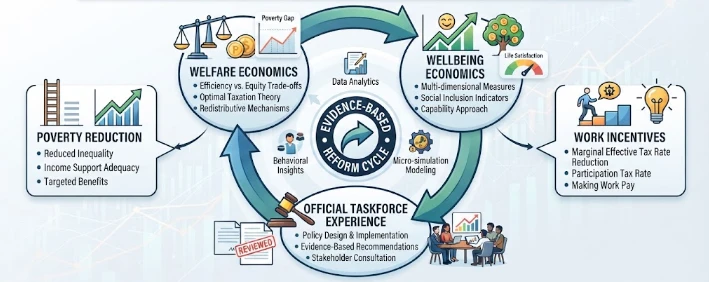
This article evaluates tax-transfer reform through wellbeing economics and welfare economics rather than treating higher employment or disposable income as sufficient measures of success. Household welfare depends on earnings, taxes, benefits and withdrawal rules, but also on housing security, health, education, time, safety, transport and childcare. The article argues that reforms can produce a financial gain while leaving families no better off if essential costs rise or access to services deteriorates. It links welfare design with human-capital development, noting that support for nutrition, housing, childcare and education may strengthen future earning capacity even when it creates a short-run fiscal cost. Consumption taxes, targeted transfers, effective marginal tax rates and benefit tapers are examined within the full fiscal system. Microsimulation is presented as a practical tool for showing distributional effects by income group, family type and labour-market position. Official taskforce experience adds an institutional lesson: technically attractive policy must also survive administrative capacity, legal clarity, political constraints and transition rules. Transparent assumptions and repeatable evaluation are therefore central to durable reform.
Tax-transfer policy is not about tax rates per se, but about disposable income. The household budget comprises earnings, income tax, social contributions, cash benefits, housing support, payments for the family and withdrawal rules. Although one tax rate may be reduced, a small benefit may remain after the elimination of another tax payment. The appropriate object for poverty and work incentives is thus the total budget constraint of a household at various income levels.
If tax-transfer reform is concerned with wellbeing economics, it's a matter of changing the baseline from income only. Whether or not there is a real improvement when a perceived financial gain occurs depends on health, housing security, time, safety, education, social connection and environmental quality. This is the general issue that is likely to arise in official policy taskforces when they are trying to convert the general welfare target into tax thresholds, benefit rates, funding for services, and budget limits. A reform which increases disposable income may not lead to an improvement, if it is offset by the increase in rent, childcare, transport, health etc. costs.
Another link between the welfare design and long-run productivity is human capital. Transfers that prevent a loss of nutrition, housing stability, child care access, or participation in education can help contribute to future earnings, even if the fiscal accounts indicate a cost in the short run. On the other hand, benefit rules which discourage training income or give rise to uncertainty about study can reduce the incentive to invest in skills. A good work-incentive system takes a more long-term perspective and asks whether current rules will help improve future earning potential.
Public economics also cautions against considering all behavioural responses as having social value. Tax changes that raise the supply of formal labour can affect the demand for informal care within a household, the demand for childcare, or the interplay with market power. Two-sided markets introduce additional complexities as a tax on the platform or the provider could impact the prices either side of a transaction. The incidence of taxation isn't limited to the legal taxpayer named in the legislation; it's determined by the elasticity of supply and demand, as well as market structure.
The distributional tension is most clearly exemplified by consumption taxes. The broad-based consumption taxes can be an efficient way to raise revenue, but it is possible that lower income groups spend a greater proportion of current income. Lower rates on necessities help to lighten that burden, but also give significant absolute benefits to more affluent households. The regressivity of targeted transfers can be addressed more directly if administrative systems provide good and consistent identification of eligible households and payment rules are kept simple.
Progressivity should be measured in the overall fiscal system. A progressive personal income tax can coexist with a progressive consumption tax, a progressive payroll tax, a progressive housing subsidy, and a progressive withdrawal of benefits. The value of following taxes and benefits down the stream of household income is shown in the New Zealand fiscal-incidence work. An apparently progressive reform will be shown to either increase or decrease the inequality in lifetime or in annual values, depending on the analysis.
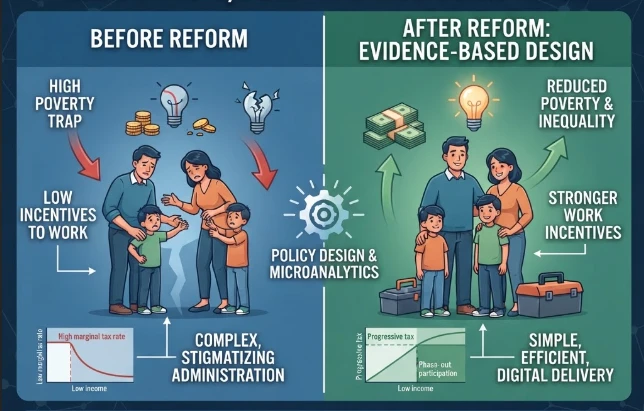
The outcome depends as much on administrative design as on statutory generosity. Complex forms, delayed reassessments, debt recovery and inconsistent reconciliation may have a negative effect on take-up or result in hardship. While automatic access and pre-filled information can help ease access, there are alternatives to digital systems for those who experience language barriers, disability, connectivity challenges, or limits in their ability to keep records. A reform does not have the welfare benefits that it's trying to achieve if eligible households do not receive or understand welfare.
Welfare economics offers an organised method for analysing those tradeoffs without taking for granted that the amount of money received in a market is a valid social measure of value. There are a number of factors that impact on the case for intervention: distributional weights, the diminishing marginal utility of income, externalities, and public goods. The experience of Taskforce also reveals that it is important for technically appealing designs to endure administrative capacity, legislative clarity, political constraints and transition rules. Policy quality is thus dependent on the ability to blend the two aspects of the policy – the normative goal and the realistic way of achieving it – rather than treating one dimension as less important.
Equity continues to include the consideration of financial sustainability. Persistent deficits can raise transfer payments from one generation to the next; inappropriate tax cuts can reduce taxes required for higher quality services. Sustainable reform finds a stable financing base and it makes distributional decisions explicit. That way, poverty reduction, incentives and public-service funding can be considered together—not as slogans in competition.
Interacting rules have made microsimulation the key to that analysis -- as averages mask the people affected. New Zealand Treasury's TAWA model has been applied to representative microdata, and has been applied for distributional, fiscal incidence and effective marginal tax rate analysis. Tax and spending microsimulation is also well established in the OECD, as illustrated by the work on inequality budgeting. These tools help to make reform discussions more real by providing data on impact by income decile, family type and labour market status.
When policy is closely targeted, poverty reduction and work incentives can work in opposing directions. A generous benefit will shield people from the bottom but as they make more they will rapidly lose money at the top, leading to a high effective marginal tax rate. That rate is the proportion of each additional unit of income that is lost due to taxation and transfers. High rates do not mean that there is a significant drop in employment, they just mark a time when increasing employment results in a remarkably small disposable-income gain.
It's not always about generosity - shape matters to design quality. Gradual tapers can help to smooth transitions into work, whereas abrupt thresholds can mark cliffs that effect hours, timing or formal reporting. While individual taxation may reinforce secondary earner incentives over family-based assessment in certain circumstances, family-based transfers may more directly target the need of the household. Policy therefore has to be about compromise between equity, fiscal cost, targeting and administrative simplicity.
Employment measures are not the only measure of economic welfare. There is a positive relationship between extra work and output and income, but the negative effects of commuting, childcare, health constraints, and lost leisure time also impact household welfare. Austerity measures, designed to boost the supply of labour, may appear to work well from a short-term employment perspective and to be detrimental to income security for a vulnerable group. There is therefore a strong emphasis on employment, hours, disposable income, poverty depth and fiscal cost in tracking.
Mobility is important due to the fact that households have a distribution of income over time. Temporary low income is caused by study, caring for others, joblessness, fluctuations in the business environment, or the early years of work; persistent low income is a separate policy issue. Tax-transfer modelling from a single year can detect the immediate incidence while it cannot detect all lifetime impacts. Longitudinal evidence provides additional information to guide interpretation of whether support supports stabilisation of temporary shocks, whether it helps to lift people out of persistent poverty, or helps facilitate progression to upward mobility.
The best reform packages employ modelling as a decision making tool, not a piece of trimming on the tail of a policy that has been decided. Distributional tables, effective-marginal-rate profiles, behavioural sensitivity tests and fiscal scenarios can be created in advance of legislation. These results can then inform about the design of thresholds, taper rates, refundable credits, and transition rules. Political decisions cannot be made on the basis of evidence, but evidence can bring to the surface the trade-offs and the likelihood of a single clear headline giving rise to a complex household situation.
Another protection is to publish assumptions, definitions, and evaluation criteria prior to when a policy becomes politically unmanageable to change. The best evidence is one that presents all four of these costs (fiscal, fairness, behaviour, and administrative) in the same assessment, not in different policy stories. Long run credibility hinges on mechanisms that are able to modify thresholds, eligibility or reporting requirements over time as economic conditions or technology evolve. The real issue is, then, whether it generates measurable public benefit once the costs of compliance, distribution, and opportunity cost are taken into account.
Transparent governance transforms that question into repeatable governance and not into a one-off justification at the point of introduction. This unified perspective minimizes the possibility of having a technically correct rule with poor results because of household, firm, and administrative responses to actual incentives. The more powerful analytical option is to assess statutory design in terms of observed incentives, administrative capacity and distributional consequences, without using labels. That view also brings uncertainty into sight, facilitating decision making when uncertainty surrounding behavioural responses or implementation costs can't be measured accurately.
CITE THIS ARTICLE
Sultana, K. R. (2025). Tax-Transfer Reform, Poverty Reduction and Work Incentives: Evidence from Wellbeing economics, welfare economics, and official taskforce experience. https://researchbysultana.com/article/1bdb0144-9890-56d7-be4c-454baade3b3f
K. R. Sultana, “Tax-Transfer Reform, Poverty Reduction and Work Incentives: Evidence from Wellbeing economics, welfare economics, and official taskforce experience,” 2025. [Online]. Available: https://researchbysultana.com/article/1bdb0144-9890-56d7-be4c-454baade3b3f
Sultana, K. R. (2025) ‘Tax-Transfer Reform, Poverty Reduction and Work Incentives: Evidence from Wellbeing economics, welfare economics, and official taskforce experience’. Available at: https://researchbysultana.com/article/1bdb0144-9890-56d7-be4c-454baade3b3f
Sultana, Kazi Rukaiya. “Tax-Transfer Reform, Poverty Reduction and Work Incentives: Evidence from Wellbeing economics, welfare economics, and official taskforce experience.” 2025, https://researchbysultana.com/article/1bdb0144-9890-56d7-be4c-454baade3b3f.
Kazi Rukaiya Sultana. “Tax-Transfer Reform, Poverty Reduction and Work Incentives: Evidence from Wellbeing economics, welfare economics, and official taskforce experience.” (2025). https://researchbysultana.com/article/1bdb0144-9890-56d7-be4c-454baade3b3f.
Sultana KR. Tax-Transfer Reform, Poverty Reduction and Work Incentives: Evidence from Wellbeing economics, welfare economics, and official taskforce experience. 2025. https://researchbysultana.com/article/1bdb0144-9890-56d7-be4c-454baade3b3f
@misc{article_1bdb0144989056d7be4c454baade3b3f,
  title = {Tax-Transfer Reform, Poverty Reduction and Work Incentives: Evidence from Wellbeing economics, welfare economics, and official taskforce experience},
  author = {Kazi Rukaiya Sultana},
  year = {2025},
  url = {https://researchbysultana.com/article/1bdb0144-9890-56d7-be4c-454baade3b3f},
}
TY  - GEN
AU  - Kazi Rukaiya Sultana
TI  - Tax-Transfer Reform, Poverty Reduction and Work Incentives: Evidence from Wellbeing economics, welfare economics, and official taskforce experience
PY  - 2025-11-02
UR  - https://researchbysultana.com/article/1bdb0144-9890-56d7-be4c-454baade3b3f
ER  -
This article uses institutional economics and applied microeconomics to show why tax-transfer reform cannot be evaluated from policy rules alone. Household disposable income reflects earnings, taxes, contributions, benefits, housing support and withdrawal schedules, but the effectiveness of those rules also depends on institutions that administer them. Different data systems, delayed appeals, inconsistent local delivery and administrative capacity can cause a theoretically efficient policy to wo
This article presents tax transparency as a governance and accounting issue rather than a simple disclosure exercise. Boards oversee tax outcomes that are influenced by risk appetite, capital allocation, internal controls, remuneration and significant transactions, while accounting systems provide the common record connecting financial profit, taxable income, deferred tax, cash tax and uncertain positions. IFRS S1 and IFRS S2 are used to show how sustainability-related financial information can
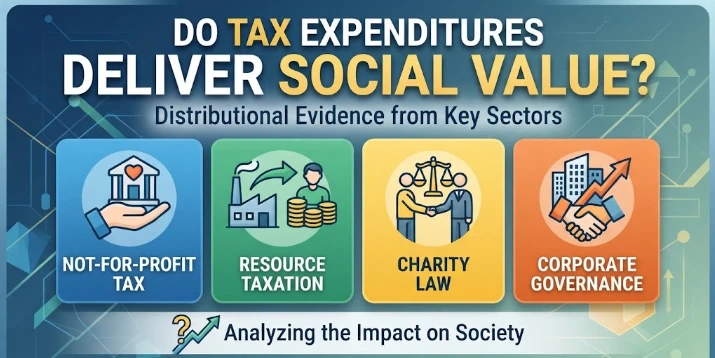
This article evaluates tax expenditures in not-for-profit, charity and resource-tax settings through distribution, governance and public value. Preferential treatment for charities and similar organisations is justified by public or community benefit, so reporting and governance should show whether concessions expand valued services, improve access or instead accumulate as private or organisational advantage. The article warns that annual income alone is an incomplete equity measure because life