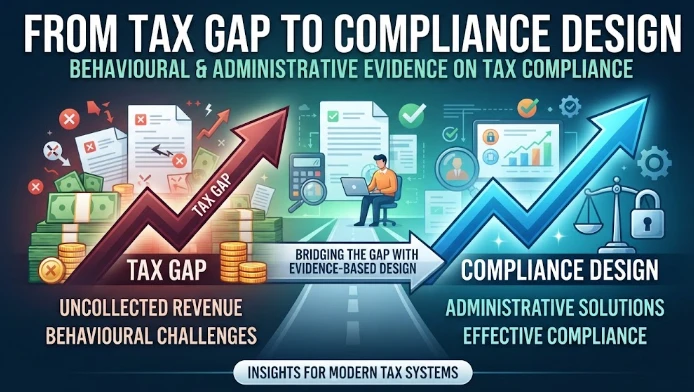
A tax gap is more than just a revenue number. It is the amount of tax that would be collected under the current law, minus the amount of tax collected, as determined by an administration's estimation procedures. Tax Administration 2024, OECD, reports that many jurisdictions are estimating gaps, and that this number is increasing to gain a better understanding of the size and scope of non-compliance. The diagnosis, wherein gaps are treated differently depending on the type of gap, provides the basis for the policy's value.
Non-compliance with income tax will usually start in the books before a tax return is filed. Errors, such as missing invoices, a combination of personal and business expenses, weak payroll records, and inconsistent classification, can all show up once you submit your tax return as under-reported income or overstated deductions. Regulatory behaviour is thus in part determined by bookkeeping ability and system design. Avoiding problems of records is cheaper than fixing them after several years of errors in a post-audit.
Special rules also increase boundaries and impact compliance through the tax expenditures. Deduction, exemption, reduced rates and sector concessions provide classification questions and planning opportunities. Each new boundary can create real ambiguity and aggressive interpretation. Administrative considerations must consequently be part of the fiscal analysis of a tax concession: a concession that may be of modest policy value but complex may generate costs larger than the revenue amount reported in a budget statement.
System of transactions is illustrated in the context of GST and VAT. There is a potential risk of different types of fraud involved with invoice chains, including refund fraud, missing traders, cash transactions, and disputes over classification of the transaction, but invoice chains can offer third-party information to support verification. For legal and technical infrastructure that is well-developed, E-invoicing and data matching can provide enhanced visibility. Robust safeguards are still needed, as errors can be amplified with large data sets, privacy issues can arise, and false positives can be produced with the absence of context in risk models.
The next level comes with fiscal federalism, which is defined by the multiple governments sharing tax bases, or administration. Compliance cost can be higher across jurisdictions due to variations in definitions, rates, exemptions and data systems. Coordination can minimise duplication by having shared registration, information sharing or harmonised definitions, or central collection. The most appropriate institutional arrangements are dependent on the constitutional role, tax autonomy and the importance attached to local policy autonomy.
Corporate tax avoidance needs a different set of tools than record errors by small businesses. Financing structures, cross-border mismatches, entity chains and intangible assets, which require specialist knowledge and international information, are available for large groups. Public disclosure and tax transparency can help with accountability, but uncontextualised disclosure can mislead as book profit is not taxable profit. The key elements of effective assurance are accounting analysis, legal interpretation, economic substance and risk-based engagement.
The credibility of administration is also influenced by governance and corruption risks. Even if statutory rules appear to be good, they may not be adhered to due to selective enforcement, murky settlements, weak procurement controls, or conflicts of interest. Legitimacy is maintained through independence, review rights, documented procedures, and publication of aggregates performance data. Compliance design is thus an integral part of a wider rule-of-law system and not part of a narrower collection function.
Accounting data is also critical to risk analysis as inconsistencies can be identified across sales data, expenses, payroll data, bank data and third party reports. Attention needs to be directed by analytics, not in place of judgment. A weird ratio can mean the business is hiding something, but can also mean it's a new business model, a one-off loss or sector volatility. Fair administration tests anomalies within context and makes conclusions.
Measurement should take into account the difference between gross and net gaps, model uncertainty and the influence of administration. Even if underlying risks are high, a net gap following compliance activity can be negative, and an economic shock can alter both liabilities and payment capacity. Stable methods or transparent revisions are required for time-series interpretation. The greater the uncertainty and methodology conveyed by the publications, the more useful the gap estimates will be, as stakeholders will be able to see what can be established by the numbers.
That is a point that is reflected in the tax-gap program of Australia, the most detailed publicly available estimates. The overall net gap was estimated at around 58.2 billion Australian dollars or 9.1 percent, with the small business size representing the largest of that at 27.2 billion. Also, there were high amounts for individuals not engaged in business and not registered for GST. These statistics are not a representation of similar activities among groups; they simply document why “one size fits all” is not the answer to non-compliance.
The traditional deterrence model is complicated by behavioural evidence. Penalties and audit probability are important considerations, but compliance also takes into account clarity, trust, perceived fairness, social norms, cash-flow pressure and ease of completing obligations. OECD tax-administration work mentions a rise in the use of ‘behavioural researchers' and ‘targeted communications'. As with the aggregate data, a timely reminder can avoid an error at a minimal cost, whereas complicated rules can lead to errors that look like evaions.
The costs of compliance should also be taken into account, since administrative hassles may lead small businesses to make mistakes or become informal. The economic cost of the time spent on interpreting the rules, maintaining records, reconciling GST and correcting returns applies even when no tax is due. While digital filing can ease up routine burden, it can only occur when digital software and identity systems and data standards are reliable. Rural obligations that are not designed properly, simply shift costs from the government to businesses and professional advisers.
The risk segmentation model is more proportionate. Education and correction of simple errors are needed, workable arrangements needed for those facing temporary payment stress, and better verification for those deliberately concealing. Every discrepancy is a case of fraud and the loss of enforcement resources and possible loss of voluntary compliance. That leads to the inverse issue: If the discrepancies are all considered harmless, then deterrence and fairness for taxpayers who are compliant without intervention will be undermined.
In a modern compliance strategy, therefore, prevention and facilitation, verification and enforcement are joined together. Omissions are avoided, errors minimised, high-risk cases can be spotted through targeted analytics, and sanctions can be used for deliberate cheating. Revenue, burden, fairness and trust are all criteria for evaluating each intervention. The aim is not to do as much as possible, which is the compliance model used by most countries, but rather to achieve sustainable compliance at the lowest reasonable social and administrative cost.
Another protection is to make assumptions explicit so that they can be reproduced or contested by other analysts. The more evidence that is examined together, the stronger the evidence becomes, when considering distribution, administration and behaviour. When evaluation criteria are agreed in advance with the beneficiaries and administrators, the durability of the policy is enhanced as the beneficiaries and administrators can adjust to a permanent rule. The key question is, does a reform survive when fiscal cost, distribution, complexity and uncertainty are put on the same page?
It is, therefore, good design to not view transparency as a communication process post-policy but part of the policy architecture. The other benefit of this method is that hidden trade-offs become apparent before thresholds, exemptions or enforcement settings become routine practice. The more fundamental message is that fiscal design must be challenged based on real behaviour, not assumed based on label placement on the statute. That is important because the legal form and economic incidence may go in opposite directions if households or firms adjust.
The next protection is to state assumptions in a manner that is clearly comprehensible for other researchers to replicate or critique the main conclusion. The distribution, administration and behaviour come together to reinforce evidence, which is strengthened when they are considered together as opposed to in separate reports. The more the evaluation criteria are determined prior to beneficiaries and administrators adjusting around a permanent policy, the more durable the policy will be. Putting fiscal cost, distribution, complexity and uncertainty on the same page is the practical test for a reform's defensibility.
Good design therefore considers transparency as part of the design process of a policy system, and not a communication tool post-facto. The other benefit of this is that you start to see the risks of hidden trade-offs before they become standard practice due to thresholds, exemptions or enforcement settings.