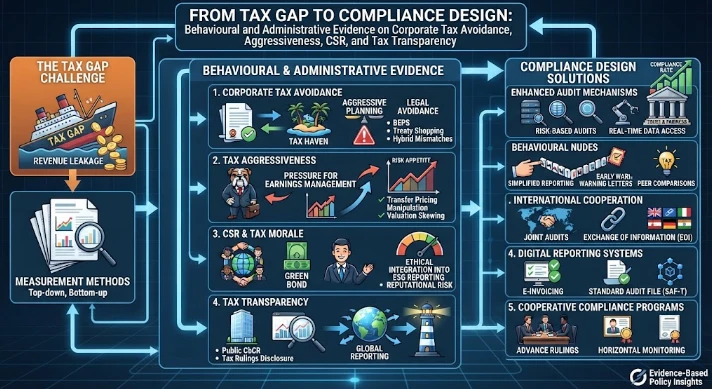
The tax gap seems like a straightforward figure – what tax is owed minus what tax is collected. In practice, that is the end of a far more complex narrative involving the interpretation of law, reporting systems, corporate actions, administrative capability, conflict and the structure of the tax base itself. A more robust solution sees the tax gap as a diagnosis, and then applies those lessons to the creation of improved compliance systems, more effective governance and more reliable business transparency.
Typically, tax administrations differentiate between gross tax gap and net tax gap. Gaps are estimated in gross terms and in net terms, after compliance activity. Estimation is challenging as non-compliance is a partial cover by definition.
Other taxes call for other techniques, such as random audits, information from audited operational documents, macroeconomic comparisons, statistical modelling, or a mixture of techniques. One percentage is to be taken with a pinch of salt. A tax-gap analysis can be best used when it indicates the location of risk and the effectiveness of compliance strategies.
A large-corporate example which may be relevant for Australia is where the Australian Taxation Office (ATO) releases estimates of tax-gap along with tax transparency and assurance activity data for the corporate sector. ATO reporting has revealed that the overall tax levy for large corporate groups is very high and a significant shortfall still exists in the collection of tax liabilities. These are findings not corresponding to two simplistic narratives. Not all large companies are non-compliant, and significant tax payments in a company do not necessarily show a high-risk arrangement. Effective administration must be able to determine the smaller number of jobs, transactions or actions which represent an disproportionate level of risk.
Corporate tax aggressiveness is not solely contained within a legal category. Normal tax planning might include selecting an option that is specifically provided by the law, such as a deduction. Effective planning can push the boundaries of the legislative intent and purpose into the realm of the complex and the bizarre, the cross-border mismatch and the uncertainty of valuation, and the highly engineered arrangement.
Evasion becomes illegality when it involves hiding or lying. Compliance design is enhanced through differentiation of these behaviours by administration. Arming for every difference as misconduct and viewing all formally recorded arrangements as harmless results in resources being lost.
Thus, the issue of risk differentiation comes to the fore. Large-business assurance programmes can include governance, significant transactions, transfer pricing, tax outcomes, and the congruence of accounting and tax outcomes. Information obtained from country-by-country offerings, international exchange reports, financial statements, tax returns and related party disclosures may be useful in prioritizing cases. While a transaction with a low-tax jurisdiction is not necessarily abusive in and of itself, there are certain patterns that are more likely to be abusive, such as high profit with low substance, unusual financing, two or more operating entities with ongoing losses, or inconsistent transfer pricing positions. More precise targeting enables specialist audit resources to be aimed in the right direction where it is expected to generate the most income and behaviour change.
This process can be fostered in two ways by transparency. Confidential reporting provides tax administrations with detailed information for risk assessment purposes and public corporate tax transparency helps broaden accountability. Australia's public entity tax information and other international approaches, like GRI 207, have raised the bar on tax transparency in the form of strategy, governance and jurisdiction contribution disclosure.
There is still a need for context in public data. There may be good reasons for the differences between income, taxable income and tax payable, such as the effects of tax losses, depreciation, investment deductions, timing differences or group structures. Responsible transparency thus accompanies numbers with explanations rather than draws conclusions based on a single ratio.
A governance dimension comes in with the concept of corporate social responsibility. Tax revenues support institutions that facilitate markets including infrastructure, education, health, courts, regulation, and others. This means there is reputational risk even if there isn't a legal determination of illegality, due to aggressive tax behaviour.
Increasingly the question needs to be asked: How does tax strategy fit with commitments to sustainability, ethics and social contribution? But if a company asserts lofty social aspirations and implements structures that seem to be primarily designed for disconnecting profit from economic activity, there is a credibility issue. Tax governance has therefore progressed towards enterprise risk management and board oversight.
Good compliance design is not just about "audits and penalties. It is often more cost effective to prevent than to correct. Before a position is set, uncertainty can be mitigated with clear law, timely guidance, pre-lodgement engagement, advance pricing arrangements, cooperative compliance, effective systems of digital aspects, and early dispute resolution. Behavioural insights can help with better reminders, clearer notices and simpler filing processes to help with behaviour change and routine compliance. While larger corporations are more complex and larger than individual taxpayers, they too should be able to enjoy the same degree of predictability of administration and consistent interpretation.
There is a need for enforcement to have credibility. When participation is used as a cover to aggressive behaviour, cooperative approaches will not work, and strict enforcement will create a lack of openness if each disclosure is perceived as an admission of guilt. The best model is one that is both transparent and verifiable. Companies that were willing to provide detailed disclosures of the material risks will get more certainty but there are still some inconsistencies that are being looked at. This provides an incentive to invest in internal controls and accurate reporting and not just audit exposure once there's a filing.
Good internal corporate governance is a significant contributor to the solution. A well-developed tax-control system can define levels of responsibility, approval requirements, data custodians, escalation protocols, documentation expectations, and levels of reporting to the board. Material transactions should be considered prior to implementation, particularly in the case of cross-border financing, intellectual property, restructures, and hybrid entities.
Incentives also matter. When tax teams are based primarily on lowering the effective tax rate, aggressive positions might be overrepresented. Incorporating compliance quality, dispute exposure, certainty and risk appetite, results in a healthier balance of performance measures.
Policy can in turn be informed by tax-gap analysis. If this rule has been the subject of repeated conflicts, it can come across as ambiguous and not necessarily the result of a lack of good faith. Lacking or inconsistent data in any given sector may indicate structural issues, withholding issues, weak third-party reporting, or lack of digital records.
Significant differences between accounting profit and taxable income may warrant investigation of individual deductions or concessions. Policy interventions should focus on the source of risk, not on complexity throughout the system. Anti-avoidance measures can increase compliance expenses for low-risk companies without meaningfully decreasing the gap if they are not applied correctly.
An added value of tax-gap reporting is institutional accountability. The revenue bodies are required to provide explanations for the methods used for estimating, uncertainty, compliance priorities and change over time for all publications. That discipline minimizes the desire to blame the "problem" for every additional dollar that is made available via audit. It also provides legislators with more grounds for assessing proportionality of additional anti-avoidance measures, disclosure requirements, and administrative investments against the risk they seek to address.
There should also be a distinction made between revenue protected and behaviour changed. A big audit settlement can boost collections one time and a change in the reporting rule can enhance compliance for a whole market. Assurance programmes can create value by motivating the firms to fix systems prior to the submission of future returns.
Good public transparency affects board behavior even in the absence of an audit. Not just annual enforcement yield, but longitudinal data is needed for these effects to be evaluated. When the tax gap is declining along with investment unchanged and compliance costs contained, it is more convincing than when the only evidence is that the year was a record year for penalties.
The most helpful change is from the question: do corporations pay taxes or not? to the question: what behaviours lead to the biggest disconnect? What controls are in place to prevent those behaviours? What transparency can enhance accountability without changing interpretation? By June 2026. Tax administrations require data, capacity of experts, uniform legislation, and effective enforcement. Companies require good board oversight, defensible transfer pricing, adequate controls and explanations that are transparent and aligned with reality. CSR is not a substitute for tax law and transparency is not a substitute for audit. Yet, through the cooperation of robust governance and compliance that is grounded in evidence, the system can shift from the reactive controversy to earlier detection, better prevention and more lasting trust in the tax system.