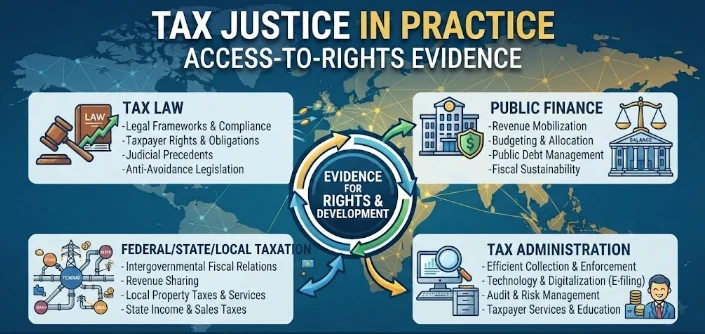
Access to rights starts with procedure and not rates and redistribution in the discussion of tax justice. A taxpayer should be aware of an obligation, have records, communicate, challenge assessment, and have a record of a review at an affordable cost. When professional advice is needed to obtain basic participation, complex law can make formal equality a de facto inequality. The question for access-to-rights analysis is then, of course, whether protections enshrined in tax law are accessible to ordinary people and small entities.
Federal, state and local taxation presents an access problem whenever similar economic activity is subject to different bases, rates, filing processes or processes for review. When both property and payroll taxes, consumption taxes, income taxes, fees and transfers are administered by different governments, they interact. Legal fragmentation makes it worthwhile to have unambiguous directions and coherent service, since the taxpayer is likely to encounter government as one entity, rather than multiple layers of constitutions. The second question public finance analysis asks is whether the revenue allocations match the spending responsibilities borne at each level.
Another aspect of access and distribution is revealed in retirement policy. While a tax deduction for superannuation or retirement savings may be useful to provide income security in retirement, the fiscal value can be quite different depending on the amount of contribution, tax rates and account value. Limited benefit can be obtained from deductions which require current contributions, by workers of lower income. Offsets that can be recovered, contribution limits, preservation rules, age, housing costs and the interaction with public pensions are therefore taken into account in fair design.
A further rule-of-law issue is that certainty is to be achieved only for those who can afford to hire specialist interpretation. Uncertainty can be mitigated through private rulings, public guidance, safe harbours and published administrative positions, subject to ensuring that such positions are easily accessible and that the reasoning is consistent. There is a risk if there is too much discretion as the same facts can yield different results. The transparent interpretation is thus a mechanism of justice as well as an instrument of administrative efficiency.
Enforcement shall continue to be proportionate. Strict measures to combat intentional evasion will benefit compliant citizens and the tax base while harsh measures on those who are truly experiencing hardship or confusion can have far-reaching implications. Collection procedures, penalties, garnishment, and litigation should be protected, reviewed and established escalation guidelines. A rights-based system enables it to differentiate between inability, mistake, avoidance, and fraud, avoiding a one-size-fits-all approach to problems.
When access indicators are paired with revenue indicators, reform seems to be credible. Admins can follow up on complaint resolution, review outcomes, debt persistence, digital exclusion, clinic referrals, and the most common type of errors. This type of information can show whether the changes in the law make things easier or just make them more difficult elsewhere. The question of tax justice is no longer an abstract matter of what the rates are, but rather one that can be captured in the day-to-day functioning of institutions.
Fiscal federalism is also a factor in reform incentives. Enhancing the tax base may be less appealing for a subnational government if the payoff of the extra revenue is not shared and equalisation or grants adjust the final revenue received; and local policy experiments can be limited by central rules. None of these pressures take away the need for clear management. Delineation of responsibility for the assessment process, the collection process, the objection process, information sharing and debt management minimises duplication of effort and potential errors in identification of who is responsible for fixing the error.
Tax clinics fill that void. The National Tax Clinic program is funded by the government to provide support to eligible people and small businesses with tax matters. Clinics also provide opportunities for learning for supervised students, and evidence of common administrative issues. The mix is important because single cases may indicate issues such as a lack of debt, record keeping, registration, family factors, digital access, or an misunderstanding of legal notices.
A second layer of justice is tax knowledge. Understanding the filing deadlines, deductible expenses, business registration, instalment payments and review rights can prevent unnecessary debt and penalties. Literacy should not replace simple law as even well-informed taxpayers have trouble absorbing rules that have several definitions and exceptions. Good systems are composed of clear instructions and commensurate responsibilities and readily available community or professional assistance.
Voluntary compliance is also influenced by procedural fairness. When reasons for adverse action are apparent, evidence is taken into account, appropriate avenues of review are believed, and communication is respectful, individuals are better able to accept the adverse action. Behavioural tax research is no longer confined to a fear of audit approach. Enforcement is not a substitute for trust, however, a consistent process can provide a more legitimate form of trust enforcement and lower the perception of resource and/or connection.
The main point to be made about gender budgeting is that it extends the tax-justice prism: policies that are apparently gender neutral can have different consequences for labour-markets and household distributions. Incidence can be affected by differences in paid work, unpaid care, saving for retirement, owning property, and consumption. A budget may thus be non-distributional without explicitly identifying a gender dimension. Gender-aware analysis considers who gets concessions, who pays consumption taxes, who is eligible for credits, and how policy effects the care-giving and lifetime earnings of all people.
Access to rights becomes particularly relevant in the case of data that cross agency boundaries. Matching can enhance compliance and minimize the risk of multiple reporting, but it must also be governed by a legal purpose, security controls, correction procedures, and, importantly, an avenue for correcting inaccurate information. There is no substitute for procedural fairness in the name of administrative convenience. A sound multi-level tax system, then, should "link services with review rights and interoperable" while at the same time "be coherent in its revenue assignments," and also be "understandable, even if more than one government is involved.
The spending side to the fairness equation is added by public finance. Tax justice cannot be considered only in terms of who gets taxed, since taxes support health, education, infrastructure, income support, security, and administration. Fiscal incurrence analysis connects taxes and benefits to show a net impact on family resources. This method also helps to avoid the simplistic arguments for and against a single tax without taking into account the services and transfers that are supported by the overall tax system.
The connection between company law and securities regulation and tax justice is related to disclosure and governance. Corporate reporting is the information that boards, investors, auditors, regulators and tax officials can see. Risk assessment can relate to related party transactions, executive incentives, provisions, deferred tax and uncertain tax positions. There is no such thing as being too good at tax planning, but good governance, with clear responsibility and credible oversight, makes it more difficult for abnormally aggressive tax planning to persist.
The accessibility challenge is unique in small businesses, as legal requirements can be similar to those of larger businesses, but without the internal resources. The cumulative burden can be caused by GST registration, payroll, deductions, record retention and entity selection. Tax clinics and easy-to-access tax advice can prevent little issues from turning into big debt. In the longer term, the right path is still to simplify, and support services shouldn't be a long-term price for unnecessary complications.
The standard in practice is that of equal abilities to engage in the tax system. The standard calls for a need to have understandable rules, affordable assistance, transparent decision making, effective review, and distributional analysis prior to the implementation of reforms. While revenue collection is still vital due to the need for services, the greater the legitimate use of these services in practice, the more legitimate the revenue will be. A tax system obtains confidence when it is not so complicated that it is not subject to debate from cross-sectoral angles, and not so complex that it can be enforced with a large army of tax officials.
A sustainable system is one that is targeted at revenue protection while also being accessible, the process is predictable, and there is clear responsibility for the action among public and private parties. This means that a sound evaluation ensures that legal design, behaviour, administrative capacity and distribution are all part of the same analytical framework. The test is whether the rule creates net public benefits when fiscal costs, compliance burden and unintended benefits are taken into account. Transparency is best when assumptions, definitions, limitations and review criteria are stated prior to when a policy becomes harder to change.
The integrated approach also helps to guard against the perception of fairness, efficiency, and responsible behaviour in a single headline. The importance of regular evaluation is that technology, market structure, household situations, and administrative capacity evolve at a rate that exceed that of many statutes.