Tax Transparency as Corporate Social Responsibility: Evidence from Corporate governance, corporate sustainability, ESG, social licence, inclusive capitalism
Kazi Rukaiya Sultana (Master of Public Policy & Master of Social Welfare and Research)
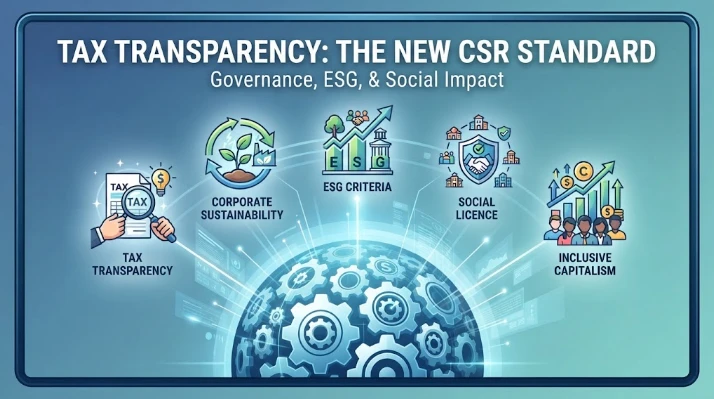
This article presents tax transparency as part of corporate governance, sustainability, ESG, social licence and inclusive capitalism. Investors, employees, customers, governments and communities increasingly assess tax strategy alongside claims about responsible business, making context more useful than a single effective-tax-rate figure. The article links sustainability to board decision rights, incentives, oversight and accountability, noting that reporting frameworks have moved sustainability issues closer to risk management and capital allocation. Social licence adds a legitimacy dimension because companies rely on public infrastructure, legal systems, skilled workers and regulatory support. Inclusive capitalism broadens the analysis to how value reaches stakeholders through wages, supplier payments, taxes, investment, dividends and community effects. The article also considers social enterprises and impact-oriented activity, where grants, concessions and tax preferences can blur ordinary profit measures. Good tax transparency should therefore explain material incentives, losses, geographic profit patterns and governance processes while preserving confidentiality. Credibility depends on consistent financial and sustainability information, clear boundaries, comparable metrics and board oversight. Transparency creates value when it exposes trade-offs, informs decisions and makes declared social commitments testable against actual corporate behaviour.
Tax transparency is no longer limited to the question of timely filing of the company's return. Tax strategy is a topic which is increasingly discussed by investors, employees, customers, governments and communities, as they consider it alongside corporate governance, statements of sustainability, public support and economic impact of a company. A clear approach provides clarity on the connection between statutory requirements, the effective tax result, incentives and losses as well as cross-border structures, without simplifying a complex position to one headline ratio. The context is important to corporate social responsibility because the institutions and infrastructure that the commercial activity relies upon are funded, in part, by tax.
Corporate governance connects sustainability with decision rights and incentives, oversight and accountability. Prior to this point, OECD corporate-governance guidance became more and more focused on sustainability and resilience as a board issue, rather than as a separate philanthropic endeavor. IFRS S1 and IFRS S2 introduced a disclosure framework around material sustainability and climate-related financial disclosures. All of this combined drew ESG into the realm of budgets, capital allocation and risk management – and brought it closer to reality – where claims can be measured against performance, not just words.
This is a similar challenge for social enterprises. It is difficult to measure the performance of hybrid missions with ordinary profit figures because their revenue may include trading income, grants, concessionary financing, and tax preferences. Social-impact reporting can help to define who's helped, what's altered and how it's measured, but metrics must have credible baselines and consistent boundaries. Financial information, tax status and impact measures provide a stronger public-benefit claim when they all support it. A difference between those records should be explained rather than labeled as a difference.
While the SDGs offer a shared language, generic alignment statements can lose any meaning if almost any activity can be aligned with multiple SDGs. Good practice involves identifying specific targets, measurable indicators, and mechanism which links activity to outcome. That discipline is included because fiscal incentives are public resources that have opportunity costs. If a company receives a concession, it can detail the investment or employment created, and governments can report the revenue it has foregone and the policy goal it has been providing.
Another significant link between sustainability and corporate responsibility and public finance is public procurement. OECD evidence indicates that procurement accounts for a significant proportion of economic activity in OECD economies, and that through procurement rules, they can have an impact on environmental performance, labour standards, integrity and innovation. Sustainability clauses may even incentivize good suppliers, but badly formulated clauses can narrow the field or be merely a formality. The language of ESG ought to drive delivery, not the paperwork, and that means the tender criteria be transparent, and evidence be verifiable, and contracts be monitored.
The long-term contractual complexities of public-private partnerships (P3s) are an additional challenge. Infrastructure contracts may last for decades and include construction, financing, services, risk transfer and guarantees. Requirements for sustainability must be included in measurable performance standards, not as aspirations. Contingent liabilities, tax assumptions, procurement decisions, and performance indicators are disclosed which aid in accountability. In the absence of that information, a project can look cheap when the contract is signed and pass on an expensive risk to the public balance sheet.
Social disclosure is a subject that requires careful interpretation, which can be demonstrated by workplace diversity. Looking at headcounts is not the best indicator of recruitment, promotion, pay, retention, safety, or leadership access. Good reporting links representation to employment outcomes and governance processes and safeguards legitimate privacy concerns. Tax breaks for work or training are similarly open to the same scrutiny since the eligibility does not mean additional jobs or the quality of jobs. If workforce claims are paired with actual results or outcomes, and fiscal support (funding) associated with them is made visible, corporate responsibility is made more credible.
The stakeholder lens is broadened in inclusive capitalism and in social licence, and there is still evidence to be measured. A company can create jobs, pay suppliers, invest in communities and pay the taxes, while at the same time imposing environmental/social costs. There must be mechanisms in place to identify those trade-offs and make sure to explain how decisions take into consideration those trade-offs. Tax transparency is one direct way of interacting with the public sector in particular when it comes to investment incentives and concessions. There is an increase in credibility when the sustainability claims of the company, the tax governance and the allocation of capital are aligned.
Social licence refers to a sense of acceptance that goes beyond legal authorization. Companies in resource, infrastructure, finance and digital activities frequently rely on community and regulatory trust and contractual rights. The trust is affected by tax behaviour as profits can depend on public infrastructure, skilled workforces, legal frameworks and government support. Transparency about tax governance does not have to mean disclosure of all sensitive information, but it must be sufficient to demonstrate that compliance with the law and declared social obligations are not in conflict.
Inclusive capitalism focuses on sharing the creation of value at the heart of governance. The various streams of company activity include wages, payments to suppliers, taxes, investing, dividends, and community impacts. Those are avenues that can be shed light on by ESG reporting, but trade-offs can also be hidden by using specific metrics. Tax transparency brings transparency into a tangible fiscal dimension by revealing contributions and incentives by jurisdiction. The best disclosure doesn't boast about tax numbers or make too simple effective rate comparisons; it provides meaningful factors that enable a meaningful review.
The transparency of a company is defined by its corporate governance. Boards must be responsible for tax risk, have escalation paths for “unresolved” tax issues, and receive information that links tax planning with strategy and reputation. Audit committees can verify that disclosures correspond to accounting records and that aggressive structures introduce risks that are not in line with disclosures. Good governance also ensures that the legitimate use of incentives is differentiated from the use of potentially opaque or artificial separations or assumptions that cannot or will not pass muster under regulatory review.
Sustainability reporting offers a more expansive information structure. The standards IFRS S1 and IFRS S2, released in 2023, establish a framework for sustainability-related financial information that includes governance, strategy, risk management, metrics and targets, with IFRS S2 clarifying the distinction between physical and transition risk in the climate standard. Those standards are based on information relevant to enterprise prospects, and not on every social impact. This model can then be complemented with tax transparency, outlining how public subsidies, geographical profit distribution and tax governance are intertwined with the sustainability approach communicated to capital providers.
Corporate communication is both opportunity and risk. Clear narrative can provide reasons for the differences between effective and statutory rates of tax, loss and timing differences and current tax, and the role of incentives in encouraging investment. When there is no quantitative evidence, vague statements about responsible tax can have the opposite effect. The reader should be given sufficient detail to distinguish the structural features from the discretionary planning. It is therefore more convincing to see consistency across the annual reports, sustainability reports, country disclosures, investor presentations and regulatory filings.
The expectation of impact investing is to take it one step further; funds are invested with a clear understanding of a specific social or environmental impact as well as a profit. Increasingly impact frameworks focus on objectives, indicators, baselines, contribution and risk of shortfall and not just on an SDG label. Tax in this context because subsidies, exemptions and credits may affect reported returns. The reporting process ought to be transparent, distinguishing market performance from creation of value due to public fiscal support.
Transparency, therefore, relies on the three pillars of comparability, assurance and consequence. There must be consistent definitions of metrics, explained boundaries for reported metrics, and reconcilitation of significant changes over time. Independent assurance can help to build confidence, but governance remains important as assurance can't fix an incorrect strategy narrative. There is also a need for reporting systems which will allow public agencies to report aggregate tax expenditures, commitments to procure and corporate disclosures, if possible, in comparable terms. Transparency is a way of creating public value when it changes people's decisions, reveals inconsistencies, and enables accountability, not simply more published content.
Long-run credibility requires review mechanisms to be able to modify thresholds, eligibility, or reporting requirements as the economy changes and technology advances.
CITE THIS ARTICLE
Sultana, K. R. (2025). Tax Transparency as Corporate Social Responsibility: Evidence from Corporate governance, corporate sustainability, ESG, social licence, inclusive capitalism. https://researchbysultana.com/article/02479f05-776f-5141-910f-27708616145f
K. R. Sultana, “Tax Transparency as Corporate Social Responsibility: Evidence from Corporate governance, corporate sustainability, ESG, social licence, inclusive capitalism,” 2025. [Online]. Available: https://researchbysultana.com/article/02479f05-776f-5141-910f-27708616145f
Sultana, K. R. (2025) ‘Tax Transparency as Corporate Social Responsibility: Evidence from Corporate governance, corporate sustainability, ESG, social licence, inclusive capitalism’. Available at: https://researchbysultana.com/article/02479f05-776f-5141-910f-27708616145f
Sultana, Kazi Rukaiya. “Tax Transparency as Corporate Social Responsibility: Evidence from Corporate governance, corporate sustainability, ESG, social licence, inclusive capitalism.” 2025, https://researchbysultana.com/article/02479f05-776f-5141-910f-27708616145f.
Kazi Rukaiya Sultana. “Tax Transparency as Corporate Social Responsibility: Evidence from Corporate governance, corporate sustainability, ESG, social licence, inclusive capitalism.” (2025). https://researchbysultana.com/article/02479f05-776f-5141-910f-27708616145f.
Sultana KR. Tax Transparency as Corporate Social Responsibility: Evidence from Corporate governance, corporate sustainability, ESG, social licence, inclusive capitalism. 2025. https://researchbysultana.com/article/02479f05-776f-5141-910f-27708616145f
@misc{article_02479f05776f5141910f27708616145f,
  title = {Tax Transparency as Corporate Social Responsibility: Evidence from Corporate governance, corporate sustainability, ESG, social licence, inclusive capitalism},
  author = {Kazi Rukaiya Sultana},
  year = {2025},
  url = {https://researchbysultana.com/article/02479f05-776f-5141-910f-27708616145f},
}
TY  - GEN
AU  - Kazi Rukaiya Sultana
TI  - Tax Transparency as Corporate Social Responsibility: Evidence from Corporate governance, corporate sustainability, ESG, social licence, inclusive capitalism
PY  - 2025-06-29
UR  - https://researchbysultana.com/article/02479f05-776f-5141-910f-27708616145f
ER  -
This article uses institutional economics and applied microeconomics to show why tax-transfer reform cannot be evaluated from policy rules alone. Household disposable income reflects earnings, taxes, contributions, benefits, housing support and withdrawal schedules, but the effectiveness of those rules also depends on institutions that administer them. Different data systems, delayed appeals, inconsistent local delivery and administrative capacity can cause a theoretically efficient policy to wo
This article presents tax transparency as a governance and accounting issue rather than a simple disclosure exercise. Boards oversee tax outcomes that are influenced by risk appetite, capital allocation, internal controls, remuneration and significant transactions, while accounting systems provide the common record connecting financial profit, taxable income, deferred tax, cash tax and uncertain positions. IFRS S1 and IFRS S2 are used to show how sustainability-related financial information can
This article evaluates tax expenditures in not-for-profit, charity and resource-tax settings through distribution, governance and public value. Preferential treatment for charities and similar organisations is justified by public or community benefit, so reporting and governance should show whether concessions expand valued services, improve access or instead accumulate as private or organisational advantage. The article warns that annual income alone is an incomplete equity measure because life