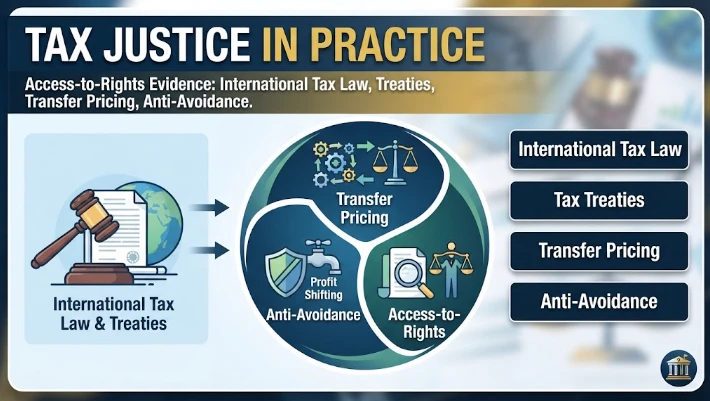
This article applies an access-to-rights framework to international tax law, treaties, transfer pricing and anti-avoidance rules. Cross-border taxation must protect the revenue base without treating every international arrangement as abusive. Treaties reduce double taxation and allocate taxing rights, but structures with limited economic substance can also exploit mismatches. Anti-treaty-shopping provisions, beneficial-ownership concepts, transfer-pricing rules and domestic anti-avoidance measures therefore operate alongside taxpayer protections. The article stresses proportional enforcement, distinguishing deliberate evasion from hardship, mistakes and legitimate disagreement. International disputes also raise questions of practical access because smaller businesses and individuals may struggle to use treaty relief or specialist procedures without affordable guidance. Broader tax-justice themes include tax clinics, tax literacy, public-finance incidence, gender budgeting, corporate disclosure and small-business compliance. Legal certainty should not depend exclusively on specialist resources, so public guidance, safe harbours and transparent administrative positions are important. The article concludes that a legitimate international tax system combines effective base protection with understandable rules, accessible dispute mechanisms, reasoned decisions and review, ensuring that anti-avoidance power remains accountable while genuine rights against double taxation can be exercised in practice.
Rates and redistribution are often used terms when talking about tax justice, but access to rights starts with procedure. A taxpayer should be aware of the duty, obtain the records, communicate with an authority, challenge the assessment and get it reviewed without undue expense. Equality becomes inequality in practice when professional advice is required for participation in formal equality. Access-to-rights analysis thus raises questions about the accessibility of the protection granted by tax law for ordinary persons and small entities.
International anti-avoidance rules are designed to ensure the taxing rights are not lost, but not to make all cross-border arrangements presumed abusive. Typically treaties minimize double taxation, but can also provide opportunities to shift income into entities that have little economic substance. The anti-treaty-shopping provisions, beneficial-ownership ideas, transfer-pricing rules and domestic anti-avoidance measures address various aspects of the problem. Efficient protection of the base coupled with limitations on administrative power is essential to justice.
The enforcement of laws should be proportional. Effective measures against deliberate tax evasion benefit honest and law-abiding taxpayers and the tax base and can have serious consequences when used against individuals experiencing hardship or misfortune. Debt collection, penalties, garnishment and litigation must be protected, monitored and have transparent escalation procedures. A rights-based system doesn't reduce every problem to a single moral category, but differentiates between inability, mistake, avoidance and fraud.
If access indicators are next to the revenue indicators, then the reform has credibility. Administration can monitor the resolution of complaints, review outcomes, the time taken to resolve complaints, debt that remains unpaid, digital exclusion, clinic referrals, and the types of errors that are repeated. This type of data can show how legal changes affect friction or just move it somewhere else. Tax justice is measurable in practice, at the day-to-day use of institutions, not only in words of abstract rates.
Tax clinics fill in that void. The National Tax Clinic program is funded by the Government to provide services to eligible people and small businesses who require help with tax matters. Clinics also provide supervised students with opportunities to learn and provide evidence of frequent administrative issues. These two elements are important because what may be occurring on a case-by-case basis can be linking to systemic issues such as debt, record keeping, registration, family dynamics, digital accessibility, or misinterpretation of legal notices.
Tax Literacy is a second layer of justice. Filing dates, deductible expenses, business registration, instalments, and review rights are all things that can be known and avoided to prevent unnecessary debt and penalties. Well-informed taxpayers have difficulty with multiple definitions, exceptions to the rules in a rule book; for that reason, literacy cannot be a replacement for simple law. The characteristics of strong systems include clear direction, reasonable expectations, and easy-to-reach resources and assistance from professionals or in the community.
Voluntary compliance is also impacted by procedural fairness. An adverse outcome is more likely to be accepted if there is clarity about the reasons, evidence is taken into account, there are channels of review that are credible, and there is respectful communication. Behavioural tax research is now less about fear of being audited, and more about the what factors influence tax behaviour. While trust cannot supplant enforcement, process can make enforcement more legitimate and less seem to be about resources or connections.
Access concerns arise specifically with transfer pricing, as it can result in significant price changes and expert valuations and years of procedure for disputes. Multinationals have a lot of advisory resources available; smaller cross-border companies may find it more difficult to find the same resources in terms of data and documentation. Where risks are routine, there are ways of improving proportionality through simplified approaches and safe harbours. Good dispute resolution is also important since a technically correct position will be of little assistance in the event of ongoing double taxation due to slow or uncoordinated administration.
Gender budgeting extends the lens of tax-justice by increasing the formal neutrality dimension, as formal neutral rules can have varying effects on labour-market and household patterns. Incidence can be influenced by variations in paid work, unpaid care, retirement saving, property ownership and consumption. However, a budget may be distributionally unequal even if it does not include any explicit reference to gender. Gender responsive analysis questions who benefits from concession, who pays consumption taxes, who is eligible for credits, and how policy relates to lifetime earning and caregiving.
The fairness equation gets the spending side from public finance. Who pays must be understood in the context of tax justice, as revenues are used for health, education, infrastructure, income support, security and administration. Fiscal incidence analysis connects taxes and benefits to show their overall impact on household resources. This method also prevents simple statements of a tax being good or bad without taking account of the services and transfers provided by the overall tax system.
The disclosure and governance aspects of company law and securities regulation intersect with tax justice. The information that boards, investors, auditors, regulators and tax authorities see is determined by corporate reporting. Various transactions with related parties, executive compensation, provisions, deferred tax and uncertain tax positions may all be relevant for risk assessment. Having good governance doesn't mean there is no aggressive tax planning, but clear responsibilities and effective oversight make it more difficult to sustain the aggressive strategies.
For small businesses, a particular challenge is gaining access to legal requirements that can be similar to those of their larger peers, but without the same knowledge or expertise. The cumulative burden can come from GST registration, payroll, deductions, record retention and entity options. In addition to tax clinics, there is also accessible guidance that will help prevent small problems from becoming entrenched debt. But while support services are good for the long term, the long term solution is still simplification, as the services need not be permanent for the sake of avoiding complexity.
Another aspect of access and distribution is exposed in the retirement policy. A contribution to superannuation or retirement saving may have a fiscal value, depending on your contribution ability, tax rates, and account balances, and may help to provide long-term income security. It helps limited lower income workers more by means of deductions that are based on current contributions. Consequently, fair design takes account of the refundable offsets, contribution caps, preservation rules, age, housing costs, as well as the interaction between public pensions and private pensions.
There is also an issue of rule of law as advanced tax issues: certainty must not be available to those who can afford the services of tax specialists. Private rulings, public guidance, safe harbours and published administrative positions can help to minimise uncertainty as long as they are accessible and the reasoning is consistent. Too much discretion equals too much risk; different facts yield different results. Transparent interpretation is then as a justice mechanism as well as a tool for administrative efficiency.
The practical test is for equality in terms of ability to engage in the tax system. That standard calls for clear rules, low cost support, clear decision making, effective oversight and distributional analysis prior to reforms. The collection of revenue is still vital because without it public services would not be provided but the legitimacy of the collection increases when rights are in practice. A system of taxation is successful in gaining the trust of citizens when it is both simple and easy to understand, and its enforcement is equally simple and open to public review and transparency, and when fiscal decisions are transparent and repeatable, that is, they are open to public review and can be repeated.
An additional protection is that assumptions, definitions and evaluation criteria are published prior to the policy becoming politically challenging to alter. Because fiscal cost, fairness, behaviour and administrative burden are best evaluated together, rather than in separate policy narratives, evidence is most informative when the four are included in the same assessment. Long run credibility requires that there are review mechanisms that can change thresholds, eligibility, or rules for reporting as conditions in the economy or technology evolve. The real issue is whether or not the instrument provides a measurable public yield when compliance, distribution and opportunity costs are taken into account.
Transparent governance converts that question into a repeatable process instead of a one-off justification at the point of introduction. This holistic perspective minimizes the chances that a technically sound rule will generate low level results when households and businesses react to actual incentives, and administrators implement and enforce the rule. The more powerful analytical method is to compare design and test against observed incentives, administrative capacity and distributional consequences—than to label. That view also highlights uncertainty and that enhances the decision-making process when there is no precise estimation of what the behavioural response and implementation costs will be.
One more precaution is the publication of assumptions, definitions, and evaluation criteria prior to the time that they become politically problematic. The combination of fiscal cost, fairness, behaviour and administrative burden in the same assessment is most informative.
CITE THIS ARTICLE
Sultana, K. R. (2025). Tax Justice in Practice: Access-to-Rights Evidence from International tax law, tax treaties, transfer pricing, anti-avoidance. https://researchbysultana.com/article/f97b6b7f-8adf-5051-8ff3-7ef8083872e1
K. R. Sultana, “Tax Justice in Practice: Access-to-Rights Evidence from International tax law, tax treaties, transfer pricing, anti-avoidance,” 2025. [Online]. Available: https://researchbysultana.com/article/f97b6b7f-8adf-5051-8ff3-7ef8083872e1
Sultana, K. R. (2025) ‘Tax Justice in Practice: Access-to-Rights Evidence from International tax law, tax treaties, transfer pricing, anti-avoidance’. Available at: https://researchbysultana.com/article/f97b6b7f-8adf-5051-8ff3-7ef8083872e1
Sultana, Kazi Rukaiya. “Tax Justice in Practice: Access-to-Rights Evidence from International tax law, tax treaties, transfer pricing, anti-avoidance.” 2025, https://researchbysultana.com/article/f97b6b7f-8adf-5051-8ff3-7ef8083872e1.
Kazi Rukaiya Sultana. “Tax Justice in Practice: Access-to-Rights Evidence from International tax law, tax treaties, transfer pricing, anti-avoidance.” (2025). https://researchbysultana.com/article/f97b6b7f-8adf-5051-8ff3-7ef8083872e1.
Sultana KR. Tax Justice in Practice: Access-to-Rights Evidence from International tax law, tax treaties, transfer pricing, anti-avoidance. 2025. https://researchbysultana.com/article/f97b6b7f-8adf-5051-8ff3-7ef8083872e1
@misc{article_f97b6b7f8adf50518ff37ef8083872e1,
  title = {Tax Justice in Practice: Access-to-Rights Evidence from International tax law, tax treaties, transfer pricing, anti-avoidance},
  author = {Kazi Rukaiya Sultana},
  year = {2025},
  url = {https://researchbysultana.com/article/f97b6b7f-8adf-5051-8ff3-7ef8083872e1},
}
TY  - GEN
AU  - Kazi Rukaiya Sultana
TI  - Tax Justice in Practice: Access-to-Rights Evidence from International tax law, tax treaties, transfer pricing, anti-avoidance
PY  - 2025-07-13
UR  - https://researchbysultana.com/article/f97b6b7f-8adf-5051-8ff3-7ef8083872e1
ER  -
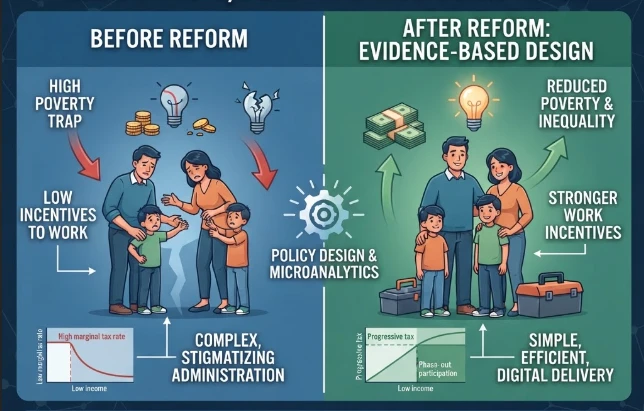
This article uses institutional economics and applied microeconomics to show why tax-transfer reform cannot be evaluated from policy rules alone. Household disposable income reflects earnings, taxes, contributions, benefits, housing support and withdrawal schedules, but the effectiveness of those rules also depends on institutions that administer them. Different data systems, delayed appeals, inconsistent local delivery and administrative capacity can cause a theoretically efficient policy to wo
This article presents tax transparency as a governance and accounting issue rather than a simple disclosure exercise. Boards oversee tax outcomes that are influenced by risk appetite, capital allocation, internal controls, remuneration and significant transactions, while accounting systems provide the common record connecting financial profit, taxable income, deferred tax, cash tax and uncertain positions. IFRS S1 and IFRS S2 are used to show how sustainability-related financial information can
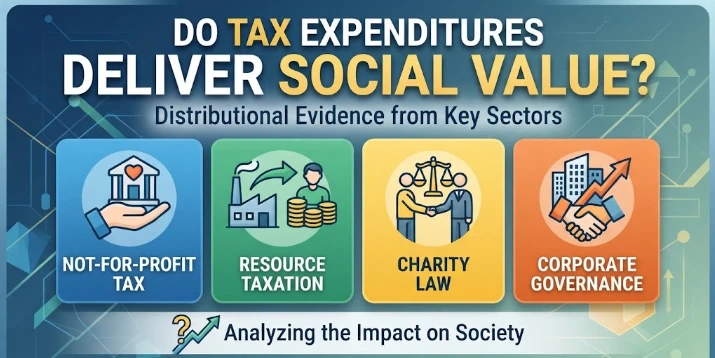
This article evaluates tax expenditures in not-for-profit, charity and resource-tax settings through distribution, governance and public value. Preferential treatment for charities and similar organisations is justified by public or community benefit, so reporting and governance should show whether concessions expand valued services, improve access or instead accumulate as private or organisational advantage. The article warns that annual income alone is an incomplete equity measure because life