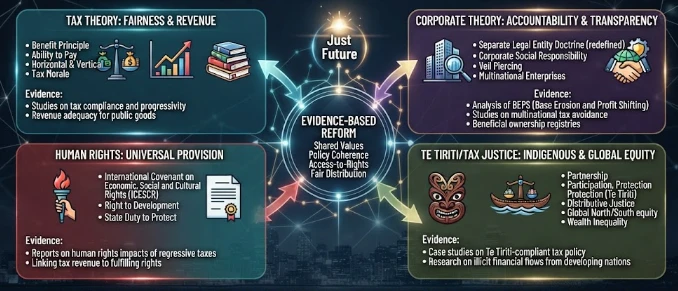
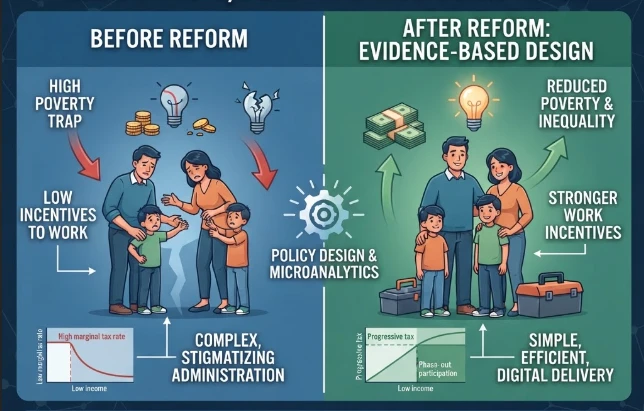
This article approaches tax justice through tax theory, corporate taxation, human rights and Te Tiriti o Waitangi in Aotearoa New Zealand. It argues that fairness cannot be judged only by rates because tax bases, economic incidence, legal structures, public services and historical conditions all shape outcomes. Classical principles such as equity, efficiency, certainty, simplicity and revenue adequacy remain important, but the article shows how they can conflict in practice. Corporate taxation adds another layer because the legal taxpayer may differ from the workers, shareholders, consumers or suppliers who ultimately bear the burden. Human-rights analysis broadens the framework by connecting taxation with the funding of health, education, housing, social security and other public institutions. Te Tiriti adds partnership, active protection, participation and redress to questions of fiscal legitimacy. The article also discusses Māori business structures, collective ownership and intergenerational stewardship. Tax administration, transparency and access to remedy are treated as central to justice, with the overall conclusion that fair taxation requires evidence, participation and accountable institutions.
Tax justice usually is treated as though it can be a matter of simply who pays more and who pays less. A more complicated picture emerges from tax theory: Fairness is predicated on the tax base and the distribution of income and wealth, legal structures, apparent tax burdens, and the public services paid for by the tax revenue. Another dimension that cannot and should not be ignored in Aotearoa New Zealand is Te Tiriti o Waitangi, which puts partnership, protection, participation and redress within a constitutional and social framework, turning tax justice into a rights, institutions, history and economic power issue, not just rates.
Typically the foundations of classical tax theory are equity, efficiency, certainty, simplicity and revenue adequacy. Horizontal equity requires that taxpayers in the same economic circumstance be treated equally, and vertical equity requires that if a taxpayer has a higher ability to pay, he or she should pay more. Efficiency considers the impact of taxation on investment, saving, working and consumption, or on the business structure. Certainty and simplicity are important because a formally fair rule can become practically unfair when it is not understood. These values may compete with each other and in the end, the design of taxes is a matter of balancing values; it is not a matter of applying a mechanical formula.
The corporate theory further muddies the waters since a company is a separate legal entity, but taxes don't necessarily end there. The impact of corporate income tax includes: Shareholders, Workers, Consumers, Suppliers, Investment decisions and Government revenue. The legal taxpayer and economic bearer of a tax do not necessarily coincide. That distinction is important if the argument from competitiveness is based solely on statutory rates or if the argument for corporate contribution is based solely on cash tax paid in one year. Taxable income can be manipulated by loss carry-forwards, depreciation, investment allowances, financing structures, cross-border transactions and timing differences without necessarily being abusive, and aggressive arrangements can still be used to exploit gaps in tax laws.
Tax justice requires a legal analysis but also a distributional analysis. A rule can abide by the law but have outcomes that seem to refute social norms of contribution. On the other hand, it is possible to have a big tax bill and simultaneously engage in risk-shifting or obscure behavior.
The way tax strategy has been addressed in a modern corporate accountability framework has increasingly incorporated tax strategy into governance, sustainability and social licence. The trend towards disclosing economic activity, profit, and tax location in public country-by-country reporting, in tax government disclosures, and in increased transfer pricing documentation generally reflects the growing need for large enterprises to explain where their economic activity is located, where their profits are generated, and where their taxes are paid. Transparency alone is not a measure of fairness, but it enhances the information available for evaluating fairness.
Another lens that human rights thinking brings is: Taxation provides funds for institutions and services related to health, education, housing, social security, justice, infrastructure and public administration. A lack of revenue capacity may limit the enjoyment of economic and social rights, and regressive or discriminatory tax structures may add an extra burden on those most affected by structural disadvantages.
Human-rights analysis thus questions the sources of revenue and the ways in which fiscal decisions facilitate. These considerations also highlight accountability, non-discrimination, participation and access to remedy. The more the affected communities can understand rules, challenge decisions, and be part of the policy development process, the more legitimate the tax system will be.
Te Tiriti serves as a unique angle on that legitimacy in Aotearoa New Zealand. The 2018 Tax Working Group conducted engagement hui with Māori, in addition to consultation on the future of the tax system. In the context of public policy, Treasury work on indigeneity has also embraced Te Tiriti as an important component of understanding public policy through an indigeneity lens, focusing on partnership, active protection of Māori interests and redress for historic and ongoing inequity. This sort of framing takes tax consideration beyond just an annual revenue calculation. Fiscal justice issues arise when looking at questions of land, collective ownership, intergenerational assets, business structures, health outcomes, and access to capital.
The change is important because rules that seem neutral on the surface can have disparate impacts depending on economic circumstances. Even when taxes are applied equally to legal owners, they can have different experiences with collectively owned resources, limited land, reduced average wealth, differential professional expertise, and past experiences of dispossession. Neutrality in the wording is not necessarily neutrality in the impact, that is why you will see that in some cases getting a little more specific is better. Distributional assessment can inform about the burden of a household or entity, region or community, and engagement can provide insights into institutional characteristics that are not captured by standard modelling. It is not necessary to depart from general principles of taxation in formulating better policy, but it is necessary to bring these principles to the test of social and historical reality.
Access to rights also depends on tax administration. The registration and filing, dispute resolution and debt collection processes can also be more complex, resulting in higher costs for small and low-income businesses or businesses with confusing ownership. While Digital systems can alleviate routineness, inaccessible design can add yet another obstacle. Formal rights have meaning if there is clear guidance, culturally competent engagement, independent advice, transparent dispute pathways, and proportional enforcement. Tax justice thus does not end at legislation but is carried to administration: a right on paper is not much good when there are practical problems with its implementation.
Additionally, there are some overlaps between the corporate theory and Te Tiriti on economic development. There are a number of different vehicle options within which Māori businesses can be established, including trusts, incorporations, companies, partnerships and other structures that are associated with collectively owned property and long-term stewardship. These intergenerational goals that also account for community wellbeing, guardianship of the environment, and cultural continuity can rub against a purely short-term approach to shareholder value. Tax policy that focuses on traditional corporate incentives can miss those differences. There is increasing institutional interest in wellbeing measures that go beyond financial outcomes, with the Living Standards Framework and a broader Treasury wellbeing frameworks showing this.
The rights-based approach also alters the standard for assessing the effectiveness of reform once it has been put into place. While revenue projections and compliance figures are relevant, effective tax rates among income and wealth groups, burden of administration, resolution of disputes, involvement in consultation and the availability of professional assistance are also factors to be considered. Distributional reporting should be able to report the effects of collective assets or historically disadvantaged communities, where applicable, not obscuring them in national averages. The frequent availability of such evidence can heighten democratic oversight and facilitate subsequent remedial action in case of a disproportionate impact of a formally neutral rule.
None of these generates a clear-cut prescription for an entirely just tax system. Competing claims remain. There can be advantages to having a broad base, although there can be concerns about distribution; exemptions or targeted relief can alleviate those concerns.
Progressive rates can enhance vertical equity, but inappropriate thresholds can make planning more complex or can lead to incorrect decisions. Transparency will help with accountability but there is sensitive commercial information that needs to be treated carefully. Legitimacy can be enhanced by te Tiriti-consistent engagement, but to make a meaningful impact on outcomes there is a need to ensure that engagement is not just about having a tick in the box, but is also ‘meaningful’ through sufficient time, evidence, and institutional respect.
Therefore, there are a number of questions to be asked in a practical tax-justice framework. Which capacities are being taxed, who bears the burden, who gains from the public spending, what historical factors influence current capacity, how easy is it to exercise them, and what are the accountability issues when the results are not what is stated in the principles? A typical structure of this kind also covers corporate structure, market power, legal incidence, economic incidence, and cross-border planning. Tax policy becomes more convincing when distributional arguments, not slogans, are backed up.
By August 2026 the most convincing approach to tax policy is one that takes into account the historic Treaty of Waitangi and a rights-based approach to accountability, plus traditional fiscal principles. Efficiency is still significant, though only efficient without legitimacy produces fragile consent. Revenue is still a must have, but revenue without equity can foster mistrust. While contribution is still required, it can be hard to measure contribution without transparency. Tax justice in practice, then, is based on evidence, participation, clear rights, credible administration, and the understanding that the same law applied to different people to achieve the same outcome does not apply in actual economic conditions.
CITE THIS ARTICLE
Sultana, K. R. (2026). Tax Justice in Practice: Access-to-Rights Evidence from Tax theory, corporate theory, human rights, Te Tiriti/tax justice. https://researchbysultana.com/article/f678bf3c-8082-58df-aaea-12a045a6a421
K. R. Sultana, “Tax Justice in Practice: Access-to-Rights Evidence from Tax theory, corporate theory, human rights, Te Tiriti/tax justice,” 2026. [Online]. Available: https://researchbysultana.com/article/f678bf3c-8082-58df-aaea-12a045a6a421
Sultana, K. R. (2026) ‘Tax Justice in Practice: Access-to-Rights Evidence from Tax theory, corporate theory, human rights, Te Tiriti/tax justice’. Available at: https://researchbysultana.com/article/f678bf3c-8082-58df-aaea-12a045a6a421
Sultana, Kazi Rukaiya. “Tax Justice in Practice: Access-to-Rights Evidence from Tax theory, corporate theory, human rights, Te Tiriti/tax justice.” 2026, https://researchbysultana.com/article/f678bf3c-8082-58df-aaea-12a045a6a421.
Kazi Rukaiya Sultana. “Tax Justice in Practice: Access-to-Rights Evidence from Tax theory, corporate theory, human rights, Te Tiriti/tax justice.” (2026). https://researchbysultana.com/article/f678bf3c-8082-58df-aaea-12a045a6a421.
Sultana KR. Tax Justice in Practice: Access-to-Rights Evidence from Tax theory, corporate theory, human rights, Te Tiriti/tax justice. 2026. https://researchbysultana.com/article/f678bf3c-8082-58df-aaea-12a045a6a421
@misc{article_f678bf3c808258dfaaea12a045a6a421,
  title = {Tax Justice in Practice: Access-to-Rights Evidence from Tax theory, corporate theory, human rights, Te Tiriti/tax justice},
  author = {Kazi Rukaiya Sultana},
  year = {2026},
  url = {https://researchbysultana.com/article/f678bf3c-8082-58df-aaea-12a045a6a421},
}
TY  - GEN
AU  - Kazi Rukaiya Sultana
TI  - Tax Justice in Practice: Access-to-Rights Evidence from Tax theory, corporate theory, human rights, Te Tiriti/tax justice
PY  - 2026-08-09
UR  - https://researchbysultana.com/article/f678bf3c-8082-58df-aaea-12a045a6a421
ER  -
This article uses institutional economics and applied microeconomics to show why tax-transfer reform cannot be evaluated from policy rules alone. Household disposable income reflects earnings, taxes, contributions, benefits, housing support and withdrawal schedules, but the effectiveness of those rules also depends on institutions that administer them. Different data systems, delayed appeals, inconsistent local delivery and administrative capacity can cause a theoretically efficient policy to wo
This article presents tax transparency as a governance and accounting issue rather than a simple disclosure exercise. Boards oversee tax outcomes that are influenced by risk appetite, capital allocation, internal controls, remuneration and significant transactions, while accounting systems provide the common record connecting financial profit, taxable income, deferred tax, cash tax and uncertain positions. IFRS S1 and IFRS S2 are used to show how sustainability-related financial information can
This article evaluates tax expenditures in not-for-profit, charity and resource-tax settings through distribution, governance and public value. Preferential treatment for charities and similar organisations is justified by public or community benefit, so reporting and governance should show whether concessions expand valued services, improve access or instead accumulate as private or organisational advantage. The article warns that annual income alone is an incomplete equity measure because life