This article uses comparative taxation to show why tax-gap reduction depends on administrative design as much as statutory rules. Similar policy goals can generate very different compliance costs depending on thresholds, registration frequency, exemptions, record requirements, digital systems and dispute procedures. A low tax rate is therefore not necessarily a simple tax system. The article distinguishes simple errors and payment stress from deliberate concealment, supporting risk segmentation rather than uniform enforcement. Behavioural evidence shows that clarity, trust, fairness, social norms and cash-flow pressure affect compliance alongside audit probability and penalties. Small businesses receive particular attention because fixed administrative work consumes a larger share of their resources. GST and VAT illustrate how invoice trails, e-invoicing and data matching can strengthen verification while also raising privacy and false-positive risks. Corporate avoidance requires specialist analysis of financing, intangibles, transfer pricing and cross-border structures. Fiscal federalism can further increase burden when jurisdictions use different definitions or systems. The recommended approach combines prevention, facilitation, targeted verification and enforcement, with outcomes assessed through revenue, taxpayer burden, fairness and institutional trust.
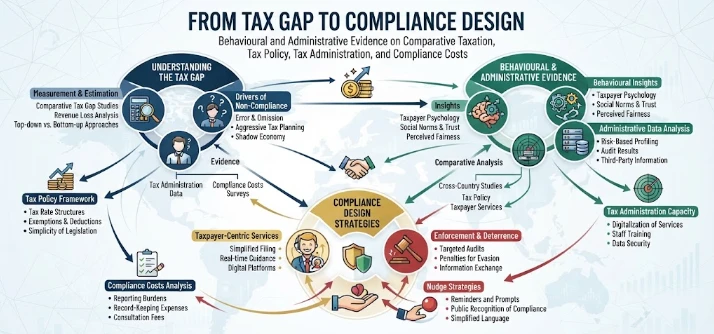
A tax gap is NOT just a revenue number. It is the difference between tax that is due according to the existing law and tax collected (based on the administration's estimation process). According to OECD Tax Administration 2024, many jurisdictions have been increasingly attempting to quantify gaps in order to better appreciate the extent and type of non-compliance. Policy value is derived from diagnosis: the treatment, data sources, service strategies, and enforcement responses are different for various gaps.
Comparative taxation reveals that, with the exception of thresholds, frequency of registration, rules about records and digital systems, and the number of exemptions, similar policy goals may have very different compliance costs. A low statutory rate does not necessarily equate to a simple system and a wide base can be complicated by differing definitions of the base under different taxes. Rate tables are not the only measure to compare administrations. Real cost of compliance is impacted by the service design, pre-filled information, dispute processes, payment arrangements and data standards.
Corporate tax avoidance demands a different toolbox to the small business record errors. Financing structures, intangible assets, transfer pricing, entity chains and cross-border mismatches are examples of arrangements available in large groups that require specialist expertise and international information. Transparency and public disclosure can help foster accountability, but raw disclosure in the absence of context may be a misrepresentation as book profit is not necessarily equal to taxable profit. Effective assurance is a mix of accounting analysis, legal interpretation, economic substance and risk based engagement.
The credibility of administration is also affected by governance and corruption risks. Even well-designed statutory rules and procedures may not increase the likelihood of compliance if they are implemented in a non-selective manner, if settlements are obscure, or if there are lax procurement controls or conflicts of interest. Legitimacy is protected through independence, review rights, documented procedures and publication of aggregate performance information. Compliance design should therefore be part of a larger framework of the rule of law, rather than a narrow collection function.
Measurement should differentiate between gross and net gaps, model uncertainty and administration effects. A net gap after compliance activity can be negative despite high underlying risks, and economic shocks can alter liabilities and payment capacity. The interpretation of time-series requires consistent methods and/or explicit revisions. This is because disclosing uncertainty and methodology enhances, not detracts from, the usefulness of gap estimates for stakeholders to understand what the numbers can and cannot determine.
The published tax-gap exercise in Australia demonstrates the need to keep estimation in the wheel of compliance design, and not out of it. In November 2024, ATO released an estimate of the 2022–23 net GST gap of approximately 7.9 billion Australian dollars, nearly 9 per cent of theoretical GST. It also noted that the level of small-business activity historically covered a significant portion of the GST gap, which meant that the risks involved with record quality, cash transactions, and GST registration behaviour were significant. A gap estimate does not provide evidence of motive, so administration must rely on other evidence before considering it as the same action if the error is an error, the payment is a payment, or the concealment is deliberate.
The traditional model of deterrence is complicated by behavioural evidence. Penalties and audit probability have significance, but compliance is also driven by clarity, trust, perceived fairness, social norms, cash-flow pressure, and ease of compliance. OECD tax-administration work indicates that targeted communications and behavioural researchers are being used more and more. A reminder at the right time will save from error at no extra cost, and complex rules can incur mistakes that add up when handling aggregate data.
Compliance-cost analysis is particularly significant for small businesses as it is the administrative work that has a fixed component that takes up more of the manager's time. The OECD has highlighted this disproportionate burden in a number of its reports. While digital filing can help eliminate duplicated data entry, poorly connected portals can just shift paperwork onto the taxpayer. Comparative evidence is most useful in highlighting process features that will minimise friction while still maintaining verification, rather than in assuming that digitalisation equals simplification.
Compliance costs need to be considered too, as administrative hassles may lure small businesses into a trap of committing mistakes or going informal. The economic impact of the time spent interpreting rules, keeping records, reconciling GST and correcting returns can be significant, even if no tax is actually owed. Routine burden can be lessened with digital filing – as long as software, identity systems and data standards are reliable. Ineffective digital obligations can be merely an alternative cost shift from government offices to businesses and professional advisers.
Risk segmentation provides a more proportionate model. Education and correction is needed for those simple errors, workable arrangements for those who are having difficulties with paying their taxes, and tougher verification for those who make deliberate errors. Responding to each discrepancy as fraud consumes enforcement resources and pessimism, leading to reduced compliance. The opposite problem arises if each discrepancy is treated as innocent, as this undermines deterrence and fairness for those taxpayers who don't have to do anything to comply.
Special rules also multiply boundaries, and tax expenditures have an impact on compliance. Deductions, exemptions, reduced rates and sector concessions pose classification issues and planning opportunities. Each additional boundary can create real uncertainty and aggressive interpretation. Fiscal authorities should consider tax expenditure at least from an administrative perspective: a concession with moderate policy value, and high complexity, may be costly beyond the amount of revenue that is stated in a tax statement.
Transaction trails are demonstrated in the case of GST and VAT systems. While invoice chains can allow for information from a third party that can aid in the verification process, there are still risks to take into account, such as the possibility of refund fraud, missing traders, cash transactions and classification conflicts. For legal and technical infrastructure that is developed, e-invoicing and data matching can help improve visibility. However, robust protections remain needed because of the risk of amplification of errors, privacy issues, and false-positive results, when risk models are not in the context.
The concept of fiscal federalism comes with one additional level where several governments have overlapping tax bases and/or administrative powers. Compliance burden to businesses can be increased due to differences in definitions, rates, exemptions, and data systems across jurisdictions. Coordination can minimize duplication by using joint registration, information sharing, shared definitions of concepts or central collection systems etc. The appropriate institutional structure is a function of constitutional duties, fiscal independence, and the importance of local policy autonomy.
A contemporary approach to compliance then integrates prevention, facilitation, verification and enforcement. The pre-filled data can obviate the need to fill in missing information, the guidance can limit mistakes, the targeted analysis can highlight cases that pose a risk, and the robust sanctions can deter intentional evasion. Interventions should be considered individually based on the three factors of revenue, burden, fairness and trust. The goal is not to be as aggressive as possible in enforcement; it is to establish compliance which is sustainable at the lowest reasonable social and administrative cost.
This view also reveals uncertainty, facilitating the decisions when there is uncertainty about behavioural responses and implementation costs. Another protection is to release assumptions, the definitions and evaluation criteria before a policy is hard to change politically. Cost, fairness, behaviour, and administrative burden are all the more informative when all are part of the same assessment, as opposed to being separate policy stories. The process of review can be used to make decisions about thresholds, eligibility, or reporting rules that will be in effect over the long term that are credible in that context.
What is really important is whether the instrument measures the public value after adding compliance costs, distribution costs, and opportunity costs. Transparent governance transforms that question into repeatable governance rather than a one-off justification at the point of introduction. This holistic perspective helps minimize the chance that a technically correct rule elicits subpar results after households, firms, and administrators adjust to the actual incentives. The more effective analytical way is to examine statutory design in light of the incentives, administrative capacity, and distributional impacts of what has actually been observed rather than on labels.
But that view also shows uncertainty, enabling better decision making when behavioural responses or implementation costs are not precisely measurable. Another protection is to publish assumptions, definitions, and evaluation criteria prior to the time that a policy becomes politically impractical to change. When fiscal cost, fairness, behaviour and administrative burden are combined in the same assessment, evidence is most informative rather than in distinct policy stories.
CITE THIS ARTICLE
Sultana, K. R. (2025). From Tax Gap to Compliance Design: Behavioural and Administrative Evidence on Comparative taxation, tax policy, tax administration, compliance costs. https://researchbysultana.com/article/f2d81b7c-197d-5a7a-a25e-6faca8c5f639
K. R. Sultana, “From Tax Gap to Compliance Design: Behavioural and Administrative Evidence on Comparative taxation, tax policy, tax administration, compliance costs,” 2025. [Online]. Available: https://researchbysultana.com/article/f2d81b7c-197d-5a7a-a25e-6faca8c5f639
Sultana, K. R. (2025) ‘From Tax Gap to Compliance Design: Behavioural and Administrative Evidence on Comparative taxation, tax policy, tax administration, compliance costs’. Available at: https://researchbysultana.com/article/f2d81b7c-197d-5a7a-a25e-6faca8c5f639
Sultana, Kazi Rukaiya. “From Tax Gap to Compliance Design: Behavioural and Administrative Evidence on Comparative taxation, tax policy, tax administration, compliance costs.” 2025, https://researchbysultana.com/article/f2d81b7c-197d-5a7a-a25e-6faca8c5f639.
Kazi Rukaiya Sultana. “From Tax Gap to Compliance Design: Behavioural and Administrative Evidence on Comparative taxation, tax policy, tax administration, compliance costs.” (2025). https://researchbysultana.com/article/f2d81b7c-197d-5a7a-a25e-6faca8c5f639.
Sultana KR. From Tax Gap to Compliance Design: Behavioural and Administrative Evidence on Comparative taxation, tax policy, tax administration, compliance costs. 2025. https://researchbysultana.com/article/f2d81b7c-197d-5a7a-a25e-6faca8c5f639
@misc{article_f2d81b7c197d5a7aa25e6faca8c5f639,
  title = {From Tax Gap to Compliance Design: Behavioural and Administrative Evidence on Comparative taxation, tax policy, tax administration, compliance costs},
  author = {Kazi Rukaiya Sultana},
  year = {2025},
  url = {https://researchbysultana.com/article/f2d81b7c-197d-5a7a-a25e-6faca8c5f639},
}
TY  - GEN
AU  - Kazi Rukaiya Sultana
TI  - From Tax Gap to Compliance Design: Behavioural and Administrative Evidence on Comparative taxation, tax policy, tax administration, compliance costs
PY  - 2025-09-14
UR  - https://researchbysultana.com/article/f2d81b7c-197d-5a7a-a25e-6faca8c5f639
ER  -
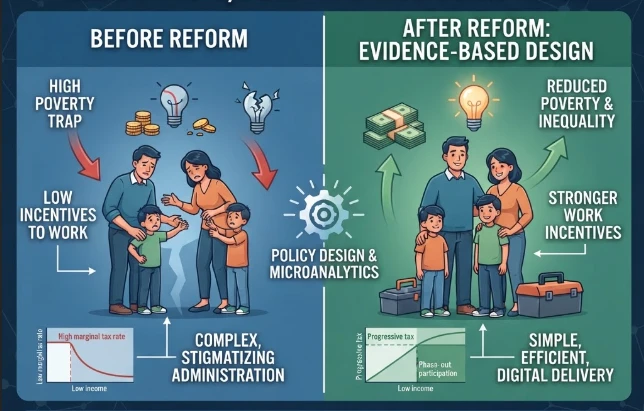
This article uses institutional economics and applied microeconomics to show why tax-transfer reform cannot be evaluated from policy rules alone. Household disposable income reflects earnings, taxes, contributions, benefits, housing support and withdrawal schedules, but the effectiveness of those rules also depends on institutions that administer them. Different data systems, delayed appeals, inconsistent local delivery and administrative capacity can cause a theoretically efficient policy to wo
This article presents tax transparency as a governance and accounting issue rather than a simple disclosure exercise. Boards oversee tax outcomes that are influenced by risk appetite, capital allocation, internal controls, remuneration and significant transactions, while accounting systems provide the common record connecting financial profit, taxable income, deferred tax, cash tax and uncertain positions. IFRS S1 and IFRS S2 are used to show how sustainability-related financial information can
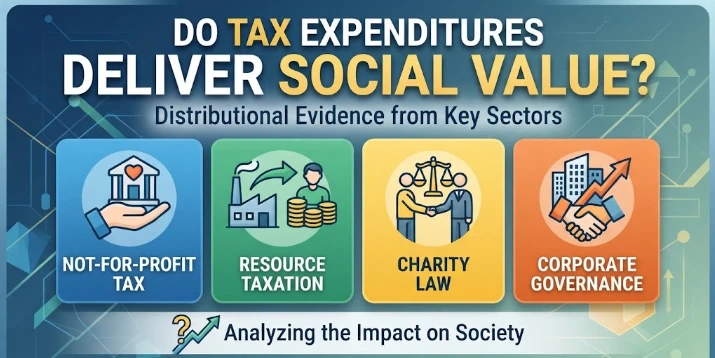
This article evaluates tax expenditures in not-for-profit, charity and resource-tax settings through distribution, governance and public value. Preferential treatment for charities and similar organisations is justified by public or community benefit, so reporting and governance should show whether concessions expand valued services, improve access or instead accumulate as private or organisational advantage. The article warns that annual income alone is an incomplete equity measure because life