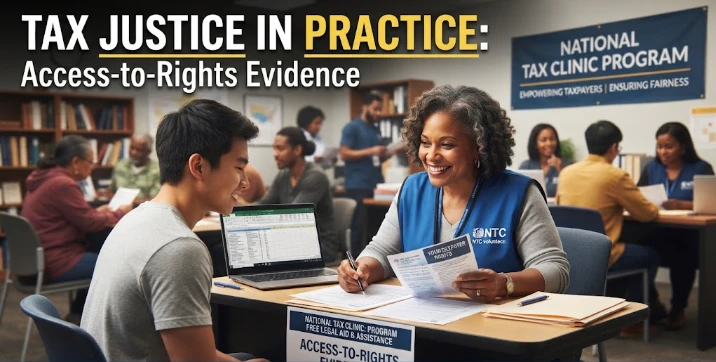
Legislation and enforcement are not enough to ensure tax compliance. A taxpayer must have to know and understand a rule, assemble records, follow an action, respond to a letter, and where to go when something goes wrong. Each step can be a challenge for individuals who lack financial resources, fragile situations, language, business complexity, or professional counsel. That problem is solved in Australia with a unique approach: free taxpayer assistance by education institutions, supervised by qualified professionals in the framework of the National Tax Clinic program.
The programme started at the national level in 2019 and expanded to a wider network of states and territories in Australia. Government expansion in 2024 was a response to evidence of high demand with more than 18,000 taxpayers assisted by funded clinics to date, including numerous small businesses. The model is aimed at individuals who are not eligible for general tax information due to financial, social or personal reasons. The programme addresses the lack of professional support, as there is a gap in access.
Tax-clinic work may be far more involved than merely preparing income-tax returns. Support may include due payments of lodgements, debt, payment arrangements, deductions, business activity statements, goods and services tax, registrations, penalties, dispute, and communication with the Australian Taxation Office, depending on the clinic. Historical problems are particularly significant. It can be more difficult for a routine compliance task to have multiple liabilities and missing documentation due to years of non-lodgement. A clinic can be used as a tool to help form a timeline, determine missing information, and help work through the process for regaining compliance.
There is a central, not incidental, educational system. Taxation, accounting, business law, and related students study real-world issues with professional supervision. That's an atmosphere that transforms knowledge into judgment. A problem in a classroom typically has all the facts and a clearly defined legal question, while a problem encountered in a clinic setting is likely to have only a few documents, some inconsistencies in time, and several related issues. Pupils must interview, listen, investigate, describe, record and acknowledge beyond competence.
Administrative law and procedure also bring a realism to tax-law education. There is more to know than the substantive tax rule, when it comes to a deadline, objection process, debt arrangement or penalty decision. Students are made aware of the conditions under which rights may be exercised and that without good communication, an otherwise valid argument may be compromised. Tax education is no longer about file management, confidentiality, conflicts, professional conduct and written advice; it's all part of tax education. In the real world of tax practice, clinical experience helps close this divide, between academic and practical understanding, in the process of learning.Thus, clinical experiences help bridge this gap between academic and practical understanding in the learning process.
Clients also get an education. Once a form is submitted on the taxpayer's behalf, strong assistance must not cease. A clinic can provide information on record keeping, withholding, business registration, reporting cycles or the meaning of an assessment, thus building capacity for future compliance.
This method is used to involve the taxpayer as an active participant. Repeat issues can be reduced through education and future interactions with the revenue authority can be less threatening. The public benefit of the programme is at its core the preventive value.
The model is also a version of the National Tax Clinic that promotes fairness in enforcement. Revenue authorities require credible authority to fulfill their lawful duties of collection and to combat intentional tax evasion and safeguard the honesty of the system. Vulnerable taxpayers require a real approach to communicate the situation, contest an error with assessment, or work out a reasonable debt resolution.
Independent Clinic Support provides support in arranging facts and bridging communication gaps. That can enhance administrators' decision making process without compromising the overall responsibility. Compliance is greater when enforcement is fair, meaning they differentiate between intentional and unintentional.Compliance is higher when enforcement is fair; when they differentiate between intentional and unintentional.
It is an even more critical role in digital tax administration. Reducing burden for many taxpayers can be achieved through online accounts, electronic filing, data matching, prefilled information and automated communication. The OECD's work has brought attention to the potential of digital systems to simplify and streamline tax administration. However, digital-first processes can be barriers for low-tech users, low-digital-confidence users, users with disability, users who do not speak English as their first language, and users who have barriers to identity verification. The gap is filled by clinics if they are able to assist their clients with navigating systems, and by documenting the repeated digital barriers that need administrative attention.
The programme is also of a regional dimension. Becoming vulnerable to tax is not exclusive to metropolitan areas, and in remote communities, a private adviser may not be readily available. Coverage can be expanded by adding more universities and vocational schools, remote appointments and regional outreach. While the hybrid service can be useful, a trusted local partner can often be needed to gain access to the area. Financial counsellors, community legal centres, Indigenous organisations, migrant services and small business networks can assist in identifying issues with tax and refer to specialist assistance.
Such collaborations also enhance the triage. Not all financial issues are tax issues. In addition to tax advice, a client may require assistance with insolvency, family law, mental health, their home, or any other aspect of financial counselling.
There is a need for a referral pathway that acknowledges these boundaries in the clinic. Professional integrity involves knowing when a tax intervention is merely one aspect of a bigger issue. A well connected clinic can thus become a gateway to a broader support network without pretending to be able to solve problems they do not have the expertise to address.
Another benefit that is not appreciated is systemic feedback. Patterns around cases seen in a clinic network: ambiguous notices, frequent registration mistakes, on-going issues with debt, problems with digital portals, disproportionate administrative burden from rules. Average observations can be reported without revealing any client identities to administrators and/or policymakers. This is a loop of experiences at the front and systems that are designed. Some professional organisations provide formal consultation, while others, particularly clinic practitioners who do not usually present technical comments, provide informal consultation.Tax policy is usually informally or formally consulted with professional organisations, but also with informal consultation, that of people who are not obviously part of the policy making process, but who experience the effects of administrative design.
Good governance is an essential requirement for credibility. Clinics will deal with personal and monetary data that must not be compromised by a secure system, supervision, confidentiality, training, or professional accountability. Student involvement is essential to learning and yet it involves robust pre-advice/representation review. Needs to be in place for funding supervisors and continuity of case, as complex issues can last beyond the teaching term. With sensitive clients, this "chase the volume" mentality can clash with the attention to detail required.
Assessment should be comprehensive and include all aspects of the model. Results of the client may be corrected liabilities, lodged returns, debt arrangement, resolved dispute, reconsidered penalties, repaired registrations, and understanding. Learning outcomes may include technical, communication, ethical and professional confidence.
System outcomes may relate to ongoing problems identified and enhanced referral processes. Equity outcomes can indicate if a group of people who are at financial, social, regional, or digital disadvantage are being served. A program that only counts contacts runs the risk of ignoring why tax clinics are the programs they are.
In the longer run, tax-law education also positively impacts the broader profession. Students who have advised unrepresented taxpayers join the accounting, legal, government, and business fields knowing firsthand the hardships and burden of unrepresented taxpayers. This interaction can shape the way future advisers communicate, the way that future firms design their services, and the way that future public servants evaluate policy. The programme thus has a long-term professional impact in addition to the impact it has in the context of clients' cases. Clinical training is not about adding on fairness, ethics and access to technical tax competence, but rather embedding them in competence.
Australia's National Tax Clinic program is a well-ripened concept of compliance: there is a right to have good advice as part of a well-functioning tax system. The provision of free assistance does not diminish the legitimate duties. Well-designed clinics can provide taxpayers with information about those responsibilities, correct errors, resolve disputes, and enhance capacity for the future. Meanwhile, supervised clinical work builds up better tax professionals and evidence of systemic barriers. The programme's most important element is therefore the triangle—taxpayer support, professional education and institutional learning are mutually reinforcing, making access to tax law a concrete public service.