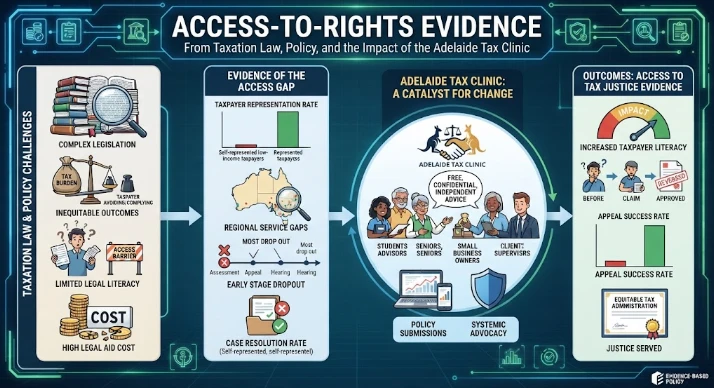
This article uses the Adelaide tax-clinic model to illustrate how access to professional assistance can make taxpayer rights meaningful in practice. It explains that the Australian National Tax Clinic network was created to assist individuals and small businesses who lack the resources to obtain conventional tax advice. The Adelaide clinic demonstrates that tax assistance often extends well beyond current-year returns to overdue lodgements, debt, payment arrangements, registrations, disputes, penalties and communication with the Australian Taxation Office. The article emphasises representation, trust and independence, showing how clients with incomplete records or anxiety about enforcement may need structured support to present their circumstances accurately. Clinical education is another major theme because supervised students gain experience in interviewing, professional conduct, confidentiality and plain-language explanation. Regional access, remote appointments and partnerships with community organisations are discussed as ways to extend coverage. The article also argues that recurring case patterns can identify systemic problems in digital processes or administrative notices. Stable funding and evaluation based on durable client outcomes are presented as essential to the model.
Tax justice is real when somebody with an unresolved tax issue is able to sit across from a person who can be able to explain the rules, reconstruct the facts and identify a realistic path forward. The Australian tax-clinic model is very much a practical one, and is particularly apparent in Adelaide. Originally the University of South Australia Tax Clinic, the Adelaide based university clinic is part of a larger National Tax Clinic network, established to help individuals who do not have the financial, social or personal resources to access a professional tax adviser. The model brings together the three aspects of taxpayer assistance, clinical education and access to justice in one place.
The National Tax Clinic program was first piloted in 2019, and subsequently rolled out following initial operating experience, because it was seen as being in demand. By 2024, the federal government announced even more expansion, stating that current funded clinics already have assisted over 18,000 taxpayers, including thousands of small businesses, without charging fees. Unresolved problems are less likely to show up in the professional-service statistics, and unsolved issues may only come to light when the debt, penalties, enforcement, or business failure brings them to light.
The Adelaide clinic is a prime example of how tax help must go beyond just preparing a tax return. Support has been provided regarding overdue lodgements, tax debt, payments arrangements, deductions, registrations, business activity statements, income tax and service tax matters, as well as penalty and dispute situations, within the material of the University clinic. Clients may be people and small businesses who don't have a tax agent. Students are supervised by qualified professionals, and complicated issues are addressed in a structured fashion without compromising on educational supervision. What emerges is more of a clinical legal education than an office that's open seasonally.
That is significant for access to justice. There are many other scenarios that a taxpayer could be involved in over the course of several years of unpaid returns – something where they may be missing their records, changing their jobs, closing their bank accounts, losing their invoices, marriages, divorces or nerves about getting in touch with the revenue authority. In a small business, the owner may find that they have to deal with the issue of overlapping requirements, touching on GST, withholding, superannuation and income tax. Legal issues are not the sole issue. Effective assistance can involve obtaining facts, reconstructing documents, arranging tasks, liaising with the Australian Taxation Office and a strategy for future compliance.
Adelaide model is also a good example of the importance of representation. Representation is more likely to take an understanding and make it real for a taxpayer than advice. Correctly written letters, explaining the ground for a request, preparing information to support a request, or negotiating a payment plan, are all things a clinic may provide assistance with. In case of dispute, it is important to present facts and succinct arguments to help defuse disagreements and avoid confusion. Representation is particularly critical when a vulnerable taxpayer is not able to communicate with a institution having a lot of enforcement authority.
Independence that enhances that role. The clinic is not in the revenue authority but within the framework of professional and legal requirements. That is what can help the unrepresented taxpayer to discuss any errors, missing paperwork, or financial problems openly with that separation. Trust does not replace the need for accuracy: rather, trust provides an environment in which the facts can be accurate. A client who is aware that he or she will not be judged and that the information is confidential is likely to be more open and give the full history necessary to get a defensible solution.
The second layer of public value is generated in clinical education. Tax students are real clients whose situations are often not neatly encompassed by examination problems. Interviewing, listening, professional conduct, confidentiality, judgement and plain-language explanation must be used along with technical knowledge. Students also observe how administrative rules influence individuals with restricted monetary sturdiness. That experience can also influence subsequent work by a tax adviser, giving them the perspective that a tax adviser is a more than just a liability calculator, but also a guide through the rights and obligations of procedures.
The benefit to education should not be the only thing in mind to supervisors. Working for vulnerable clients may raise complicated legal issues, emotional issues, data-security concerns, and issues beyond a student's ability to deal with. It is, therefore, essential to have good supervision. Systems are needed for supervisors to check for conflict, review, escalate, file, professional boundaries and refer to specialist legal, financial and social assistance as needed. Quality must be maintained as a sustainable clinic builds its caseload and has more funding and staffing.
Access also has a geographical component. South Australian taxpayers live over a much broader area than Adelaide, which offers an urban centre housing universities, professional networks and public transport. Extended reach with remote appointments and videoconferencing can help, but digital delivery isn't the answer to all barriers. Taxpayers do not have reliable internet access, the right equipment, secure areas, or confidence in online systems. Collaborating with regional services, community groups, financial counsellors and local advisers can provide opportunities to establish referral pathways that provide access to remote expertise and trusted local advice.
Tax clinics bring to light systemic issues that are not apparent in regular administrative data. A pattern of the client misreading the same notice, having trouble with the same online process, or facing the same challenges to debt resolution may indicate a design problem. Observations like this can be aggregated at clinics without revealing confidential information about clients. This evidence can be used to provide feedback to the Australian Taxation Office, government policy makers, professional organisations and educators of the regular issues of friction. The practice of medicine is thus grounded policy research.
As the tax administration became digitised, the risk of systemic learning took on additional relevance. Each electronic layer can exclude a smaller number of taxpayers, while simultaneously easing burden for the majority.Each electronic layer can exclude a smaller number of taxpayers, while easing burden for the majority. The edge cases are when someone loses access to the phone number, struggles to prove themselves, doesn't understand data that was prefilled, or can't understand an electronic notice. These incidents remind administrators that efficiency in digital processes and the ease of access to them are not the same.
The importance of funding design is that complex things are not always found to have a university teaching calendar. Historical disputes may last several months and debt discussions may need to be repeated with new financial information. Limited funding can lead to short-term solutions instead of long-term solutions. Stable support enables clinics to have secure systems, professional supervision, outreach and continuity between academic periods. The outcomes of public funding are more easily justified when they are not just client services but when they include better compliance in the future, client professional education, and evidence for system change.
Therefore, more than just appointment numbers should be captured in evaluation. Positive outcomes include overdue returns recovered, corrected assessments, affordable payment plans, settlements made, complaints addressed, penalties reconsidered, business registrations rectified, successful referrals, client awareness and a decrease in reoccurring incidents of non-compliance. Student learning and professional-development outcomes are also important. Qualitative evidence can indicate whether clients' attitudes towards the tax system become more positive or negative following assistance. These actions demonstrate the more profound goal: to make sense by engaging in a system that may otherwise seem impenetrable.
The Adelaide experience also goes against the theory that taxpayer support will diminish enforcement. An improved access might strengthen compliance, as unmet obligations become visible, records will improve and taxpayers will be provided with a realistic path to re-enter the system. A clinic isn't going to eliminate legal responsibilities. Rather, the service is meant to be a way to differentiate between correct tax and error, responsible debt management and avoidance, and real vulnerability and purposeful refusal. Targeting support of taxpayers can reinforce revenue integrity if it is done correctly.
The Adelaide tax-clinic model is now a concrete example of tax justice that has been constructed through institutions as opposed to slogans, by June 2026. Legal rights are important but the ability to receive advice, representation, explanation and remedy is what makes legal rights effective. We can add value to the University Clinic by providing supervised professional service, education and system feedback. The general lesson is simple: it is easier to believe in a tax system where a vulnerable taxpayer can find a competent way to access it, contest the result if it is wrong or work through the difficult obligations without having to rely exclusively on their ability to pay.
CITE THIS ARTICLE
Sultana, K. R. (2026). Tax Justice in Practice: Access-to-Rights Evidence from Taxation law, policy, Adelaide Tax Clinic, taxpayer assistance, access to tax justice. https://researchbysultana.com/article/da7677e7-4ebf-5cdd-bcb6-bb3fad0dc93e
K. R. Sultana, “Tax Justice in Practice: Access-to-Rights Evidence from Taxation law, policy, Adelaide Tax Clinic, taxpayer assistance, access to tax justice,” 2026. [Online]. Available: https://researchbysultana.com/article/da7677e7-4ebf-5cdd-bcb6-bb3fad0dc93e
Sultana, K. R. (2026) ‘Tax Justice in Practice: Access-to-Rights Evidence from Taxation law, policy, Adelaide Tax Clinic, taxpayer assistance, access to tax justice’. Available at: https://researchbysultana.com/article/da7677e7-4ebf-5cdd-bcb6-bb3fad0dc93e
Sultana, Kazi Rukaiya. “Tax Justice in Practice: Access-to-Rights Evidence from Taxation law, policy, Adelaide Tax Clinic, taxpayer assistance, access to tax justice.” 2026, https://researchbysultana.com/article/da7677e7-4ebf-5cdd-bcb6-bb3fad0dc93e.
Kazi Rukaiya Sultana. “Tax Justice in Practice: Access-to-Rights Evidence from Taxation law, policy, Adelaide Tax Clinic, taxpayer assistance, access to tax justice.” (2026). https://researchbysultana.com/article/da7677e7-4ebf-5cdd-bcb6-bb3fad0dc93e.
Sultana KR. Tax Justice in Practice: Access-to-Rights Evidence from Taxation law, policy, Adelaide Tax Clinic, taxpayer assistance, access to tax justice. 2026. https://researchbysultana.com/article/da7677e7-4ebf-5cdd-bcb6-bb3fad0dc93e
@misc{article_da7677e74ebf5cddbcb6bb3fad0dc93e,
  title = {Tax Justice in Practice: Access-to-Rights Evidence from Taxation law, policy, Adelaide Tax Clinic, taxpayer assistance, access to tax justice},
  author = {Kazi Rukaiya Sultana},
  year = {2026},
  url = {https://researchbysultana.com/article/da7677e7-4ebf-5cdd-bcb6-bb3fad0dc93e},
}
TY  - GEN
AU  - Kazi Rukaiya Sultana
TI  - Tax Justice in Practice: Access-to-Rights Evidence from Taxation law, policy, Adelaide Tax Clinic, taxpayer assistance, access to tax justice
PY  - 2026-06-21
UR  - https://researchbysultana.com/article/da7677e7-4ebf-5cdd-bcb6-bb3fad0dc93e
ER  -
This article uses institutional economics and applied microeconomics to show why tax-transfer reform cannot be evaluated from policy rules alone. Household disposable income reflects earnings, taxes, contributions, benefits, housing support and withdrawal schedules, but the effectiveness of those rules also depends on institutions that administer them. Different data systems, delayed appeals, inconsistent local delivery and administrative capacity can cause a theoretically efficient policy to wo
This article presents tax transparency as a governance and accounting issue rather than a simple disclosure exercise. Boards oversee tax outcomes that are influenced by risk appetite, capital allocation, internal controls, remuneration and significant transactions, while accounting systems provide the common record connecting financial profit, taxable income, deferred tax, cash tax and uncertain positions. IFRS S1 and IFRS S2 are used to show how sustainability-related financial information can
This article evaluates tax expenditures in not-for-profit, charity and resource-tax settings through distribution, governance and public value. Preferential treatment for charities and similar organisations is justified by public or community benefit, so reporting and governance should show whether concessions expand valued services, improve access or instead accumulate as private or organisational advantage. The article warns that annual income alone is an incomplete equity measure because life