From Tax Gap to Compliance Design: Behavioural and Administrative Evidence on Digital Tax Administration, E-Invoicing, Data Matching, and Taxpayer Trust
Kazi Rukaiya Sultana (Master of Public Policy & Master of Social Welfare and Research)
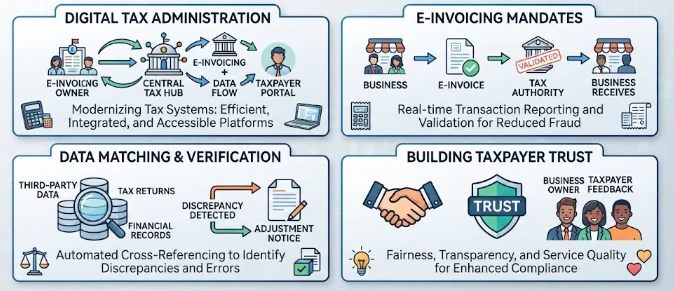
This article examines how digital tax administration, e-invoicing and data matching can move compliance closer to the transactions that create tax liabilities. Tax-gap estimates remain diagnostic rather than proof of motive, so administrations need to distinguish simple error, payment difficulty and deliberate concealment. The article highlights electronic filing, digital identity, APIs and structured invoice data as tools for bookkeeping, pre-filling, VAT control and risk assessment. These systems can reduce routine burden and identify mismatches earlier, but only when software, identity systems and data standards are reliable. Poorly designed digital obligations may shift costs onto businesses and advisers, while large datasets can create privacy, security and false-positive risks. Behavioural evidence shows that taxpayer trust, clarity, fairness, social norms and cash-flow pressure influence compliance alongside penalties and audit probability. Risk segmentation is therefore preferred to uniform enforcement. Data matching can identify missing income, registration anomalies and unusual transactions, but context and human review remain important. The article concludes that successful digital administration combines better data with correction rights, transparent governance, proportionate intervention and service design that strengthens rather than undermines taxpayer trust.
The tax gap is a more than a revenue number. It is the gap between tax that is supposed to be collected by existing laws and the tax that is collected by an administration, with the estimation method adopted by an administration. OECD Tax Administration 2024 indicates that more jurisdictions are estimating gaps to gain an understanding of the extent and characteristics of non-compliance. Diagnosis is the value of the policy: They require different treatments, different data sources, different service strategies and different responses to enforcement.
The main objective of digital tax administration is to shift the compliance process nearer to where the transactions are made. OECD Tax Administration 2024 highlighted continued use of electronic filing and payment, and an increasing reliance on data, onboarding using digital identity, application programming interfaces, and data on transactions. E-invoicing takes the model one step further by generating data for the invoice in a structured format that can assist in bookkeeping, pre-filling, risk assessment and VAT control. The central question is not only how much data an authority will be able to gather, but how it will help to reduce errors and compliance workload, and yet still be secure and legally protected.
The published work by the Australian Tax Gap Taskforce provides insights into why estimation should be part of the design of the compliance, not separate from it. In November 2024, the ATO released its estimates of the 2022-23 net GST shortfall is approximately 7.9 billion Australian dollars, or around 9 per cent of the theoretical amount of GST. Small business also historically made up a significant portion of the GST shortfall, posing certain risks in terms of registration behaviour, cash transactions and record quality, the agency said. Even a gap estimate cannot evidence motive and so administration must have other evidence before considering an error, a payment issue or a deliberate concealment to be identical behavior.
The traditional deterrence model is complicated by behavioural evidence. However, penalties and probability of audit are important factors, but compliance also is influenced by clarity, trust, a perceived sense of fairness, social norms, cash-flow pressure, and ease of completing obligations. OECD tax-administration work documents growth of the use of behavioural researcher and targeted communications. In aggregate data, if a reminder is sent at the right time, no error will occur; if it is not sent at the right time, an error will occur at a cost of only a few lines of code as opposed to many lines of code in complex rules.
It is important to also consider the cost of compliance as administrative hassle can drive small businesses into making mistakes and doing informal work. The economic cost of interpreting rules, keeping records, reconciling GST and correcting returns amounts to time spent, whether or not there is an extra amount of tax to pay. While routine burden can be reduced through digital filing, this is only possible if there are reliable workings of software, identity systems and data standards. The sloppy development of electronic tasks may just shift costs from government agencies to businesses and professional advisors.
This is a more proportional model with risk segmentation. Education and correction are needed for taxpayers who have made simple errors; arrangements should be put in place for temporary payment stress for taxpayers; verification should be enhanced for deliberate concealment. If every discrepancy is treated as a case of fraud, it's using enforcement resources that could be better spent otherwise and endangers the voluntary compliance effort. This approach to innocent mistakes would cause the opposite imbalance by reducing the deterrent and fairness for taxpayers who do not seek assistance.
Data Matching will be able to find missing income, mismatch claims, registration threats, or otherwise bizarre transactions much quicker than manual review. Identifiers, data standards, timeliness, and the capacity to fix records are still important for accuracy. Sometimes false matches can lead to avoidable conflicts, particularly if there are complicated names, ownership or business relationships. Effective systems can then include notification, explanation, correction pathways and proportionate human review prior to automated risk signals becoming serious enforcement implications.
Special rules have an impact on tax compliance as well; they create additional boundaries. Deduction, exemptions, reduced rates and sector concessions lead to questions around classification and planning opportunities. Each new boundary can generate real ambiguity and mischief making. The fiscal authorities should therefore consider tax expenditures in part from an administrative perspective: a tax concession that makes little policy sense but is very complex may cost more than the number of tax dollars that is estimated in a budget statement.
The advantage of transaction trails can be seen from the GST and VAT systems. While third-party information from invoice chains can assist with verification, there are still problems with missing traders, cash transactions, and with classification. In the legal and technical environment in which e-invoicing and data matching are well established, this makes them more effective at increasing visibility. It is still important to have robust protections in place, especially since there are potential issues of privacy, large data sets can have errors, and with a lack of context, risk models can produce false positives.
There is another level where several governments share tax bases and/or administrative functions, fiscal federalism. Enforcement costs for businesses may rise across jurisdictions, due to differing definitions, rates, exemptions, and data systems. Co-ordination may minimize duplication by enabling joint registration, sharing information, having harmonized definitions or having a central collection scheme. This requires a proper institutional framework, which is shaped by constitutional roles, local revenue independence and the importance of local policy flexibility.
While record errors are a tool that applies to a small business, corporate tax avoidance calls for a different toolkit. Financing structures, intangible assets, entity chains, transfer pricing and cross-border mismatches are available to construct financing for large groups which require specialist expertise and international information to be in place. While disclosure and transparency in taxation can help with accountability, context is necessary to avoid misleading that could otherwise be caused by raw disclosure without context as book profit and taxable profit are subject to different rules. Effective Assurance is a combination of Accounting Analysis, Legal Interpretation, Economic Substance and Risk Based Engagement.
Trust of the tax-payer is an essential component of digital governance. Having a convenient portal can make the service better, but when the systems are opaque and hard to challenge and they are also inaccessible and insecure, the trust falls. Private controls, cyber security, audit trails, service alternatives and regulations on automatic decision support are required in digital transformation. The best model is the one that will incorporate e-invoicing and matching in order to avoid routine non-compliance and focus the effort of intensive enforcement on evidence-based risk, thereby associating administrative efficiency with procedural fairness.
Administration's credibility is also influenced by governance and corruption risks. In cases where the rules may appear to be sound, the willingness to comply can decline due to selective enforcement, opaque settlements, weak procurement controls, and/or conflicts of interest. Legitimacy is safeguarded through independence, review rights, procedures, and publication of overall performance data. Compliance design should thus be seen in a larger, rule of law context, not within the narrow contours of a collection function.
Measurement should be able to differentiate between gross and net gaps, model uncertainty, and administration effect. A net gap after compliance activity may become negative even if the underlying risks are elevated and an economic shock may alter the net gap, as well as the ability to pay for it. Time-series interpretation requires reliable techniques or revisions that are clearly documented. Transparency and method robustness enhance the value of gap estimates—it is easier for stakeholders to see what is and isn't being established with the numbers.
The modern compliance approach, therefore, involves prevention, facilitation, verification and enforcement. Omissions can be avoided, fewer errors can be made with pre-filled data, high risk cases can be targeted with analytics, and robust sanctions can help with intentional evasion. There are four yardsticks for each intervention: revenue, burden, fairness, trust. It is not about enforcing at the maximum level, it is about compliance in the most cost effective way on a social and administrative level.
These are then kept within one analytical frame through a sound evaluation. It's when the rule generates quantifiable public benefit – when the costs to the public (fiscal, implementing, unintended) are subtracted from the benefit it offers. Assumptions, definitions, limitations, and the criteria by which review will be conducted are easier to use to provide transparency when a policy is not yet difficult to change. That joined-up approach also helps to avoid the mistake of seeing a single headline measure as evidence of fairness, efficiency or responsible behaviour.
Routine evaluation is important because technology, market structure, household situations and administrative capacity evolve more rapidly than do many statutes. The higher the credibility the more public authorities will be able to discuss uncertainty instead of declaring estimates as predictions of behaviour or revenue. Institutions, which can adjust thresholds, procedures and reporting requirements in the light of evidence, will be essential to long-term reform. A durable system is one that is both accessible and has a clear procedure and accountability, while protecting revenue.
CITE THIS ARTICLE
Sultana, K. R. (2025). From Tax Gap to Compliance Design: Behavioural and Administrative Evidence on Digital Tax Administration, E-Invoicing, Data Matching, and Taxpayer Trust. https://researchbysultana.com/article/cdac5dd2-c66e-5b6c-a257-753cce9aeab5
K. R. Sultana, “From Tax Gap to Compliance Design: Behavioural and Administrative Evidence on Digital Tax Administration, E-Invoicing, Data Matching, and Taxpayer Trust,” 2025. [Online]. Available: https://researchbysultana.com/article/cdac5dd2-c66e-5b6c-a257-753cce9aeab5
Sultana, K. R. (2025) ‘From Tax Gap to Compliance Design: Behavioural and Administrative Evidence on Digital Tax Administration, E-Invoicing, Data Matching, and Taxpayer Trust’. Available at: https://researchbysultana.com/article/cdac5dd2-c66e-5b6c-a257-753cce9aeab5
Sultana, Kazi Rukaiya. “From Tax Gap to Compliance Design: Behavioural and Administrative Evidence on Digital Tax Administration, E-Invoicing, Data Matching, and Taxpayer Trust.” 2025, https://researchbysultana.com/article/cdac5dd2-c66e-5b6c-a257-753cce9aeab5.
Kazi Rukaiya Sultana. “From Tax Gap to Compliance Design: Behavioural and Administrative Evidence on Digital Tax Administration, E-Invoicing, Data Matching, and Taxpayer Trust.” (2025). https://researchbysultana.com/article/cdac5dd2-c66e-5b6c-a257-753cce9aeab5.
Sultana KR. From Tax Gap to Compliance Design: Behavioural and Administrative Evidence on Digital Tax Administration, E-Invoicing, Data Matching, and Taxpayer Trust. 2025. https://researchbysultana.com/article/cdac5dd2-c66e-5b6c-a257-753cce9aeab5
@misc{article_cdac5dd2c66e5b6ca257753cce9aeab5,
  title = {From Tax Gap to Compliance Design: Behavioural and Administrative Evidence on Digital Tax Administration, E-Invoicing, Data Matching, and Taxpayer Trust},
  author = {Kazi Rukaiya Sultana},
  year = {2025},
  url = {https://researchbysultana.com/article/cdac5dd2-c66e-5b6c-a257-753cce9aeab5},
}
TY  - GEN
AU  - Kazi Rukaiya Sultana
TI  - From Tax Gap to Compliance Design: Behavioural and Administrative Evidence on Digital Tax Administration, E-Invoicing, Data Matching, and Taxpayer Trust
PY  - 2025-02-09
UR  - https://researchbysultana.com/article/cdac5dd2-c66e-5b6c-a257-753cce9aeab5
ER  -
This article uses institutional economics and applied microeconomics to show why tax-transfer reform cannot be evaluated from policy rules alone. Household disposable income reflects earnings, taxes, contributions, benefits, housing support and withdrawal schedules, but the effectiveness of those rules also depends on institutions that administer them. Different data systems, delayed appeals, inconsistent local delivery and administrative capacity can cause a theoretically efficient policy to wo
This article presents tax transparency as a governance and accounting issue rather than a simple disclosure exercise. Boards oversee tax outcomes that are influenced by risk appetite, capital allocation, internal controls, remuneration and significant transactions, while accounting systems provide the common record connecting financial profit, taxable income, deferred tax, cash tax and uncertain positions. IFRS S1 and IFRS S2 are used to show how sustainability-related financial information can
This article evaluates tax expenditures in not-for-profit, charity and resource-tax settings through distribution, governance and public value. Preferential treatment for charities and similar organisations is justified by public or community benefit, so reporting and governance should show whether concessions expand valued services, improve access or instead accumulate as private or organisational advantage. The article warns that annual income alone is an incomplete equity measure because life