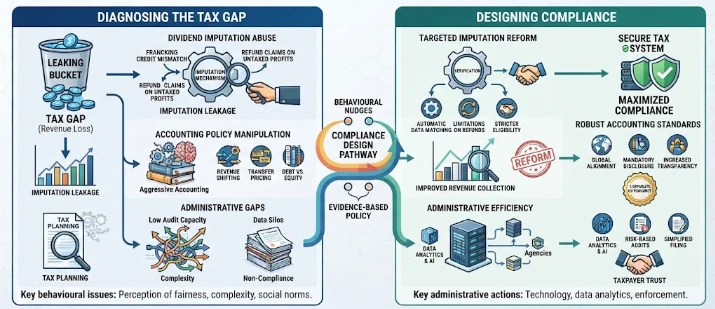
The article connects tax-gap analysis with dividend imputation, accounting policy and corporate tax avoidance. Dividend imputation reduces double taxation of distributed company profits by recognising company tax through shareholder credits, but it also creates integrity questions around franking accounts, eligibility, streaming and refunds. Good compliance design must protect the system without turning ordinary dividend payments into an unnecessarily complex process. The article stresses the importance of distinguishing gross and net tax gaps, publishing uncertainty and using stable methods for time-series analysis. Behavioural evidence shows that tax compliance depends not only on penalties and audits but also on trust, clarity, social norms, cash-flow conditions and administrative simplicity. Risk segmentation allows administrations to separate simple mistakes, temporary payment stress and deliberate concealment. GST and VAT transaction trails, e-invoicing and data matching can strengthen verification, while fiscal federalism may increase compliance costs through fragmented definitions and systems. Corporate avoidance requires specialist assessment of financing, ownership, cross-border structures and accounting-tax differences. The preferred model combines prevention, facilitation, targeted verification and credible enforcement.
Tax gap is more than a revenue number. It means the difference between what the tax should be according to the current law, and what the administration estimates that it will be. As tax non-compliance is becoming an increasing concern for a variety of jurisdictions, gaps are now being estimated to gain an understanding of the nature and extent of non-compliance, OECD Tax Administration 2024. The policy value is based on diagnosis: gaps in one measurement domain are addressed differently in another and data sources are different, as are service strategies and responses to enforcement.
Dividend imputation alters the company tax to shareholder tax nexus, and introduces a tax credit for the company to recognise tax paid on dividends distributed. It can overcome the double taxation of distributed profit, but it also establishes regulations on the franking accounts, eligibility, streaming and refunds. The information which is tracked by those credits is affected by accounting policy. Integrity, however, must be ensured by compliance design, while not becoming a specialist obstacle course on the path of ordinary dividend payments.
Measurement should be used to differentiate between gross and net gaps, model uncertainty and the impact of administration. A net gap after compliance activity can still be negative despite high underlying risk and economic shocks may affect the net gap and payment capacity. Stable methods and/or transparent revisions are required for time-series interpretation. Allowing uncertainty and methodology to be published enhances, not detracts from, the usefulness of gap estimates for stakeholders, as the numbers can and cannot be used to resolve uncertainty.
The Australian tax-gap program is an example of that with the particularly detailed public estimates. The overall net gap in November 2025 was estimated to be around 58.2 billion Australian dollars, or 9.1 per cent, with the small companies making up the biggest share at 27.2 billion. There were also significant amounts of taxes collected for individuals not engaged in business and not paying GST. These do not mean that there is the same pattern of behaviour across each group, but rather that there is a need to have different strategies of enforcement to tackle different aspects of non-compliance.
The traditional deterrence model is hampered by behavioural evidence. Penalties and the likelihood of an audit have impact, but compliance is also affected by clarity, trust, perceived fairness, social norms, pressure of cash flow and ease of fulfilling obligations. The OECD tax-administration work notes that behavioural researchers and targeted communications are becoming more commonplace. With complex rules, there can be mistakes that are similar to what you find in aggregate data, that can be avoided for a small reminder given at the right time.
Compliance costs are equally important as they can deter the small firms from going wrong or going informal because of administrative hassles. The economic cost of the time invested in interpreting and applying the rules, keeping records, reconciling GST and correcting returns is not only when there is a tax liability to pay, but also when there is none. While digital filing may help alleviate the burden of routine filing, these benefits can be achieved only when software, identity systems and data standards are reliable. Badly written digital obligations can simply shift the cost of the obligations from the government onto businesses and professional advisers.
Risk segmentation provides a more proportionate model. Simple errors should be educated and corrected; where there are temporary tax payment challenges, flexibility should be provided; and where there is deliberate concealment, the verification should be tightened up. Addressing each discrepancy as a case of fraud consumes resources for the enforcement effort and potentially harms the enforcement of voluntary compliance. By treating each discrepancy as a harmless error, you will actually have just the opposite problem because deterrence and fairness will not be as strong for those taxpayers who are complying without your intervention.
Imputation analysis should also take into account that imputation may alter corporate incentives, but it cannot eliminate all incentives to move profit. Foreign shareholders, retained earnings, cross-border structures, timing and accounting and tax treatment differences still may be relevant. Assessment of risk is best conducted as a combination of ownership, financing, distributions and international arrangements. The pattern of behaviour can not be completely accounted for by a single aspect of the corporate tax system.
Special rules increase boundaries and tax expenditures have an impact on tax compliance as well. Questions of classification arise and planning opportunities occur due to deductions, exemptions, reduced rates, and sector concessions. The more boundaries added, the more authentic uncertainty and aggressive interpretation. Tax expenditures, therefore, must be analysed to some extent by the administration: the less policy content a concession has and the higher its complexity, the more its costs may exceed what is recorded in the revenue estimate in the budget statement.
Transaction Trails are demonstrated in the GST and VAT systems. While invoice chains can offer third-party information to assist with the verification, risks include: refund fraud, missing traders, cash transactions and classification disputes. In the case of legal and technical infrastructure that is well developed, the use of e-invoicing and data matching are two ways to reinforce visibility. Even with the large datasets, additional safety measures are still required for large datasets due to the possibility of error, privacy issues, and false positives when risk models don't have context.
There is another level of fiscal federalism, with more than one government sharing tax bases or administrative powers. Businesses can face more compliance burden when they have to operate across jurisdictions, due to variations in definitions, rates, exemptions, and data systems. Coordination can help minimize duplication by using a common registration system, sharing information, harmonizing definitions or by having a central collection system. The appropriate institutional structure depends on the constitutional division of responsibilities, the autonomous sources of revenue and the importance attached to local policy flexibility.
Corporate tax avoidance calls for a different toolbox than record mistakes for small business. Large groups can avail of financing structures, use intangibles, transfer pricing, entity chains and cross-border mismatches which require specialised knowledge and international information. Accountability can be supported through public disclosure and tax transparency, but if the disclosure is raw and not in context, it can mislead, as book profit and taxable profit are different. Effective assurance includes accounting analysis, legal interpretation, economic substance and risk-based engagement.
Administration's credibility is also influenced by governance and corruption risks. Wherever the statutory rules appear well conceived but are not enforced in a selective way, not enforced in opaque settlements, if procurement controls are weak, or if there is a conflict of interest, there will be a decrease in "willingness to comply". Legitimacy is secured through independence, review rights, documented procedures and publication of aggregate performance information. The compliance design falls under a larger umbrella of a rule-of-law concept and not within a narrow collection function.
An up-to-date compliance approach, therefore, should be a mix of prevention, facilitation, verification and enforcement. Pre-filled data can avoid missing data, clear guidance can minimise data errors, targeted analytics can help to find high-risk cases, and robust sanctions can deal with any intentional data evasion. Revenue, burden, fairness, and trust are the four principles by which each intervention should be evaluated. The aim is not to be as active as possible, it is to support compliance at the lowest possible social and administrative cost.
What's really tested, though, is the defensibility of a reform once fiscal cost, distribution, complexity, and uncertainty are all on the same page. Good design, then, does not just look at transparency as a way to communicate with people after the policy has been adopted, but sees it as a component of the policy architecture. One other benefit of this is hidden trade-offs emerge before thresholds, exemptions or enforcement settings become routine. The underlying message is that the structure of a tax should not be judged by its statutory designation, but by its effects on behaviour.
That's an important distinction because legal form and economic incidence can go in different directions when households or firms adjust. Another protection is to make clear assumptions in such a way that they can be reproduced or challenged by other analysts. The strength of the evidence also is improved when distribution, administration and behaviour are considered together, as opposed to in separate reports. Evaluation criteria are better understood if agreed in advance with beneficiaries and administrators when administrators adapt around a permanent policy.
The test for a reform to be defensible is whether it is defensible when costs, distribution, complexity, and uncertainty are put on the same page. Good design, therefore, considers transparency as a component of the policy architecture, and not a communication activity after the policy has been adopted. One other benefit of this is hidden trade-offs emerge before thresholds, exemptions or enforcement settings become routine. The deeper lesson is that fiscal design ought to be evaluated through empirical evidence, not on the basis of labels placed on the statute books.
That's important because legal form and economic incidence can diverge after adjustment by households and/or firms.
CITE THIS ARTICLE
Sultana, K. R. (2026). From Tax Gap to Compliance Design: Behavioural and Administrative Evidence on Dividend imputation, accounting policy, corporate tax avoidance. https://researchbysultana.com/article/8da8c2fe-7fbd-5274-b502-3118b2537644
K. R. Sultana, “From Tax Gap to Compliance Design: Behavioural and Administrative Evidence on Dividend imputation, accounting policy, corporate tax avoidance,” 2026. [Online]. Available: https://researchbysultana.com/article/8da8c2fe-7fbd-5274-b502-3118b2537644
Sultana, K. R. (2026) ‘From Tax Gap to Compliance Design: Behavioural and Administrative Evidence on Dividend imputation, accounting policy, corporate tax avoidance’. Available at: https://researchbysultana.com/article/8da8c2fe-7fbd-5274-b502-3118b2537644
Sultana, Kazi Rukaiya. “From Tax Gap to Compliance Design: Behavioural and Administrative Evidence on Dividend imputation, accounting policy, corporate tax avoidance.” 2026, https://researchbysultana.com/article/8da8c2fe-7fbd-5274-b502-3118b2537644.
Kazi Rukaiya Sultana. “From Tax Gap to Compliance Design: Behavioural and Administrative Evidence on Dividend imputation, accounting policy, corporate tax avoidance.” (2026). https://researchbysultana.com/article/8da8c2fe-7fbd-5274-b502-3118b2537644.
Sultana KR. From Tax Gap to Compliance Design: Behavioural and Administrative Evidence on Dividend imputation, accounting policy, corporate tax avoidance. 2026. https://researchbysultana.com/article/8da8c2fe-7fbd-5274-b502-3118b2537644
@misc{article_8da8c2fe7fbd5274b5023118b2537644,
  title = {From Tax Gap to Compliance Design: Behavioural and Administrative Evidence on Dividend imputation, accounting policy, corporate tax avoidance},
  author = {Kazi Rukaiya Sultana},
  year = {2026},
  url = {https://researchbysultana.com/article/8da8c2fe-7fbd-5274-b502-3118b2537644},
}
TY  - GEN
AU  - Kazi Rukaiya Sultana
TI  - From Tax Gap to Compliance Design: Behavioural and Administrative Evidence on Dividend imputation, accounting policy, corporate tax avoidance
PY  - 2026-02-04
UR  - https://researchbysultana.com/article/8da8c2fe-7fbd-5274-b502-3118b2537644
ER  -
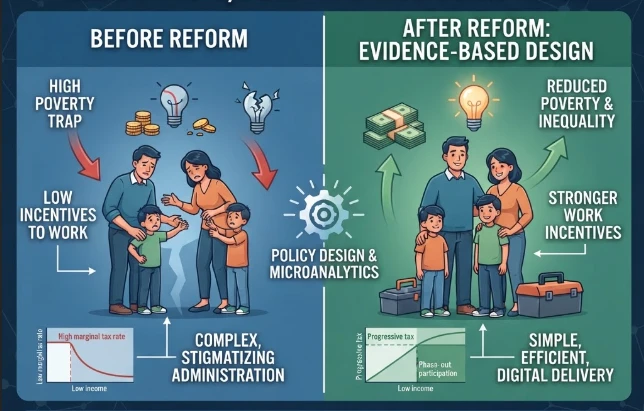
This article uses institutional economics and applied microeconomics to show why tax-transfer reform cannot be evaluated from policy rules alone. Household disposable income reflects earnings, taxes, contributions, benefits, housing support and withdrawal schedules, but the effectiveness of those rules also depends on institutions that administer them. Different data systems, delayed appeals, inconsistent local delivery and administrative capacity can cause a theoretically efficient policy to wo
This article presents tax transparency as a governance and accounting issue rather than a simple disclosure exercise. Boards oversee tax outcomes that are influenced by risk appetite, capital allocation, internal controls, remuneration and significant transactions, while accounting systems provide the common record connecting financial profit, taxable income, deferred tax, cash tax and uncertain positions. IFRS S1 and IFRS S2 are used to show how sustainability-related financial information can
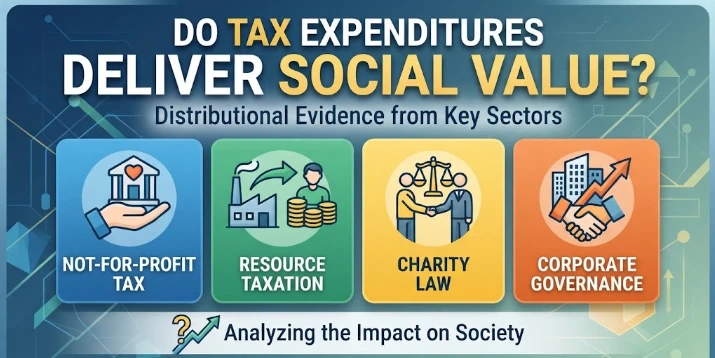
This article evaluates tax expenditures in not-for-profit, charity and resource-tax settings through distribution, governance and public value. Preferential treatment for charities and similar organisations is justified by public or community benefit, so reporting and governance should show whether concessions expand valued services, improve access or instead accumulate as private or organisational advantage. The article warns that annual income alone is an incomplete equity measure because life