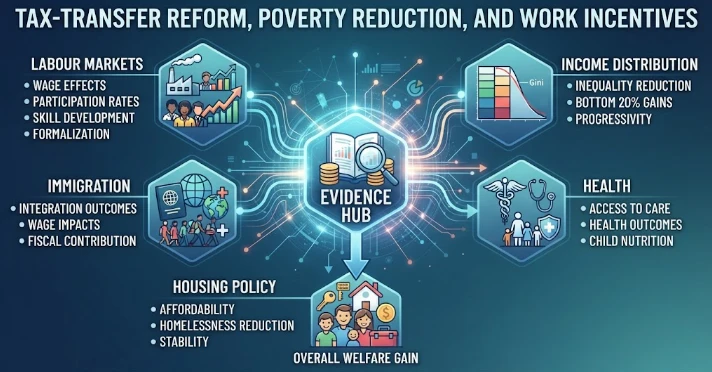
This article broadens tax-transfer reform by linking household income with labour markets, immigration, health and housing policy. Disposable income is shaped by earnings, taxes, social contributions, cash benefits, housing support and benefit withdrawal, but households also face childcare, commuting and local housing costs that can alter the real return from work. Immigration can affect labour supply, labour demand, household composition and settlement patterns, while health influences the capacity to work. The article therefore warns that a tax-transfer model may overstate welfare gains if it ignores these related constraints. Microsimulation can show distributional and effective-marginal-rate effects across income groups, family types and labour-market positions. Targeted support can protect low-income households but steep withdrawal may create weak financial gains from additional work. Mobility and human-capital development require longer-term evidence because temporary low income differs from persistent disadvantage. Regional and household differences also matter. Consumption taxes, fiscal incidence, administrative access and fiscal sustainability are considered within the same framework. Strong reform uses modelling before legislation and tests thresholds, tapers and transitions against real housing, health and labour-market conditions.
Transfers are not an effective way to change tax rates themselves, they are an effective way to change the level of disposable income. Household incomes and expenditures are integrated into a single household budget, including earnings, income tax, social contributions, cash benefits, housing support, family payments and withdrawal rules. Even a modest increase after one of the other taxes is removed can result in a reform that reduces one tax rate. The relevant object is then the full budget constraint of a household of various income categories for poverty and work incentives.
Labour-market policy relates to tax and transfers via wages, hours, childcare, commuting, housing and access to services. Immigration creates a demand for labour and/or labour supply, and can also affect labour household composition and settlement. Housing costs impact on the amount of disposable income after basic costs, and health impacts on capacity to work. A tax-transfer model without taking those links into account can overestimate the gain to welfare of increasing the level of employment or underestimate obstacles to households in expensive locations.
Because of the importance of the people who are affected by interacting rules, microsimulation has now become the core of that analysis. New Zealand Treasury's TAWA model is a model which uses tax and welfare settings on representative microdata, and has been applied to carry out distributional, fiscal-incidence and effective-marginal-rate analysis. Tax-and-spending microsimulation is also widely used in the advanced administrations, as evidenced by OECD work on inequality budgeting. These tools enable a more tangible understanding of the impact of reform, by breaking down effects into income deciles, family structures and labour-market status.
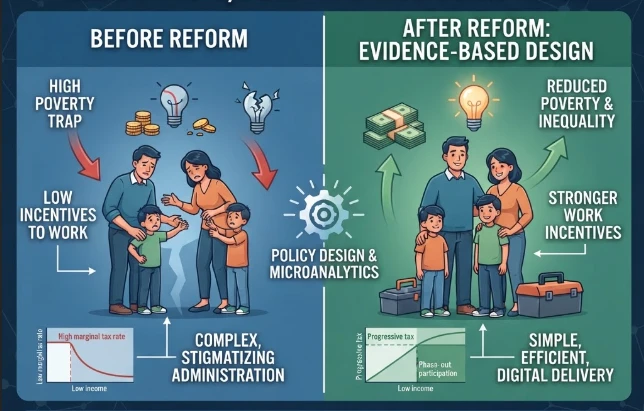
With close targeting of support, poverty reduction and work incentives can work against each other. A generous benefit provides protection for earnings at the low end, but can have a high effective marginal tax rate at the top because if the benefit is withdrawn quickly with rising earnings. The rate is an index of the percentage of lost income due to increased taxes and reduced transfers. Employment doesn't decline at high rates, but it does indicate when a little more work yields a surprisingly little increase in disposable income.
Generosity is not the only factor that determines design quality. Gradual tapers can provide smooth transitions into work, abrupt thresholds can provide cliffs which impact hours, timing or formal reporting. In some contexts, individual taxation could reinforce the incentive to have a second earner rather than family-based assessment; in other Family-based transfers could be more directly targeted to the need at the household level. Policy entails compromises in terms of equity, fiscal cost, targeting and administrative simplicity.
Economic welfare is another measure than employment counts. There are other factors that influence household welfare besides the effort required to produce output and income: commuting, child care, health considerations, and lost leisure. A measure that raises the supply of labour in an extreme way by reducing benefits can appear to be a success in a limited sense of employment, but at the same time make a particular group of people less secure in terms of income. Strong evaluation follows this up with an attention to employment, hours, disposable income, poverty depth and fiscal cost.
The importance of mobility is due to the fact that households are dynamic and move around in the income distribution over time. Temporary low income occurs when people are studying, taking care of others, out of work, experiencing business fluctuations, or in early career; persistent low income represents an additional policy issue. The incidence of a single year may be identified using tax-transfer modelling, but not all lifetime effects. Longitudinal evidence enhances interpretation by allowing for an understanding of whether support provides stability to temporary shocks, limits chronic poverty, or impacts on the prospects of upward mobility.
There are regional and household-type variations in income distribution, too. A national tax threshold is the same in all jurisdictions, but there are significant variations in transport and housing costs, and family structure and access may vary for migrants. Distributional analysis extending beyond the income deciles thus becomes a useful tool to design the policy. Groups can be identified through the average reform effect by age, years of experience, disability, family structure, region, and migration.
Human capital is also a connection between welfare design and productivity in the long run. Future earnings can benefit from transfers that provide support for nutrition, housing stability, child care access or education participation, even if their short-run fiscal impacts appear to be a cost. On the other hand, benefit rules which reduce benefits for training income or cause uncertainty in regard to study can deter skill investment. A serious work-incentive scheme would not be content just with supply of labour but also ask whether existing schemes enhance ability to earn in the future.
Public economics also says that it is not good to assume that all behavioural responses are socially useful. An increase in formal labour supply due to a tax change may lead to redistribution of informal care in a household, alter the demand for childcare, and/or affect market power. Two-sided markets also pose additional challenges because taxes on a platform or provider can impact transactions on both sides of a market. Incidence is not just about the legal taxpayer that is identified in legislation, it is about elasticities, and the market structure.
The distributional conflict is obvious in the case of consumption taxes. It is possible to raise revenue efficiently with broad consumption taxes, but, on the other hand, lower income groups tend to spend a higher proportion of their current income. Lower rates of the essentials will alleviate some of that burden, but they can also give large absolute benefits to higher spending households. Targeted transfers can more directly compensate for regressivity if administrative systems are able to consistently and accurately identify eligible households and payment rules are readily comprehensible.
The fiscal system as a whole should be considered for progressivity. The final pattern is different if personal income tax is progressive, consumption taxes, payroll contributions, housing subsidies, and benefit withdrawal are different. New Zealand fiscal-incidence work illustrates the importance of looking at taxes and benefits as a whole, rather than examining them individually. Similar analysis can give us insight into the effect of an apparently progressive reform on lifetime inequality, annual inequality, or neither.
As well as statutory generosity, administrative design has an impact on outcomes. Take-up can be reduced or hardship can be caused because of the complexity of forms, delayed reassessment, debt recovery and/or unpredictable reconciliation. While automatic data matching and pre-filled information may help make access easier, digital systems must have alternatives for individuals who may experience language, disability, connectivity, or record-keeping challenges. A reform must be designed to achieve its intended welfare benefits if it is to be able to be accessed and understood by eligible households.
Fiscal sustainability continues to be a part of the equity calculation. Ongoing budget deficits can be used to redistribute costs across generations, and tax cuts that are not targeted can lead to loss of revenue for the provision of high-value services. Sustainable reform establishes a stable funds base, and creates distributional decisions. That way, poverty reduction, incentives and public-service funding can be viewed as linked aims as opposed to mutually exclusive catchcry targets.
The most effective reform packages are ones where modelling is used as a decision making device and not a pretty afterthought once decisions have been made on policy. Pre-legislation distributional tables, effective-marginal-rate profiles, behavioural sensitivity tests and fiscal scenarios can be created. Based on the results, thresholds can be set, taper rates can be determined, refundable credits can be granted and transition rules can be established. Political decisions do not disappear from the picture when evidence is introduced, but it can shed light on underlying compromises and minimise the likelihood of a headline creating an intricate household picture.
This holistic perspective mitigates the likelihood that a technically sound rule will result in suboptimal outcomes once household, firm, and administrator responses to real incentives come into play. The better way to evaluate statutory design, however, is by measuring actual incentives, administrative capacity, and distributional impacts, and not by labeling. That same view also allows you to see uncertainty, and helps with decision making when you can't precisely estimate behavioural responses or implementation costs. Another precaution is that assumptions, definitions and evaluation criteria should be published prior to a policy becoming politically unpopular that can be changed.
The most effective and informative evidence is when fiscal cost, fairness, behaviour and administrative burden can all be seen together in the same assessment, as opposed to being heard in separate policy stories. Review mechanisms which allow the threshold or eligibility for reporting or the thresholds themselves to be adjusted as economic conditions and technology evolve are necessary for long-run credibility. The question which is of practical importance is whether the instrument will provide measurable public value, when compliance costs, distribution costs and opportunity costs are added in. Transparent governance transforms that into a repeatable process, rather than a one-time justification when introducing it.
CITE THIS ARTICLE
Sultana, K. R. (2025). Tax-Transfer Reform, Poverty Reduction, and Work Incentives: Evidence from Labour markets, income distribution, immigration, health, housing policy. https://researchbysultana.com/article/85591dbb-7b22-5946-b065-45c46ecfc4c8
K. R. Sultana, “Tax-Transfer Reform, Poverty Reduction, and Work Incentives: Evidence from Labour markets, income distribution, immigration, health, housing policy,” 2025. [Online]. Available: https://researchbysultana.com/article/85591dbb-7b22-5946-b065-45c46ecfc4c8
Sultana, K. R. (2025) ‘Tax-Transfer Reform, Poverty Reduction, and Work Incentives: Evidence from Labour markets, income distribution, immigration, health, housing policy’. Available at: https://researchbysultana.com/article/85591dbb-7b22-5946-b065-45c46ecfc4c8
Sultana, Kazi Rukaiya. “Tax-Transfer Reform, Poverty Reduction, and Work Incentives: Evidence from Labour markets, income distribution, immigration, health, housing policy.” 2025, https://researchbysultana.com/article/85591dbb-7b22-5946-b065-45c46ecfc4c8.
Kazi Rukaiya Sultana. “Tax-Transfer Reform, Poverty Reduction, and Work Incentives: Evidence from Labour markets, income distribution, immigration, health, housing policy.” (2025). https://researchbysultana.com/article/85591dbb-7b22-5946-b065-45c46ecfc4c8.
Sultana KR. Tax-Transfer Reform, Poverty Reduction, and Work Incentives: Evidence from Labour markets, income distribution, immigration, health, housing policy. 2025. https://researchbysultana.com/article/85591dbb-7b22-5946-b065-45c46ecfc4c8
@misc{article_85591dbb7b225946b06545c46ecfc4c8,
  title = {Tax-Transfer Reform, Poverty Reduction, and Work Incentives: Evidence from Labour markets, income distribution, immigration, health, housing policy},
  author = {Kazi Rukaiya Sultana},
  year = {2025},
  url = {https://researchbysultana.com/article/85591dbb-7b22-5946-b065-45c46ecfc4c8},
}
TY  - GEN
AU  - Kazi Rukaiya Sultana
TI  - Tax-Transfer Reform, Poverty Reduction, and Work Incentives: Evidence from Labour markets, income distribution, immigration, health, housing policy
PY  - 2025-08-03
UR  - https://researchbysultana.com/article/85591dbb-7b22-5946-b065-45c46ecfc4c8
ER  -
This article uses institutional economics and applied microeconomics to show why tax-transfer reform cannot be evaluated from policy rules alone. Household disposable income reflects earnings, taxes, contributions, benefits, housing support and withdrawal schedules, but the effectiveness of those rules also depends on institutions that administer them. Different data systems, delayed appeals, inconsistent local delivery and administrative capacity can cause a theoretically efficient policy to wo
This article presents tax transparency as a governance and accounting issue rather than a simple disclosure exercise. Boards oversee tax outcomes that are influenced by risk appetite, capital allocation, internal controls, remuneration and significant transactions, while accounting systems provide the common record connecting financial profit, taxable income, deferred tax, cash tax and uncertain positions. IFRS S1 and IFRS S2 are used to show how sustainability-related financial information can
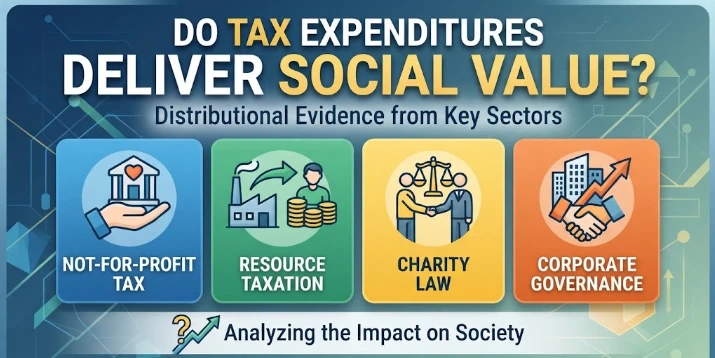
This article evaluates tax expenditures in not-for-profit, charity and resource-tax settings through distribution, governance and public value. Preferential treatment for charities and similar organisations is justified by public or community benefit, so reporting and governance should show whether concessions expand valued services, improve access or instead accumulate as private or organisational advantage. The article warns that annual income alone is an incomplete equity measure because life